
What Makes These Reef Fish Remarkable—and What They Need in an Aquarium
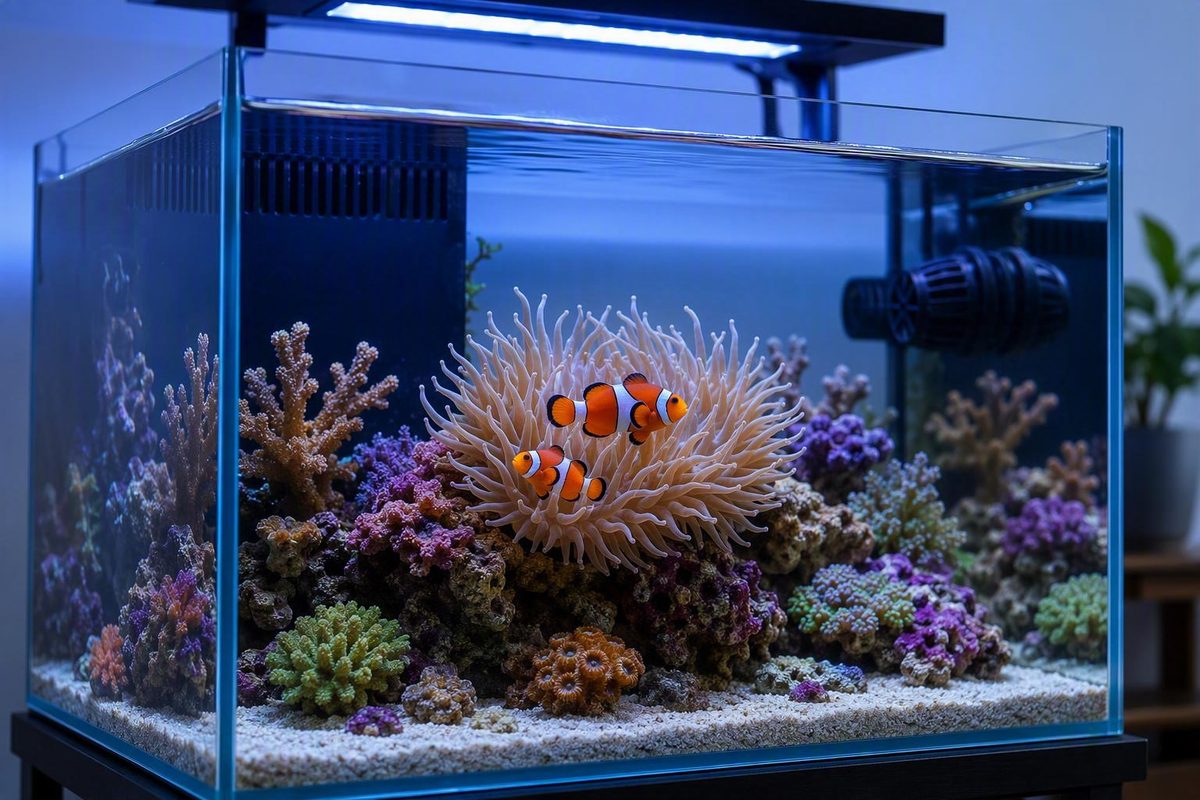
For a first Ocellaris setup, 20–30 gallons is a more forgiving practical target, with species-specific guidance on care and anemones.
Clownfish are instantly recognizable, but the familiar orange fish with three white bars represents only part of a varied group. Different species occupy different habitats, reach different adult sizes, associate with different host anemones, and display different levels of territoriality. Selective breeding has added commercial names and patterns that can obscure the underlying species.
Their biology is unusual even by reef-fish standards. Clownfish live in size-based social hierarchies, can transition from the male reproductive role to the female role, communicate with sounds, and care for eggs beside their territory or host. None of those traits makes them maintenance-free aquarium fish.
Successful care starts with identification. A captive-bred Ocellaris clownfish may be a reasonable choice for a prepared marine aquarist, while a larger or more territorial maroon, Clarkii, tomato, cinnamon, skunk, or saddleback clownfish requires its own assessment. In every case, the priorities are an established saltwater aquarium, stable water quality, appropriate space, suitable food, and realistic expectations about pairing and aggression.
Clownfish at a glance: identity, range, and defining traits
Clownfish, also called anemonefish, are saltwater members of the damselfish family Pomacentridae. They are principally classified in the genus Amphiprion. “Clownfish” refers to the broader group, not to one interchangeable aquarium species.
In nature, clownfish inhabit tropical Indo-Pacific waters, including the Red Sea, Indian Ocean, and western Pacific. They are not native to the Atlantic Ocean or Caribbean. Their typical habitats include shallow reefs and sheltered lagoons where suitable host anemones occur, although the precise distribution and habitat differ by species. National Geographic summarizes the group’s Indo-Pacific distribution and absence from the Atlantic and Caribbean.
The classic orange body with white vertical bars is common in Ocellaris and Percula clownfish, but it is not a universal feature. Natural coloration can include yellow, red, brown, black, and deep maroon. Pale markings may form complete bars, partial bars, saddles, or a single band. Selective breeding has produced still more combinations of color, body coverage, bar shape, and fin form.
Adult size also varies too much for one number to serve as a universal care standard. As a broad comparison across the group, clownfish range from approximately 7 to 17 centimeters, or about 3 to 7 inches. Those figures represent a smallest-to-largest overview rather than the expected size of every species. The Great Barrier Reef Foundation gives this broad size range and describes the group’s varied coloration.
That distinction between group-level biology and species-level husbandry is essential. Statements such as “clownfish are peaceful,” “clownfish are easy,” or “clownfish fit small aquariums” may be reasonable for a particular species under particular conditions, but they should not be applied to every fish carrying the common name.
Before buying a clownfish, obtain its scientific name. That identification anchors questions about:
- Expected adult size
- Territorial behavior
- Appropriate aquarium dimensions
- Social and pairing risks
- Natural host associations
- Feeding behavior
- Compatibility with other clownfish
- Compatibility with a wider marine community
A commercial morph name cannot answer those questions by itself. A Wyoming White and a standard orange Ocellaris may look dramatically different, but both can be forms of Amphiprion ocellaris. Conversely, two orange-and-white fish sold simply as “clowns” may belong to different species with different care considerations.
Life on the reef: habitat, food, and daily behavior
The anemone’s stinging tentacles discourage many fish predators, while the surrounding reef provides feeding opportunities and firm surfaces for spawning.
Clownfish are variously described as carnivores or omnivores. The actual food lists are more useful than the labels: documented foods include zooplankton, copepods and other tiny drifting animals, small invertebrates, algae, and scraps associated with the host. Because that diet includes both animal and plant-derived material, “broadly omnivorous” is the most practical general description.
A fish occupying a productive lagoon may encounter a different mix of plankton and algae than one living in another reef zone. A general diet profile therefore provides a starting point, not proof that every species eats identical proportions of the same foods.
Clownfish also communicate acoustically. Popping and clicking sounds have been documented during social interactions. It is reasonable to describe those sounds as communication, but not to assign a precise meaning to every click without observing the full behavioral context.
Much of a clownfish’s daily behavior revolves around social position and territory. Individuals may remain physically close while occupying unequal ranks. The largest fish controls the hierarchy, and smaller individuals regulate their behavior around dominant members.
That does not make every chase harmless. Persistent cornering, repeated biting, damaged fins, loss of feeding access, abnormal breathing, or exclusion from all shelter indicates a welfare problem rather than something that should automatically be dismissed as normal hierarchy formation.
Wild ecology helps explain this territoriality.
The clownfish–anemone partnership, without the usual myths
Sea anemones possess stinging tentacles that deter or capture many animals. A resident clownfish can move among those tentacles and use them as refuge from numerous fish predators. It may also intercept food near the host or consume scraps left behind.
The anemone may receive benefits in return. Reported or proposed benefits include cleaning, nutrient delivery through clownfish waste, leftover food, parasite removal, and defense against butterflyfishes or other anemone-eating fish. These should not be presented as an identical package delivered in every pairing. The type and magnitude of any benefit can vary with the clownfish, the anemone, the environment, and the animals’ behavior.
Why doesn’t the anemone sting the clownfish?
A specialized skin mucus layer is associated with sting tolerance. Clownfish may also acclimate through cautious contact, touching an anemone’s tentacles before moving fully into the host.
Mucus should not, however, be presented as a complete and final explanation. Saying that a clownfish is simply “immune to venom” obscures that uncertainty and can create the false impression that any clownfish can enter any anemone safely.
Natural host relationships are species-specific. Not every clownfish naturally associates with every host-anemone species, and visual appeal does not establish compatibility. Anyone considering a pairing must identify both animals and investigate the needs and documented associations of each one.
An anemone is optional in a clownfish aquarium
The ecological importance of host anemones in the wild does not make one mandatory in captivity. Captive clownfish can live successfully in an otherwise suitable marine aquarium without an anemone. They may instead remain near rockwork, coral, equipment, or a preferred corner.
Even when a compatible anemone is present, hosting is not guaranteed. Hosting should not be treated as an on-demand performance.
This distinction matters because anemones have their own requirements. They are not décor or standard clownfish equipment. Adding one to an immature or unsuitable aquarium solely because a clownfish is assumed to need it can put the anemone at risk without supplying an essential requirement for the fish. Coralife’s Ocellaris guide states that captive clownfish do not require an anemone to survive.
A fish-only-with-rock system or mixed reef can therefore be suitable when it meets the identified clownfish species’ needs for water stability, shelter, food, space, and social management. An anemone should be selected for its own husbandry requirements and documented compatibility, not purchased as a compulsory accessory.
Hierarchy, sex change, spawning, and early life
Clownfish groups are organized by size and reproductive status. The largest individual is normally the dominant breeding female. Below her is a breeding male, followed by smaller nonbreeding fish.
The correct biological term for this system is protandry. Simplified accounts often say that every clownfish is “born male,” but that phrasing blurs the distinction between an immature, nonbreeding fish and a functional adult male.
If the dominant female disappears, the breeding male can irreversibly transition into the female role. A subordinate fish can then mature into the newly vacant breeding-male position. This allows the social group to restore a functioning pair without the arrival of another mature female.
The hierarchy has direct aquarium implications. If two fish are socially compatible, they may establish unequal ranks and eventually form a pair. If they are not compatible, the result can be sustained aggression. Color cannot be used to determine sex reliably.
Spawning and egg care
A breeding pair deposits eggs on rock or another firm surface close to its territory or host. Fertilization is external.
After hatching, the larvae enter a dispersive open-water stage. This is very different from the life of an adult defending a compact reef territory. Surviving juveniles later settle near suitable reef habitat and seek an appropriate host environment.
Spawning in a display aquarium and successfully raising larvae are separate achievements.
Clutch size, incubation time, reproductive output, and spawning season vary with species and conditions. A universal figure would therefore be less useful than the basic sequence:
- A size-based hierarchy produces a breeding pair.
- The female deposits eggs on a prepared firm surface.
- The male fertilizes the eggs externally.
- The male guards and fans the clutch.
- Larvae hatch and enter open water.
- Surviving juveniles settle near suitable reef habitat and a host.
The combination of social hierarchy, irreversible sex change, benthic eggs, parental care, and dispersive larvae is central to clownfish biology.
Species, designer morphs, and the Ocellaris–Percula question
Commonly encountered clownfish include:
- Ocellaris clownfish, Amphiprion ocellaris
- Percula clownfish, Amphiprion percula
- Maroon clownfish, commonly listed in the aquarium trade as Amphiprion biaculeatus
- Clarkii clownfish, Amphiprion clarkii
- Tomato clownfish, Amphiprion frenatus
- Cinnamon clownfish, Amphiprion melanopus
- Saddleback clownfish, Amphiprion polymnus
- Pink skunk clownfish, Amphiprion perideraion
- Orange skunk clownfish, Amphiprion sandaracinos
These are not merely different colors of one fish. They represent distinct species or, in the case of loose labels such as “skunk clownfish,” commonly used groups that require more precise identification. Adult size, territoriality, host association, and aquarium suitability should be investigated for the particular species rather than inferred from the word “clownfish.”
The available care evidence does not justify a universal ranking table for all these species. Ocellaris receives much of the beginner-oriented guidance, while general care sheets describe maroon clownfish as notably territorial. For Clarkii, tomato, cinnamon, skunk, and saddleback clownfish, buyers should not extrapolate an Ocellaris tank plan without additional species-specific research.
Designer names describe forms, not species
Snowflake, Picasso, Black Storm, Wyoming White, Frostbite, Platinum, Lightning, and similar labels are commercial names for selectively bred traits. Those traits may involve color, bar pattern, body coverage, fin length, or combinations of features. The label does not replace the scientific species name.
A breeder’s catalog illustrates the distinction. Black Storm, Frostbite, Wyoming White, and Snowflake are listed as forms of Amphiprion ocellaris; Picasso forms are associated with Amphiprion percula; and several Lightning, Goldflake, and Gold Nugget maroons are listed under Amphiprion biaculeatus. The ORA catalog connects these commercial forms to their underlying scientific names.
That produces a simple purchasing rule: ask for both names.
For example:
- Wyoming White Ocellaris — Amphiprion ocellaris
- Picasso Percula — Amphiprion percula
- Lightning Maroon — Amphiprion biaculeatus
The first part describes the marketed appearance. The scientific name identifies the biological species on which care decisions should be based. An unusual pattern does not transform an Ocellaris into a separate species or automatically change its basic husbandry requirements.
Ocellaris versus Percula
Ocellaris and Percula clownfish are closely related but distinct species:
- False Percula or Ocellaris: Amphiprion ocellaris
- True Percula: Amphiprion percula
“True” and “false” do not mean wild-caught and captive-bred. Either species may be collected from the wild or bred in captivity.
Several average visual clues can assist identification:
| Identification clue | Ocellaris | Percula |
|---|---|---|
| Dorsal spines | Usually about 11 | Usually about 10 |
| Black edging around white bars | Often thinner | Often thicker |
| Rear dorsal-fin profile | Often taller | Often lower |
| Eye appearance | Often more black around the pupil | Often more orange around the pupil |
These are clues rather than infallible tests. Rare spine-count exceptions occur, black margins vary among individuals, and selective breeding can alter coloration dramatically. Eye appearance and fin shape are supporting evidence, not stand-alone proof. A detailed Ocellaris–Percula comparison documents the typical spine counts, rare exceptions, and other visual clues.
When identification matters, combine several features and confirm the breeder’s or seller’s scientific label. Do not infer species solely from the amount of black visible in one photograph.
Building a stable clownfish aquarium
A hardy fish still needs a fully established marine aquarium. “Hardy” means that a species may tolerate ordinary variation better than a delicate one; it does not mean the fish can safely be used to test an incomplete nitrogen cycle.
A basic system includes:
- An appropriately sized aquarium
- Functioning biological and mechanical filtration
- A heater and reliable thermometer
- Tools for measuring salinity and marine water chemistry
- Low-to-moderate, well-distributed circulation
- Rockwork or other secure shelter
- Marine-safe substrate, if substrate is used
- Properly mixed saltwater
- A practical schedule for testing and maintenance
- A contingency plan for isolating an injured, incompatible, or sick fish
A host anemone is also optional. Neither belongs in the same category as temperature control, circulation, testing, shelter, and filtration.
Cycle first, then stock
A functioning nitrogen cycle allows microbial communities to process ammonia produced by fish waste and decomposing food. Ammonia and nitrite should not be accepted as routine features of a newly stocked aquarium. Readiness should be confirmed through testing rather than assumed because a fixed number of weeks has passed.
Elapsed time alone cannot demonstrate that a tank is prepared for fish. Cycling depends on the ammonia source, microbial establishment, available filtration surfaces, temperature, salinity, and other conditions. Test results matter more than a calendar.
Once fish are introduced, stocking should proceed gradually. A system that supported one small fish has not automatically shown that it can absorb several immediate additions.
Temperature and salinity
Several care guides converge on a practical temperature range of 74–80°F and a specific gravity of 1.020–1.025, although the selected species and the needs of every other aquarium inhabitant should be checked. A veterinary care overview also recommends stable saltwater conditions, regular testing, filtration, heat, shelter, and low-to-moderate circulation. PetMD summarizes these general equipment requirements and parameter ranges.
Stability is as important as the target. Petco’s general care sheet advises limiting temperature movement to approximately 2°F in 24 hours and specific-gravity movement to approximately 0.001 over the same period. Those limits appear alongside its 74–80°F and 1.020–1.025 recommendations.
These figures are not permission to force an aquarium back to target rapidly. If salinity or temperature has drifted, identify the cause and correct it cautiously. Stability should not be pursued through another abrupt change.
How large should the tank be?
Published recommendations differ, in part because they address different species, configurations, and levels of risk tolerance.
For Ocellaris specifically, Coralife lists a minimum of 10 gallons. That is a commercial husbandry recommendation, not a universal welfare threshold or a suitable figure for every clownfish. Coralife’s recommendation applies to Amphiprion ocellaris.
Other guidance starts higher. LiveAquaria recommends at least 20 gallons for most Ocellaris and 30 gallons for Percula, while acknowledging exceptions and differences among varieties. Its species comparison presents those figures as retailer recommendations rather than universal standards.
PetMD uses a broader recommendation of at least 29 gallons for one adult clownfish and calls for more space for larger species or multiple fish. Its care sheet also notes that smaller aquariums undergo faster changes in water conditions.
Taken together, these conflicting recommendations support a cautious conclusion rather than one absolute minimum. For a first Ocellaris setup, 20–30 gallons is a more forgiving practical target than the smallest published recommendation. This is a risk-management choice, not a scientifically proven threshold that every Ocellaris requires.
More water volume generally provides greater buffering against small additions of food, waste, evaporation, or replacement water. It also allows more room for equipment, shelter, and territorial separation. Dimensions still matter: useful territory and swimming space cannot always be predicted from gallon capacity alone.
Larger or more territorial species need a species-specific plan beyond this Ocellaris-oriented range. Pairs and community arrangements also require additional consideration because the aquarium must provide territories, retreats, and reliable feeding access—not merely enough volume to contain the fishes’ combined body length.
A bare-minimum setup leaves less margin for equipment failure, delayed maintenance, overfeeding, and social conflict. Beginners generally benefit from choosing the largest aquarium they can maintain consistently rather than the smallest vessel in which a fish might persist.
Feeding, pairing, tankmates, and reef compatibility
Clownfish should receive a varied diet appropriate for marine omnivores. A practical rotation can combine quality marine pellets or flakes with thawed frozen foods containing animal and algae-derived ingredients. Food size should match the fish’s mouth, especially for small juveniles.
Variety is useful because no single prepared food reproduces the changing mixture of plankton, small invertebrates, algae, and scraps encountered in nature. It also reduces dependence on one food that a particular fish may refuse.
Offer small portions and observe consumption. Petco recommends two or three small meals per day, limited to what the fish consume within one or two minutes. That is a starting schedule rather than a reason to keep adding food when fish have stopped eating. Petco’s care sheet gives this feeding frequency and portion guidance.
Pairing clownfish
There is no universal procedure that guarantees two clownfish will form a safe pair. Compatibility depends on species, reproductive status, prior social history, size, territory, aquarium layout, and individual behavior.
This should be treated as a practical convention rather than a validated guarantee. It does not eliminate the possibility of rejection or serious aggression.
Quarantine and health assessment should occur before social introductions where appropriate. The aquarist should also have a realistic separation plan, such as a suitable second system or secure isolation arrangement, before attempting a pairing. Do not wait until an injured fish can no longer feed or escape.
During an introduction, confirm that both fish can:
- Reach food at every meal
- Retreat to separate shelter
- Leave the dominant fish’s immediate area
- Rest without continual pursuit
- Maintain intact fins and normal respiration
- Occupy part of the aquarium without persistent exclusion
Persistent biting, pinning a fish in a corner, preventing it from eating, or causing repeated injury requires intervention. “They are sorting it out” should not become an excuse to ignore deterioration.
Mixing species adds uncertainty, as does adding a new clownfish to an established adult’s territory. Because visual appearance does not reliably reveal reproductive status, aquarists should not assume that any two attractive specimens constitute a compatible male-and-female pair.
Choosing tankmates
Compatibility cannot be reduced to a retailer’s list of species names. Important variables include:
- The exact clownfish species
- Adult size and territoriality
- Whether the clownfish is single, paired, or spawning
- Aquarium dimensions and rock layout
- Existing territories
- Introduction order
- Feeding competition
- The temperament of each fish
Gobies, blennies, cardinalfish, some wrasses, and other community marine fish may be possible tankmates. They are not guarantees. Each candidate needs species-level research into adult size, diet, aggression, predation risk, swimming behavior, and aquarium requirements.
Clownfish may defend a host, nesting surface, or preferred corner. Maroon clownfish are commonly described in the available care guidance as particularly territorial and should not be managed as though they were interchangeable with Ocellaris.
Are clownfish reef-safe?
Clownfish are generally considered reef-safe because they are not normally selected as coral-eating fish. That label still needs qualification. Species and individuals vary, and reef compatibility covers more than deliberate coral consumption.
Observe whether the coral remains expanded and healthy rather than assuming that the phrase “reef-safe” makes every interaction harmless.
Responding to health concerns
Loss of appetite, rapid or labored breathing, unusual spots, cloudy eyes, damaged fins, color loss, erratic swimming, or persistent hiding can have multiple causes. Begin by checking the environment and recent history:
- Test ammonia and nitrite.
- Verify temperature and salinity.
- Check circulation and oxygenation.
- Look for aggression or feeding exclusion.
- Review recent livestock, equipment, and maintenance changes.
- Isolate or quarantine fish where appropriate and feasible.
Do not select medication solely from a symptom list. A qualified aquatic veterinarian should be consulted when signs are severe, unexplained, potentially contagious, or persistent.
Choosing captive-bred fish and discussing conservation accurately
Captive-bred clownfish are widely represented in the aquarium trade. Commercial hatcheries and smaller breeders produce standard forms as well as many selectively bred patterns and colors.
Captive-bred fish are a practical preference because care sources describe them as readily acclimated to aquarium conditions and willing to accept prepared foods. Individual health still matters: captive-bred origin does not guarantee good transport, disease-free status, or compatibility with a particular aquarium. LiveAquaria recommends captive-bred clownfish while emphasizing the work required to maintain a saltwater system.
Choosing a captive-bred fish reduces the buyer’s direct reliance on wild collection. That is a clear supply-chain distinction, but it should not be inflated into a quantified promise about wild populations. The broader conservation outcome depends on the species, region, breeding practices, resource use, market demand, and whether captive production actually replaces collection.
Wild collection should also be described precisely. Harmful chemical capture is a documented reef concern in some locations; chemicals used to stun fish can kill or injure non-target fish, corals, and other reef life. That does not mean every wild clownfish was collected chemically or that all collectors use destructive practices. Monterey Bay Aquarium describes the damage associated with chemical capture and recommends captive-raised fish.
Broad global descriptions can coexist with local pressure. A species may not be considered globally threatened while particular populations face collection pressure, warming, acidification, reef degradation, or loss of host anemones. Conservation statements are most meaningful when tied to a particular species, location, collection method, and time period.
Traceability is therefore more useful than slogans. Ask the retailer or breeder:
- What is the fish’s scientific name?
- Is it captive-bred or wild-collected?
- If captive-bred, can the breeder or hatchery be identified?
- What adult size and temperament should be expected?
- What food is the fish currently eating?
- Has it been housed alone, as a pair, or in a group?
- Are there visible injuries or signs of respiratory distress?
Before purchase:
- Identify the species, not only the morph.
- Research adult size and territorial behavior.
- Ask whether the fish is captive-bred and traceable.
- Confirm through testing that the marine aquarium is established.
- Provide space for shelter and territorial separation.
- Plan tankmates at the species level.
- Prepare a separation option before attempting a pair.
- Do not buy an anemone simply because it is assumed to be mandatory.
Clownfish FAQs
Do clownfish need an anemone in an aquarium?
No. Captive clownfish generally do not require an anemone to survive. A suitable aquarium can provide shelter through rockwork and other structures. Even when a compatible anemone is present, the clownfish may not adopt it.
Anemones have their own water-quality, lighting, space, and compatibility requirements. They should be added only when the system is appropriate for the anemone itself—not because the fish is assumed to need one.
Can clownfish live in freshwater?
No. Clownfish are marine fish and require properly prepared saltwater. Freshwater cannot meet their physiological needs.
A clownfish aquarium requires marine salt mix, an appropriate method of measuring salinity, biological filtration suitable for a saltwater system, and controlled acclimation. Adding a product labeled “aquarium salt” to a freshwater tank does not create a suitable marine environment.
What tank size is best for a clownfish?
There is no universal minimum for every clownfish. Published recommendations vary by species and source, and tank dimensions, social arrangement, equipment, and territory also matter.
For a first Ocellaris setup, 20–30 gallons is a more forgiving practical target than the smallest published recommendations. It is not a scientifically established universal minimum. Larger or more territorial species, pairs, and community arrangements require additional species-appropriate space.
Can two clownfish live together?
Yes, two compatible clownfish can form a pair, but success is not guaranteed. Starting with juveniles of the same species is a common hobby practice, not a foolproof pairing protocol.
Monitor feeding access, shelter, respiration, fin condition, and the ability of each fish to withdraw. Persistent injury, cornering, abnormal breathing, or feeding exclusion requires intervention. Have a separation plan before introducing the fish.
What is the difference between Ocellaris and Percula clownfish?
Ocellaris, or False Percula, is Amphiprion ocellaris. True Percula is Amphiprion percula. “True” and “false” do not indicate whether a fish is wild-caught or captive-bred.
Percula usually has about 10 dorsal spines and often shows thicker black borders around the white bars. Ocellaris usually has about 11 dorsal spines and often has thinner borders. Dorsal-fin profile and eye appearance provide secondary clues, but exceptions and designer morphs make every visual feature imperfect. Identification should combine several traits with a reliable scientific label.
Clownfish are remarkable because of their anemone association, social hierarchy, protandrous sex change, acoustic communication, and parental care—not because they can thrive without preparation. Responsible care begins by identifying the species rather than the morph alone, establishing and stabilizing the marine aquarium before stocking, allowing realistic space for territorial behavior, treating an anemone as optional, and favoring traceable captive-bred fish without overstating conservation outcomes.