
Captive-Bred Yellow Tangs Survive Demanding Larval Stages
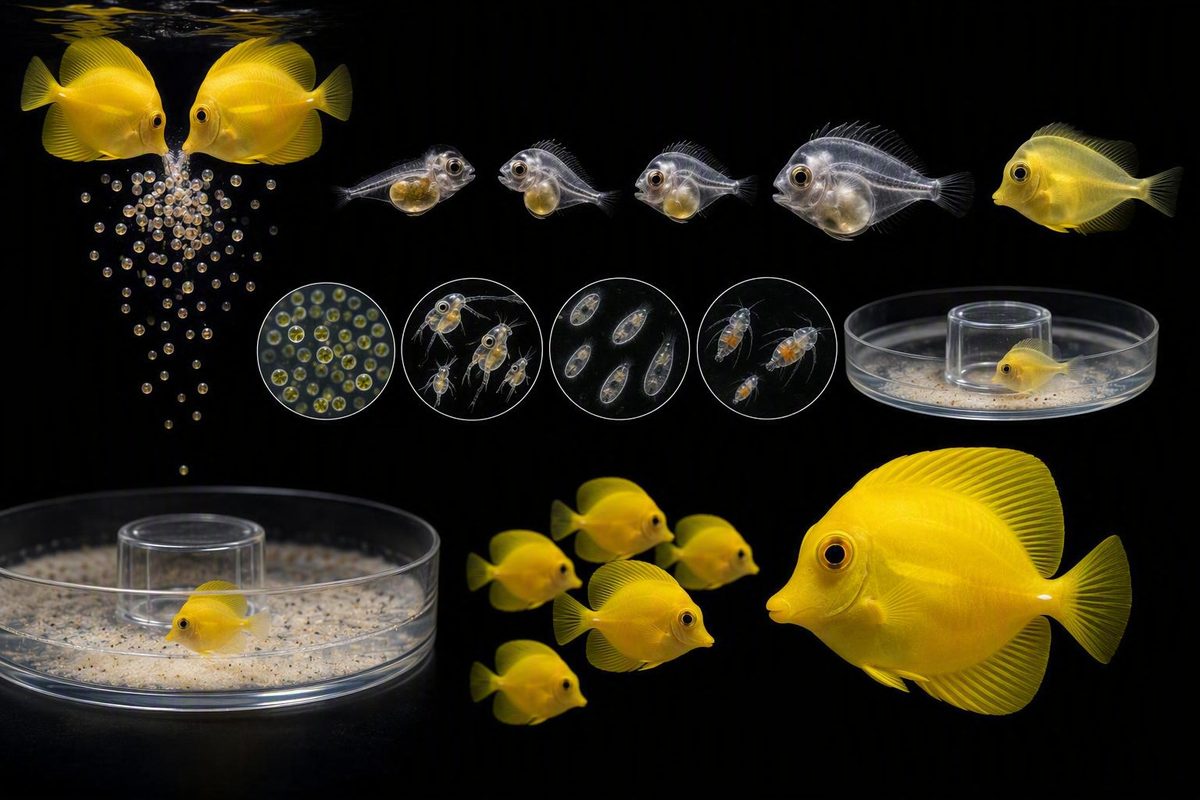
Tiny-mouthed larvae need suitably small live prey, carefully controlled water, settlement and metamorphosis before they become yellow juveniles.
Captive-bred yellow tangs are produced by getting adult yellow tangs (Zebrasoma flavescens) to spawn in a managed facility, collecting the fertilized eggs, and raising the resulting larvae through an unusually demanding open-water stage. The larvae must be offered live prey small enough for their tiny mouths, kept in carefully controlled water, guided through settlement and metamorphosis, and then grown into recognizable yellow juveniles.
This is ordinary sexual reproduction supported by sophisticated aquaculture. It is not cloning, artificial coloring, or genetic engineering. The difficult part is not “making” a different kind of tang; it is keeping a naturally produced larva alive long enough to become a juvenile.
The process at a glance
A hatchery’s exact protocol can be proprietary, but the published yellow tang work describes the same broad sequence:
- Keep mature males and females as healthy broodstock and condition them for reliable spawning.
- Collect buoyant fertilized eggs after a spawning event and move viable eggs into incubation or larval-rearing systems.
- Hatch the eggs and maintain the delicate, free-swimming larvae in exceptionally clean, stable water.
- Feed the larvae cultured live prey, beginning with tiny copepod nauplii and changing prey size as the fish develop.
- Support the long pelagic phase until the larvae are developmentally ready to settle and transform into reef-associated juveniles.
- Move settled fish into nursery and grow-out systems, where they learn to take practical prepared and algae-based foods and grow to a saleable size.
Each step depends on the one before it. A tank full of eggs is not yet a batch of captive-bred fish: most of the work happens between hatching and settlement.
Step 1: Condition adult broodstock
Production starts with mature broodstock, not with a laboratory manipulation of embryos. Adults need consistent water quality, appropriate social conditions, and a nutritionally complete diet so they can produce viable eggs and sperm.
The Oceanic Institute of Hawai‘i Pacific University maintained adult yellow tangs for years while researchers learned their reproductive rhythm. In a technical account written by members of that team, the broodstock spawned for several days around the full moon and supplied tens of thousands of eggs for larval trials. That did not make production automatic: the team still had to maintain the fish and hatchery in a ready state because egg quality and spawning success varied. The PNAS “Inner Workings” profile captures the practical challenge—the researchers had to be prepared whenever usable eggs appeared.
“Conditioning” does not mean injecting a finished fish into existence. It means keeping the parent fish healthy enough, for long enough, that natural spawning produces eggs capable of developing.
Step 2: Collect and incubate the eggs
Yellow tang spawning produces fertilized eggs that enter the water column. Hatchery staff separate promising eggs from debris and transfer them into a controlled system. Water movement, cleanliness, temperature, oxygen, stocking density, and handling all matter because the embryos and newly hatched larvae are extremely small and fragile.
After hatching, a yellow tang does not look like the disk-shaped yellow fish seen in an aquarium store. The PNAS report describes day-old larvae as pinhead-sized specks. They enter a pelagic, or open-water, larval phase and must feed while their mouths, digestive systems, swimming ability, and senses are still developing.
That mismatch—high nutritional demand paired with a tiny mouth and weak hunting ability—is one reason yellow tang culture took years to solve.
Step 3: Build a live-food chain for the larvae
The larval diet is the heart of the process. Newly feeding yellow tangs cannot simply be given a sheet of dried seaweed or ordinary fish flakes. Early work succeeded in getting larvae through first feeding with copepod nauplii, the minute newly hatched stages of small crustaceans.
Those copepods are themselves a crop. Hatchery staff culture microalgae, use the algae to nourish copepods, and then harvest copepods of suitable sizes for the fish. In other words, the facility raises food for the food. This multi-level live-feed system is documented both in the PNAS profile and in the Oceanic Institute team’s detailed yellow tang culture account.
Prey size must track larval development. The Oceanic Institute account reports that researchers began with copepod nauplii, gradually added larger nauplii and copepodites, and later offered newly hatched Artemia alongside copepods. The larvae did not use every offered prey equally well. At one stage they often struck at Artemia but missed or rejected it, while larger copepods could be too fast. That is why “feed more” is not a solution by itself: the prey must be catchable, digestible, nutritionally suitable, and present at the right developmental moment.
Step 4: Control water and microbial conditions
Live food makes the water system more complicated. Algae, copepod cultures, uneaten prey, and high larval sensitivity all create opportunities for unstable microbial communities and declining water quality.
In a 2014 trial, the Oceanic Institute team carried thousands of larvae beyond three weeks in a 1,000-liter tank. The authors associated the improved early survival with clear water, high water exchange, strong ultraviolet treatment, and a relatively low bacterial load. They were careful to frame these as factors under investigation, not as a universal recipe. Their report also describes work on the bacteria associated with live-feed cultures and possible probiotic approaches.
Modern commercial producers may refine tank design, flow, lighting, microbial management, feed enrichment, density, and transfer timing. The principle is stable even when the exact recipe changes: larval fish and their living food must be managed as one biological system.
Step 5: Carry larvae through settlement
Yellow tangs remain pelagic larvae far longer than many familiar captive-bred reef fish. During this phase their body shape, fins, mouth, behavior, and feeding capacity change. The Oceanic Institute account followed fish that became deeper-bodied and more associated with tank walls between roughly days 35 and 50. An early run reached day 83 but did not produce a fully settled juvenile, showing that keeping larvae alive for weeks was still not the finish line.
Settlement is the transition from a drifting larva to a small, reef-associated fish. It involves metamorphosis as larval structures recede and juvenile form and behavior emerge. Hatchery staff watch for developmental readiness and manage environmental cues, food, transfers, and tank conditions through this vulnerable handoff.
The eventual breakthrough came when the team carried fish through that entire bottleneck. A contemporary 2015 progress report described 187 juveniles already moved to grow-out and another group of pelagic larvae approaching metamorphosis. Those numbers show the distinction between a one-off larval survival record and repeatable production of juveniles.
Step 6: Grow the juveniles into robust aquarium fish
Once settled, the young fish finally begin to resemble miniature yellow tangs. They still need nursery care: stable water, appropriate stocking density, frequent nutrition, room to swim, and careful observation for fin, body-condition, or pigmentation problems.
The first public wave was a learning exercise as well as a milestone. A CORAL Magazine account of the first captive-bred fish documented both successful grow-out and quality issues seen in some early juveniles. That history matters because “captive-bred” describes origin, not a guarantee that every individual is flawless. Responsible producers still have to grade, condition, and transport their fish well.
During grow-out, juveniles can be transitioned toward foods practical for aquariums. Current captive-bred listings describe yellow tangs accepting prepared foods while retaining their natural grazing behavior; the Biota-supplied yellow tang care page emphasizes swimming space and an algae-based diet. A captive origin does not remove the adult species’ needs.
What “captive-bred” means for a buyer
A genuinely captive-bred yellow tang was hatched and raised under human care from an egg produced by broodstock. It was not merely a wild juvenile held in a tank for a while; that would be captive-conditioned, not captive-bred. It also was not genetically engineered to become yellow. Its color, shape, and grazing behavior are normal traits of Zebrasoma flavescens.
Captive breeding can reduce the need to collect another individual from a reef and can produce fish already familiar with aquarium foods and conditions. It does not make the fish maintenance-free. A buyer should still choose an alert, well-bodied animal that is eating, quarantine it appropriately, and provide a mature, stable marine system with ample swimming space, grazing opportunities, a varied algae-forward diet, and compatible tankmates. Yellow tangs have tail-base spines and can be territorial, so introductions and handling require care.
The short answer, then, is that captive-bred yellow tangs are not manufactured. They are spawned, hatched, fed through a painstaking live-food chain, shepherded through a long larval metamorphosis, and carefully grown out. The fish is natural; the achievement is recreating enough of its early ocean life inside a hatchery for it to survive.