
Open Mouth Signals Threat, Not Necessarily Injury
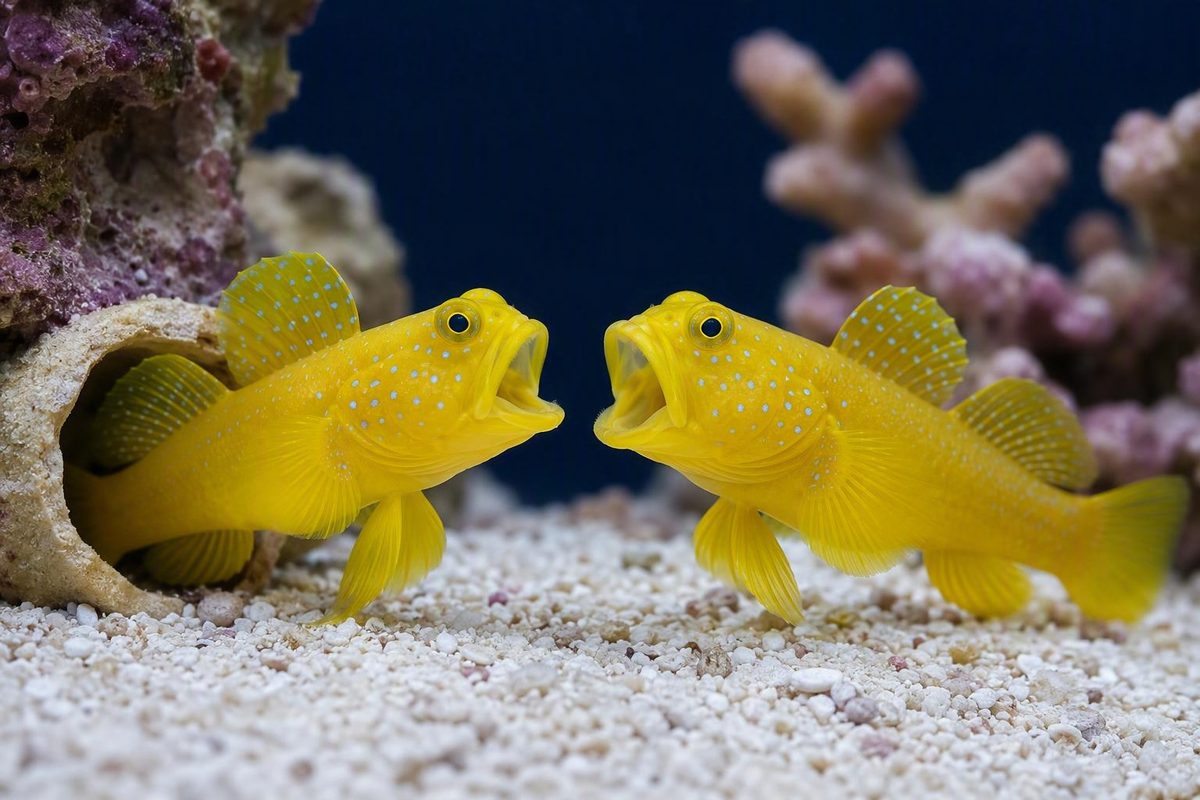
Mouth-to-mouth contact, persistent chasing or preventing retreat means the interaction is an active fight and the fish should be separated.
If you see a yellow watchman goby opening its mouth when another fish approaches, the most likely explanation is a territorial warning—especially near its burrow. If two fish make mouth-to-mouth contact, keep chasing, or prevent one another from retreating, treat the interaction as an active fight and separate them. A mouth held open away from a confrontation, particularly with fast gill movement, loss of appetite, or lethargy, may instead signal injury, poor water quality, or illness and deserves prompt investigation.
That distinction matters because “yellow watchman goby mouth when fighting” can describe several very different scenes. A short threat display may end without contact. Jaw-gripping can cause damage. Repeated mouth opening with labored breathing is not something to label as aggression from a video alone.
Read the Whole Behavior, Not Just the Mouth
Use the setting, duration, and the fish’s behavior immediately afterward to decide how urgently to act.
| What you see | More consistent with | What to do |
|---|---|---|
| A brief wide gape at a fish nearing the burrow; no contact; both fish disengage | Territorial warning or threat display | Keep watching and make sure both fish can retreat |
| Mouth-to-mouth gripping, lunging, circling, repeated chasing, or blocking access to shelter | Escalated aggression | Separate the fish now; do not wait for visible wounds |
| A crooked, swollen, bleeding, or persistently open jaw; trouble taking food | Mouth or jaw injury | Isolate from aggression and contact an aquatic veterinarian or experienced fish-health professional |
| Repeated mouth opening with rapid gill movement, surface piping, unusual posture, lethargy, or loss of appetite | Respiratory or systemic distress, not safely explained as a display | Check water and aeration immediately; seek fish-health help if it persists |
| Several fish breathing abnormally at once | A tank-wide environmental problem is more likely than one goby’s territorial behavior | Treat as urgent: verify oxygenation and water quality for the whole system |
The last two patterns are red flags rather than diagnoses. The Merck Veterinary Manual’s list of common illness signs in fish includes rapid or slow breathing, lethargy, not eating, sores, discoloration, and abnormal swimming. One sign cannot identify a cause, but several signs together make “it is only displaying” a poor assumption.
Why a Yellow Watchman Goby Defends This Space
The yellow watchman goby is Cryptocentrus cinctus, also called the yellow prawn-goby. FishBase describes the species as a reef-associated fish of sandy lagoons and protected coastal bays that lives in a burrow with alpheid shrimp. In an aquarium, that small patch of sand, rock, and burrow entrance can be the center of the fish’s usable territory.
Territorial conflict is therefore plausible when another bottom-dwelling fish or watchman goby crowds the same shelter. A study of a different goby species found that intraspecific aggression affected access to food and invertebrate burrows; it is useful evidence that burrows can be contested resources in gobies, but it does not prove that every gape by C. cinctus is a fight.
Species-specific husbandry advice is more direct: Bulk Reef Supply’s watchman goby care guide says these gobies may be aggressive toward their own species unless kept as a mated pair, and that this tendency can increase as they mature. Because sex and pairing are not reliably established by a casual visual check, do not assume two gobies are bonding simply because they were sold together or tolerated each other when younger.
A brief gape with no contact can be a successful warning—the intruder leaves and the resident returns to watching its burrow. But mouth-to-mouth gripping is already physical escalation. Even if both fish look intact afterward, repeated contests can interfere with feeding and keep the subordinate fish away from shelter.
What to Do During an Active Fight
1. Separate before assessing the cause
Use a tank divider, specimen container, fish trap, or secure acclimation box to stop contact. If possible, move the aggressor rather than forcing an injured or exhausted fish through a long chase. Ensure any temporary enclosure has suitable water flow, enough room for the fish to orient normally, and a cover; startled gobies can jump.
Do not use your hands to pry apart fish that have gripped mouths. Reduce stimulation, prepare the separator, and let them release if they are still attached. If one cannot release or has severe bleeding or deformity, seek urgent professional advice.
2. Check both fish under ordinary light
Look at the lips, jaw alignment, gill covers, fins, eyes, and body. Note whether each fish can close its mouth, maintain position, and take food. Photographing the same angles over time is more useful than relying on memory. Avoid repeatedly netting the fish just to inspect it; handling can add trauma.
3. Test the system, even if the fight looked obvious
Aggression and environmental trouble can occur at the same time. The UF/IFAS Introduction to Fish Health Management recommends checking water quality first when fish appear sick and identifies dissolved oxygen, ammonia, nitrite, and pH as a minimum screen, with nitrate particularly relevant in saltwater systems. Also verify temperature and salinity against the tank’s normal, stable range and confirm pumps, overflows, and aeration are working.
Do not make several large corrections at once unless an immediate life-safety problem has been identified. Sudden swings can compound the problem. If a test result is abnormal, use a response appropriate to the established system and obtain expert help when unsure.
4. Do not medicate based on gaping alone
Mouth opening is not a diagnosis. Parasites, gill irritation, injury, poor oxygenation, and water chemistry problems can produce overlapping signs, while a territorial display may require no medical treatment. Unnecessary medication can complicate later diagnosis and may be unsafe for invertebrates or the biological filter.
When Open-Mouth Behavior May Be Respiratory Distress
Watch the gill covers rather than the mouth alone. During a territorial moment, the gape is usually tied to the opponent’s approach and stops after the fish disengage. With respiratory distress, mouth and gill movement may remain fast at rest, continue after the other fish is gone, or occur throughout the tank.
Check for these companion signs:
- unusually rapid or forceful gill movement;
- remaining near high-flow areas or the surface;
- lethargy, loss of appetite, poor balance, or unusual posture;
- excess mucus, spots, sores, redness, frayed fins, or color change;
- more than one fish showing similar breathing behavior.
Water chemistry deserves immediate attention because the gills are directly exposed to the environment. The MSD Veterinary Manual’s review of environmental disease in aquatic systems explains that unionized ammonia can damage gill tissue and that ammonia toxicity depends partly on pH and temperature. A single total-ammonia number should therefore be interpreted with the rest of the water data, not in isolation.
Persistent breathing difficulty, inability to eat, a jaw that will not close, worsening swelling or redness, or an open wound are reasons to contact an aquatic veterinarian or qualified fish-health professional. If multiple fish are affected, treat the situation as a system emergency while arranging help.
Preventing Another Territorial Clash
Separation fixes the immediate danger, not the underlying layout or compatibility problem. Before reintroduction:
- provide more than one usable shelter or burrow area rather than two entrances to the same contested cavity;
- break direct sightlines with stable rockwork while preserving open sand and safe escape routes;
- make sure rock is supported securely and cannot collapse when sand is moved;
- avoid forcing two yellow watchman gobies together unless they are a known compatible pair;
- watch feeding so a dominant fish cannot exclude the other from food;
- use an acclimation box for a controlled visual reintroduction, and end the attempt if fixation, lunging, or repeated attacks resume.
Adding a pistol shrimp is not a remedy for incompatible gobies. A shrimp-goby partnership may make a burrow more valuable to its resident, so it should not be used as a way to force pairing or settle an existing territorial dispute.
The Practical Bottom Line
A yellow watchman goby’s wide-open mouth near its burrow can be a threat display. The safe dividing line is contact and recovery: if the fish touch mouths, chase repeatedly, trap one another, or fail to return quickly to normal breathing and feeding, intervene. Separate active combatants, inspect for injury, test the water and aeration, and escalate persistent breathing or jaw problems to a fish-health professional. That approach protects the fish without pretending a single visible behavior can provide a remote diagnosis.