
Pink-Streaked Wrasse Thrives in Mature Reefs With Cover
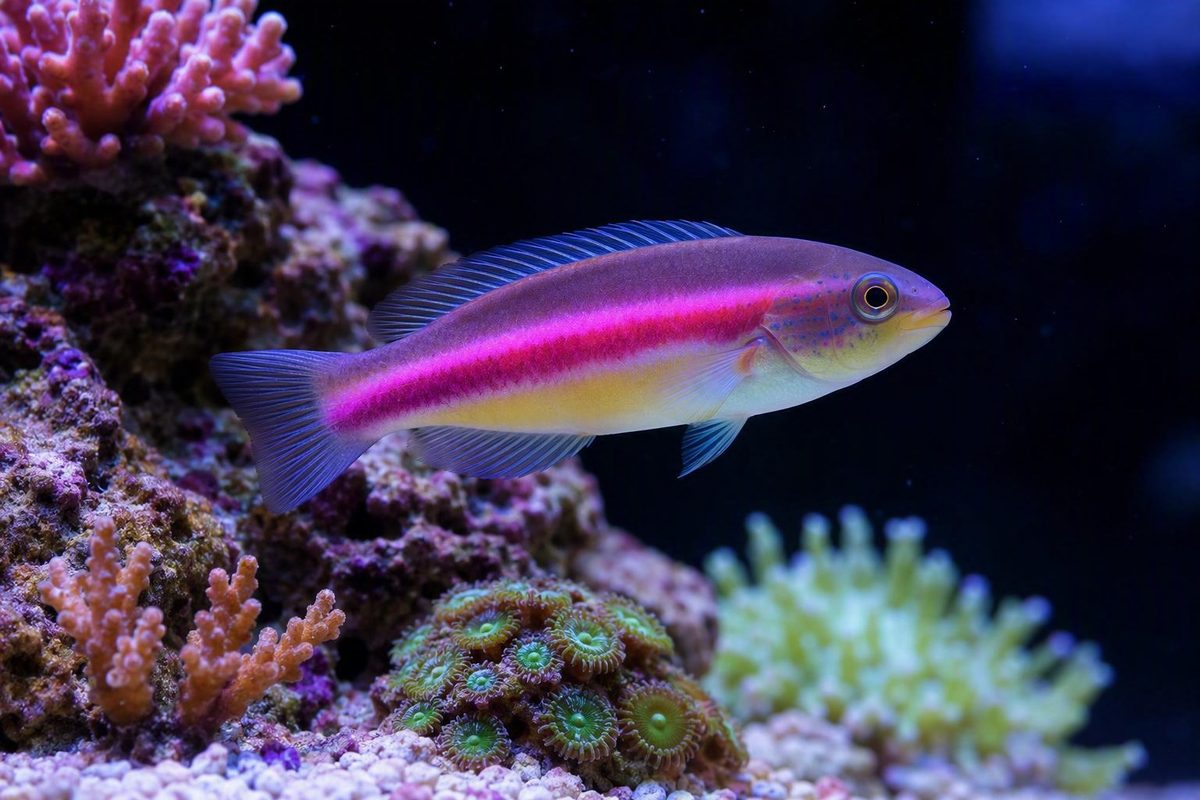
Success depends less on raw water volume than on stable reef conditions, shelter, feeding access and protection from both bullying and jumping.
The pink-streaked wrasse is a small, peaceful reef fish best suited to a mature, covered aquarium with gentle tankmates, intricate rockwork and suitably small foods. Its accepted scientific name is Pseudocheilinops ataenia, and it reaches about 6.5 cm (2.6 inches), not the much larger sizes associated with many other wrasses. A 15-gallon tank appears in retail guidance, but 20 gallons or more is a more forgiving practical starting point when the fish will share the aquarium.
That compact size does not make this a fish for an immature bowl or an aggressive nano community. Its success depends less on raw water volume than on stable reef conditions, shelter, feeding access and protection from both bullying and jumping.
Pink-streaked wrasse at a glance
| Question | Evidence-qualified answer |
|---|---|
| Accepted name | Pseudocheilinops ataenia Schultz, 1960; the Catalog of Fishes records it as a valid species. |
| Adult size | Up to 6.5 cm total length, or about 2.6 inches, according to FishBase. |
| Practical tank size | One established care listing specifies 15 gallons; 20 gallons or more gives a community fish more room and more feeding territory. |
| Temperament | Generally peaceful and passive; select calm tankmates and watch for intimidation. |
| Reef compatibility | Commonly kept as reef-compatible, although no fish should be treated as a guaranteed pest-control tool. |
| Food | Small meaty frozen or prepared foods, supplemented by the small crustaceans it naturally hunts. |
| Sand and rockwork | Complex rockwork with narrow retreats matters. Species-specific accounts describe cave shelter and mucus-cocoon sleep rather than sand burial. |
| Lid | Use a tight-fitting mesh top or canopy; hobby records identify a jumping risk. |
| Availability | Intermittent rather than dependable; stock status can change quickly. |
Identification, natural history and adult size
The common names “pink-streaked wrasse,” “pelvic-spot wrasse” and sometimes “midget wrasse” refer to Pseudocheilinops ataenia. This matters at purchase time because common names can be loose, while the scientific name anchors the care advice to the correct fish. The California Academy of Sciences’ Eschmeyer’s Catalog of Fishes lists the species as valid in the family Labridae and places its natural distribution in the western Pacific.
FishBase’s species account describes a reef-associated fish found at roughly 5–15 metres, usually around branching coral in quieter coastal water. It stays close to shelter, occurs in small groups and feeds on amphipods and other small invertebrates. That natural history explains three aquarium priorities: lots of broken sight lines, a mature surface to inspect for food, and tankmates that will not keep it pinned inside a crevice.
The recorded maximum of 6.5 cm is a useful ceiling, not a promise that every fish will reach exactly that length. Retail specimens may be much smaller. The fish’s small mouth should influence food particle size from day one.
Tank size, maturity and aquascape
LiveAquaria’s pink-streaked wrasse listing gives a 15-gallon minimum. A detailed long-term hobby account recommends 20 gallons or more for an active fish in a community. These numbers are husbandry recommendations, not biological thresholds: shape, stocking density, stability and usable shelter all affect whether a given aquarium is appropriate.
For most keepers, treat 20 gallons as the more comfortable baseline and scale upward for additional fish. A longer tank with open lanes and several separated retreats is more useful than a cramped layout with the same nominal volume. The aquarium should already be cycled and stable, with enough established rock surface to host the tiny animals this wrasse searches for between meals.
Build a network of narrow caves, shaded overhangs and branching structure, while leaving clear water for cruising. Secure the rockwork before introducing livestock. The fish needs more than one escape route so a territorial neighbour cannot control its only refuge.
Does a pink-streaked wrasse need sand?
Do not automatically apply the sand-burrowing habits of other wrasse genera to this species. The species spotlight based on long-term aquarium observation describes P. ataenia retiring near small caves and forming a mucus cocoon; it does not describe diving into sand to sleep. A sand bed can still be part of a healthy reef and may support microfauna, but complex rock shelter is the directly documented need. In a bare-bottom system, compensate with abundant secure crevices and close observation rather than assuming the lack of sand is harmless in every setup.
Feeding a small, active hunter
In the wild, the fish takes amphipods and other small invertebrates. In aquariums, the evidence is encouraging: LiveAquaria reports acceptance of frozen and flake foods, while the Reef2Reef account records mysis, cyclops, rotifers and suitably small pellets or flakes.
Use a varied rotation of appropriately sized marine foods rather than relying on one item. Offer small portions where the wrasse can actually reach them, especially during its first days. A shy new fish may lose every feeding contest even when food is abundant overall. Watch the fish eat; food entering the tank is not the same as food entering this fish.
A mature pod population is useful enrichment and a feeding buffer, but it is not a substitute for a complete prepared diet. Heavy pod-eaters such as dragonets can also compete for the same limited resource. Avoid buying the wrasse solely as a cure for flatworms, bristleworms or another perceived pest. Individual prey choices vary, and a fish is not a deterministic control product.
Temperament and compatible tankmates
Pink-streaked wrasses are consistently described as peaceful, but “peaceful” does not mean invulnerable. LiveAquaria notes that related Pseudocheilinus wrasses may chase this more passive species. The detailed hobby account likewise emphasizes retreat rather than confrontation.
Choose calm, non-predatory fish that will not monopolize food or caves. Be cautious with six-line and other assertive wrasses, aggressive clownfish pairs, dottybacks, large hawkfish and any established fish that treats the entire nano tank as its territory. Compatibility depends on the individuals and the available space, so observe behaviour instead of relying only on a chart.
Warning signs include repeated chasing, blocked access to food, rapid breathing after encounters, damaged fins or a fish that never leaves one hiding place. If those persist, separation and a stocking-plan reassessment are safer than waiting for the passive fish to “stand up for itself.”
Jumping, acclimation and the first week
Fit the aquarium with a tight lid before the fish arrives. Close gaps around cables, overflow boxes and feeding ports; a cover with a wrasse-sized opening is not a complete cover. The species-specific Reef2Reef account explicitly warns of jumping, and shy fish may launch when startled or pursued.
During introduction, dim the lights, provide immediate shelter and follow the seller’s acclimation instructions without prolonging the fish’s exposure to shipping water. The first week’s job is observation: confirm that it emerges, eats small foods, is not being harassed and shows no obvious injury or abnormal breathing. Quarantine and disease-management choices should match the aquarist’s established protocol and the advice of an aquatic veterinarian when illness is suspected.
Availability and what to check before buying
FishBase characterizes P. ataenia as rare in the aquarium trade. Current listings support the idea that supply is sporadic rather than absent: on July 14, 2026, LiveAquaria showed its listing sold out, while Reef Pro showed availability varying by size. Those snapshots are not forecasts, and neither a displayed price nor stock badge should be assumed current later.
Before ordering, confirm the scientific name, actual specimen size, feeding response, collection or captive-breeding claim, health guarantee, shipping schedule and arrival policy. Do not repeat an unsourced “captive-bred” label: ask the seller who produced the fish and request traceable details. When possible, choose an alert, undamaged specimen that the seller can demonstrate is eating.
Is the pink-streaked wrasse right for your reef?
This species is a strong candidate when the aquarium is mature, covered and stocked with peaceful fish; the aquascape provides many small retreats; and the keeper can deliver tiny foods without stronger feeders taking everything. Its modest adult size and generally gentle behaviour are genuine advantages.
Pass for now if the tank is newly cycled, uncovered, dominated by aggressive fish or dependent on a single fragile pod population. The best setup is not the smallest tank in which the fish might survive. It is the one that reliably provides stable water, food access, shelter and freedom from harassment.