
Cycle Your Tank Before Adding Any Livestock
A 2 ppm ammonia dose must leave ammonia and nitrite at zero within 24 hours for the cycle to be complete, replacing guesswork with a readiness test.
Starting a reef tank is not complicated, but it is unforgiving of the wrong sequence. Most first-year crashes come from adding livestock before the biology is ready, not from bad equipment or bad water. This guide covers the setup order that prevents those crashes.
Start with the right tank size
Counterintuitively, smaller tanks are harder to keep. A 10-gallon nano has almost no buffer — a temperature spike, a parameter swing, or a single dying fish can wipe it out in hours. For a first reef, 40 to 75 gallons gives you enough water volume to absorb mistakes while staying manageable.
Acrylic vs. glass: glass is heavier but cheaper and scratch-resistant. Either works. Buy rimless if you want clean aesthetics; standard-rim if you’re dropping it in furniture.
Equipment to install before water goes in
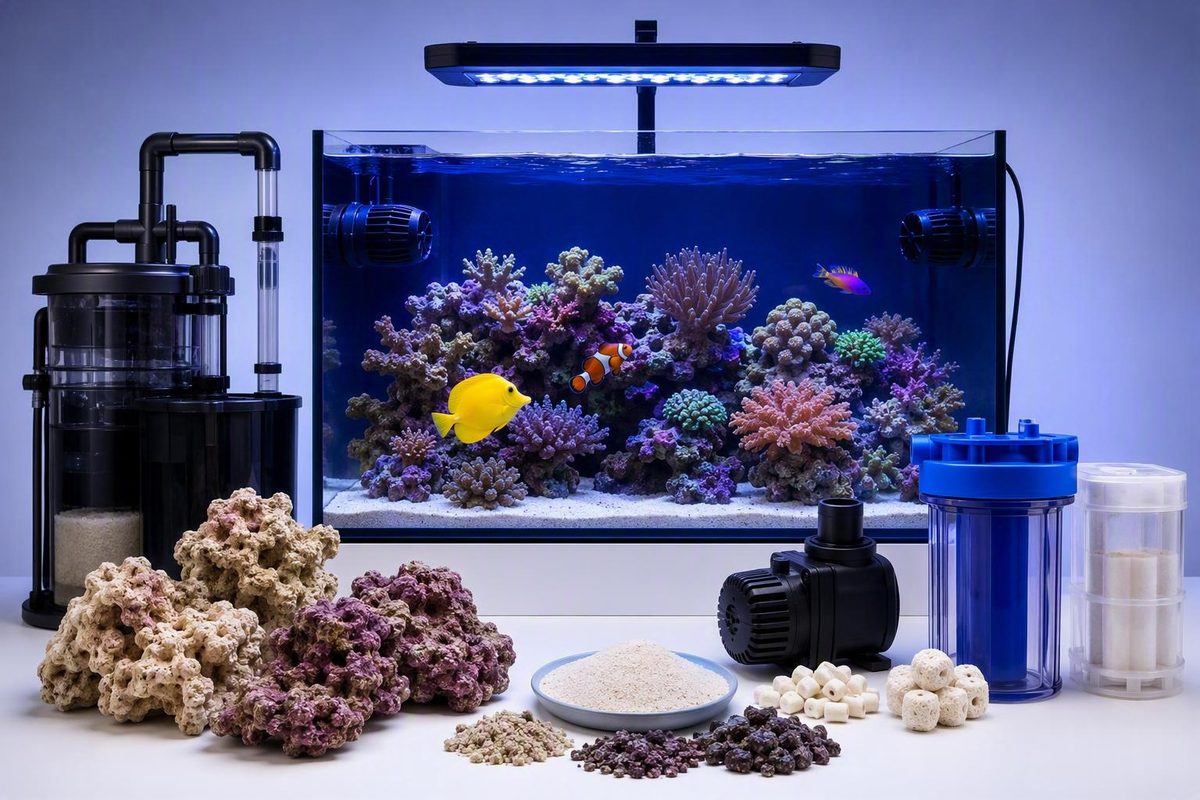
- Sump or HOB filter: A sump gives you equipment space, extra water volume, and a place to hide a skimmer. A hang-on-back protein skimmer is a workable alternative for smaller tanks.
- Return pump: Size for 5–10x tank volume per hour before head loss. A 55-gallon tank needs a pump that delivers 275–550 GPH at operating head.
- Circulation pumps: Coral needs flow across its tissue. Two wavemakers positioned to create random turbulence across the aquascape, targeting 20–40x tank volume per hour total.
- Heater: Two smaller heaters rather than one large one — if one fails stuck-on, the backup shuts off before the tank cooks. Target 78–80°F.
- Lighting: Reef-specific LED (Radion, Hydra, Kessil, or a well-regarded import). You need 420 nm and 450 nm output. Don’t run full intensity until coral is established.
Rock placement before the water
Aquascape dry. Once it’s wet, you’re fighting buoyancy and risking dropped rock and crushed coral. Live rock is the biofilter — 1 to 1.5 pounds per gallon as a rough guide for porous dry rock. Avoid aragonite-heavy rock that releases silicates.
Glue the base layer together with reef-safe epoxy. Towers and unsupported ledges fall at 2 a.m. and crack tank glass.
Filling and the nitrogen cycle
Mix saltwater in a separate container to 1.025–1.026 specific gravity (35–36 ppt salinity). Add to the tank with the heater and return pump running. Let it stabilize for 24 hours before adding any ammonia source.
The cycle process:
- Dose pure ammonia (no surfactants) to 2 ppm, or add a raw shrimp and remove it after 48 hours.
- Test ammonia and nitrite every two days.
- Watch for the nitrite spike — this means ammonia-oxidizing bacteria have colonized. Nitrobacter then converts nitrite to nitrate.
- The cycle is complete when: you dose to 2 ppm ammonia and both ammonia and nitrite read zero within 24 hours.
This takes six to eight weeks with no seeding. With established rock or a bottle of bacteria, four weeks is realistic — but you still confirm with tests.
Cleanup crew before fish
Once the cycle is confirmed complete, run the tank for two more weeks with the lights off to control algae expectations. Then add a cleanup crew: a mix of nassarius snails (sand-sifters), cerith snails (substrate cleaners), and hermit crabs. Let them work for three to four weeks before adding any fish.
Cleanup crew acts as a bioload test. If ammonia spikes after addition, you are not cycled and you added them too early.
Your first fish
One fish. Hardy and disease-resistant. A clownfish pair, a firefish goby, or a small dottyback. Quarantine in a separate 10-gallon bare-bottom tank for four weeks before introducing to the display. Ich and velvet entering your display tank through an unquarantined fish is a tank-wide disaster.
First coral: six to eight weeks after fish are stable
By this point, you have two to three months in. Add a single soft coral or LPS frag. Torch coral, hammer coral, mushrooms, and zoanthids are the appropriate starting point. Acropora and montiporas (SPS) require stable parameters you have not had long enough to prove.
The reef tank hobby rewards patience with a 12-month timeline to a stable mixed reef. Every shortcut compounds.