
Yellow Coris Wrasse Sleeps in Sand and Hunts Daily
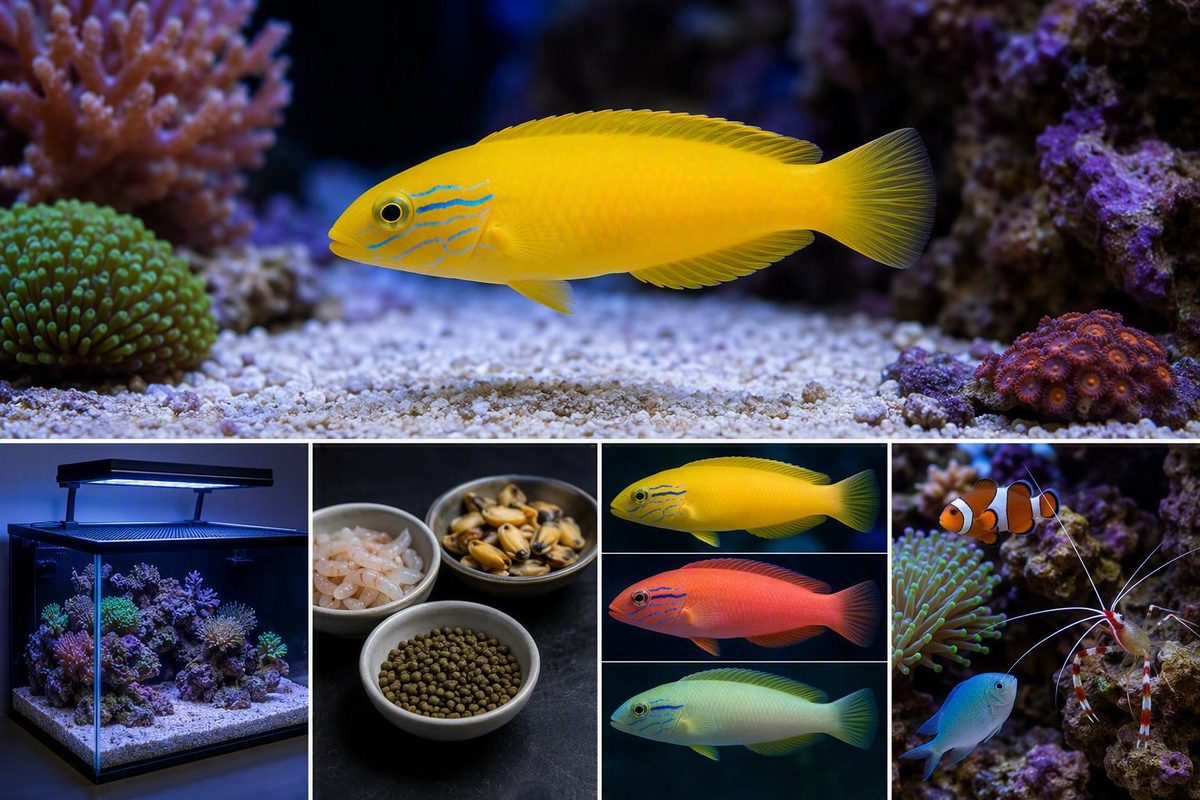
A prized ornamental worm or very small shrimp may make this wrasse the wrong tradeoff, even when the corals themselves are safe.
The fish sold as a yellow coris wrasse is usually Halichoeres chrysus: a small, active marine wrasse that sleeps in sand, spends the day searching rockwork and substrate for food, and generally fits a peaceful reef community. It is not a true member of the genus Coris. A practical home should include an established aquarium of about 50 gallons or more, a tight lid, open swimming space, rockwork, and 2–3 inches of fine sand. Its bright color and mild temperament are appealing, but it is still a predator of small invertebrates—not a guaranteed or perfectly selective “pest-control fish.”
First, confirm which fish the name means
“Yellow coris wrasse” is a trade name, not a precise scientific label. The accepted name for the all-yellow species discussed here is Halichoeres chrysus. The World Register of Marine Species lists H. chrysus as an accepted species in the wrasse family Labridae.
Common-name ambiguity matters at the store. Some sellers use the same label for either H. chrysus or Halichoeres leucoxanthus. One retailer even warns that an order under “yellow coris wrasse” may arrive as either of those two species. Ask the seller for the scientific name and inspect the actual fish rather than treating the common name as an identification guarantee.
FishBase also notes that H. chrysus is replaced by H. leucoxanthus through much of the Indian Ocean, with some overlap in Indonesia. That geographic relationship helps explain why the trade names can blur together. This guide is specifically about H. chrysus.
Yellow coris wrasse at a glance
| Care point | Practical starting point |
|---|---|
| Scientific name | Halichoeres chrysus Randall, 1981 |
| Adult size | Up to about 12 cm (4.7 inches) total length |
| Aquarium | Established marine tank; about 50 gallons or larger is a common husbandry recommendation |
| Substrate | Fine, soft sand, about 2–3 inches deep, with an open area for diving and burial |
| Cover | Tight-fitting lid with cable and overflow gaps secured |
| Diet | Varied small meaty foods plus suitable prepared marine foods |
| Temperament | Generally peaceful, but individual and wrasse-to-wrasse interactions vary |
| Reef suitability | Usually coral-compatible; use caution with small ornamental invertebrates |
Natural history explains the care requirements
This is not simply a yellow fish that happens to tolerate sand. FishBase describes H. chrysus as a reef-associated species found at reef edges in sand and rubble areas, often in small groups. Its recorded range extends from Christmas Island through the western Pacific, including the Solomon Islands, southern Japan, and eastern Australia. FishBase gives a maximum total length of 12 cm.
Those details translate directly into aquarium design. The fish needs room to cruise, rocks to inspect, and a sand area that remains accessible. Dense rockwork over every inch of the bottom or a bare-bottom system removes an important refuge. An aquarium can have ample water volume and still be a poor fit if it lacks usable substrate or has uncovered escape gaps.
Build the tank around sand, cover, and stability
Use a mature aquarium with swimming room
A 50-gallon tank is a sensible baseline rather than a magic threshold. LiveAquaria’s yellow wrasse husbandry guide recommends at least 50 gallons, live rock, open substrate, and open swimming space. Tank shape, stocking density, filtration, and the behavior of existing fish all affect whether that volume works.
Use an established system with stable salinity and temperature and a functioning biological filter. The same guide gives a conventional marine range of 72–78°F (22–26°C), pH 8.1–8.4, and specific gravity 1.020–1.025. Do not chase a single number by making abrupt corrections; consistent conditions and good water quality are more useful than repeated swings within a published range.
Provide fine sand for nightly burial
Allow an open bed of fine, soft sand roughly 2–3 inches deep. The fish dives into it to sleep and when startled. Coarse, sharp rubble is not an equivalent substitute, and a small decorative patch may not provide enough room for the fish to enter cleanly.
Before adding the wrasse, check that rocks are supported securely rather than balanced on loose sand. The fish’s digging should not be able to undermine an unstable structure. Keep the chosen sand zone free of buried sharp objects.
Treat the lid as essential equipment
Use a close-fitting mesh or solid top, and inspect every opening around cords, returns, overflows, and feeding ports. A cover is only as effective as its largest fish-sized gap. Keep it in place during feeding and maintenance whenever possible; a startled wrasse can move faster than expected.
Feed a predator, not a cleanup device
In nature, H. chrysus searches sand, rubble, and reef edges for small animals. In an aquarium, offer a varied diet of appropriately sized meaty foods such as mysis and enriched brine shrimp, supplemented with quality marine pellets or flakes the individual accepts. Several small portions are often easier for an active forager to use than one oversized feeding.
Watch the fish eat. A tank may contain copepods and other microfauna, but that does not prove it can supply enough food indefinitely. This matters especially in a young tank or in a community with mandarins and other animals that also depend heavily on small crustaceans. Prepared food acceptance and body condition are better guides than the assumption that live rock will feed everyone.
Yellow wrasses are often promoted for eating flatworms, fireworms, or pyramidellid snails. They may consume some of these animals, but the result is individual and opportunistic. A wrasse cannot identify which invertebrates the keeper considers pests. LiveAquaria cautions that larger specimens may also eat fan worms, shrimp, and other desirable crustaceans. Use direct pest management and quarantine practices rather than buying one fish as the entire treatment plan.
Behavior, hiding, and daily routine
A settled yellow wrasse is usually visible by day, moving through open water and inspecting rock and substrate. At night it normally disappears beneath the sand. It may also bury itself when frightened or after transfer to a new aquarium.
Do not dig through the substrate simply because a newly introduced fish is out of sight. First verify that the lid is secure, the fish did not enter an overflow, and water conditions are appropriate. Give it a quiet environment and maintain a normal light cycle. If it reappears, confirm that it eats and swims normally. Persistent absence combined with poor water quality, injury, abnormal breathing, or refusal to eat calls for closer investigation; burial alone does not establish either health or disease.
Color and markings change with maturity
The bright yellow body persists, but the spots and facial markings can change as the fish matures. Fishes of Australia documents the color pattern: smaller females and juveniles can show three dark spots toward the dorsal and rear fin area, females retain a second dorsal spot, and males typically show a prominent front dorsal-fin eyespot along with colored facial bands. The same reference classifies the species as hermaphroditic.
That makes spot-counting a clue, not a foolproof way to assign age or sex to a store specimen. Lighting, stress, size, viewing angle, and the fish’s transition stage can all affect what is visible. Use the overall pattern and provenance, and avoid promising that a particular juvenile appearance will remain unchanged.
Compatibility: peaceful fish, cautious invertebrate choices
Yellow wrasses are generally mild compared with many larger wrasses. Good companions are peaceful marine fish that will not harass or consistently outcompete them at feeding time. Additions should still be observed closely, especially when combining wrasses or fish with a similar shape and feeding niche. A larger tank and broken sightlines help, but they do not guarantee harmony.
For a reef aquarium, “reef compatible” needs qualification:
- Corals: H. chrysus is generally not kept as a coral eater. Soft and stony corals are usually compatible.
- Mobile invertebrates: small shrimp, worms, tiny crustaceans, and similar animals may be investigated or eaten.
- Cleanup crew: larger established snails and hermit crabs may coexist, but no small invertebrate is automatically safe from an opportunistic wrasse.
- Other sand sleepers: make sure there is enough open substrate and that residents are not repeatedly competing for the same refuge.
Introduce the fish only after considering the invertebrates already present. If a prized ornamental worm or very small shrimp is central to the display, this species may be the wrong tradeoff even when the corals themselves are safe.
A pre-purchase checklist
Before bringing home a yellow coris wrasse, confirm all of the following:
- The seller identifies the fish as Halichoeres chrysus, not only by a common name.
- The aquarium is established, stable, and large enough for an active adult and its tankmates.
- There is an open area of fine sand around 2–3 inches deep.
- Rockwork is secure and cannot be undermined by activity in the sand.
- Every opening in the lid is smaller than the fish.
- Peaceful tankmates allow it to feed, and no similar wrasse is likely to corner it.
- You can provide varied prepared foods rather than depend on pests or pods alone.
- You accept that small ornamental invertebrates may be eaten.
When those conditions are met, H. chrysus can be an engaging, constantly moving reef fish. The key is to plan for the animal it is—a sand-burying invertebrate hunter with changing markings—not for the overly tidy promise implied by the name “yellow coris” or the label “pest eater.”