
Copepods in Your Tank Are Usually Beneficial
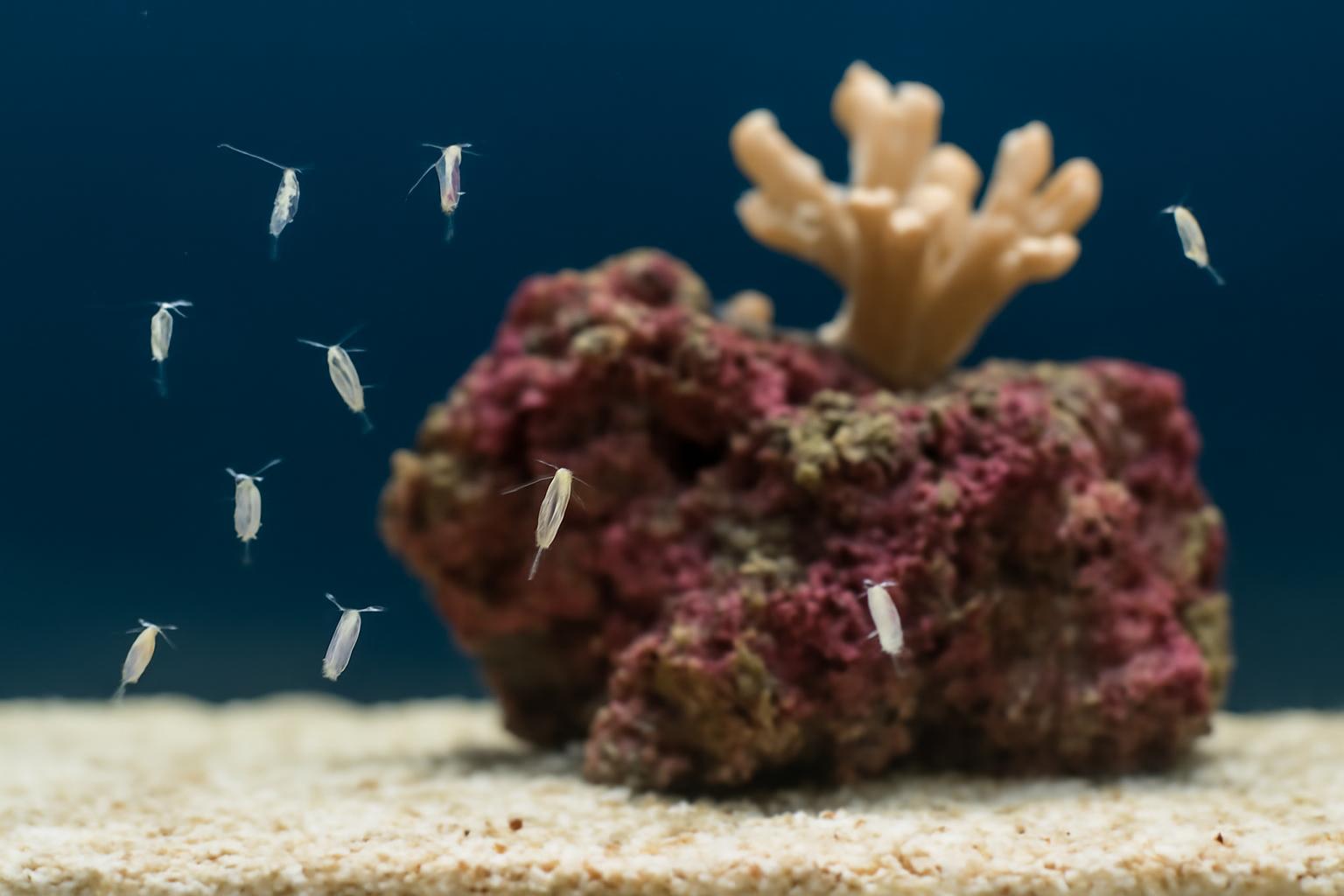
A fish can consume copepods faster than the tank produces them, especially in a small or newly established system.
Copepods in an aquarium are tiny crustaceans that usually belong there. In marine and freshwater tanks, they occupy the microfauna layer: some swim in open water, while others crawl over rock, sand, glass, plants, or macroalgae. They can graze on microscopic food and organic material, and many fish and invertebrates eat them in turn.
For most aquarists, seeing a few small “pods” is not a reason to treat the tank. The better response is to identify what is present, consider the tank’s age and livestock, and avoid assuming that every moving speck is either a copepod or a pest.
What copepods are
Copepods are not insects or worms. They are aquatic crustaceans related, at a distance, to shrimp and crabs. The NOAA COPEPOD database overview describes them as common zooplankton found in marine and freshwater habitats. Their life cycle progresses from egg to nauplius, then through copepodite stages before adulthood.
“Copepod” covers many species with different habits. In reef aquariums, three broad groups often appear in discussions and cultured blends:
- Harpacticoids are commonly associated with surfaces and sediment. Genera such as Tisbe and Tigriopus are frequently cultured for aquariums.
- Cyclopoids include forms that spend more time swimming in the water column. Apocyclops is one cultured marine example.
- Calanoids are largely planktonic and are important in open-water food webs, though they are generally less associated with permanent colonies on aquarium surfaces.
Those labels describe broad biological groups, not interchangeable products. Salinity tolerance, adult size, preferred food, and whether a culture will persist vary by species. A bottle intended for a reef tank should not be assumed suitable for a freshwater aquarium, and wild-collected pond or seawater should not be used as an uncontrolled shortcut.
What copepods can—and cannot—do for a tank
They add live prey and food-web diversity
Copepods connect microscopic producers and organic matter with larger animals. NOAA places them within the aquatic food web, while the FAO manual on copepod production discusses copepods as live food for cultured marine fish larvae. In a home reef, that makes established pod populations useful prey for fish and invertebrates that hunt small moving foods.
This does not mean a visible pod population is a complete feeding plan. A fish can consume copepods faster than the tank produces them, especially in a small or newly established system. Species that graze on microcrustaceans throughout the day still need a husbandry plan appropriate to that species; adding one bottle of pods is not proof that the aquarium can support it long term.
Some graze on microalgae and organic matter
Feeding behavior differs among copepods and life stages. Benthic types may consume microalgae, bacteria-associated material, leftover food, or detrital particles. Aquarium guidance from AlgaeBarn describes Tisbe and Tigriopus grazing on algae and coarse organic matter in hard-to-reach spaces.
That makes pods contributors to a cleanup community, not a replacement for maintenance. They will not correct overfeeding, poor export, unstable water chemistry, or accumulated waste on their own. A sudden population boom can simply mean that abundant food is available.
They do not cycle a new aquarium for you
Copepods are not a substitute for the microbes that process ammonia and nitrite. Their presence also does not prove that a new aquarium has completed its nitrogen cycle. Confirm cycling with appropriate water tests and a deliberate cycling method.
Once the cycle is complete and immediate ammonia or nitrite danger has passed, a lightly stocked tank can offer pods time to find shelter and reproduce before heavy predator pressure begins. Adding them later can still work, but more of the initial culture may be eaten quickly.
How to seed copepods in a reef aquarium
Start with a cultured product labeled for the aquarium’s salinity and check its storage and expiration instructions. Do not mix an unknown wild culture into a display tank; along with the desired organisms, it may introduce predators, parasites, algae, or other hitchhikers.
Use this practical sequence:
- Confirm the tank is ready. Finish the nitrogen cycle, stabilize salinity and temperature, and make sure no medication or treatment in the system conflicts with crustaceans.
- Inspect the culture. Follow the supplier’s instructions and do not use a container that smells foul, has leaked, or was held outside its stated temperature range.
- Reduce immediate removal. Temporarily pause or reduce equipment that would export the new animals before they settle, following the equipment manufacturer’s safety guidance. Never leave circulation or life-support equipment off longer than intended.
- Add pods to sheltered areas. Distribute them near porous rock, substrate, macroalgae, or a refugium rather than releasing the entire culture directly in front of actively feeding fish.
- Restore normal operation. Resume the system on the schedule appropriate to the product and tank; there is no universal shutoff time for every setup.
- Observe before buying more. Give the population time to occupy surfaces and reproduce. Repeated dosing cannot compensate for a habitat with no food or refuge and intense predation.
Practical reef guidance from Bulk Reef Supply recommends introducing pods when predators are less active and placing them in the display or refugium after temporarily reducing removal. Treat those steps as general husbandry guidance and follow the specific culture’s directions when they differ.
Do copepods need a refugium?
No. Copepods can persist in pores within rock, substrate, macroalgae, and other protected surfaces in the display. A refugium helps when it provides habitat connected to the aquarium but relatively protected from fish.
A refugium is most useful when predator pressure is high or when the aquarist wants a reservoir that can continually export some pods into the display. It is not automatically productive merely because it is called a refugium. Copepods still need suitable salinity and temperature, food at the right scale, oxygenated water, and surfaces appropriate to the species.
Avoid turning supplemental feeding into nutrient pollution. If live phytoplankton or another food is used, start conservatively, follow product directions, and watch the aquarium’s nutrient trend. Clear water does not prove the pods are starving, and cloudy water does not prove they need more food.
How to tell whether a pod population is established
Check after the display lights have been off for a while. Use a small flashlight to inspect the glass near the substrate, porous rock, macroalgae, sump walls, and refugium. A magnifying lens or a phone macro lens can help.
Look for repeat observations rather than one isolated animal:
- very small translucent or pale crustaceans moving on glass or rock;
- quick, short swimming bursts from planktonic forms;
- crawling animals among algae or substrate from surface-associated forms;
- multiple sizes over time, which may indicate more than one life stage.
Not seeing them does not establish that none are present. Many remain hidden, are most active under low light, or have been reduced by predators. Conversely, a dense patch on the glass is not automatically evidence of ideal water quality. Population size changes with food, habitat, filtration, competition, and predation.
Copepods versus amphipods and aquarium pests
The word “pod” is often used loosely. Amphipods are also crustaceans, but they are generally more shrimp-like, laterally compressed, and conspicuous than the tiny specks aquarists commonly call copepods. Many amphipods are harmless or useful, so “not a copepod” does not mean “pest.”
Under magnification, adult copepods typically show a segmented body with antennae; females of some species carry visible egg sacs. Nauplii look different from adults, which makes identification from a phone photo difficult. The University of New Hampshire zooplankton key notes that accurate species-level identification depends on adult morphology.
Use movement and body plan as screening clues, not as a diagnosis:
- Likely copepod: tiny crustacean; teardrop-like or segmented outline; crawling or moving in short, jerky bursts.
- Likely amphipod: larger, curved or shrimp-like body with obvious legs; often crawls or scurries through rockwork.
- Likely flatworm: flattened body that glides over a surface rather than swimming in crustacean-like bursts.
- Likely hydroid or other attached organism: fixed to a surface, sometimes with a stalk or tentacle-like crown; it does not crawl like a pod.
Do not medicate a reef because of an uncertain “white speck” identification. First capture a close image or short video, compare it with a reputable identification key, and note whether the organism is free-living or attached to fish or coral. Anything embedded in tissue, fixed to a fish, associated with lesions, or followed by abnormal livestock behavior needs more careful identification than a general copepod guide can provide.
The practical bottom line
Copepods are normal members of many mature aquariums and are usually beneficial as microfauna and live prey. Their value depends on species, habitat, available food, and predator pressure. Seed a cycled tank with an appropriate cultured source, give the animals sheltered surfaces, and judge establishment through repeated low-light observation.
Keep the limits clear: copepods do not complete the nitrogen cycle, replace routine maintenance, guarantee adequate food for specialist fish, or identify themselves simply because they are small. When an organism does not match a copepod’s body plan and movement—or appears attached to livestock—identify it before deciding whether any treatment is warranted.