
Give Pyramid Butterflyfish 125 Gallons to Swim Naturally
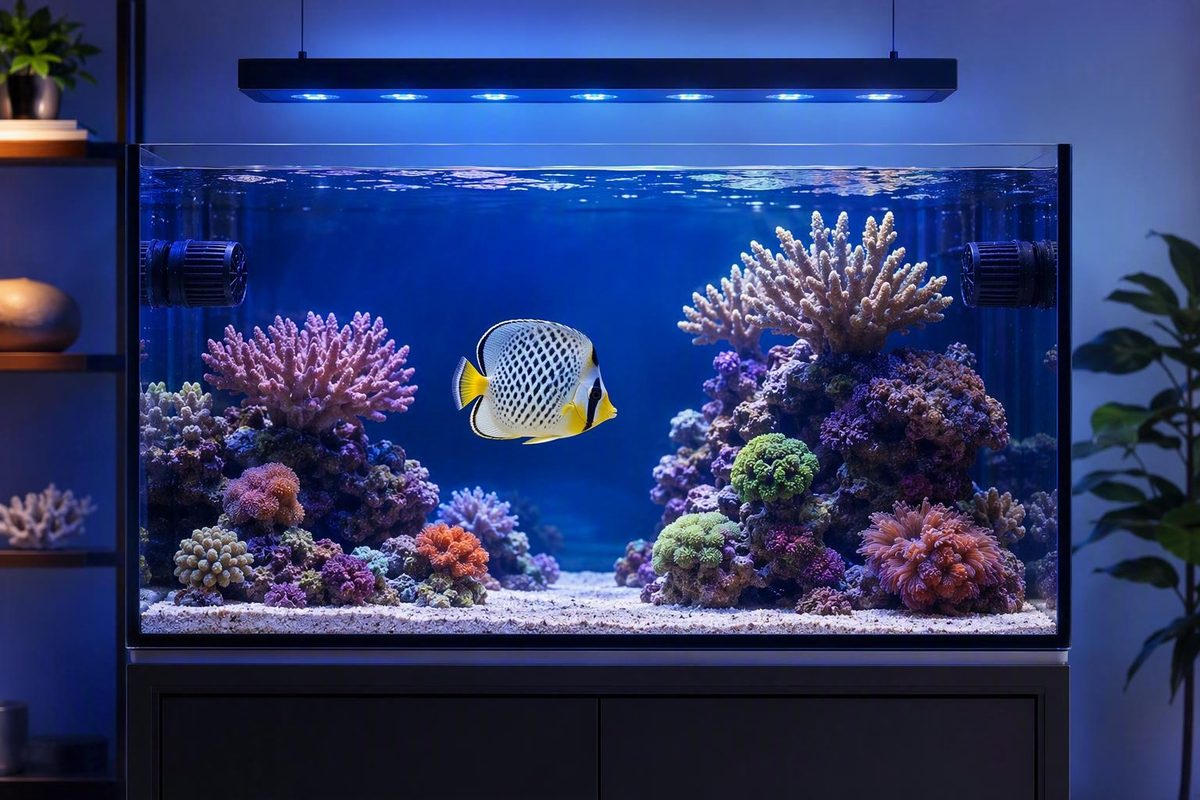
A long 125-gallon aquarium with a clear swimming lane is a better starting point; a pair or group needs more room.
For one adult pyramid butterflyfish, 125 gallons is the most defensible practical minimum. A few care sheets list 75 or 100 gallons, but those figures are better treated as bare published floors than as welfare-oriented targets. This species can reach about 7 inches (18 cm), spends much of its time swimming in open water, and naturally feeds above outer reef slopes. A long 125-gallon aquarium with a clear swimming lane is a better starting point; a pair or group needs more room.
The short answer: plan around 125 gallons
Tank-size advice for the pyramid butterflyfish is not standardized:
- Sustainable Aquatics lists 75 gallons or greater for the species, while saying that a small group needs several hundred gallons of swimming space.
- A Reefs.com care article cites 100 gallons as the usually suggested minimum.
- Quality Marine recommends 125 gallons or larger, as do LiveAquaria and the specialist profile at Saltcorner.
Those numbers describe volume, not usable habitat. A tall, rock-packed tank can hold many gallons while providing a poor horizontal swimming lane. For this active, laterally compressed fish, tank length, unobstructed water column, mature biological filtration, hiding places, and the existing fish load all matter.
A sensible planning rule is:
- 75 gallons: a low-end published floor, not the preferred long-term target for an adult.
- 100 gallons: more water and dilution capacity, but still less conservative than the care guides that account for adult swimming behavior.
- 125 gallons or larger: the practical baseline for one adult when the aquarium is long, mature, lightly enough stocked, and arranged for open swimming.
- Pair or small group: go materially larger. One supplier specifically calls for several hundred gallons for a small group, and specialist guidance recommends more than 125 gallons when keeping multiple fish.
If the available aquarium is 75 or 90 gallons, the safer choice is to select a smaller species rather than buy a juvenile with an upgrade plan that may never happen.
Why this fish needs more than its body length suggests
The accepted name is Hemitaurichthys polylepis. The World Register of Marine Species lists it as an accepted species, and FishBase records a maximum total length of 18 cm, roughly 7 inches. Retail names can be confusing: “yellow zoster butterflyfish” is sometimes applied to this fish, but H. zoster is a different species. Confirm the scientific name before buying.
Adult length alone does not determine space needs. FishBase describes H. polylepis forming large schools above steep, current-swept outer reef slopes and feeding on plankton. That natural history points to an open-water swimmer that repeatedly crosses the aquarium, not a fish that stays close to one cave or occupies a small territory.
The aquarium therefore has to provide three things at once:
- A long, open swimming route. Build rockwork toward the back and ends instead of creating a wall through the center.
- Retreats without crowding the water column. Caves and overhangs help a newly introduced or startled fish settle, but they should not consume the whole footprint.
- Stable capacity for frequent feeding. A planktivore offered several small meals produces a steady nutrient load. Mature filtration and a realistic maintenance routine matter as much as nominal gallons.
This is why a well-planned 125-gallon system is a baseline, not an automatic guarantee. Heavy stocking, aggressive tankmates, or dense aquascaping can make even that volume functionally too small.
Single fish, pair, or group?
Pyramid butterflyfish occur in large wild schools, but “social in nature” does not mean that every home aquarium should hold a group. Captive-care sources agree that the species can be kept singly, in pairs, or in small groups, while also warning that multiple fish require substantially more space.
For most home systems, one fish in a suitable 125-gallon-or-larger aquarium is the straightforward plan. A pair increases swimming-space and feeding competition requirements. A group adds both social interactions and considerable bioload, so it belongs in a system sized in the several-hundred-gallon range rather than a standard 125.
Do not add extra pyramid butterflyfish merely to mimic schooling if the tank cannot support them. When keeping more than one, provide multiple retreats, broad open water, and enough feeding stations that every fish can eat without being displaced.
Tank layout and mature-system requirements
Quality Marine’s husbandry guidance calls for a large, well-established aquarium with room to swim and rockwork for shelter and grazing. That balance is the right design brief.
Before adding the fish, check that the display offers:
- a continuous horizontal swimming lane;
- several caves or shaded retreats;
- secure rockwork that does not narrow the tank into tight corridors;
- stable marine water conditions and adequate oxygenation;
- filtration that can handle several small feedings per day; and
- a covered or otherwise secure top appropriate for an active marine fish.
“Established” is more than finishing the initial nitrogen cycle. The aquarium should have a stable maintenance history, consistent temperature and salinity, and enough biological capacity that increased feeding does not cause persistent nutrient or water-quality problems. Adding this fish to a newly cycled or already crowded aquarium removes the safety margin that a large tank is supposed to provide.
Feeding affects the space decision
In the wild, pyramid butterflyfish take plankton from the water column. In captivity they commonly accept meaty foods such as mysis shrimp, enriched brine shrimp, finely chopped marine foods, and suitable prepared foods. Reef Builders recommends several feedings per day, a pattern also reflected in other care profiles.
Watch the fish eat rather than assuming food reached it. A shy new arrival may lose meals to tangs, triggers, large wrasses, or other fast, assertive feeders. Several small portions distributed through the water column are usually more useful than one large dump of food. Remove uneaten food and adjust filtration and export as needed.
Frequent feeding is another reason not to use the smallest published tank size as the goal. More water volume and mature filtration provide a buffer, but they do not replace testing and maintenance.
Compatibility and reef-tank cautions
Pyramid butterflyfish are generally peaceful and are considered among the more reef-compatible butterflyfish because their natural diet centers on plankton rather than coral polyps. “Reef-compatible” is not the same as guaranteed safe with every invertebrate, however.
Care sources warn that underfed fish may pick at some soft corals, tubeworms, small worms, clam mantles, or crustaceans. Monitor any individual closely, especially during acclimation. A fish that hides continuously or misses meals may be reacting to aggressive or overly competitive tankmates.
Choose peaceful to moderately assertive companions that will not pin the butterflyfish in the rockwork or monopolize every feeding. If the display already contains territorial fish, consider whether the new fish can establish a retreat and feed successfully before treating the stocking list as compatible on paper.
A pre-purchase checklist
Before committing to a pyramid butterflyfish, answer these questions:
- Is the display at least 125 gallons for one adult, with useful horizontal length rather than volume alone?
- Is there a clear swimming lane plus several retreats?
- Is the aquarium mature and stable under its current bioload?
- Can the filtration and maintenance schedule support several small daily feedings?
- Are the current tankmates peaceful enough for a potentially shy newcomer to eat?
- If buying a pair or group, is the system substantially larger than 125 gallons?
- Does the seller identify the fish as Hemitaurichthys polylepis rather than relying only on an ambiguous common name?
The practical conclusion is simple: use 125 gallons as the minimum planning point for one pyramid butterflyfish, and choose a larger aquarium for more than one. The lowest number on a care sheet may describe survival space; a welfare-oriented choice also accounts for adult size, open-water behavior, feeding frequency, social stocking, and the real usable layout of the tank.