
Choose a Wrasse That Fits Your Corals, Invertebrates, and Fish
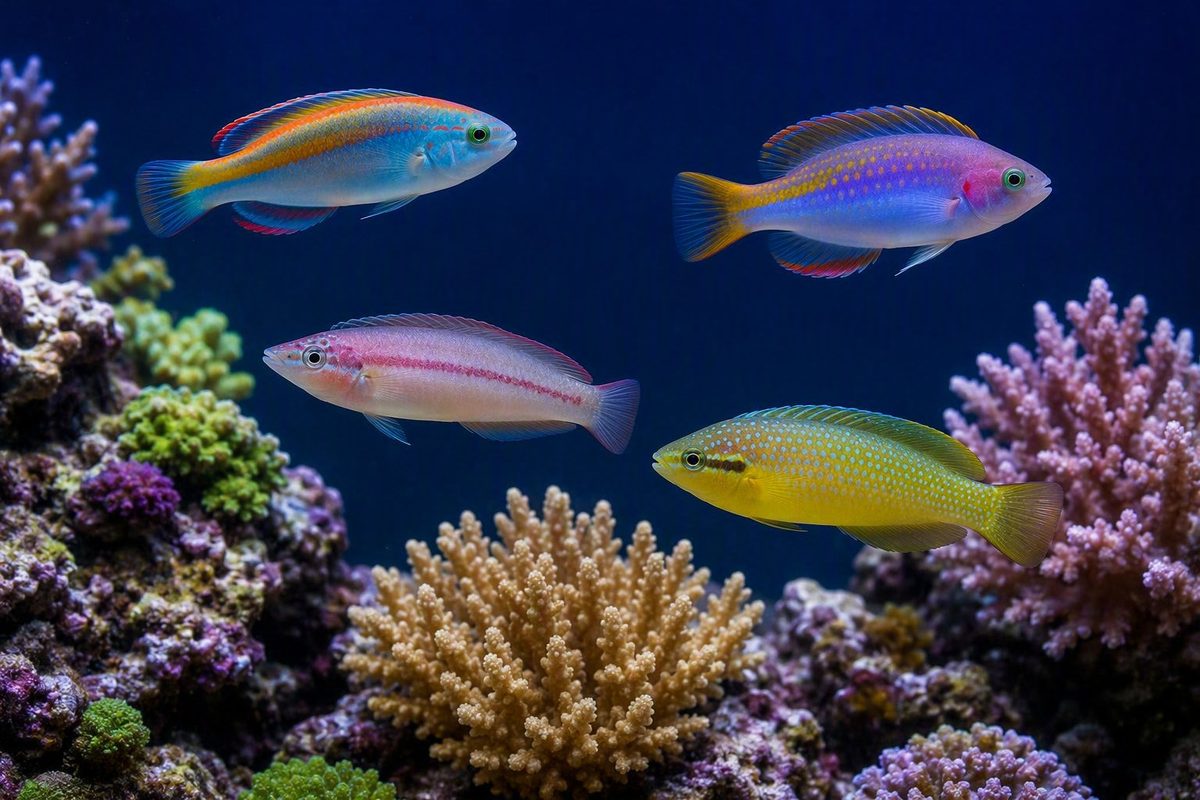
Fairy, flasher, pink-streaked and possum wrasses are lower-risk starting points; check exact species, tank dimensions, sleeping habitat and tankmates.
The best lower-risk starting points for a reef aquarium are appropriately selected fairy wrasses (Cirrhilabrus), flasher wrasses (Paracheilinus), pink-streaked wrasses (Pseudocheilinops ataenia), and possum wrasses (Wetmorella). These are starting points, not blanket approvals: the exact species and individual must fit the aquarium’s dimensions, maturity, sleeping habitat, feeding capacity, invertebrates, and existing fish.
Many Halichoeres wrasses occupy a different category. They are often compatible with coral tissue but more likely to hunt small shrimp, snails, worms, feather dusters, copepods, and other mobile invertebrates. Leopard wrasses can also be reef candidates, but their sand, feeding, acquisition, and maturity requirements make them advanced choices rather than easy substitutes for fairy or flasher wrasses.
The short answer: which wrasses are lower-risk choices?
Start your research with these groups:
- Fairy wrasses: Comparatively low risk to corals and most ornamental invertebrates, but adult size and temperament vary substantially among Cirrhilabrus species.
- Flasher wrasses: Generally peaceful, water-column-feeding candidates with comparatively low coral and mobile-invertebrate risk. They still require suitable swimming room, regular feeding, compatible tankmates, and a secure cover.
- Pink-streaked wrasse: A small, shy, rock-sleeping option for an established reef with intricate retreats, calm fish, suitably small foods, and a sealed lid.
- Possum wrasses: Small, retiring, rock-oriented candidates for peaceful reefs. Their compact size does not make every small aquarium appropriate.
- Selected Halichoeres wrasses: Often compatible with coral tissue but conditionally suitable where shrimp, snails, worms, feather dusters, and other small invertebrates matter.
- Leopard wrasses (Macropharyngodon): Potential reef fish for experienced keepers with suitable sand, mature habitat, careful specimen selection, and dependable feeding.
Commercial husbandry guidance likewise identifies fairy, flasher, pink-streaked, and possum wrasses as comparatively approachable starting points while distinguishing them from coral-compatible Halichoeres hunters that may consume mobile invertebrates (Top Shelf Aquatics’ wrasse care guide).
Treat those genera as research categories rather than final recommendations. Before choosing a fairy or flasher wrasse, confirm the accepted scientific name, expected adult size, likely temperament, feeding behavior, sleeping habitat, and space needs for that species. A genus-level label cannot tell you whether a particular fish fits your aquarium.
Six-line wrasses (Pseudocheilinus hexataenia) and mystery wrasses (Pseudocheilinus ocellatus) show why “reef safe” is incomplete. They may leave coral tissue alone yet become territorial toward peaceful fish, similarly shaped species, or wrasses introduced later.
For species-level contrasts, Reef Directory’s pink-streaked wrasse and yellow coris wrasse guides cover a shy rock sleeper and an active sand-burying invertebrate hunter, respectively.
What “reef safe” must measure
A useful reef-safety assessment separates three risks:
- Coral risk: Is the fish likely to bite or damage coral tissue?
- Mobile-invertebrate risk: Is it likely to hunt shrimp, snails, hermit crabs, worms, feather dusters, copepods, or other small animals?
- Aggression risk: Is it likely to chase, injure, intimidate, or prevent another fish from feeding?
A wrasse can pass the first test and fail the other two. A fish that ignores SPS, LPS, and soft corals may still reduce a pod population, eat exposed worms, investigate a small ornamental shrimp, or harass a peaceful newcomer. “Coral-compatible” is therefore often more accurate than an unqualified “reef safe.”
Evaluate the exact species rather than treating the family Labridae—or even an entire genus—as interchangeable. Wrasses differ in adult size, prey choice, swimming behavior, temperament, sleeping habitat, and care difficulty. Genus-level patterns can screen candidates, but they cannot complete the purchase decision.
Use relative labels rather than promises:
- Lower risk: A reasonable candidate when the exact species fits the aquarium and livestock.
- Conditional risk: Suitable only when the keeper accepts a defined risk, such as predation on small mobile invertebrates.
- Unsuitable for the stated livestock: A poor match because its normal feeding or territorial behavior conflicts with animals the keeper wants to protect.
Practical risk can change with prey size, individual behavior, tankmates, territory, feeding access, and available space. Regular feeding is part of responsible husbandry, but it cannot remove a wrasse’s predatory capacity or guarantee that ornamental invertebrates will be ignored.
Wrasse comparison table: match the fish to the reef
These are qualitative editorial screening labels derived from species and genus-level husbandry guidance, not measured probabilities. “Invert risk” refers primarily to mobile animals rather than coral, and every candidate still requires an exact-species check.
| Candidate | Coral, invert, and aggression screening | Sleeping habitat and relative care | Space considerations |
|---|---|---|---|
| Fairy wrasses (Cirrhilabrus) | Coral: comparatively low. Inverts: comparatively low. Aggression: species-dependent. Fairy wrasses are commonly treated as lower-risk water-column feeders, but the genus is not uniform (reef-safety overview). | Rock sleepers; generally moderate care. Verify food size, temperament, and compatibility. | Often active swimmers. Choose by exact species, adult size, tank length, and open swimming room. |
| Flasher wrasses (Paracheilinus) | Coral: comparatively low. Inverts: comparatively low. Aggression: usually low, with individual and species variation. | Rock sleepers; generally moderate care. Peaceful tankmates, regular feeding, and a sealed lid matter. | Dimensions and swimming room are more useful than one genus-wide gallon figure. |
| Pink-streaked wrasse (Pseudocheilinops ataenia) | Coral: comparatively low. Inverts: low but not zero. Aggression: generally low. | Small, shy rock sleeper requiring intricate retreats, calm fish, small foods, aquarium maturity, and cover. | About 20 gallons or more is Reef Directory’s practical community baseline, not a biological threshold (pink-streaked wrasse guide). |
| Possum wrasses (Wetmorella) | Coral: comparatively low. Inverts: comparatively low. Aggression: generally low. | Shy and rock-oriented; require shelter and reliable access to food. | Small size alone does not validate a very small or crowded aquarium. |
| Yellow coris wrasse (Halichoeres chrysus) | Coral: generally low. Inverts: conditional to meaningful. Aggression: generally mild but variable. | Sand sleeper and active forager; moderate care when habitat and food are suitable. | Plan around adult size, swimming room, sand area, secure rockwork, and tankmates. |
| Other selected Halichoeres | Coral: generally low. Inverts: conditional to high. Aggression: species-dependent. Retailer husbandry guidance describes the group as coral-compatible while warning about predation on small shrimp, snails, and feather dusters. | Normal sand sleepers and active foragers. Relative care and prey risks vary by species. | Many require substantially more room than small, rock-oriented wrasses. |
| Six-line and mystery wrasses (Pseudocheilinus) | Coral: generally low. Inverts: conditional. Aggression: meaningful territoriality risk, especially toward later additions or similar fish. | Rock sleepers; often considered hardy, but hardiness does not equal community compatibility. | Territory, stocking order, visual barriers, and tank dimensions can matter more than nominal volume. |
| Leopard wrasses (Macropharyngodon) | Coral: generally low. Inverts: may consume small live prey. Aggression: generally low but variable. | Sand-burying grazers with advanced acquisition, acclimation, and feeding requirements. Specimen condition and prepared-food acceptance are critical. | Assess habitat maturity, forage, feeding capacity, sand area, tankmates, and dimensions rather than relying on one gallon rule. |
Fairy and flasher wrasses are sensible first groups to investigate when both corals and valued mobile invertebrates matter. Their water-column feeding pattern generally presents a different risk profile from that of active substrate hunters. That does not make every fairy or flasher wrasse suitable for the same tank.
Published minimum volumes are husbandry recommendations, not validated biological thresholds. Tank length, open swimming room, aquascape, stability, feeding capacity, substrate area, and stocking density may be as important as nominal gallons.
Start with the tank: sand bed, maturity, cover, and space
Apply a parameters-first gate before comparing color, price, or pest-eating claims. Postpone the purchase if the aquarium is unstable, biologically immature for the selected fish, unable to sustain its feeding needs, or not completely covered. Trade-association guidance also emphasizes species-appropriate space, stable conditions, suitable substrate for burying species, secure rockwork, and a cover because wrasses may jump (OATA’s wrasse care sheet).
Use this habitat decision path:
- Bare-bottom aquarium: Exclude species that normally bury in sand. Focus research on rock-sleeping candidates such as fairy, flasher, pink-streaked, and possum wrasses.
- Suitable sand bed present: Sand-burying Halichoeres or Macropharyngodon species may be considered after checking the exact fish’s adult size, feeding requirements, and invertebrate risk.
- New or sparsely established aquarium: Avoid specialized grazers that depend heavily on naturally occurring live prey.
- Uncovered aquarium: Install and inspect a secure cover before adding a wrasse.
Cirrhilabrus and Paracheilinus wrasses shelter and sleep in rockwork, while Halichoeres and Macropharyngodon normally bury in sand. Sleeping habitat is a behavioral requirement, not an optional decoration. Sand-moving fish can also undermine insecure structures, so arrange stable rockwork before introduction rather than balancing it loosely on movable substrate.
For H. chrysus, Reef Directory recommends an established aquarium of about 50 gallons or more, an open area with roughly 2–3 inches of fine, soft sand, secure rockwork, swimming space, and a close-fitting lid. These are practical husbandry recommendations for this species, not universal wrasse rules or scientifically validated cutoffs (yellow coris wrasse setup guidance).
Do not transfer that exact sand prescription to every burying wrasse. Published recommendations vary in depth and grain size, and the appropriate arrangement changes with species and fish size. The core requirement is more defensible: a normal sand-burying species needs a suitable, unobstructed substrate area where it can enter without striking rock or coarse material.
Inspect the entire cover rather than only the main lid panel. Check gaps around cables, return lines, overflow boxes, mounting arms, and feeding ports. A nominally covered tank can still contain fish-sized escape routes.
Choose by livestock priority, not by color or pest claims
Match the candidate to what the reef must protect. The categories below are a decision aid based on the risk distinctions in the comparison table, not a guarantee of individual behavior.
| Reef scenario | Start with | Avoid or approach cautiously |
|---|---|---|
| Prized shrimp, snails, or feather dusters | Appropriately sized fairy, flasher, pink-streaked, or possum wrasses | Active Halichoeres hunters and larger predatory wrasses |
| Peaceful community | Pink-streaked, possum, selected flasher, or suitably tempered fairy wrasses | Six-line, mystery, and more assertive larger wrasses |
| Bare-bottom reef | Rock-sleeping species whose remaining requirements are met | Halichoeres, leopard, and other normal sand-burying wrasses |
| Small, established peaceful reef | Pink-streaked wrasse when retreats, food access, stability, and a lid are present | Fish chosen solely because a retailer lists a small minimum volume |
| Some small-invertebrate loss is acceptable | H. chrysus if sand, space, feeding, and cover are suitable | Any purchase based on the assumption that cleanup-crew animals are guaranteed safe |
| Mature system with experienced care | A carefully selected leopard wrasse after habitat and feeding checks | Thin, non-feeding specimens or placement in an immature system |
| Temporary pest problem | Identify the pest and assess targeted responses first | Any wrasse bought solely as an eradication tool |
The pink-streaked wrasse may fit a smaller established aquarium when it has complex rock retreats, calm tankmates, suitably small foods, dependable feeding access, and a sealed lid. A cramped or aggressive community can remain unsuitable regardless of the fish’s compact adult size.
H. chrysus may fit a reef where some predation on small invertebrates is an accepted tradeoff. It is generally treated as coral-compatible, but small shrimp, worms, tiny crustaceans, and other exposed prey may be investigated or consumed.
Do not buy a wrasse solely to solve flatworms, bristleworms, pyramidellid snails, or another temporary problem. Pest consumption is opportunistic and varies by individual.
Consider competition for pods before adding any grazing wrasse. A fish that hunts copepods and other small organisms can reduce live prey available to mandarins or other specialized feeders. An established pod population may supplement a wrasse’s diet, but it is not unlimited or automatically nutritionally complete.
Feeding and buying checks that prevent a poor match
Before paying for a wrasse, verify:
- The scientific name, not only the trade name
- Likely adult size
- Normal feeding behavior and prey
- Current body condition
- Whether the specimen actively takes and swallows suitable food
- Its normal sleeping habitat
- Compatibility with existing shrimp, snails, worms, pods, and fish
- Whether the seller’s identification matches the actual specimen
- Whether your long-term feeding schedule is realistic
- Whether the aquarium has sufficient feeding territory for a shy fish
Wrasses generally need varied, appropriately sized meaty foods. Depending on the species and aquarium, several small meals may be more appropriate than one large feeding. Food size and access are especially important for small or retiring fish housed with fast competitors. Frequent feeding remains husbandry, not an invertebrate-safety guarantee.
Take extra care when buying a leopard wrasse. Observe the fish through a feeding rather than accepting “it eats” as sufficient. Look for a well-filled body and confirm that the specimen repeatedly takes and swallows suitable prepared food. First-person leopard-wrasse guidance places particular emphasis on body condition, prepared-food acceptance, mature habitat, sand access, and multiple small feedings (Manta Systems’ leopard-wrasse guide).
Naturally occurring copepods and other small animals can supplement the diet of grazing species. They should not be treated as a permanent substitute for a sustainable feeding plan, especially where several fish compete for the same prey.
Finally, verify the trade name. “Yellow coris wrasse” usually refers to Halichoeres chrysus, which is not a true Coris species. The name may also be applied to another Halichoeres, so confirm the scientific name before transferring care advice from a listing to the fish in front of you.
Stocking order and aggression: coral-safe does not mean community-safe
When the stocking plan allows, introduce peaceful wrasses before more assertive species. An established territorial fish may treat a later addition as an intruder even when both fish are described as coral-compatible.
Use extra caution with:
- Six-line wrasses
- Mystery wrasses
- Some larger or more assertive Halichoeres
- Any established wrasse defending preferred rockwork or feeding territory
An acclimation box can allow fish to see and respond to one another before direct contact. It is an experience-based introduction tool, not a compatibility guarantee. If an established fish repeatedly charges the box, or the newcomer remains panicked and cannot settle, do not assume release will resolve the conflict.
Brief chasing, displaying, or posturing can occur during introductions. Persistent biting, cornering, visible injury, forced hiding, or preventing another fish from eating indicates a more serious problem. Specialist hobby guidance makes the same distinction between short displays and sustained attacks that suppress normal behavior (The Wrasse Guy’s introduction guidance).
Plan a removal response before adding a territorial fish. Decide which fish would be removed, how it could be caught, and where it could safely go.
Avoid rigid formulas for multi-wrasse communities. Compatibility depends on species, sex, individual behavior, aquarium dimensions, visual barriers, existing territories, and introduction order. A combination that works in one reef may fail in another.
Final pre-purchase scorecard
Answer each question yes or no:
- [ ] Have I confirmed the exact scientific name?
- [ ] Have I researched the fish’s likely adult size?
- [ ] Are the tank dimensions and swimming room suitable?
- [ ] Is the biological filtration established?
- [ ] Are water conditions stable?
- [ ] Is the correct sleeping habitat available?
- [ ] Is the rockwork secure?
- [ ] Is the lid sealed around cables, returns, overflows, and feeding openings?
- [ ] Can I sustain the required feeding plan?
- [ ] Have I assessed risks to shrimp, snails, worms, feather dusters, pods, and other invertebrates?
- [ ] Have I assessed compatibility with every existing fish?
- [ ] Does the stocking order make sense?
- [ ] Do I have a realistic response if aggression develops?
A no on identity, stability, lid security, sleeping habitat, or feeding capacity means postponing the purchase. These are foundational requirements rather than problems to solve after the fish comes home.
The best wrasse is one that remains suitable after the target pest disappears—or if the fish never eats that pest. Compare the pink-streaked wrasse and yellow coris wrasse species guides for two useful examples of how a small rock sleeper and a sand-burying invertebrate hunter require different decisions. The label “reef safe” is only the beginning; the exact species and the reef it will enter determine the practical answer.
Are wrasses safe with cleaner shrimp and snails?
Some wrasses are lower risk than others, but none is guaranteed safe with every cleaner shrimp or snail. Appropriately selected fairy, flasher, pink-streaked, and possum wrasses are generally better starting points when ornamental invertebrates are a priority. Many Halichoeres wrasses may leave coral tissue alone while hunting small shrimp, snails, worms, and tiny crustaceans; risk varies with the exact wrasse, individual behavior, and prey size (species-level reef-safety guidance).
Do all reef-safe wrasses need a sand bed?
No. Fairy wrasses, flasher wrasses, pink-streaked wrasses, and possum wrasses generally sleep or shelter in rockwork, so they can be considered for bare-bottom systems when their other requirements are met.
Halichoeres and leopard wrasses normally bury in sand to sleep or seek refuge. A bare-bottom aquarium does not provide that normal sleeping habitat (OATA’s wrasse care guidance).
Is a six-line wrasse reef safe?
A six-line wrasse is commonly treated as compatible with coral tissue, but that does not make it suitable for every community. It may prey on some small invertebrates and can become territorial toward peaceful, similarly shaped, or later-added fish (six-line wrasse comparison guidance).
Treat it as a low coral-risk but conditional community choice. Consider existing wrasses, stocking order, available territory, and how the fish could be removed if persistent aggression develops.
Why are leopard wrasses considered difficult to keep?
Leopard wrasses combine several demanding requirements: they normally bury in sand, graze on small live prey, may arrive stressed or in poor condition, and do not always accept prepared foods reliably. A mature aquarium can provide supplemental forage, but it does not remove the need to confirm that the individual fish is feeding adequately.
Before purchase, inspect body condition and watch the fish actively swallow suitable food. Suitable sand, stable mature habitat, calm tankmates, a secure lid, and a dependable feeding plan all matter. These acquisition and feeding challenges are why leopard wrasses are generally treated as advanced rather than routine reef additions (leopard wrasse care guide).