
Mastering Flame Angelfish Care: Setup, Feeding, and Reef Success Strategies
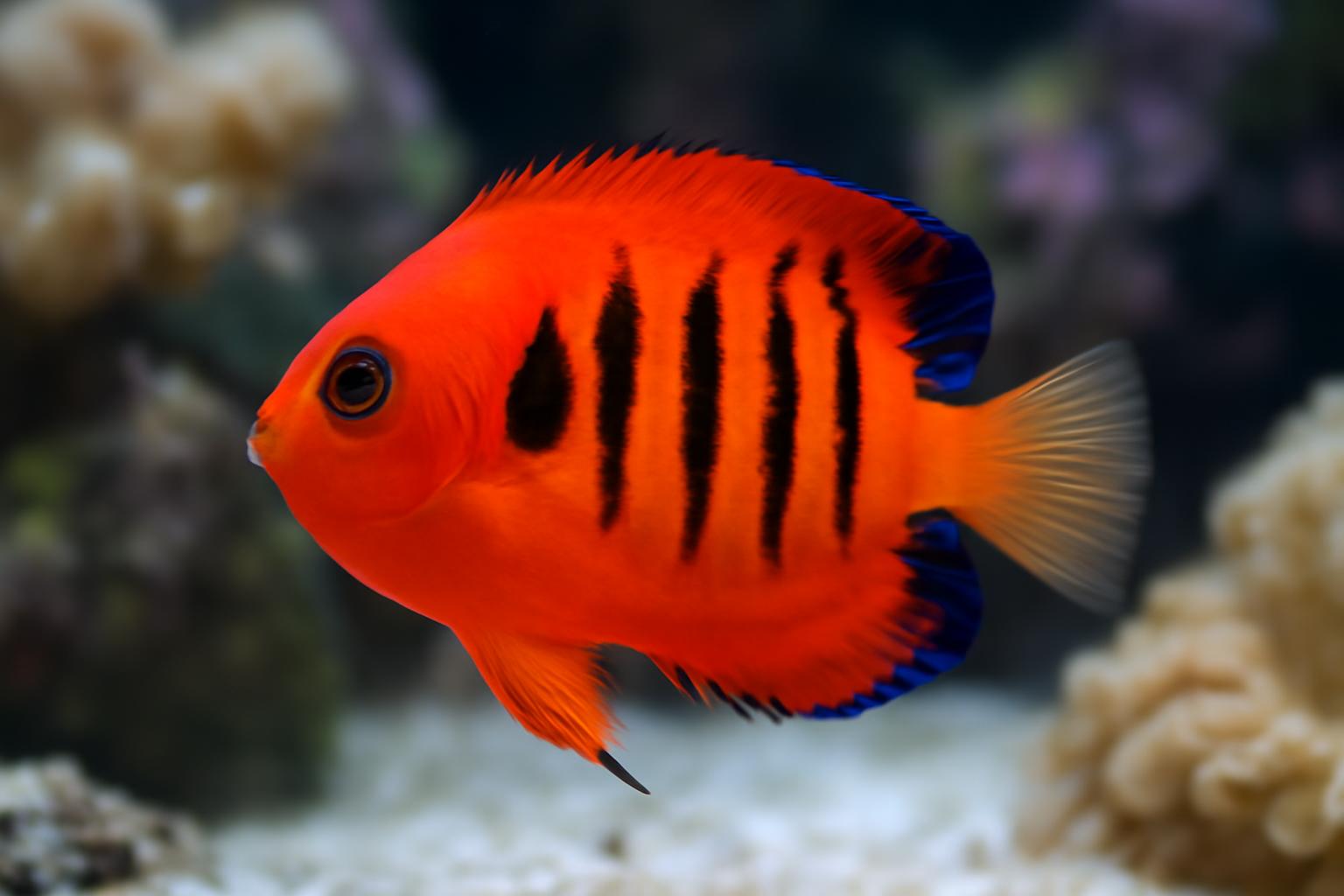
Pairs or harems need roughly 100 to 120 gallons or more, with a 4-foot footprint favored over a short, compact aquarium layout.
The flame angelfish is one of those saltwater fish that can still make an experienced reefer stop and stare. Its color is almost unreal, its movement is constant, and its attitude is bigger than its body. That appeal is exactly why so many hobbyists want one, and exactly why so many tanks are not actually ready for one.
A good flame angelfish care guide has to be honest about both sides. Centropyge loricula is not a giant fish, but it is active, territorial, and unpredictable enough that short retailer care cards usually leave out the real challenge. The question is not whether a flame angel can stay alive in captivity. The question is whether it can settle in, feed hard, hold body condition, coexist with tankmates, and avoid turning into a coral problem in the particular reef or FOWLR system you are building.
For most intermediate keepers, success comes from planning around behavior rather than shopping by the smallest number on a listing. A mature tank, abundant rock, stable reef conditions, repeated small feedings, and realistic expectations give you the best odds. If you want certainty, this is not the fish. If you can tolerate some risk and manage the details well, it can be one of the most rewarding dwarf angels in the hobby.
Species Overview and Identification
The flame angelfish, Centropyge loricula, is a dwarf angelfish with a vivid red-orange body, dark vertical bars, and blue edging along the fins. Trade descriptions also note regional color variation, with specimens commonly associated with the Marshall, Line, and Cook Islands and less frequent occurrence in Hawaii. Wild fish may reach about 6 inches, but captive adults are more often reported around 4 to 4.5 inches, and males are often described as slightly larger and brighter than females (Saltwater Aquarium Blog).
That biology helps explain the fish’s aquarium behavior. In the wild, flame angels are described from Indo-Pacific outer reef fringes, often around branching coral structure such as Acropora, where they occur in harems of one male with several females. They are also protogynous hermaphrodites, meaning a female can transition to male under the right social conditions.
Those are not just interesting trivia points. They help explain why a flame angel behaves less like a passive display fish and more like a compact, constantly moving grazer with a strong sense of territory. It wants routes through the rockwork, shaded retreats, and surfaces to inspect between feedings. A new arrival may hide for days and then become bold almost overnight, or it may arrive in great color and still struggle if shipping stress, food competition, or an immature tank work against it.
That is why the species gets described in ways that sound contradictory at first: moderately hardy and touchy. Both can be true. A settled fish in a mature, stable system can do very well. A freshly imported fish in its first weeks is much less forgiving.
Tank Size and Aquascape Essentials
For long-term care, the practical minimum for a single flame angelfish lands in the 55- to 70-gallon range, with 55 gallons functioning as the lower practical floor and 70 gallons as the more conservative species-specific recommendation. A 4-foot footprint is repeatedly favored over a short, compact layout, and pairs or harems are pushed into roughly 100- to 120-gallon territory or larger (Saltwater Aquarium Blog; LiveAquaria).
In practice, the footprint matters as much as the volume. This is a patrol fish. It does not just hover in one cave and wait for food. A longer aquarium gives it room to move without turning every pass into a territorial lap.
Rockwork is not decoration for this species. It is shelter, grazing surface, and territory map at the same time. Published care notes consistently call for abundant live rock, moderate to high flow, and a tight or netted lid because flame angels browse the rock constantly, use it for cover, and can jump if startled (Reef Chasers).
A good flame angel layout should therefore do three things at once. First, it should provide mature grazing surfaces rather than sterile, newly stacked rock. Second, it should include caves, overhangs, and broken sightlines so the fish can disappear when stressed or back out of a conflict. Third, it should preserve open water lanes in front of or between structures so the fish can travel normally instead of pinballing through a cramped wall of stone.
Tank maturity matters more than many buyers expect. These fish tend to reward patience. If the system is only barely ready for fish, it is usually too early for this one.
Optimal Water Parameters
Flame angelfish do not require exotic chemistry, but they do require stable marine chemistry. Published care guidance clusters around roughly 72 to 80°F, pH 8.1 to 8.4, specific gravity 1.020 to 1.025, and alkalinity 8 to 12 dKH (LiveAquaria; FishLore).
Ammonia and nitrite should remain at 0, and nitrate is generally described as best kept very low for this species (Frank Baensch).
The simplest operating rule is to keep the fish inside normal reef standards and avoid swings. For a species that often arrives with shipping stress already in play, consistency usually matters more than trying to chase the outer edge of an acceptable range. Stable salinity, stable temperature, predictable alkalinity, and mature nutrient handling do more for a flame angel than constant small adjustments.
This is also a fish that may reflect water-quality or system-stability problems through behavior before it shows obvious physical decline. Those signs do not always mean chemistry is wrong, but they are good reasons to check the basics before dismissing the behavior as personality.
Diet and Feeding Schedule
Flame angelfish are omnivores. In nature they feed on algae and small invertebrates, and captive diets are most successful when they reflect that mix. Commonly recommended foods include nori, Spirulina-based foods, mysis, frozen shrimp, and angelfish formulas that include sponge material (LiveAquaria).
Feeding pattern matters almost as much as food type.
A practical menu for most systems includes marine algae, Spirulina foods, mysis shrimp, chopped frozen marine blends, and a quality angelfish preparation if the individual accepts it. Pellets and flakes can be useful parts of the rotation, but they are a weak plan if they become the whole diet.
Frequent feeding can improve your odds in a reef, but it does not create a reef-safe guarantee. Some flame angels ignore corals for years. Some keep returning to the same coral even when they are clearly well fed. Feeding is risk management, not a personality override.
If possible, ask a vendor to hold the fish before pickup and confirm that it is eating consistently. That extra patience is often more valuable than buying the brightest fish the day it lands.
Behavior, Temperament, and Tankmates
Flame angelfish are best treated as semi-aggressive, territorial fish with strong individual variation. Specialist captive-care guidance notes that flame angels can be hostile to tankmates and especially to their own kind, and that passive fish should generally be established first if a flame angel will join a community later (Frank Baensch).
The safest stocking rule is still the conservative one: keep one per tank and add it late. When a flame angel gets first claim to all of the rockwork, later arrivals may be treated as intruders.
Multiple dwarf angels are where many otherwise decent plans go wrong. Guidance aimed at Centropyge angels repeatedly pushes pairs or multiples into 100-plus-gallon systems with more complex rockwork, and even then success depends heavily on introduction order and individual temperament. The species can sometimes be kept in pairs or small harems by experienced keepers, but that is not the baseline recommendation for a standard mixed reef.
In a community setting, dissimilar fish usually make better companions than similar-shaped grazers or other dwarf angels. The goal is not to find tankmates that are weaker than the angel. The goal is to avoid fish that either trigger territorial rivalry or keep the flame angel from feeding with confidence. A fish that spends every meal hanging back can decline even in a tank that looks peaceful at a glance.
Watch the actual behavior rather than trusting a compatibility list. If you are comparing peaceful wrasse options for a community around a flame angel, our pink-streaked wrasse guide and yellow coris wrasse guide cover two very different reef-tank profiles.
Reef Compatibility and Nipping Risks
The honest answer is that flame angelfish are reef safe with caution, not reef safe in any absolute sense. Dwarf-angelfish guidance repeatedly places the species in the hit-or-miss category, with the highest concern around fleshy LPS corals, zoanthids, and clam mantles, while SPS systems often report better odds rather than certainty (Top Shelf Aquatics).
No setup can remove that uncertainty entirely. What a mature tank can do is reduce some of the obvious pressure points. Dense live rock, natural grazing surfaces, and repeated algae-based feedings are all commonly recommended because hunger, sparse browsing opportunity, stress, and individual temperament are recurring themes in whether a flame angel settles in quietly or becomes a chronic sampler (Top Shelf Aquatics).
A useful reef-keeper mindset is not, “How do I guarantee this fish never nips?” It is, “How quickly will I recognize a pattern, and am I prepared to act?” A single investigative peck is not the same thing as a real problem. Flame angels are much easier to manage when you respond to a pattern than when you wait until damage is obvious.
This is why the species often makes especially clean sense in a FOWLR display. You still get the color, the constant browsing, and the attitude, but you remove the question of whether your favorite coral colony eventually lands on the menu. Some care guides explicitly frame the species as a better fit for FOWLR than for keepers who need absolute coral security (LiveAquaria).
Quarantine, Health, and Hardiness
Flame angelfish are often described as moderately hardy once acclimated, but the hardest part of ownership is still the stretch from arrival through the first month. The evidence here supports a real quarantine period, with published guidance ranging from about 2 to 3 weeks up to 4 to 6 weeks depending on the keeper’s protocol (Frank Baensch; Top Shelf Aquatics).
A practical workflow is straightforward. Start with specimen selection. Choose an alert fish with normal posture and respiration, intact fins and skin, and a clear feeding response if you can observe one. Then quarantine in a calm, stable system rather than rushing the fish into a competitive display. Because flame angels are repeatedly noted as poor shippers and frequent post-import problem fish, asking a store to hold one for a short period before pickup is often worth it (FishLore).
During quarantine and the first weeks after transfer, focus on outcomes you can actually observe: steady feeding, regular browsing, normal respiration, stable coloration, and body weight that is holding or improving. If the fish hides constantly, backs off food, or never competes successfully in the display, that is not something to shrug off.
Once established, captive lifespan is commonly cited around 5 to 7 years, with longer survival possible in especially stable systems (FishLore).
Medical caution matters with this species. Post-import risks mentioned in the care literature include ich, velvet, and bacterial problems, and dwarf angels are repeatedly described as copper-sensitive, with explicit warnings to avoid exposure near or above 0.15 ppm during quarantine (Saltwater Aquarium Blog; Reef Chasers). The takeaway is not that disease should be ignored. It is that treatment planning should be deliberate and species-aware rather than automatic.
Breeding and Advanced Topics
Breeding flame angelfish in captivity is possible in theory and difficult in practice. Their reproductive biology is not beginner-friendly: they are protogynous hermaphrodites, social structure matters, and they are pelagic spawners rather than simple nest builders (LiveAquaria).
That means the real bottleneck is not just getting compatible fish together. It is larval rearing. Even when a pair or harem forms, this is not a typical home-aquarium breeding project.
The same caution applies to keeping pairs or harems in ordinary home tanks. The wild social structure makes the idea attractive, but the aquarium version becomes credible only in large, complex systems with extensive rockwork and a keeper ready to intervene if the social balance collapses. This is advanced husbandry, not an efficient shortcut to a more “natural” setup.
Captive-bred flame angels remain relatively uncommon, but they are attractive when available because captive-bred dwarf angels are often described as adapting better to aquarium foods and general captive conditions than wild-caught fish (Top Shelf Aquatics).
For most advanced hobbyists, the better stretch goal is not breeding. It is getting the fish to display normal, confident behavior for years: steady browsing, aggressive feeding, full body condition, manageable interaction with tankmates, and no escalating coral problem. If you can do that consistently, you have already solved the hard part of flame angelfish care.
FAQ
What is the best minimum tank size for flame angelfish?
If you want the simplest conservative answer, use 70 gallons as the floor. Broader husbandry guidance places the lower practical range around 55 gallons for a single fish, but species-specific care references repeatedly land at 70 gallons and favor a longer footprint over a compact tank (LiveAquaria; Saltwater Aquarium Blog).
How can I minimize coral nipping from flame angelfish?
You cannot guarantee prevention, but you can improve your odds with a mature tank, abundant live rock, and repeated algae-based feeding. The recurring pattern in the care guidance is that hunger, stress, sparse grazing surface, and individual temperament all matter, which is why a well-fed fish in a mature reef may still nip while another never does (Top Shelf Aquatics).
Is copper safe for treating flame angelfish diseases?
Use extra caution. Flame angels and other dwarf angels are repeatedly described as copper-sensitive, with specific warnings against exposure near or above 0.15 ppm in quarantine (Reef Chasers; Saltwater Aquarium Blog).
What are safe tankmates for flame angelfish?
The safest choices are usually dissimilar community fish that do not trigger angelfish rivalry and do not keep the flame angel from feeding confidently. Other dwarf angels are the riskiest category, and stocking order matters enough that a fish added late to an established community often behaves better than one allowed to claim the whole tank first (Frank Baensch).
How long do flame angelfish live in aquariums?
A healthy, well-acclimated flame angelfish is commonly cited at about 5 to 7 years in captivity, with longevity tied closely to how well it came through collection, shipping, acclimation, and long-term system stability (FishLore).
Success with this fish comes down to discipline more than luck. Give it a mature tank, stable parameters, abundant rock, repeated small feedings, and a quarantine plan that respects its vulnerabilities. Then stay honest about the one variable you cannot engineer away: individual temperament. One flame angel may become a model citizen. Another may decide your favorite coral is worth sampling every day. Both outcomes fit the species, and planning for that reality is what turns this from a risky impulse buy into a genuinely rewarding long-term fish.