
Everything You Need to Successfully Keep Vibrant Crystal Red Shrimp
A 10% to 20% weekly change is one practical range, but matching new water to the tank's GH, TDS, pH and temperature matters more than the percentage.
Crystal Red Shrimp are one of the prettiest ways to move beyond hardier beginner shrimp, but they also expose a lesson that many freshwater keepers only learn once they try sensitive Caridina: “acceptable” water is not the same thing as repeatably stable water.
If you already keep Cherry Shrimp successfully, moving into crystal shrimp is less about buying rarer livestock and more about changing your whole operating style. These shrimp reward softer water, very low KH, calm flow, mature surfaces full of edible biofilm, and water changes that match the tank instead of “refreshing” it by force.
That also means this is a hobby-consensus topic more than a lab-standardized one. Most practical guidance comes from specialist sellers, commercial care pages, comparison posts, and hobby troubleshooting threads rather than formal husbandry studies. The safest way to use any number in this guide is as a working range supported by repeated hobby use, not as a single magic target to chase every weekend.
Related: Horned Nerite Snail Care: Tank Setup, Water Parameters, Diet & Compatibility.
What Are Crystal Red Shrimp?
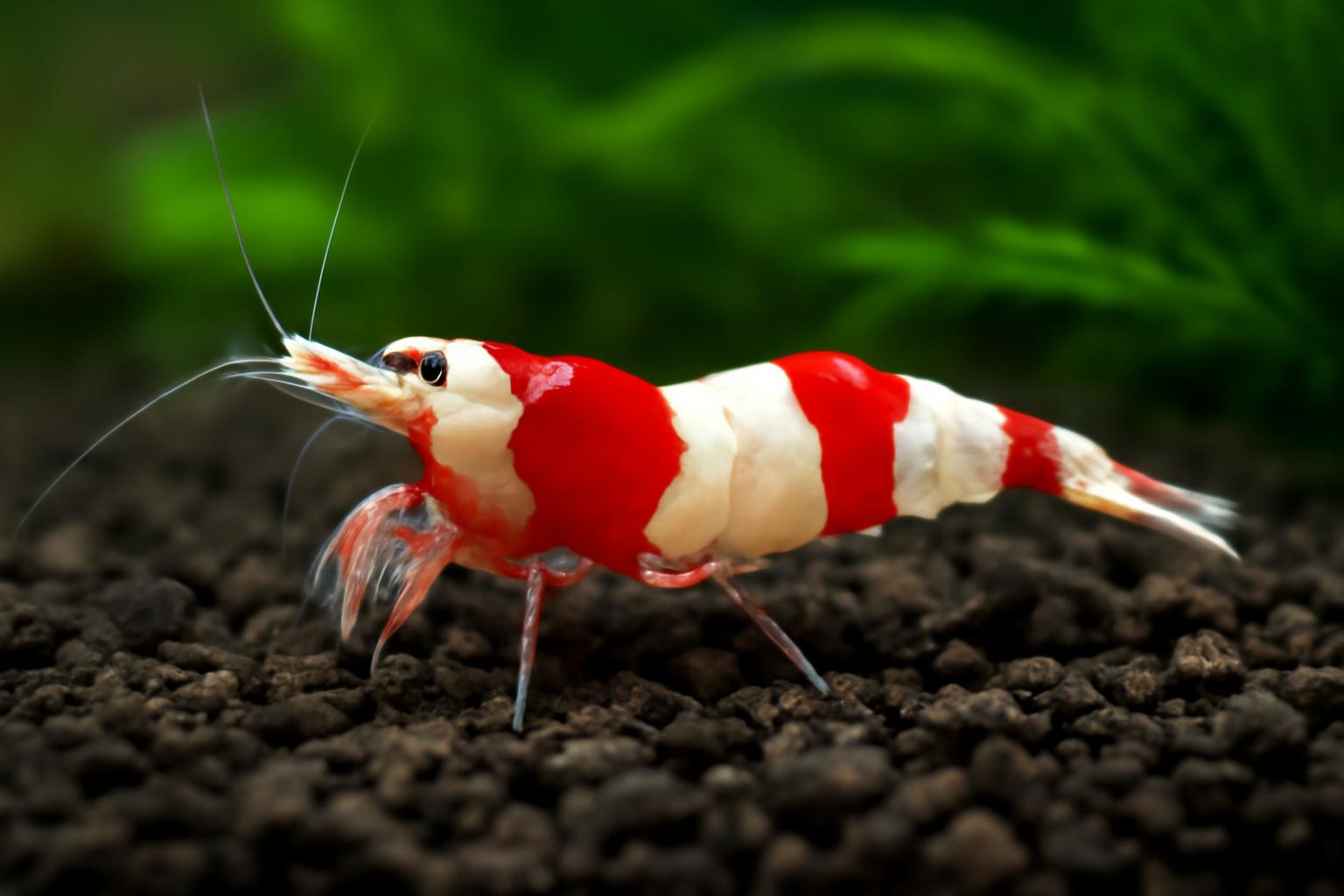
Crystal Red Shrimp are a selectively bred freshwater Caridina line, usually sold in the hobby as Caridina cantonensis or Caridina cf. cantonensis. Hobby care pages broadly trace the red-and-white form to selective breeding in Asia during the 1990s, commonly crediting Japanese breeder Hisayasu Suzuki and stock tied to Crystal Black or bee shrimp lines before the strain spread through the wider hobby in Japan and Taiwan (Shrimpy Business).
In aquarium terms, they are small dwarf shrimp, but not insignificant once mature. One specialist seller lists adults at about 0.75 to 1.25 inches with a lifespan around 1 to 2 years in stable conditions, and describes them as intermediate rather than beginner shrimp because they prefer soft, acidic water and react poorly to sloppy swings in chemistry (The Shrimp Farm).
What you buy is often smaller and plainer than the adults shown in display photos.
They are also constant grazers. Crystal Reds spend much of the day picking at algae films, biofilm, soft detritus, and microscopic foods on hardscape, plants, and substrate. That matters because a mature shrimp tank does not merely hold food; it produces food between feedings.
This is the first major mindset shift from Neocaridina keeping. With Crystal Reds, success usually comes from building a calm, mature, boringly predictable tank and then leaving it alone more than your instincts initially want to.
Crystal Shrimp Grading System
The familiar hobby ladder runs from C through B, A, S, SS, and SSS, with lower grades generally showing more red and less dense white, while higher grades emphasize heavier white coverage, cleaner separation, and more opaque coloration (Shrimpy Business).
When hobbyists talk about “quality,” they are usually looking at a few visual traits:
- how opaque the white looks
- how cleanly the red and white areas separate
- how balanced the pattern appears from side to side
- how strong the shrimp looks from the side view, not just in a top-down photo
For most keepers, the practical importance of grading is economic, not biological. Higher grades cost more, so they make early mistakes more expensive without removing the husbandry challenge. If you are new to Caridina, lower or mixed grades are often the smarter start because you learn the same lessons about water chemistry and stability while risking less money.
It is also worth separating market value from care value. Forum discussions sometimes treat more heavily selected grades as less forgiving, but that is hobby opinion rather than a formal grading rule, so it is safest to treat grading primarily as a visual and pricing system rather than a care score.
Optimal Water Parameters for Crystal Shrimp
Across hobby guides, the overlap is clear: Crystal Red Shrimp are typically kept in soft, acidic, low-KH water, with many sellers clustering around pH 6.0 to 6.8, GH 4 to 6, KH 0 to 1, TDS about 120 to 150, and temperatures around 68 to 78°F (SoShrimp).
Many Caridina-focused keepers tighten that operating zone further by starting with remineralized RO water or by using an active buffering substrate to hold the tank softer and more acidic. A comparison guide aimed at shrimp keepers gives Crystal Reds at pH 5.8 to 6.8, GH 4 to 6, KH 0 to 2, and 22 to 24°C, and specifically recommends remineralized RO water or buffering substrate as the practical path to those conditions (Gensou Aquascaping).
The important distinction is that there is a difference between a broad keeping range and a narrower breeding-optimized range. A shrimp may survive at the outer edge of what hobby guides list, especially in an otherwise stable tank. Breeding colonies are usually run softer, lower in KH, and more tightly controlled than a simple survival setup.
For most hobbyists, the two reliable approaches are straightforward:
- start with RO or RO/DI water and remineralize for Caridina use
- or start with suitably low-mineral source water and let an active shrimp substrate help buffer the tank downward
Either way, the logic is the same. Keep KH low, provide enough GH for normal molts, and make sure new water is close to the tank water before it goes in.
That last point matters as much as the headline numbers. In practice, keepers often get into trouble not because one number is catastrophic by itself, but because several “small” shifts arrive together on change day.
Temperature deserves the same respect. With Caridina, repeated swings are often more dangerous than an imperfect but steady reading.
Tank Setup and Equipment Essentials
A true nano tank can work, but most practical care guidance treats 5 gallons as the hard lower edge and 10 gallons as the more forgiving starting point. The same care guidance recommends a shrimp-focused setup with sponge filtration, plants, and few or no risky tankmates; snails are commonly treated as the low-drama companion choice if you want anything else in the tank at all (The Shrimp Farm care article).
The best crystal shrimp tanks are usually simple rather than gadget-heavy. Sponge filters, textured hardscape, mosses, fine-rooted plants, leaf litter, and porous surfaces all help because they increase grazing area and give juveniles places to disappear. A tank can look clean and attractive to you while still being biologically poor from a shrimp’s point of view, so think less about open display space and more about edible surface area.
An active shrimp substrate is commonly used because it supports the chemistry these Caridina prefer, but it is still a support tool, not a shortcut. If the tank is immature, if the replacement water is poorly matched, or if the system is being pushed around by aggressive maintenance, the substrate will not rescue the colony by itself.
Low flow matters more than many fish keepers expect. In one hobby troubleshooting thread, repeated Crystal Red losses followed a move into a larger setup that may not have been fully cycled, combined with a 530 GPH propeller and 30% weekly water changes; experienced responders pushed the keeper toward actual parameter testing, smaller water changes, and less flow, after which later shrimp were reportedly surviving better (Shrimp Keepers Forum).
That thread is anecdotal, but the lesson fits the broader consensus well: fully cycle the tank, keep ammonia and nitrite out of the system, avoid blasting the colony with circulation meant for fish, and prioritize biological maturity over extra equipment.
Diet and Feeding Routine
Crystal shrimp are easiest to feed when you stop treating them like tiny fish. They are grazers first. The tank should already be providing algae films, biofilm, and other microscopic foods throughout the day, especially in a planted setup with wood, moss, and textured surfaces.
Supplemental foods still matter, just not in huge quantities. Commonly listed options include shrimp pellets, algae wafers, blanched vegetables, and specialized shrimp foods.
A useful feeding routine usually looks like this:
- feed lightly enough that food disappears quickly
- rotate foods instead of relying on one pellet forever
- remove leftovers before they sit long enough to foul the tank
- watch the colony’s behavior instead of feeding by habit alone
If shrimp rush food immediately, that is normal.
Overfeeding creates more problems than underfeeding in many shrimp tanks. One long-form hobby account linked heavy feeding in another tank to hydra trouble and advised caution around copper exposure in shrimp systems; that same account described Crystal Reds as fairly manageable to keep alive, but pickier to breed well over time (Krystof.IO).
The broad rule is simple: build the tank so the shrimp can graze all day, then use prepared foods as support rather than as the whole diet.
Breeding Crystal Red Shrimp
Crystal Red Shrimp breed in freshwater. Under stable conditions, hobby care guidance commonly places sexual maturity at roughly 70 days, with females carrying eggs for about 30 days before releasing miniature shrimp rather than free-swimming larvae (The Shrimp Farm care article).
That has two practical consequences. First, you do not need a separate brackish or saltwater larval stage. Second, fry care is mostly about tank design rather than rescue feeding. In a mature shrimp tank, shrimplets eat the same sort of microscopic surface foods that the adults graze.
This is why moss, leaf litter, fine roots, rough wood, and gentle filtration matter so much. Tiny shrimp need constant access to edible surfaces and low-stress hiding zones.
Stable parameters matter more for breeding than for simple survival. Many keepers can keep Crystal Reds alive in conditions that are merely acceptable.
Soft acidic water is the common recommendation, but hobby reports also show an important nuance: survival and even some breeding can happen in harder source water when buffering substrates and careful maintenance are doing part of the work. The catch is that breeding often becomes less reliable over time in those setups, which is very different from saying the setup is ideal.
If adults are surviving but breeding stalls, the most useful questions are usually the boring ones:
- Is the tank actually stable from week to week?
- Is the substrate still doing what it used to do?
- Does the tank have enough mature biofilm for shrimplets?
- Are change water and tank water drifting farther apart than you think?
- Has temperature become less stable than it was when the colony was more productive?
Common Issues and Troubleshooting
When Crystal Reds decline, the cause is often cumulative rather than dramatic. The recurring hobby pattern is some combination of parameter instability, oversized water changes, excessive flow, immature tanks, or maintenance that is technically clean but poorly matched to the colony’s preferred chemistry. The forum case above is useful precisely because nothing in it looked outrageous to a general aquarist: bigger tank, stronger circulation, large regular changes, more hardware. For Crystal Reds, those “improvements” can move the system in the wrong direction (Shrimp Keepers Forum).
That leads to the first troubleshooting rule: stop changing five things at once. Test the water, compare the display tank to the replacement water, reduce turbulence, and simplify maintenance before you start guessing about disease.
Common failure points include:
- a tank that is not fully cycled or is biologically too young
- pH, GH, KH, TDS, or temperature shifts during water changes
- flow that is too strong for newly acclimated adults and shrimplets
- overfeeding that drives waste buildup or pest outbreaks
- additives or medications that are not shrimp-safe
- a planted tank that still is not mature enough to provide steady grazing
Copper deserves special attention because shrimp keepers flag it so often. If a medication, fertilizer, or additive is not clearly suitable for invertebrates, treat it with suspicion until you verify it.
Molting trouble is another warning sign.
Acclimation matters as well. Crystal Reds are one of those animals where the shortcut at the beginning can create the problem you spend the next month trying to diagnose.
If losses start and you need a simple order of operations, work through this sequence:
- Confirm the tank is actually cycled and not merely clear.
- Measure pH, GH, KH, TDS, and temperature.
- Compare replacement water to tank water before the next change.
- Reduce flow and avoid large “corrective” water changes.
- Review every food, fertilizer, treatment, and additive for shrimp risk.
- Ask whether the tank is mature enough to feed a colony between scheduled meals.
Most Crystal Red problems become easier to interpret once tank age, maintenance history, and new-water chemistry are written down side by side.
Crystal Shrimp vs. Cherry Shrimp
The shortest honest comparison is this: Cherry Shrimp tolerate the kind of inconsistency that Crystal Reds often punish.
In hobby practice, Cherry Shrimp are kept in a much broader water window, while Crystal Reds are run softer and more acidic. One comparison guide gives Cherries at roughly pH 6.5 to 8.0, GH 4 to 14, KH 2 to 10, and Crystal Reds at roughly pH 5.8 to 6.8, GH 4 to 6, KH 0 to 2, with Crystal Reds framed as the more advanced, chemistry-sensitive option (Gensou Aquascaping).
That water difference is the real dividing line. Cherry Shrimp usually fit the average planted-tank routine more easily. Crystal Reds make more sense when you actually want the Caridina process: softer water, matched maintenance, buffering substrate, slower stocking, and a tank designed around shrimp from the beginning.
The price gap tends to follow the difficulty gap, but it should be treated as illustrative rather than universal. The same Singapore comparison lists Cherry Shrimp around the low single digits per shrimp depending on grade and Crystal Reds from low-grade pricing up into premium high-grade territory, which is a useful reminder that mistakes with Crystal Reds often cost more twice: once in sensitivity and again in purchase price.
That does not make Cherry Shrimp inferior. In many homes, they are simply the smarter match because they fit the water and maintenance style already available. If your tap water is hard, your room runs warm, and you do not want to build a remineralized-water routine, Cherries are usually the easier answer.
It also means the two are a poor one-tank match. A mixed colony forces one side or the other away from its preferred conditions, which defeats the point of choosing a species because it suits your water.
So if you are coming from Cherry Shrimp, the right question is not, “Can I keep more expensive shrimp?” It is, “Am I ready to run a more exact system?”
The most reliable path is still the least glamorous one: start with a cycled planted nano tank, buy a realistic grade, keep the water soft and steady, feed lightly, and resist the urge to keep “improving” a tank that is already working.
What is the minimum tank size for Crystal Shrimp?
If you want the safer short answer, start at 10 gallons. One marketplace listing for Crystal Reds specifies a 10-gallon tank, and that lines up with the wider hobby preference for a little more water volume and a little more stability (Amazon listing).
Experienced keepers do run them in 5-gallon systems, but smaller tanks leave less room for error. With Crystal Reds, extra water volume is not about swimming space so much as chemistry stability.
Are Crystal Shrimp suitable for beginners?
Usually not as a first shrimp. They are better thought of as a first Caridina once you already know how to cycle tanks, test GH and KH, watch TDS, and avoid shocking livestock with poorly matched maintenance.
A careful beginner can still succeed if the entire tank is built around Crystal Reds from the start. But that is different from calling them beginner-friendly. Cherry Shrimp remain the easier starting point for most people because they tolerate a much broader range of ordinary planted-tank conditions.
Where can I buy Crystal Red Shrimp and what about guarantees?
Specialist shrimp vendors are usually the best starting point because they tend to publish the details that matter: collection pages by variety, policy pages, shipping information, and some explanation of quarantine or hold practices. As one example, Flip Aquatics’ crystal shrimp collection links directly to quarantine, shipping, return, and live-arrival policy pages from the collection itself (Flip Aquatics).
The important buying habits are practical ones. Read the care parameters before ordering. Check whether the seller explains shipping size, arrival-claim rules, and weather limitations. Buy only when you can receive the box promptly and acclimate the shrimp without delay.
Good policy language is not all identical, so actually read it. A “guarantee” may mean a short live-arrival window, a platform refund structure, store credit, or replacement terms with photo requirements. The red flags are usually ordinary but telling: no clear parameter guidance, no shipping-size disclosure, no visible policy terms, and no weather caution for live animals.
Can Crystal Shrimp live in hard tap water?
Sometimes they can survive in it, especially if the tank uses a pH-lowering buffering substrate, but survival and reliable breeding are not the same thing. In one personal long-term account, Crystal Reds were kept in small tanks with hard tap water plus buffering substrates and initially lived and bred, but breeding later became pickier and reportedly improved after substrate and wood refreshes (Krystof.IO).
So the honest answer is: possible in some setups, yes; recommended as the default, no. If your water is hard and you do not want to manage remineralization or buffering carefully, Cherry Shrimp are usually the easier fit.
How often should I change water for Crystal Shrimp?
Think “small and matched,” not “large and clean.” One seller care sheet recommends regular 10% to 20% weekly changes, and the practical point is less the exact percentage than the need to keep replacement water close to the tank in GH, TDS, pH, and temperature (SoShrimp).
The exact schedule depends on stocking, evaporation, and how mature the tank is. But in Crystal Red tanks, a modest well-matched change is usually safer than a big reset that swings several parameters at once.