
Create a Natural Blackwater Aquarium: Tannins, Plants, Fish and Proven Care Steps
Most hobby guidance points toward RO/DI or distilled water as a far more controllable base when tap water is strongly buffered.
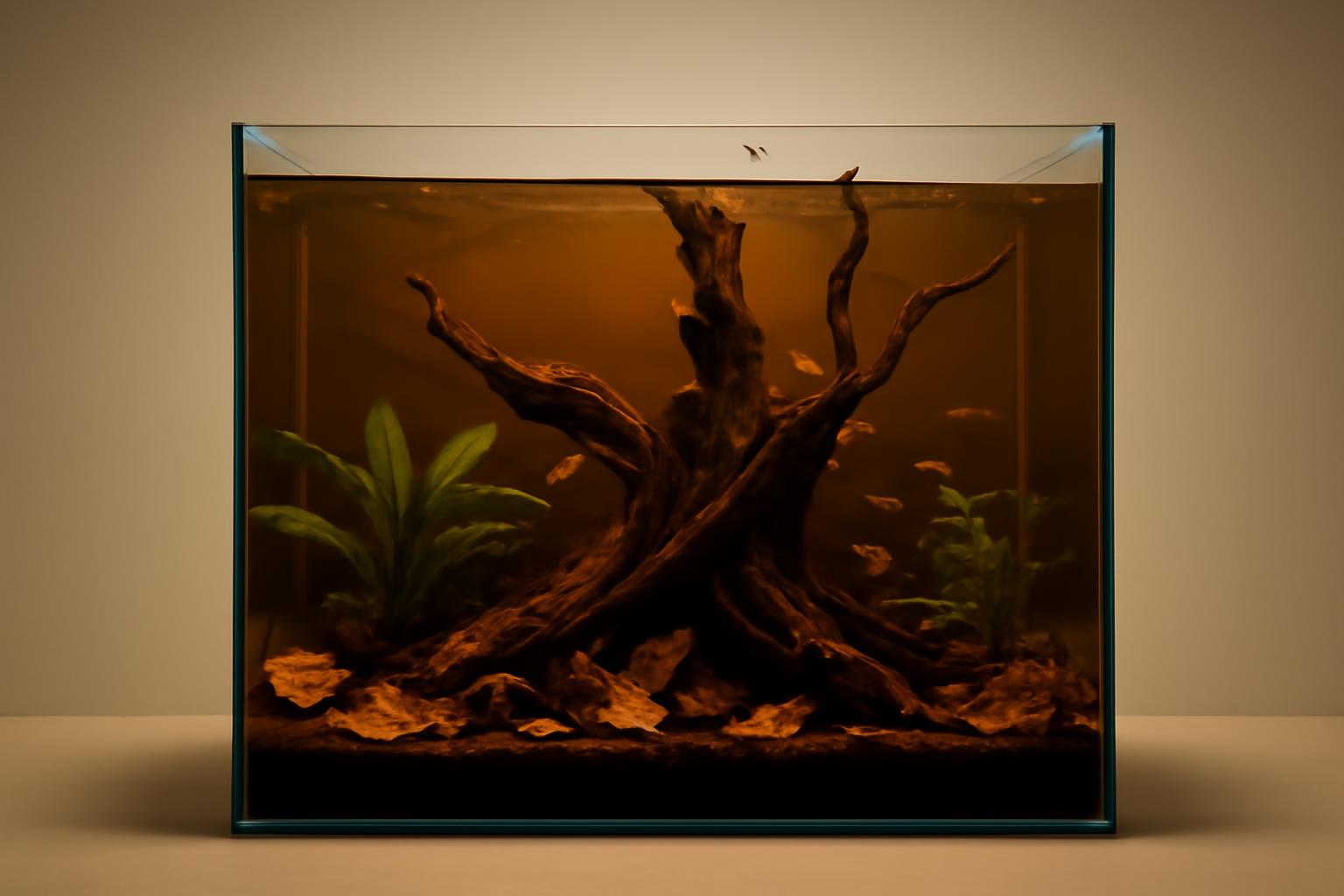
A blackwater aquarium can be one of the most distinctive freshwater setups you can keep: driftwood, leaf litter, subdued light, and water stained amber to dark tea by natural plant material. It can also be one of the more confusing styles in the hobby, because aquarists use the term blackwater in more than one way.
Some mean an attempt to approach the very soft, acidic chemistry of wild habitats such as the Rio Negro. Others mean a botanical-style aquarium: a tank built around leaves, wood, cones, pods, and humic-rich aesthetics without trying to force extreme wild parameters. For most beginners and intermediate hobbyists, that second path is the safer and more practical one.
Evidence note: Much published blackwater guidance is hobby-derived rather than lab-grade: retailer articles, aquascaping case studies, and forum discussions make up much of the available advice. This guide sticks to conservative, repeatedly cited practices and labels anecdotal points as such.
This article explains what a blackwater aquarium is, how to set one up, which botanicals and plants are practical, what water targets are commonly used, and how to keep the system stable over time.
What Is a Blackwater Aquarium?
A blackwater aquarium is a freshwater tank designed to resemble tannin-stained habitats shaped by decaying leaves, wood, bark, cones, pods, and other plant matter. As those materials break down, they release tannins and other dissolved organic compounds that tint the water amber, tea-colored, or deep brown.
In nature, blackwater is associated with tropical rainforest streams, flooded forests, swampy zones, and peat-influenced waters. Hobby references commonly point to parts of the Amazon Basin, especially the Rio Negro, and to some Southeast Asian habitats as classic examples. These waters are usually soft, low in dissolved minerals, and acidic. In the wild, pH can fall to levels that most home aquarists should not try to chase.
That leads to the most important distinction in this topic:
- True blackwater, in a stricter scientific sense, is not just brown water. It also involves very low mineral content, very low hardness, low buffering, and dissolved organic chemistry shaped by geology, soils, and organic decay.
- Hobby blackwater, often described as a botanical-style or faux blackwater aquarium, usually means a tank tinted by leaves, wood, cones, bark, and similar materials. It may be softer and more acidic than a standard community aquarium, but it does not automatically match wild blackwater chemistry.
That distinction matters because color alone is not enough. Hard, alkaline tap water can still turn beautifully brown if you add enough botanicals. It may look blackwater, but chemically it may still be far from a Rio Negro-type system.
For practical home care, many hobby guides cluster around this starting range:
| Parameter | Common practical target |
|---|---|
| pH | 5.0-6.5 |
| GH | 1-4 dGH |
| KH | 0-3 dKH |
Those are not universal rules. They are a conservative hobby range, not a law of nature. Livestock should drive the target, and captive-bred fish often tolerate a wider range than wild fish from ultra-soft habitats.
Why do aquarists choose blackwater tanks at all?
- A distinct natural look: wood, litter beds, and tinted water create a very different visual style from a bright planted aquarium.
- Habitat fit for certain species: many tetras, rasboras, Apistogramma, wild bettas, and similar fish are commonly associated with softer, calmer, dimmer environments.
- Possible lower algae pressure: some hobby guides and aquarists report less algae in dimmer, tannin-rich tanks, but that should be treated as a possibility, not a guaranteed outcome.
- Possible fish-health support: hobby sources often attribute benefits to humic substances, including better recovery, improved fry and egg outcomes, or reduced disease pressure. Those claims are widely repeated, but the evidence in this source set is mixed and often promotional or anecdotal rather than definitive.
- A simpler aesthetic: blackwater layouts can be striking without relying on intense lighting, CO2, or dense stem planting.
The most useful working definition is simple: a blackwater aquarium is a tank built around botanicals, soft-to-very-soft water, subdued light, and compatible livestock, with stability valued more than strict purity.
Essential Equipment and Tank Setup
A blackwater aquarium does not need exotic gear, but it does reward thoughtful choices. The goal is not high-tech intensity. The goal is a stable, low-light system that can handle natural organics without sudden swings.
Tank size
Almost any size can work. Some hobby guides describe nano tanks as accessible because the visual effect is dramatic even in a small footprint. At the same time, smaller tanks react faster to mistakes.
A more forgiving beginner range often mentioned in blackwater and dirted-botanical guidance is 10 to 20 gallons, especially for a first attempt. That gives you more room for stable hardscape, a modest litter bed, and safer water chemistry than a tiny tank.
Larger aquariums work very well for schooling fish, bigger wood pieces, and more immersive litter beds. The tradeoff is cost, especially if you are using RO/DI or distilled water as your base.
Substrate
For most setups, the safest base is a pH-neutral substrate:
- fine sand
- smooth natural gravel
- a mix of the two
Sand is especially popular because it looks natural under leaf litter and wood, and it suits fish that forage along the bottom.
Avoid substrates and decor that actively raise hardness or pH. In practice, that usually means steering clear of:
- crushed coral
- aragonite
- carbonate-heavy decorative rock
A more advanced option is a dirted blackwater tank: an organic soil layer capped with sand or fine gravel. This approach borrows from dirted or Walstad-adjacent methods but adds botanicals for tannins, humics, and biofilm-rich microhabitat. If you try it, use an organic soil without added fertilizers or pesticides, cap it well, and expect a more delicate setup process.
Filtration and flow
Blackwater tanks usually look and function best with gentle flow. Hobby references on blackwater biotopes consistently point to slow-moving natural waters, and many commonly recommended fish suit calmer output.
Common filter choices include:
- sponge filters for small or breeding-style tanks
- canister filters for larger displays, ideally with a gentle return
- hang-on-back filters only if you can soften or baffle the flow
A prefilter sponge on the intake is useful when you have leaves, pods, bark, and fine organic debris in the tank.
One point is repeated across almost every blackwater setup guide: if your goal is to keep tannins in the water, do not run activated carbon as standard media. Carbon removes the compounds many blackwater keepers are intentionally trying to retain.
Lighting
Blackwater aquariums usually benefit from dim to moderate light. The tint already reduces light penetration, and the plants most often used in these tanks tend to be shade tolerant.
A low-output or adjustable LED is usually enough. Strong lighting can work in hybrid planted-blackwater tanks, but it often fights the aesthetic and increases the difficulty of plant selection.
Lower light helps maintain the overall look and suits plants commonly recommended for this style, including Anubias, Bucephalandra, Java fern, and Cryptocoryne.
Heater and temperature
A heater is usually necessary. Common hobby guidance places many blackwater fish within 72 to 82°F, but the correct target depends on species.
Examples often cited in hobby sources:
- many tetras, rasboras, and Corydoras: mid to upper 70s
- many wild bettas and some gouramis: warmer end of the range
- discus: generally toward the warm end
Choose livestock first. Then set temperature around their needs.
Water source
Source water is one of the biggest make-or-break factors in blackwater keeping.
If your tap water is already soft and lightly buffered, you may be able to use it directly or with minor adjustment. If your tap is hard or strongly buffered, most hobby guidance points toward RO/DI or distilled water as a far more controllable base.
That is because leaves and wood usually tint hard water more easily than they soften it. Beginners often discover they have created brown water without achieving lower GH, lower KH, or a lower pH.
A practical source-water decision path looks like this:
- Soft, low-KH tap water: often workable with gradual botanical use and regular testing
- Moderately hard tap water: may work as an RO/tap blend
- Hard, alkaline, strongly buffered tap water: usually easiest to manage by starting with RO/DI or distilled water
A caution on remineralization and near-zero KH
Ultra-soft water is where many blackwater tanks stop being relaxing and start becoming chemistry-sensitive.
If you use RO/DI or distilled water, do not assume “purer” is always better. Very low mineral content and near-zero buffering can make the system less forgiving. Several hobby sources stress that consistency matters more than chasing an extreme number.
Practical lessons from the source set:
- RO or distilled water gives control, but it may need to be blended or remineralized depending on your livestock.
- Very low KH means pH can move more easily.
- In one blackwater aquascaping case, wild fish were kept around 60-80 TDS, but plant performance improved once TDS was somewhat higher, around 110 or above. That is one documented hobby experience, not a universal rule, but it illustrates the fish-versus-plants tradeoff.
If you are new to soft-water systems, aim for stable soft water, not the lowest possible number.
Hardscape
Blackwater hardscape is usually built from:
- driftwood
- branchy wood
- roots
- leaf litter
- cones and seed pods
- occasional inert stone, if any
South American-inspired layouts often minimize rock. Southeast Asian-inspired layouts may also lean heavily on wood and botanicals rather than stone.
A simple beginner layout:
- Sand base
- One or two main wood pieces
- Leaf litter gathered around and beneath the wood
- A small number of cones or pods for texture
- Plants attached to wood or tucked into shaded areas
That is enough to get the look without overloading the tank.
A conservative beginner setup workflow
If you want one safe starting path, use this:
- Choose the livestock direction first — South American soft-water community, Southeast Asian botanical tank, wild betta setup, and so on.
- Test your source water for pH, GH, and KH.
- Decide whether tap, RO blend, or RO/distilled base makes the most sense.
- Set the tank up lightly at first with sand, wood, and a modest initial amount of botanicals.
- Run filter and heater with gentle flow.
- Fishless cycle the tank fully before adding animals.
- Increase botanicals gradually after the tank starts to stabilize.
Restraint is a strength in blackwater keeping. Most problems come from trying to make the tank dark, acidic, and “finished” too quickly.
Choosing and Preparing Botanicals
Botanicals are the center of a blackwater aquarium. They provide the tint, much of the structure, shelter, micro-surfaces for biofilm, and the slow organic breakdown that gives these tanks their character.
Common beginner-friendly botanicals
The most commonly cited beginner options are:
- Catappa / Indian almond leaves
- Oak leaves
- Magnolia leaves
- Guava leaves
- Alder cones
- Driftwood
- Seed pods and bark pieces
Each behaves a little differently.
- Catappa is the hobby standard and the most widely recognized aquarium leaf.
- Oak is commonly collected locally and works well for natural-looking litter beds.
- Magnolia is valued for durability and visual impact.
- Guava is often praised in hobby writing for its longevity.
- Alder cones are easy to place and often used to add tint and grazing surface.
- Pods and bark add texture and hiding places.
Some commercial botanical sellers also describe their leaves and pods as tested with fish, shrimp, or snails, or as sourced from cleaner environments. That may be helpful, but it should not replace your own inspection and preparation.
How to source botanicals safely
You have two realistic options: buy them or collect them.
Buying botanicals
Aquarium-marketed botanicals are convenient, especially for beginners who are unsure about tree identification or contamination risk. They also make it easier to start with known items such as catappa leaves, alder cones, and common seed pods.
Still, bought does not mean drop-in ready. Rinse and prepare everything yourself.
Collecting your own
Collecting can work very well, but only if you are selective.
Avoid gathering from:
- roadsides with heavy traffic
- lawns or parks likely treated with pesticides
- industrial zones
- smoky, polluted, or obviously contaminated areas
Hobby collection advice also commonly stresses choosing recently fallen, intact material rather than moldy or degraded pieces. Rinsing and drying before storage are common practices.
Preparation: boil, soak, or add dry?
There is no single universal method. Different hobbyists prioritize cleanliness, sinking speed, placement control, or maximum tannin release.
Boiling or soaking is commonly used to:
- kill hitchhikers
- reduce floating
- make pieces sink faster
- release tannins more predictably
- reduce an overwhelming first tint burst
Adding botanicals dry is sometimes used to:
- preserve more initial tannin release
- keep preparation simple
- let the material break down more naturally in the tank
A conservative beginner method looks like this:
- Rinse the material thoroughly.
- Briefly boil it or pour boiled water over it.
- Soak until it sinks, if needed.
- Add it in small amounts.
This works especially well for leaves and cones. Wood often needs a much longer soak.
Do not over-boil if you want strong tint. Multiple sources note that extended boiling can send much of the color into the prep water instead of the aquarium.
Dose slowly, not dramatically
This is one of the most repeated blackwater lessons in hobby writing: add botanicals gradually.
Large sudden additions can contribute to:
- rapid pH movement in very soft water
- cloudiness or bacterial bloom
- excess decaying organics
- a rougher early cycle
A much safer approach is to start with a light amount, observe the tank for a week or two, and then build slowly.
That matters because two tanks of the same size may respond very differently depending on:
- KH
- GH
- substrate
- stocking level
- filtration
- existing organics
Longevity and replacement
Botanicals do not all last equally long. Reported life span varies with water chemistry, grazing pressure, and flow, but the hobby expectations repeated in the source set look roughly like this:
| Botanical | Common hobby lifespan |
|---|---|
| Catappa leaves | About 2-3 weeks to 1-2 months |
| Alder cones | Around 1 month |
| Guava leaves | Often 2 months or more |
| Magnolia leaves | Often 2-3 months or longer |
Magnolia is regularly described as one of the more durable leaf choices. That makes it useful when you want the layout to hold its shape longer.
Leaf litter beds and pods
A blackwater aquarium does not have to be sparse. In many botanical-style setups, the litter bed is a major part of the habitat.
Leaves, pods, and cones can provide:
- shade and cover
- foraging surfaces
- biofilm growth
- microhabitat complexity
- a more natural forest-floor look
There is real disagreement in the hobby on decomposition practice. Some aquarists prefer removing leaves before they fully break down. Others deliberately leave them to decompose completely. For a beginner, the safest middle path is practical:
- let some material age naturally
- do not strip everything out at once
- do not allow huge amounts of collapsing mush to build up unchecked
Water Chemistry Targets and Cycling
Water chemistry is where blackwater aquariums either become calm and repeatable or turn into a series of avoidable surprises. The aim is not simply dark water. It is water that remains appropriate and stable for the animals you keep.
Practical target ranges
A conservative hobby range repeated across blackwater guides is:
| Parameter | Practical starting range |
|---|---|
| pH | 5.0-6.5 |
| GH | 1-4 dGH |
| KH | 0-3 dKH |
| Temperature | species-dependent, often 72-82°F |
Again, those are starting points, not universal species requirements. Some guides use broader or slightly higher values, especially for captive-bred fish or for less extreme “faux blackwater” tanks.
Start with the source water
If your tap is hard and alkaline, the easiest route is usually:
- start with RO/DI or distilled water
- blend or remineralize as needed
- let botanicals handle the tint and part of the acidifying effect
If you start with hard tap and expect leaves alone to do all the chemical work, you may get the color without getting the softness.
Is peat required?
Not necessarily.
Some hobbyists consider peat important for getting closer to “true” blackwater because it can soften water through ion exchange and has long been part of blackwater practice. Other aquarists avoid it because they can reach their goals with RO and botanicals, or because they have sustainability concerns.
The most defensible beginner answer is:
- peat can help
- peat is not mandatory
- RO plus botanicals is often enough for a practical blackwater display
Cycling a blackwater tank
A blackwater tank still needs a real nitrogen cycle. Tannins do not replace nitrifying bacteria.
A conservative sequence:
- Set up the tank with substrate, wood, and a modest amount of botanicals.
- Fill with prepared water.
- Start filtration and heating.
- Add an ammonia source for a fishless cycle.
- Test until the system processes ammonia reliably before adding livestock.
Some commercial guides mention waiting 48-72 hours before adding fish. Treat that as a settling period at most, not as proof of a completed cycle.
Expect early-stage “ugly” phases
Many new blackwater tanks look rough before they look good.
Common early issues include:
- cloudy or hazy water
- strong initial tannin release
- white biofilm on wood
- slime-like or fungal-looking growth
- a generally messy appearance
These are widely reported in blackwater hobby sources, especially where fresh organics are added early. In many cases they settle with time rather than emergency intervention.
Test more often in the beginning
Frequent testing matters, especially in softer water.
Pay attention to:
- pH
- GH
- KH
- ammonia
- nitrite
- nitrate
Some hobbyists also report that heavily stained water can make color-based liquid test kits harder to read. That does not make testing useless. It just means you should be consistent: same kit, same lighting, same routine.
The main stability rule
If one principle ties blackwater chemistry together, it is this:
Make changes gradually.
Avoid trying to solve every problem with:
- sudden large botanical additions
- concentrated tannin extracts
- aggressive chemical pH reducers
- abrupt source-water changes
In soft, low-buffer water, slow correction is usually safer than fast correction.
Best Plants for Blackwater Tanks
Plants are absolutely possible in blackwater aquariums, but plant choice matters. The easiest way to succeed is to think in terms of shade-tolerant accents rather than a bright, dense stem-plant display.
Best beginner plants
The most consistently recommended plant categories are:
- Anubias
- Bucephalandra
- Java fern
- Java moss
- Cryptocoryne
- Floaters such as frogbit or water lettuce, where appropriate
These are repeated across blackwater guides for two simple reasons:
- they tolerate lower light
- many do not require nutrient-rich, high-energy conditions
Why epiphytes work so well
Epiphytes such as Anubias, Bucephalandra, and Java fern are especially useful in blackwater layouts because they can be attached directly to wood.
That suits the style visually and practically:
- the wood-heavy scape already gives them mounting points
- they do not depend on enriched substrate
- they tend to handle dimmer conditions better than many stem plants
This is one reason blackwater tanks and epiphytes pair so naturally.
Crypts and floaters
Cryptocoryne species are among the more workable rooted plants for this style. They suit low light and look appropriate in botanical tanks once they settle in.
Floaters can also fit blackwater systems well by further softening the light. The only caution is that it is easy to make the tank too dark if you combine dense floaters with heavy tannins and low lighting.
The challenge with stem plants
Stem plants are not impossible in blackwater. They are just less predictable, especially early.
In one documented blackwater aquascaping case, epiphytes and crypts eventually did well, while stem plants such as Hygrophila corymbosa and Rotala rotundifolia melted during the initial phase and did not recover. That setup also went through a heavy tannin burst, biofilm, cloudiness, and very soft conditions.
That does not prove stem plants always fail. It suggests they are more likely to struggle when:
- the tank is still cycling
- the initial tannin load is heavy
- TDS is very low
- light is very dim
- the system is still chemically unsettled
A practical compromise is to add delicate stem plants after the tank has fully cycled and stabilized, not during the first chaotic weeks.
TDS and plant performance
One recurring tradeoff in blackwater planting is that fish and plants may not want the exact same extreme.
In the aquascaping example above:
- wild fish were kept around 60-80 TDS
- plants reportedly performed better once TDS was closer to 110 or above
That is one hobby example, not a universal planting formula. Still, it supports a useful beginner takeaway:
- if your top priority is sensitive wild soft-water fish, plant choice becomes narrower
- if your top priority is lush plant growth, a lighter blackwater approach may be easier
In other words, the more extreme the chemistry, the more selective the plant list tends to become.
Compatible Fish and Livestock
A blackwater aquarium works best when the livestock actually matches the environment. Many fish can tolerate tinted water. Fewer are genuinely associated with soft, acidic, low-light habitats.
Common blackwater fish choices
Hobby blackwater references repeatedly list fish such as:
- tetras, especially cardinal, neon, rummynose, and similar soft-water species
- Apistogramma
- pencilfish
- bettas, especially wild types in appropriate setups
- rasboras
- some gouramis
- Corydoras
- discus
- angelfish
- other small peaceful catfish
That does not mean they all belong together. It means these are the groups most often associated with blackwater-style husbandry.
Compatibility matters more than geography
Do not stock by continent alone.
Several hobby sources explicitly warn that fish from the same region are not automatically compatible. Practical issues include:
- aggression
- adult size
- temperature mismatch
- feeding differences
- plant destruction
- constant rearranging of the litter bed
A fish can be “from blackwater” and still be a bad fit for your particular tank.
Two safer theme directions
If you want a coherent look, two broad directions appear often in hobby blackwater setups:
South American-style direction - small tetra school - wood-heavy scape - leaf litter - optional compatible bottom species if tank size allows
Southeast Asian-style direction - rasboras or similar small schooling fish - wood and botanicals - subdued planting - species-specific research before adding bettas or gouramis
These are themes, not exact stocking formulas.
Wild versus captive-bred fish
Wild-caught fish from blackwater habitats often show the strongest preference for very soft, acidic water. Captive-bred fish can be more adaptable, but that varies.
That is why many mixed-stock hobby tanks do best as moderate botanical systems rather than extreme chemistry projects. You still provide tannins, cover, wood, and softer water, but you avoid pushing the numbers lower than necessary.
Invertebrates: shrimp and snails
This is where caution matters.
Some hobbyists keep shrimp successfully in lightly tinted, stable botanical tanks, where biofilm on leaves and wood becomes a food source. But as the tank gets softer and more acidic, risks increase.
Common concerns include:
- poor shell formation in low-mineral water
- shell erosion in snails at lower pH
- sudden losses in unstable, under-buffered systems
- maintenance neglect leading to drift over time
The source set includes conflicting anecdotes: some keepers report shrimp thriving with steady small water changes, while others report shrimp deaths after months without water changes and major pH drop. The safest interpretation is not “shrimp always fail” or “shrimp are always fine.” It is that stability and mineral availability matter a lot.
Best beginner stocking mindset
For a first blackwater tank, simpler is better:
- one small schooling species
- one compatible bottom species only if tank size supports it
- avoid aggressive centerpiece fish unless the tank is built around them
A small, coherent stocking plan makes it much easier to interpret what the tank is doing.
Maintenance and Troubleshooting
Blackwater tanks are not no-maintenance systems. They are consistency-driven systems. Once mature, many are fairly calm to run, but they do not reward neglect.
Water changes
Across the source set, maintenance guidance generally lands somewhere between 10-25% water changes, done weekly through every 4 weeks depending on tank size, stocking, and how heavily botanical the system is.
A practical rule:
- smaller tanks: usually benefit from smaller, more regular changes
- larger, lightly stocked tanks: can sometimes go longer between changes if chemistry remains stable
The key is not the exact schedule. It is matching the replacement water closely:
- similar temperature
- similar GH and KH
- similar pH, within reason
- ideally similar tint if the tank is heavily botanical
Some hobbyists prepare change water in advance with the same type of botanicals to reduce visual and chemical shock.
Replacing botanicals
Do not remove all litter and replace it in one session.
A safer rhythm is:
- remove part of the oldest collapsing material
- leave some older material in place
- add fresh botanicals in small amounts
This avoids abrupt shifts in appearance, microbial activity, and dissolved organics.
Normal early-stage issues
Several things that worry beginners are often normal.
Cloudy water
Common in new tanks, especially during cycling or after adding fresh botanicals.
White biofilm on wood
Very common in newer setups and often temporary.
Slime-like or fungal-looking growth
Frequently part of early decomposition and colonization.
Strong initial tannin burst
Normal when fresh wood or a larger botanical batch goes in. Routine water changes usually moderate it over time.
Common mistakes
Most blackwater problems come from doing too much, too fast.
Avoid:
- dumping in large amounts of botanicals at once
- forcing pH down with chemical adjusters
- replacing all leaf litter in one session
- overfeeding a tank already rich in organics
- doing water changes with unmatched hard tap water
- over-cleaning until the microbial layer is constantly stripped away
pH swings and neglect
A blackwater tank should trend gradually, not crash.
If pH is dropping faster than expected, check:
- whether KH is extremely low
- whether too many botanicals were added too quickly
- whether maintenance has slipped
- whether your source water is inconsistent
One forum anecdote in the source set described a tank left for months without water changes, with pH reportedly dropping from around 7.5 to 6.0 and shrimp dying. That is not controlled evidence, but it is a useful warning against treating a “natural” look as permission to stop maintaining the tank.
If you want darker water, build that through time and repeated small additions, not with abrupt concentrate use.
Benefits and Realistic Expectations
Blackwater aquariums have real strengths, but they also attract a lot of overstatement. The safest way to evaluate them is to separate what is clearly supported from what is mostly hobby belief.
What they realistically do well
A well-run blackwater aquarium can offer:
- a highly distinctive natural aesthetic
- subdued light and shelter-rich structure
- a habitat style that suits many soft-water fish
- a simpler visual approach than high-light planted layouts
- a strong focus on wood, litter, and natural materials
Those benefits are straightforward and well supported in hobby practice.
Benefits that are commonly reported, not guaranteed
This is where caution helps.
Some hobby guides and retailers say blackwater tanks may provide:
- reduced algae pressure
- lower maintenance
- calmer fish behavior
- improved health, healing, or breeding outcomes
Those claims should be read carefully.
- Reduced algae is plausible in lower-light tanks, but not guaranteed.
- Lower maintenance depends entirely on the setup. A moderate botanical tank can be simple; an ultra-soft, unstable one can be demanding.
- Health benefits are often attributed to humic substances rather than tannins themselves, but the evidence in this source set is still mixed and not strong enough to promise disease resistance or breeding success.
So the balanced view is:
- blackwater may be supportive husbandry for appropriate species
- blackwater is not magic water
True versus faux blackwater
This may be the most useful expectation to set from the beginning.
A home blackwater aquarium is often a representation, not an exact copy, of natural blackwater ecosystems. That is normal. It is also usually the right goal.
For most hobbyists, the best result is not a chemically extreme wild clone. It is a stable botanical aquarium with:
- soft enough water for the livestock
- natural tannin tint
- compatible fish and plants
- a maintenance routine you can repeat
That is where blackwater keeping becomes enjoyable instead of stressful.
If you are new to the style, start small, stock lightly, add botanicals gradually, and let the tank mature into itself.
Can I use tap water for blackwater?
Sometimes, yes.
If your tap water is already soft and low in KH, it may work directly or with minor adjustment. If it is hard and strongly buffered, it is much harder to create blackwater conditions with botanicals alone. In that case, RO/DI or distilled water is usually the more controllable base.
The practical problem is simple: leaves and wood usually color hard water more easily than they soften it.
A common middle ground is to use an RO/tap blend, then add botanicals gradually and test often.
How long do botanicals last before replacement?
It depends on the botanical, flow, grazing activity, and water chemistry.
As rough hobby expectations:
- catappa leaves: about 2-3 weeks to 1-2 months
- alder cones: around 1 month
- guava leaves: often 2 months or more
- magnolia leaves: often 2-3 months or longer
Do not replace everything on a rigid schedule. Replace gradually as material collapses and as the look of the tank changes.
Are blackwater tanks hard to maintain?
Not automatically. They are usually different, not inherently harder.
What makes them easier: - simple hardscape direction - low to moderate lighting - limited plant list - naturalistic layout
What makes them harder: - soft-water chemistry is less forgiving - KH can be very low - source water matters more - overcorrection causes problems quickly
A moderate botanical tank is usually manageable if you: - use suitable source water - add botanicals slowly - keep stocking sensible - do regular small water changes - avoid chasing dramatic pH shifts
They become difficult when people try to force extreme chemistry quickly or neglect maintenance because the tank “looks natural.”
What if plants melt in blackwater?
Do not panic. Initial melt is common, especially with stem plants.
Blackwater tanks often begin with: - heavy tannin release - cycling instability - low TDS - lower light than many plants are used to
That combination can cause plants to sulk or melt back. A practical response is to:
- lean on tougher species such as Anubias, Bucephalandra, Java fern, Java moss, and Cryptocoryne
- wait until the tank is fully cycled before adding delicate stems
- avoid ultra-soft extremes if lush plant growth is also a major goal
- let the tank stabilize before judging the planting plan
In many cases, the fix is changing the plant list, not rebuilding the whole tank.
Safe for shrimp and snails?
Sometimes, but with caution.
Shrimp often do well in light blackwater or botanical-style tanks with stable maintenance, where biofilm grows on leaves, wood, and cones. Snails and shrimp become riskier as the tank gets softer, more acidic, and lower in mineral content.
The main concerns are:
- shell problems in snails
- mineral limitation in very soft water
- pH instability in neglected systems
So the safest summary is:
- light blackwater: often workable for some shrimp, and sometimes for snails
- more extreme soft, acidic blackwater: use much more caution, especially with shelled invertebrates
For invertebrates, darkness is not the main issue. Stability is.