
Mastering Care for the Electric Blue Jack Dempsey: Size, Setup, and Proven Tank Tips
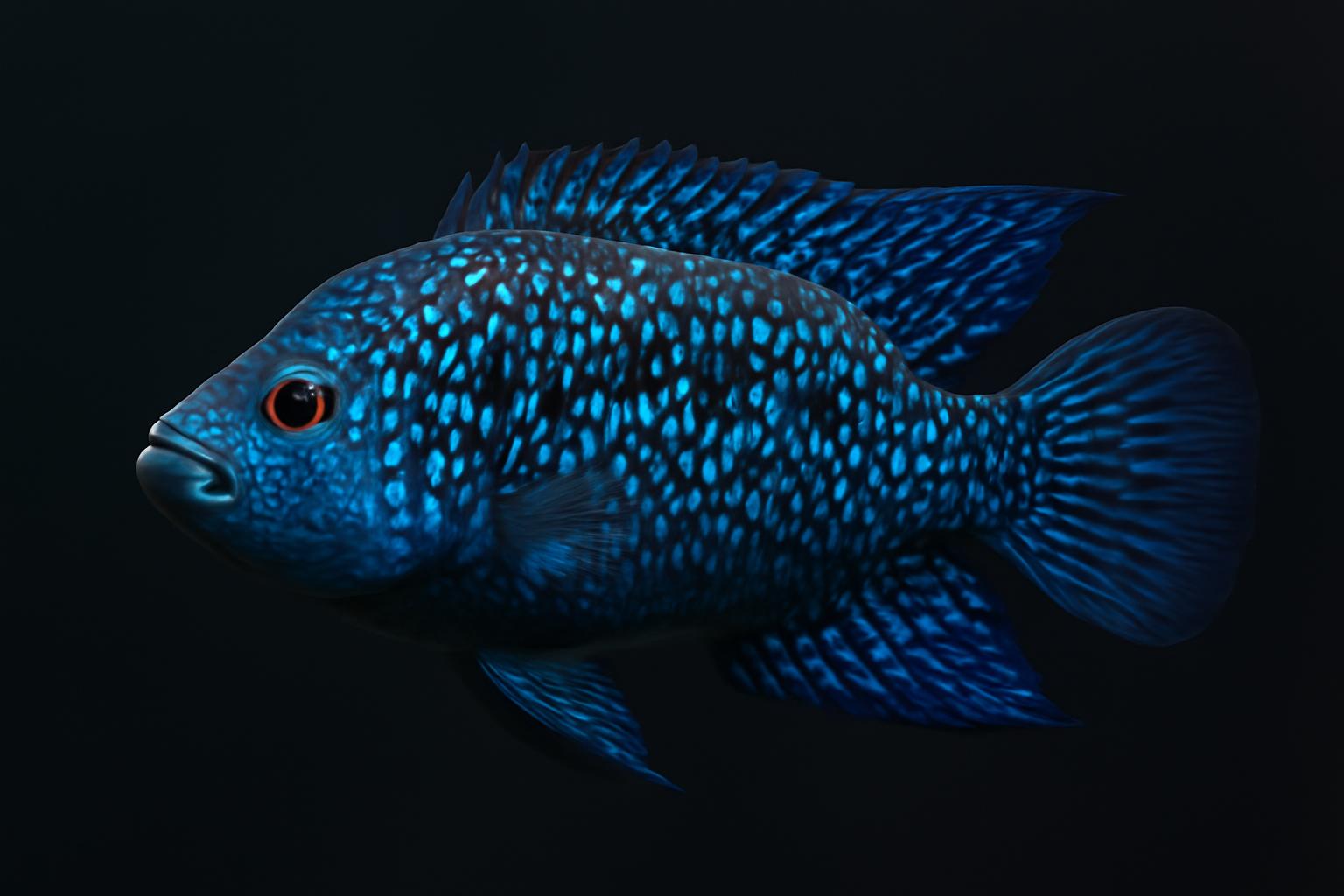
Treat it as a territorial, structure-dependent cichlid with variable bloodline quality, not a guaranteed peaceful blue showpiece.
The Electric Blue Jack Dempsey is one of the most eye-catching Central American cichlids in the hobby. A good specimen shows intense blue iridescence, dark contrast, and the same broad Jack Dempsey personality traits aquarists expect from Rocio octofasciata: territorial behavior, digging, and a strong response to shelter and space.1412
The difficulty is not finding praise for the fish. It is sorting reliable care guidance from a source base that is mostly made up of retailer listings, hobby profiles, and forum discussions that do not fully agree. Adult size, minimum tank size, origin of the blue line, comparative aggression, and even water ranges are presented differently depending on where you look.34591315
So the safest way to approach EBJD care is to separate what is broadly consistent from what is commonly claimed but still disputed. Across the available sources, the most defensible practical picture is this: in the aquarium trade, the Electric Blue Jack Dempsey is treated as a blue form of Rocio octofasciata; adults are often listed around 8 inches, though larger fish are reported; a larger, structured tank is preferable to pushing published minimums; warm, stable water near neutral is a safer starting point than chasing extremes; and this is still a semi-aggressive cichlid, not a peaceful community centerpiece.1461210
| Care point | Conservative starting point | Confidence level |
|---|---|---|
| Scientific identity | Electric Blue form or colour morph of Rocio octofasciata in aquarium trade | Fairly consistent across aquarium sources |
| Common names | Electric Blue Jack Dempsey, Electric Blue JD, Powder Blue JD | Consistent |
| Adult size | Often around 8 inches; some listings and hobby reports go higher | Moderately consistent |
| Lifespan | Often cited at 10–15 years with strong long-term care | Commonly cited, but care-dependent |
| Minimum tank | A 55-gallon tank is a conservative baseline for one fish | Published minimums vary |
| Temperature | A practical middle zone of 72–82°F within broader published ranges | Moderately consistent |
| pH | Near-neutral water, often around 6.5–7.5 as a practical target | Moderately consistent |
| Diet | Quality pellets or flakes plus frozen meaty foods; some plant-based content | Consistent |
| Temperament | Semi-aggressive and territorial, especially when breeding | Consistent |
| Best setup | Sand, caves/wood/rocks, visual breaks, secure cover | Consistent |
Evidence note: This guide uses only the overlap from retailer care sheets, species profiles, standard Jack Dempsey references, and hobby forum reports. Where those sources disagree, the disagreement is stated instead of hidden.
What Is the Electric Blue Jack Dempsey Fish?
In aquarium use, the Electric Blue Jack Dempsey is generally treated as an Electric Blue form, variant, or colour morph of the Jack Dempsey cichlid, Rocio octofasciata.1712 It is also sold as the Powder Blue Jack Dempsey or Electric Blue JD.13
The parent species is a Central American cichlid associated in the sources with Atlantic coastal Mexico and nearby parts of Central America, especially Mexico, Guatemala, Honduras, and sometimes Belize.112910 That geographic background matters because the fish’s care still follows the broad Jack Dempsey pattern: warm freshwater, structure, substrate it can work over, and enough room to establish territory.4810
What is not settled is the exact history of the Electric Blue line itself. Some hobby and retailer sources describe it as a natural variant or naturally occurring morph. Other sources say the origin is controversial or suggest selective line breeding. One mainstream care article explicitly says DNA work would be needed to resolve whether all lines are true morphs or involve hybrid history.41219 For a keeper, the practical conclusion is simple: use Jack Dempsey-style care, but do not pretend the line’s origin story is fully resolved.
A compact way to think about the comparison with a standard Jack Dempsey is this:
| Difference from standard Jack Dempsey | How safe is the claim? | Practical reading |
|---|---|---|
| Same species background used for care planning | Widely accepted in aquarium sources | Treat it as a Jack Dempsey-type Central American cichlid |
| Brighter electric blue coloration | Widely accepted | This is the defining trade trait |
| Smaller adult size | Commonly claimed, not universal | Often true in listings, but not guaranteed |
| Less aggressive temperament | Commonly claimed, not universal | Plan for cichlid aggression anyway |
| Lower juvenile robustness | Repeated in hobby reports, not proven for every line | Use extra caution during grow-out |
| Exact origin of the blue line | Unresolved | Avoid absolute claims |
Another point that appears again and again: young fish often do not look like the finished product. Juveniles may be pale, whitish, grayish, or only faintly blue when sold, and several sources say the richer blue commonly develops around 6 to 7 months of age.41412 That does not mean every fish changes on the same timeline, but it does explain why a healthy juvenile can look disappointing in a dealer tank.
Fish in the trade are also commonly sold as tank-bred or aquarium-bred, which is important because most EBJDs you encounter as hobby stock are not being presented as wild-collected specimens.152 Even here, though, it is better to say “commonly sold as tank-bred” than to make broader claims about every fish in circulation.
The bottom line: the Electric Blue Jack Dempsey is best understood as a trade-established blue Jack Dempsey form kept under the same broad husbandry logic as Rocio octofasciata, while its exact line history and some of its commonly repeated differences from standard JDs remain partly unsettled.14129
Appearance, Size, and Lifespan
The appeal of the Electric Blue Jack Dempsey is obvious. Mature fish are described across sources as vivid blue to blue-green, with metallic spotting, broken iridescent lines, and dark or black speckling that increases contrast.34126 The result is a fish that still has the thick, laterally compressed, stocky Jack Dempsey build, but with a brighter and more uniform blue presentation than the standard form.
Many descriptions mention:
- a bright electric blue body,
- iridescent blue or blue-green spots and lines,
- darker specks or flecks on the head, body, lips, and fins,
- and elongated dorsal and anal fins, especially in males or in some lines.4123
Color also is not completely static. Several sources say coloration can intensify during breeding, while stress, poor diet, age, or inferior conditions may make the fish look duller.34814 That makes color a useful clue rather than just a selling point. A washed-out EBJD is not automatically sick, but it is worth checking water quality, diet, and social pressure.
Size
Adult size is one of the most inconsistent data points in the source pack.
- Multiple Electric-Blue-specific listings and guides give about 8 inches or up to 8 inches.141214
- Dan’s Fish lists around 8–9 inches.5
- LiveAquaria and some standard Jack Dempsey references allow up to 10 inches.38109
- One retailer lists adult size at 6 inches, which is notably lower than most other EBJD-specific material.7
Because of that spread, the cleanest planning rule is: expect an adult around 8 inches, but do not treat that as a hard ceiling. A fish that ends up closer to 9 inches is not outside published hobby experience.5613
Juveniles are usually sold small. Listings in the evidence pack mention fish around 1 inch, 1 to 2 inches, or 2 to 3 inches at sale or shipping.135 That small purchase size is one reason people underestimate the eventual space requirement.
Color progression in juveniles
Young EBJDs are often described as pale before their adult color develops. Light.fish says juveniles can be pale white before turning blue around 6 to 7 months, while forum hobbyists similarly describe young fish as less brilliant until later growth stages.414 That does not make 6 to 7 months a guaranteed clock, but it is a repeated enough theme to be useful when evaluating juveniles.
Lifespan
Lifespan claims also need careful wording. Several EBJD-specific sources cite 10 to 15 years with good care.41214 Standard Jack Dempsey references broaden that picture by giving averages around 8 to 10 years, with some fish reaching beyond 15 years under strong husbandry.810
So the safest phrasing is this: 10 to 15 years is a commonly cited long-term range, not a guarantee. Genetics, line quality, stress, tank size, diet, and water quality all matter.41415
For an aquarist, that means an EBJD is not an impulse color purchase. It is potentially a decade-plus cichlid commitment with a fixed territory, a predatory mouth, and a personality that becomes more obvious as the fish matures.
Ideal Tank Setup and Size
A recurring mistake with Electric Blue Jack Dempseys is treating them like a medium community fish because they are sold as small juveniles and have a calmer reputation than standard JDs. The evidence does not support that approach. Even the more optimistic sources still describe them as territorial cichlids that dig, defend structure, and need a defined home base.141012
Tank size
Published minimums are inconsistent:
- Aquatic Arts and Aquatic Arts mirror copy say 45+ gallons for a pair.12
- LiveAquaria says 50 gallons.3
- Light.fish and Absolutely Fish say 55 gallons.47
- Standard Jack Dempsey references commonly suggest 55 gallons for one fish, with more space preferred as aggression rises.810
Given that spread, a sensible conclusion is that 55 gallons for one EBJD is the more conservative and forgiving starting point, even though some sales pages publish lower minimums.4108 If you want a pair or a mixed cichlid tank, larger is clearly safer.
What matters most is not just raw gallons but usable territory:
- more bottom area,
- room for hardscape,
- broken lines of sight,
- and space to retreat without constant visual pressure.3810
A cramped tank tends to magnify aggression in Jack Dempsey-type cichlids.1011
Substrate
Fine sand is the most consistent substrate recommendation across EBJD and standard JD sources.1341210 It suits digging behavior, is appropriate for pit-making, and fits the species’ breeding habits. Smaller rounded gravel is sometimes accepted in standard JD care, but sand is the cleaner match for how these fish are repeatedly described.
Hardscape and shelter
The strongest agreement in the source pack is on structure. EBJDs do best with shelter and defensible areas built from:
This is not just decoration. It is territory management. Fish that can retreat and break visual contact are often easier to manage than fish forced to sit in an open glass rectangle with nowhere to claim.
When arranging rockwork, stability matters. These fish dig. Anything balanced loosely on top of substrate can become unsafe once the fish undermines it.310
A practical layout usually includes:
- one primary shelter or cave,
- one or two secondary hides,
- open swimming room,
- and visual interruptions created by wood or rock.
Lighting and flow
Several sources suggest dim or subdued lighting for Jack Dempseys, and that advice fits the fish’s preference for cover.84 Floating plants or shadowed hardscape can help soften a bright display, even if the tank is not run under low-output lighting.
Water movement should not be extreme. Light.fish specifically mentions slow current, while standard JD profiles describe the fish as associated with slower or more sluggish water.49 Good filtration still matters, but the display does not need to feel like a river-tank setup.
Plants
Plant advice is mixed, but the safe interpretation is that EBJDs are not reliably plant-safe.
- Aquatic Arts says they dig but may spare plants in some setups.1
- LiveAquaria and several standard JD sources warn that they burrow, attack, uproot, or damage plants.3812
If you want greenery, attached or hardier plants are the more realistic choice. Repeated examples include:
That does not guarantee survival. It just improves the odds.
Lid and security
A tight-fitting lid is a smart precaution. Standard JD keepers note jumping risk, especially during stress, aggression, or maintenance.10 A secure cover is inexpensive insurance for a powerful cichlid.
In practice, the ideal EBJD setup is functional rather than fancy: a larger tank than the fish store minimum, sand, stable hardscape, dimmer sightlines, and enough structure that a territorial cichlid can behave naturally without turning every inch of the aquarium into a conflict zone.
Water Parameters and Maintenance
Water chemistry is the area where the sources disagree most sharply. That does not mean anything goes. It means the fish appears to be fairly adaptable within freshwater tropical ranges, provided the water is stable and the tank is clean.5410
Temperature
Published temperature ranges include:
- 68–86°F from Aquatic Arts,1
- 72–86°F from Light.fish and hobby profile material quoted in forums,414
- 72–77°F from Live Fish Direct,6
- 75–80°F from FishLore’s standard JD profile,10
- and 78–82°F from LiveAquaria.3
The overlap is broad, but the safest practical reading is not to chase the edges. For everyday care, 72–82°F is a reasonable middle zone, and many keepers will find the mid-to-upper 70s easier to hold consistently.4103
Two cautions come up repeatedly in hobby discussions:
- sudden swings are worse than holding a stable number,
- and pushing temperatures upward may increase activity and sometimes aggression.1415
pH
Published pH ranges vary from quite soft and acidic to moderately alkaline:
- 6.0–7.2 at Aquatic Arts,1
- 6.0–7.0 at Light.fish and Aquadiction,412
- 6.5–7.5 at Absolutely Fish,7
- 6.5–8.0 at LiveAquaria,3
- and even harder water in a seller’s holding system at Dan’s Fish, where the fish are kept around pH 8.3 with high mineral content.5
That looks contradictory until you notice the common lesson: stable water matters more than chasing a perfect published number.54 A practical home target around pH 6.5–7.5 is a defensible middle-ground starting point, but fish already established in other stable water may adapt well if transition is gradual.745
Hardness
Hardness is even less settled than pH.
- Aquatic Arts lists KH 0–10.1
- LiveAquaria lists dKH 5–12.3
- Light.fish gives GH 9–20 dGH.4
- Aquadiction gives GH 8–12.12
- Dan’s Fish reports keeping their stock in very hard water.5
- Standard Jack Dempsey references can run harder still.8
The safest conclusion is not a single target number. It is that EBJDs are reported from a fairly wide hardness range, and exact hardness appears less important than stability, careful acclimation, and clean husbandry.54
Maintenance and water quality
This is the one point the source pack does agree on: clean water is especially important, particularly for juveniles.41415
Several hobby and care sources mention:
- pristine or very clean conditions,
- substantial regular water changes,
- and extra caution during juvenile grow-out.41415
A useful practical routine is weekly 40–50% water changes, not because it is the only schedule that can work, but because it appears repeatedly in the hobby material and gives a good safety margin for a meaty-food cichlid with a reputation for juvenile fragility.414 Treat that as a strong starting point rather than a law.
A solid maintenance strategy includes:
- a fully cycled aquarium,
- dependable filtration,
- consistent water-change scheduling,
- quick removal of uneaten food,
- and avoiding abrupt parameter shifts.4105
If there is a single “best practice” supported by the evidence, it is this: do less chemistry chasing and more consistency.
Diet and Feeding Guide
The Electric Blue Jack Dempsey is best described as a carnivore-leaning cichlid rather than a strict specialist. Sources consistently recommend prepared cichlid foods plus meaty frozen items, and several also mention some plant-based or vegetable content.136810
Staple foods
The safest staple is a quality prepared diet:
- cichlid pellets,
- smaller pellets for juveniles,
- flakes for young fish,
- or similar prepared foods for medium to large cichlids.1687
Prepared foods matter even more during grow-out because multiple forum discussions warn that young EBJDs may be prone to parasites, bloat, or digestive trouble when pushed too hard on rich or risky foods.1415
Frozen and occasional meaty foods
Commonly recommended supplemental foods include:
- bloodworms,
- brine shrimp,
- tubifex,
- insects,
- ocean plankton,
- and other frozen or freeze-dried meaty items.36812
These are useful for variety and conditioning, but most sources still imply that a balanced prepared staple should do the heavy lifting.
Plant-based content
Even though the fish is usually listed as carnivorous, some sources explicitly say to include vegetable matter or occasional plant-based foods.168 In practice, that usually means using a balanced cichlid formula rather than feeding pure meat alone.
Feeding frequency
Feeding-frequency advice is less EBJD-specific than some other care points, but a practical schedule appears in standard Jack Dempsey guidance and matches hobby usage:
Juveniles - small meals 3 times daily as a grow-out starting point,8 - modest portions, - and quick cleanup of leftovers.
Adults - 1 main feeding daily is a common baseline.8
Because the evidence for exact frequency is thinner than the evidence for food type, it is best to treat this as a useful starting schedule, not a fixed rule. Appetite, filtration, growth rate, and waste load should shape final practice.
Foods to use cautiously with young fish
The hobby evidence is consistent enough here to be worth respecting: many keepers advise caution with live foods for small juveniles because of parasite risk and digestive issues.1415 One MonsterFishKeepers discussion recommends starting with flakes before moving to larger pellets as the fish grows; another Cichlid Forum thread recommends flakes or pellets for 1-inch juveniles and warns against early live-food use.1415
That makes a conservative juvenile feeding strategy fairly clear:
- keep it clean,
- start with quality prepared foods,
- add frozen foods more confidently once the fish is stronger,
- and do not confuse aggressive begging with actual nutritional need.
Good diet is not just about growth. Across the sources, it also ties into color quality, body condition, and general robustness.48
Temperament and Tankmates
Temperament is where the phrase semi-aggressive can mislead people. In practical terms, it means an EBJD may be more manageable than some larger Central American cichlids, but it is still territorial, still capable of eating small tankmates, and still much more difficult during breeding.4610
How aggressive is it?
The available evidence supports three things at once:
- Many sources describe EBJDs as less aggressive than standard Jack Dempseys.16712
- Other hobbyists argue you should expect the same basic Jack Dempsey behavior, just in blue.11
- Nearly all sources agree that aggression can rise sharply during breeding, crowding, or poor tank design.14108
So the safest planning assumption is: an EBJD may be somewhat calmer than a standard JD, but you should never build the tank around that hope.
Best beginner approach: solo fish or pair?
For most keepers, especially anyone without much Central American cichlid experience, the lowest-risk option is:
A solo specimen is often easiest because it avoids:
- pair instability,
- breeding-triggered aggression,
- and competition from equally territorial cichlids.
A pair can be rewarding, but once a bond forms, the fish may become much more defensive.11210
Tankmates that can work
When tankmates do work, they are usually:
- too large to be eaten,
- not so timid that they collapse under pressure,
- and not so hyper-aggressive that the tank becomes a permanent contest.1610
Sources commonly frame suitable companions as similar-sized semi-aggressive cichlids or other robust fish in larger tanks.610
Tankmates to avoid
The avoid-list is much more reliable than any “safe tankmate” list. Avoid:
- small community fish,
- tiny schooling fish,
- dwarf shrimp,
- ornamental shrimp,
- and delicate invertebrates if you expect them to be ignored.1210
These fish have predatory instincts and a mouth large enough to make smaller tankmates unsafe.10
Mixing with regular Jack Dempseys or stronger fish
One specific hobby rule-of-thumb appears in MonsterFishKeepers: let the EBJD reach around 3.5 inches or larger before mixing with regular Jack Dempseys or similarly assertive fish.13 That is not a formal species rule. It is hobby advice based on repeated reports that small EBJDs may be less robust and more easily outcompeted.
If you do try a mixed cichlid setup, the key variables are:
- tank size,
- layout,
- whether the EBJD is already feeding strongly,
- and whether aggression is one-sided.1310
Compatibility by risk level
| Setup style | Risk level | Why |
|---|---|---|
| Single specimen | Lowest | No mate conflict, no cichlid rivalry, easiest territory control |
| Compatible pair | Moderate to high | Spawning and bond aggression can escalate quickly |
| Mixed cichlid tank | Highest management demand | Success depends on space, structure, and individual temperament |
That last point matters. Compatibility with this fish is highly conditional. The more fish you add, the more tank layout and observation matter.
Breeding the Electric Blue Jack Dempsey
Breeding behavior in EBJDs broadly follows standard Jack Dempsey patterns: they are egg-layers, they form defended spawning sites, and both parents may guard eggs and fry aggressively.31210
Sexing males and females
Sexing very small juveniles is unreliable. A MonsterFishKeepers discussion suggests that around 2 to 2.5 inches you can begin making more informed sex guesses, though not perfectly.13
Repeated sexing clues include:
- males tending to become larger,
- more elongated and pointed dorsal and anal fins,
- and central or tail-area black spotting in some profile material;812
- females tending to show rounder fins and a slightly less extended look.129
As with many cichlids, these are tendencies, not guarantees.
Spawning sites and egg numbers
EBJDs are described as egg depositors. Sources say females may lay about 500 to 800 eggs on a cleaned flat rock, in a burrow, or in a sheltered depression.31214 LiveAquaria gives a lower “up to 500” figure, while Aquadiction and hobby profile material quoted in forums allow 500–800, so it is best to treat egg count as approximate rather than fixed.31214
This is another reason sand and hardscape matter. A tank with no suitable site makes breeding behavior harder to manage.
Parental care
Parental care is one of the more consistent Jack Dempsey traits. Both parents are commonly described as guarding eggs and fry strongly, and standard JD references say they may even move fry into pits and defend them against intruders.310
For the keeper, the charming part and the dangerous part are the same: once guarding begins, tolerance for tankmates often collapses.
Separate tank or mixed setup?
If breeding is the goal, a separate breeding tank is the safer route.810 It gives the pair a defined territory and reduces the chance that other fish will be pinned into corners or injured.
It also helps with another issue that appears often in EBJD discussions: not every line is equally robust.1315 A pair that spawns is not automatically a pair you should breed heavily.
Line-quality caveats
This is where EBJDs differ from a generic Jack Dempsey care sheet. Hobby discussions repeatedly mention:
- weaker juveniles,
- deformities,
- inconsistent survival,
- eye or facial problems,
- and random losses in some lines.1315
Those claims are still hobby evidence, not controlled study results, but they are frequent enough to matter. If breeding or even just long-term keeping is your goal, ask about:
- the size and age of the parents,
- survival of previous batches,
- visible jaw or skull abnormalities,
- whether the young are feeding strongly,
- and whether the seller has seen chronic losses.
A beautiful fish is not necessarily a good line.
Health Issues and Prevention
The health story around EBJDs is dominated by one repeated warning: juveniles may be more fragile than standard Jack Dempseys, especially in weaker bloodlines.4131415 Not every fish fits that pattern, but it shows up too often to ignore.
Common problems reported in juveniles
Hobby sources commonly mention:
- parasites,
- bloat,
- stress-related decline,
- swim-bladder issues in some young fish,
- deformities,
- and unexplained random deaths.141513
Because this evidence is mostly anecdotal, it should not be treated as a formal disease profile. But it is strong enough to shape cautious husbandry.
Early-food strategy matters
One of the clearest preventive themes is feeding young fish flakes or pellets first, rather than leaning heavily on live foods.1415 The reasoning given in the forums is parasite avoidance and gentler digestion during a vulnerable stage.
That matches the broader rule for EBJD juveniles:
- keep food simple,
- keep water exceptionally clean,
- and do not push growth at the expense of stability.
Dropsy and white spot
A general-care article on the fish mentions dropsy and white spot as possible problems, but this is exactly where caution is needed.4 Dropsy is a symptom complex, not a single disease, and “white spots” are easy to misidentify.
Supportive steps commonly mentioned in hobby sources include:
- immediate water-quality correction,
- isolation in a hospital tank if needed,
- and disease-specific treatment only after the diagnosis is reasonably clear.4
The same source mentions Epsom salt for dropsy support and elevated temperature for white spot treatment, but those are not universal fixes.4 They depend on what the fish actually has. The safest advice is diagnosis first, medication second.
Dull color as a warning sign
A faded EBJD can be normal temporary stress coloration, but repeated sources also connect dull color with:
If the fish looks washed out, check:
- whether anything changed recently,
- whether tankmates are harassing it,
- whether maintenance has slipped,
- whether the fish is still eating,
- and whether the change is temporary or persistent.
UV sterilizers and disease prevention
Forum advice here is mixed. Some hobbyists recommend a UV sterilizer, especially where parasite problems repeat; another says it is not necessary if water quality and maintenance are strong.1415 The balanced reading is that UV may be a support tool in some systems, but it is not a substitute for quarantine, clean water, and careful feeding.
Prevention that is actually supported
The strongest preventive steps in the evidence pack are basic ones:
- Buy carefully. Ask about line quality and previous juvenile survival.1415
- Quarantine new fish when possible. This is especially sensible for juveniles and mixed cichlid tanks.
- Keep water very clean. This is one of the few truly repeated success themes.41415
- Use prepared foods early. A cautious juvenile feeding strategy shows up again and again.1415
- Watch for deformities or poor vigor. These may reflect line issues rather than a simple short-term husbandry mistake.1315
- Avoid abrupt changes. Stability is repeatedly emphasized over constant correction.54
For this fish, prevention is less about a miracle additive and more about refusing to cut corners during the juvenile stage.
FAQ
What is the minimum tank size for an Electric Blue Jack Dempsey fish?
Published minimums range from about 45 gallons for a pair on some retailer listings to 50–55 gallons on other care pages and standard Jack Dempsey references.13410 For a practical, lower-risk starting point, 55 gallons for one fish is the more conservative baseline, with larger tanks preferred for pairs or mixed cichlid setups.
Is the Electric Blue Jack Dempsey fish beginner-friendly?
Only with qualifications. Some listings call it beginner-level, especially as a single fish.37 But that sits uneasily beside repeated hobby reports of juvenile fragility, compatibility challenges, and line-quality issues.41415 A motivated newer keeper may succeed with one fish in a properly sized, stable tank, but the species is better viewed as beginner-to-intermediate at best, and clearly more demanding once tankmates or breeding are involved.
What temperature and pH does the Electric Blue Jack Dempsey fish prefer?
Published ranges are broad, but a practical middle-ground target is 72–82°F and roughly pH 6.5–7.5.1473 The key is stability. Some keepers maintain them successfully in harder, more alkaline water, while other guides recommend softer, near-neutral conditions.54 Avoid sudden shifts and aim for consistency first.
Can Electric Blue Jack Dempsey fish live with other cichlids?
Yes, but selectively and with caution. They are most often paired with similar-sized, semi-aggressive fish in larger, structured tanks.610 Avoid small, timid, or bite-sized species, and remember that breeding can sharply increase aggression.11210
Why do Electric Blue Jack Dempsey juveniles die easily?
The repeated hobby explanations are a mix of stress, parasites, digestive issues, and uneven strain quality.131415 Those are not proven universal causes, but they are frequent enough that keepers should plan around them: buy from stronger stock, keep water very clean, feed prepared foods early, and avoid sudden changes during grow-out.
If you want the safest summary, it is this: an Electric Blue Jack Dempsey can be a superb centerpiece cichlid, but success comes from treating it as a territorial, structure-dependent fish with variable bloodline quality—not as a guaranteed peaceful blue showpiece.
-
Aquatic Arts, “Electric Blue Jack Dempsey Cichlid (Rocio octofasciata)” — tank-bred trade presentation; Powder Blue name; Atlantic coastal Mexico/Central America; up to 8 inches; sandy substrate; refuges; carnivorous diet with vegetable matter; 68–86°F; pH 6.0–7.2; minimum 45+ gallons for a pair. ↩↩↩↩↩↩↩↩↩↩↩↩↩↩↩↩↩↩↩↩↩↩↩↩↩↩↩↩↩
-
Aquatic Arts duplicate product capture with the same trade description and care data. ↩↩↩
-
LiveAquaria, “Electric Blue Jack Dempsey” — 50-gallon minimum; 78–82°F; pH 6.5–8.0; maximum 10 inches; aggressive; carnivorous; burrowing and breeding notes. ↩↩↩↩↩↩↩↩↩↩↩↩↩↩↩↩↩↩↩↩↩↩↩↩↩↩
-
Light.fish, “Electric Blue Jack Dempsey: Care, Diet, Size, and More” — origin debate; juveniles turning blue around 6–7 months; adult size around 8 inches; lifespan 10–15 years; 55+ gallon minimum; 72–86°F; pH 6–7; GH 9–20; slow current; pristine conditions; bi-weekly 40% water changes; dropsy and white spot discussion. ↩↩↩↩↩↩↩↩↩↩↩↩↩↩↩↩↩↩↩↩↩↩↩↩↩↩↩↩↩↩↩↩↩↩↩↩↩↩↩↩↩↩↩↩↩↩↩
-
Dan’s Fish, “Electric Blue Jack Dempsey (Rocio otofasciata)” — aquarium-bred and raised; shipping size 2–3 inches; adult size around 8–9 inches; seller keeps stock at 79°F, pH about 8.3, high KH/GH; stability emphasized over matching seller water. ↩↩↩↩↩↩↩↩↩↩↩↩↩↩
-
Live Fish Direct, “Electric Blue Jack Dempsey” — up to 8–10 inches; less aggressive than standard JD; 72–77°F; slightly acidic to neutral pH; varied diet including plant-based foods; territorial during breeding. ↩↩↩↩↩↩↩↩↩↩↩↩↩
-
Absolutely Fish Naturals, “Electric Blue Jack Demspey” — Rocio octofasciata “Electric Blue”; semi-aggressive; pH 6.5–7.5; adult size listed at 6 inches; 55-gallon minimum; not plant safe. ↩↩↩↩↩↩↩↩↩
-
Aqua-Fish, “Comprehensive Guide to Jack Dempsey Cichlid Care” — dim lighting; digging substrate; hardy plants such as Anubias or Java fern; 55 gallons for one adult as one published benchmark; juveniles 3x daily and adults 1x daily; breeding aggression; eggs hatch in 3–4 days; males larger with elongated fins. ↩↩↩↩↩↩↩↩↩↩↩↩↩↩↩↩↩↩↩↩↩↩
-
Practical Fishkeeping, “Keeping Jack Dempsey cichlids in the aquarium” — standard JD range in Mexico, Honduras, Guatemala, Belize; realistic size often around 8 inches; warm, sluggish-water association; 72–86°F and pH 7–8 for standard JDs; commentary that EBJD origin remains debatable. ↩↩↩↩↩↩↩
-
FishLore, “Jack Dempsey Fish Care – Rocio octofasciata” — 55-gallon minimum for one; pH 6–8; 75–80°F; lifespan 10–15+ years; aggression if cramped; cave territory; sand or small gravel; eats smaller tankmates; breeding pairs guard fry aggressively. ↩↩↩↩↩↩↩↩↩↩↩↩↩↩↩↩↩↩↩↩↩↩↩↩↩↩↩↩↩↩↩↩
-
FishLore Forum, “Difference Between a Jack Dempsey and an Electric Blue JD Except Colour?” — forum debate showing conflict between “same behavior” and “more docile, smaller, less robust” views. ↩↩
-
Aquadiction, “Electric Blue Jack Dempsey – Rocio octofasciata cf Fish Profile & Care Guide” — colour morph framing; 20 cm max length; lifespan up to 15 years; minimum 190 L; fine sand; rocks and wood; floating plants; 22–30°C; pH 6.0–7.0; GH 8–12; 500–800 eggs; both parents guard fry; males with elongated fins and black spots. ↩↩↩↩↩↩↩↩↩↩↩↩↩↩↩↩↩↩↩↩↩↩↩↩↩↩↩↩
-
MonsterFishKeepers, “Regular Jack Dempsey and blue electric jack dempsey behavior” — sexing becomes more possible around 2–2.5 inches; EBJDs described by hobbyists as weaker, less aggressive, more prone to stress/deformities; suggestion to grow EBJDs to 3.5+ inches before mixing with regular JDs. ↩↩↩↩↩↩↩↩↩↩↩
-
MonsterFishKeepers, “EBJD questions” — weekly 50% water changes discussed; flakes first, then pellets; young fish prone to bloat and swim-bladder issues; clean water emphasized; copied hobby profile noting max 8 inches, lifespan 10–15 years, 72–86°F, pH 6.5–7.0, hardness 8–12 dGH, and 500–800 eggs. ↩↩↩↩↩↩↩↩↩↩↩↩↩↩↩↩↩↩↩↩↩↩↩↩↩↩
-
Cichlid Fish Forum, “Electric blue jack dempsey (EBJD) questions” — repeated hobby reports of fragility, parasites, stress, random deaths, and advice to use flakes or pellets for 1-inch juveniles while avoiding live foods early. ↩↩↩↩↩↩↩↩↩↩↩↩↩↩↩↩↩↩↩↩