
How Much Space Does a 10-Gallon Aquarium Really Need?
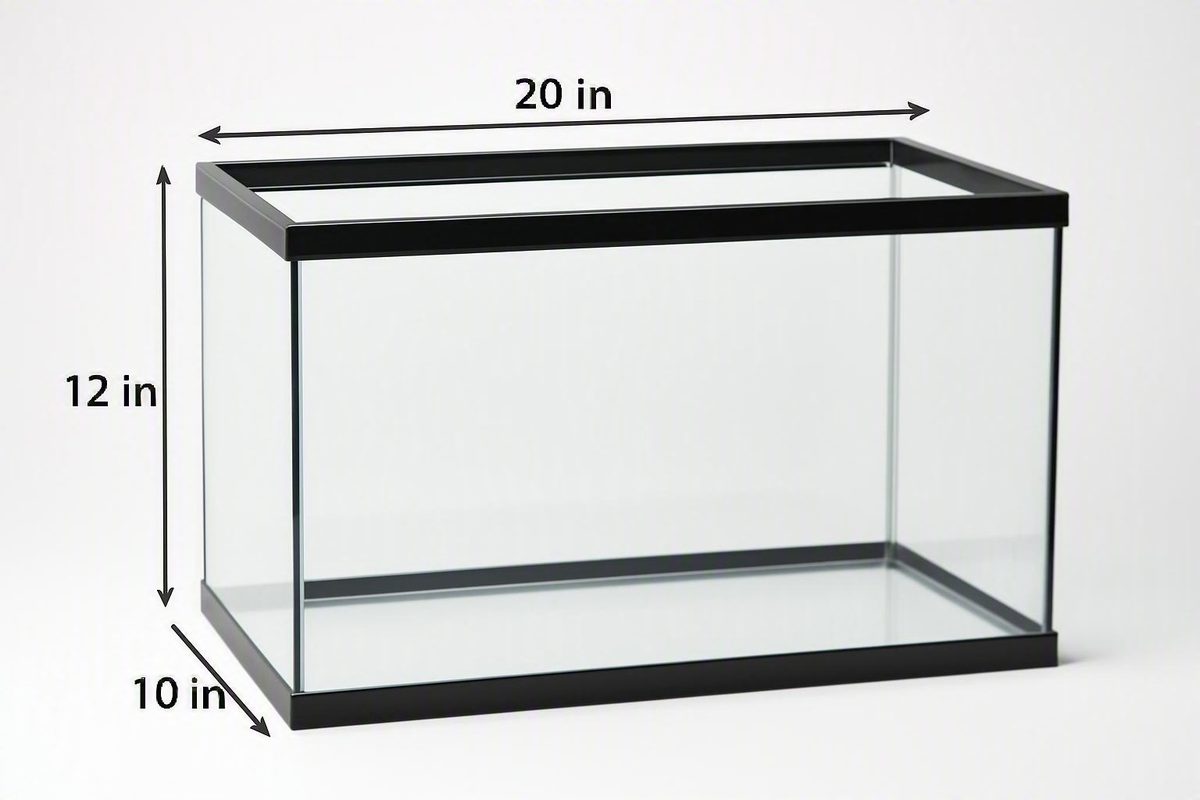
AquariumCalc lists 20 × 10 × 12 inches as a common 10-gallon size. Exact models can differ in proportions, frames, rims and equipment.
A typical rectangular 10-gallon fish tank measures about 20 × 10 × 12 inches—approximately 50.8 × 25.4 × 30.5 centimeters—in length × width × height order. Its usual base footprint is about 20 × 10 inches, or 200 square inches. These are common planning dimensions, not guaranteed specifications for every model. AquariumCalc lists 20 × 10 × 12 inches as a common 10-gallon size.
The tank itself is also only part of the required space. A complete installation may need additional room behind or above the glass for a filter, hood, cords, tubing, plugs, and maintenance access.
“10 gallons” describes a nominal capacity category rather than one mandatory exterior design. Before buying a stand, lid, hood, cabinet, or aquarium, check the current specifications and physical measurements of the exact model.
The quick answer: standard 10-gallon tank dimensions
For initial planning, use these typical 10-gallon fish tank measurements:
- Length: approximately 20 inches
- Width or depth: approximately 10 inches
- Height: approximately 12 inches
- Metric equivalent: approximately 50.8 × 25.4 × 30.5 centimeters
- Base footprint: approximately 20 × 10 inches, or 200 square inches
A rough aquarium size-and-weight table gives the following planning figures for a standard glass 10-gallon “Leader” tank. Its 111-pound filled figure is a published chart estimate, not an itemized calculation or a guarantee for every installation. SaltwaterAquarium.com labels its dimensions and weights as rough guidelines.
| Nominal capacity | Typical exterior dimensions | Approximate metric dimensions | Typical base footprint | Approximate empty weight | Published tank-plus-water estimate |
|---|---|---|---|---|---|
| 10 U.S. gallons | 20 × 10 × 12 in | 50.8 × 25.4 × 30.5 cm | 20 × 10 in, or 200 sq in | 11 lb for a standard glass tank | 111 lb |
All entries are typical or approximate. Construction, actual water volume, substrate, décor, and equipment can change the dimensions or installed weight.
Dimension labels can also vary. Listings may use:
- L × W × H: length × width × height
- L × D × H: length × depth × height
- W × D × H: width × depth × height
For a conventional front-facing rectangular tank, the roughly 20-inch side runs horizontally across the front, the roughly 10-inch side runs from front to back, and the roughly 12-inch measurement is vertical. A seller using “width” for the front dimension might therefore write W × D × H without describing a different shape.
The nominal footprint is only the starting point. Use the maximum exterior measurements of the actual tank for physical placement, then add the space required by the selected equipment and by routine access.
Why not every 10-gallon aquarium has the same measurements
A gallon rating describes nominal volume, not a universal exterior shape. Tanks in the same 10-gallon category can have different proportions, frames, rims, and included equipment.
Three examples show why model-specific measurements matter:
| Example | Published or typical dimensions | Dimension order | Important qualification |
|---|---|---|---|
| Common rectangular 10-gallon tank | About 20 × 10 × 12 in | L × W × H | General planning convention, not a universal specification |
| Aqueon 10-gallon open-glass tank listed by Petco | 20.25 × 10.5 × 12.625 in | L × W × H | Retailer-listed dimensions for one model |
| Tetra Complete LED Aquarium Kit, 10 gallon | Approximately 20 × 10 × 12 in | W × D × H | Manufacturer describes the dimensions as approximate |
Petco lists the Aqueon open-glass aquarium at 20.25 inches long, 10.5 inches wide, and 12.625 inches high. Petco also says its product information is supplied by manufacturers, suppliers, and other third parties and is not independently verified. The cited tank is sold without a lid, light, filter, heater, substrate, or décor. See Petco’s Aqueon product listing.
Tetra gives its Complete LED Aquarium Kit approximate dimensions of 20 inches wide, 10 inches deep, and 12 inches high. The kit includes a hinged LED hood and a power filter, so its installation envelope differs from that of a bare open-glass tank even though the basic measurements are similar. See Tetra’s dimensions and kit contents.
Several factors can account for differences among published measurements:
-
Rounded size charts: A general chart may round dimensions to whole inches.
-
Unclear measurement boundaries: A listing may not say whether its figures include every frame edge, hood, handle, or projection.
- Different proportions: Tanks with similar nominal capacities can distribute their volume across different lengths, depths, and heights.
- Tank versus kit: A kit may add a hood, light, filter, handle, or other component beyond the bare glass.
Do not assume that any one measurement convention applies universally. When the published method is unclear, ask the manufacturer what is included or measure the assembled product.
An older, manufacturer-unspecified table provides a historical example of different proportions. It lists a 10-gallon “leader” at 20 × 11 × 13 inches and a 10-gallon “long” at 24 × 9 × 13 inches, both in L × D × H order. These are dated stock-tank examples, not current specifications for all tanks carrying those labels. View Melissa Kaplan’s stock-aquarium table, last updated in 2014.
The long-format example uses more horizontal length and less front-to-back depth. It would need a longer supporting surface than the familiar 20-inch tank, but its narrower depth could fit a location where a conventional footprint would not.
The decision rule is straightforward: use 20 × 10 × 12 inches for early planning, but use the exact model’s current specification for purchasing and installation. If a shelf, recess, stand, or fitted accessory has little tolerance, measure the actual product.
How to read and measure aquarium dimensions correctly
Before comparing an aquarium with a stand or cabinet, identify what each measurement means:
- Length: normally the longest horizontal side, usually the front viewing side.
- Width or depth: the distance from the front panel to the back.
- Height: the vertical distance from the base to the top.
Do not assume that the first number always represents length. Product pages may use L × W × H, L × D × H, or W × D × H. Read the labels beside the figures and consult the product diagram when available.
You need two separate sets of measurements because physical fit and water volume are different questions.
Use maximum exterior dimensions for placement. Measure the farthest points across the tank and any applicable rim or frame. These figures determine whether the aquarium fits on a stand, through a cabinet opening, under a shelf, or inside a recess.
Use internal dimensions for volume estimates. Measure the usable interior length and width, then measure vertically from the internal bottom to the normal waterline. A rectangular tank’s filled volume is based on internal length × internal width × filled depth, and the result remains an estimate when the real tank differs from an ideal geometric box. CalculatorSoup’s tank-volume method specifies inside dimensions and actual fill depth.
Do not automatically measure water depth to the rim. Aquariums are not necessarily operated completely full, and the gap above the normal waterline is not water volume.
Verify whether:
- The rim extends beyond the glass
- The listed height includes a hood or only the tank
- A hinged lid rises beyond the listed height when opened
- A filter projects behind the rear panel
- Handles, knobs, tubes, or cables create additional high points
- A separate base or kit component affects the installation envelope
A practical measuring workflow is:
- Identify the exact product. Record the manufacturer, model name, material, and model or product number.
- Confirm the dimension order. Determine what the listing means by length, width, depth, and height.
- Measure the maximum exterior footprint. Record the widest and deepest points that must fit the support.
- Measure the rim separately. Use the relevant outside and inside rim dimensions when selecting a fitted lid, hood, or screen.
- Check assembled height. Include the hood, light, handles, and the lid’s opening path.
- Record internal dimensions. Measure inside the tank rather than copying the exterior figures.
- Measure normal water depth. Measure to the intended waterline, not automatically to the rim.
- Keep the records separate. Label one set “exterior fit” and the other “internal water volume.”
This avoids two common errors: using internal dimensions to determine whether the tank fits a support and using exterior dimensions to claim an exact water capacity.
Footprint, stand space, and equipment clearance
The familiar rectangular 10-gallon tank has a typical glass footprint of about 20 × 10 inches, equal to 200 square inches. That is a planning baseline, not the complete installation envelope.
The supporting surface must match the actual aquarium base and the support method required by the aquarium and stand manufacturers. A stand described only as suitable for “10 gallons” is not necessarily a dimensional match for every tank in that capacity category.
Load capacity also needs to be evaluated against the complete setup rather than the empty glass alone. Petco’s planning guide includes the tank, water, and gravel when estimating load and notes that décor and equipment add further weight; such retailer estimates are planning aids, not structural certification. Final installation requirements should come from the aquarium and support manufacturers. Review Petco’s aquarium weight-planning guide.
The space around the aquarium may need to accommodate:
- Hang-on-back or external filters
- Intake and return components
- Airline or other tubing
- Power plugs and cord routing
- Heater and light cables
- A hood or lid opening upward
- Removal of filter media
- Equipment lifting and cleaning
- Feeding and water-change access
A compact internal filter and a hang-on-back filter do not occupy the same space, and hinged hoods differ in their opening paths. Use the documentation and physical dimensions of the equipment that will actually be installed.
A bare tank and a kit illustrate the difference. The cited Aqueon model is an open-glass tank with major setup components sold separately. The Tetra kit has similar approximate tank dimensions but includes a hinged LED hood and filter. The kit therefore needs room for its supplied hardware and hood movement, while the bare tank’s final clearance depends on the accessories added later.
Before installation, check that:
- [ ] The support is at least as long and deep as the actual tank base.
- [ ] The support arrangement follows the aquarium manufacturer’s instructions.
- [ ] The stand or support is assembled, positioned, and maintained as its manufacturer requires.
- [ ] Its stated load capacity covers the complete planned setup.
- [ ] Rear space is sufficient for the selected filter, tubing, plugs, and cords.
- [ ] Overhead space allows the lid or hood to open or be removed.
- [ ] Cables can be routed without being trapped behind the aquarium.
- [ ] Filter media and equipment can be removed for maintenance.
- [ ] Feeding, cleaning, and water changes can be performed without obstruction.
- [ ] Nearby doors, drawers, switches, and vents remain usable.
Avoid fitting the glass tightly into a recess simply because the opening matches the nominal tank dimensions. The bare tank might fit while leaving no practical way to install a filter, open the hood, route a plug, or reach the equipment.
How much a 10-gallon aquarium weighs
There is no single filled weight for every 10-gallon aquarium. Any useful estimate must specify what it includes.
Empty glass tank
A standard glass 10-gallon “Leader” tank is commonly estimated at approximately 11 pounds empty. The same rough reference table reports 111 pounds filled, but it does not itemize the arithmetic behind that figure. Treat both numbers as chart estimates for planning, not as measurements of every tank. See the published aquarium size-and-weight table.
Different tank designs and actual contents can produce different results. Use a model-specific empty weight when one is available.
Tank plus freshwater
Freshwater is commonly estimated at about 8.34 pounds per U.S. gallon, so exactly 10 gallons of water would weigh approximately 83.4 pounds. Adding that amount to an 11-pound empty tank produces an itemized tank-and-water total of about 94.4 pounds before substrate, rock, décor, or equipment.
That itemized calculation should not be confused with the separately published 111-pound chart estimate. The chart describes its figures as rough and does not explain the components of the 111-pound value. It should therefore be labeled as a reference estimate rather than treated as an exact physical total.
The aquarium’s nominal label also does not prove that the installed setup contains exactly 10 gallons of water. Internal dimensions, fill height, and displacement can reduce the actual amount.
Conservative tank, water, and gravel example
Petco presents a more conservative planning example of approximately 121 pounds, consisting of:
- 11 pounds for the empty glass tank
- 100 pounds as a deliberately conservative water allowance
- 10 pounds for gravel
That example rounds water up to 10 pounds per nominal gallon for planning instead of using the stated physical estimate of approximately 8.34 pounds per gallon. It excludes décor, rocks, filters, heaters, sumps, and other equipment, all of which can add weight.
The different estimates represent different assumptions:
| Scenario | What it represents | Approximate planning weight |
|---|---|---|
| Empty standard glass aquarium | Tank only | 11 lb |
| Itemized tank plus exactly 10 gallons of freshwater | 11 lb tank + 83.4 lb water | 94.4 lb |
| Published rough filled-weight chart | Table’s non-itemized estimate | 111 lb |
| Conservative Petco example | Tank + enlarged water allowance + gravel | 121 lb |
| Complete installed aquarium | Actual tank, water, substrate, décor, and equipment | Must be totaled for the setup |
For a stand or shelf evaluation, itemize:
- Actual empty tank weight
- Expected water weight
- Substrate weight
- Rock and décor weight
- Filter and heater weight
- Hood and lighting weight
- Water held in any external equipment
A published weight estimate cannot certify that a particular stand, shelf, cabinet, or floor arrangement is suitable. Confirm the support dimensions, capacity, condition requirements, and installation method with the relevant manufacturers.
Nominal capacity versus actual water volume
Four related measurements are often confused:
- Nominal capacity: the commercial category printed on the tank or package.
- Exterior dimensions: the maximum outside length, width, and height.
- Internal geometric capacity: the theoretical volume inside the walls.
- Practical filled water volume: the water actually present at the normal fill line after displacement.
These values are not interchangeable.
Multiplying the rounded exterior dimensions of a typical tank gives:
20 in × 10 in × 12 in = 2,400 cubic inches
One U.S. gallon contains 231 cubic inches, so the exterior-box calculation is:
2,400 ÷ 231 ≈ 10.4 U.S. gallons
This does not prove that the aquarium holds 10.4 gallons of usable water. The calculation treats the complete exterior box as hollow water space. The 231-cubic-inch conversion is established, but usable volume must be based on internal dimensions and actual water depth. The dated stock-tank reference states the 231-cubic-inch U.S.-gallon conversion.
For a rectangular aquarium, estimate gross filled volume with:
Internal length × internal width × actual water depth
When all measurements are in inches:
U.S. gallons ≈
(internal length in inches
 × internal width in inches
 × actual water depth in inches)
÷ 231
Practical water volume may be reduced by:
- Glass thickness and internal framing
- The gap between the waterline and rim
- Substrate
- Rocks
- Wood and other décor
- Internal filters
- Heaters and submerged equipment
- Other internal features
Use this template with measurements from the actual aquarium:
Internal length: _____ inches
Internal width:  _____ inches
Water depth:     _____ inches

_____ × _____ × _____ = _____ cubic inches

_____ cubic inches ÷ 231 = _____ gross filled gallons

Estimated displaced volume from substrate,
rock, décor, and equipment: _____ gallons

Estimated practical water volume:
_____ gross gallons − _____ displaced gallons
= _____ gallons
Do not insert the published exterior dimensions of the cited Aqueon or Tetra products and present the result as their actual capacity. The evidence here does not establish their internal dimensions or precise normal fill depths.
Actual volume matters whenever a task depends on water quantity. For example:
25% of 10 nominal gallons = 2.5 gallons
That is a convenient rough figure. If the finished aquarium contains less than 10 gallons of water, however, removing 2.5 gallons changes more than 25% of the water actually present. Precise percentage calculations should use the setup’s estimated practical water volume.
A pre-purchase checklist for tanks, lids, kits, and stands
Use this checklist in a store or while comparing online listings.
Tank identity and construction
- [ ] Confirm the manufacturer and exact model name.
- [ ] Record the product or model number.
- [ ] Confirm whether the aquarium is glass, acrylic, or another material.
- [ ] Determine whether the listed dimensions are exact, nominal, or approximate.
- [ ] Check whether the measurements describe the tank alone or an assembled kit.
Dimensions
- [ ] Confirm whether the order is L × W × H, L × D × H, or W × D × H.
- [ ] Record the maximum exterior length, depth, and height.
- [ ] Determine whether the published height includes the hood.
- [ ] Check for frames, handles, hinges, knobs, filters, or other projections.
- [ ] Measure the actual rim before ordering a fitted lid or hood.
A lid marketed for a nominal 20 × 10-inch aquarium is not guaranteed to fit every 10-gallon tank. The Petco-listed Aqueon example has horizontal dimensions of 20.25 × 10.5 inches, and lid compatibility can also depend on the rim profile, inside lip, hinge arrangement, and equipment openings.
Stand or support
- [ ] Compare the stand’s usable top with the actual tank base.
- [ ] Follow the support method specified for the selected aquarium.
- [ ] Follow the stand manufacturer’s assembly and placement instructions.
- [ ] Compare the stated load capacity with the complete installed weight.
- [ ] Include water, substrate, rocks, décor, and equipment.
- [ ] Do not rely only on a “fits 10 gallons” marketing label.
Equipment and access
- [ ] Measure the selected filter’s rear and vertical projections.
- [ ] Allow room for tubing, intakes, returns, plugs, and cords.
- [ ] Check the full opening path of the lid or hood.
- [ ] Confirm that filter cartridges and equipment can be removed.
- [ ] Leave practical access for feeding, cleaning, and water changes.
- [ ] Make sure the installation will not block doors, vents, switches, or drawers.
Bare tank versus kit
- [ ] Read the included-components list rather than relying on the word “complete.”
- [ ] Identify the supplied filter, hood, and light.
- [ ] Determine which intended components must be purchased separately.
- [ ] Base clearance calculations on the equipment that will actually be installed.
The distinction matters here: the cited Aqueon product is an open-glass tank with major accessories sold separately, whereas the cited Tetra kit includes a hinged LED hood and filter. Similar basic dimensions do not create identical installation requirements.
Water volume
- [ ] Measure internal length and width.
- [ ] Measure water depth to the normal waterline.
- [ ] Calculate gross filled volume from those internal measurements.
- [ ] Account for displacement from substrate, rocks, décor, and equipment.
- [ ] Keep nominal capacity separate from practical water volume.
General size charts are useful for narrowing a search and planning a room layout. Make the final decision using current manufacturer documentation and, where compatibility is tight, physical measurements of the specific tank and accessory.
Frequently asked questions
What are the dimensions of a standard 10-gallon fish tank in inches and centimeters?
A typical rectangular model is approximately 20 × 10 × 12 inches, or 50.8 × 25.4 × 30.5 centimeters, but individual products can differ. AquariumCareBasics reports both the rounded convention and a slightly larger alternative measurement.
Are all 10-gallon aquariums exactly 20 × 10 × 12 inches?
No. Ten gallons is a nominal capacity category. Use the common dimensions for early planning, then verify the exact model before choosing a stand, cabinet, hood, or other fitted accessory.
How much does a 10-gallon fish tank weigh when filled?
It depends on what “filled” includes. Published references provide different tank-only, tank-and-water, and conservative tank-water-gravel estimates. For support planning, total the actual aquarium, expected water, substrate, rocks, décor, and equipment rather than relying on one universal figure.
Will a 20 × 10-inch lid fit every 10-gallon aquarium?
No. The lid must match the actual rim dimensions, profile, hinge arrangement, and equipment openings. Measure the tank and check the lid manufacturer’s compatibility information before buying.
How do I calculate how much water my 10-gallon tank actually holds?
Multiply the internal length by the internal width and the water depth to the normal waterline. If the measurements are in inches, divide the cubic-inch result by 231, then allow for displacement from substrate, rocks, décor, and internal equipment.
The bottom line
A typical 10-gallon aquarium is about 20 × 10 × 12 inches, but that is a planning baseline rather than a universal specification. Confirm the exact model’s exterior and rim measurements, follow the tank and support manufacturers’ installation requirements, allow room for equipment and maintenance, total the complete setup weight, and use internal dimensions when estimating actual water volume.