
How to Add Useful Automation Without Putting Your Aquarium on Autopilot
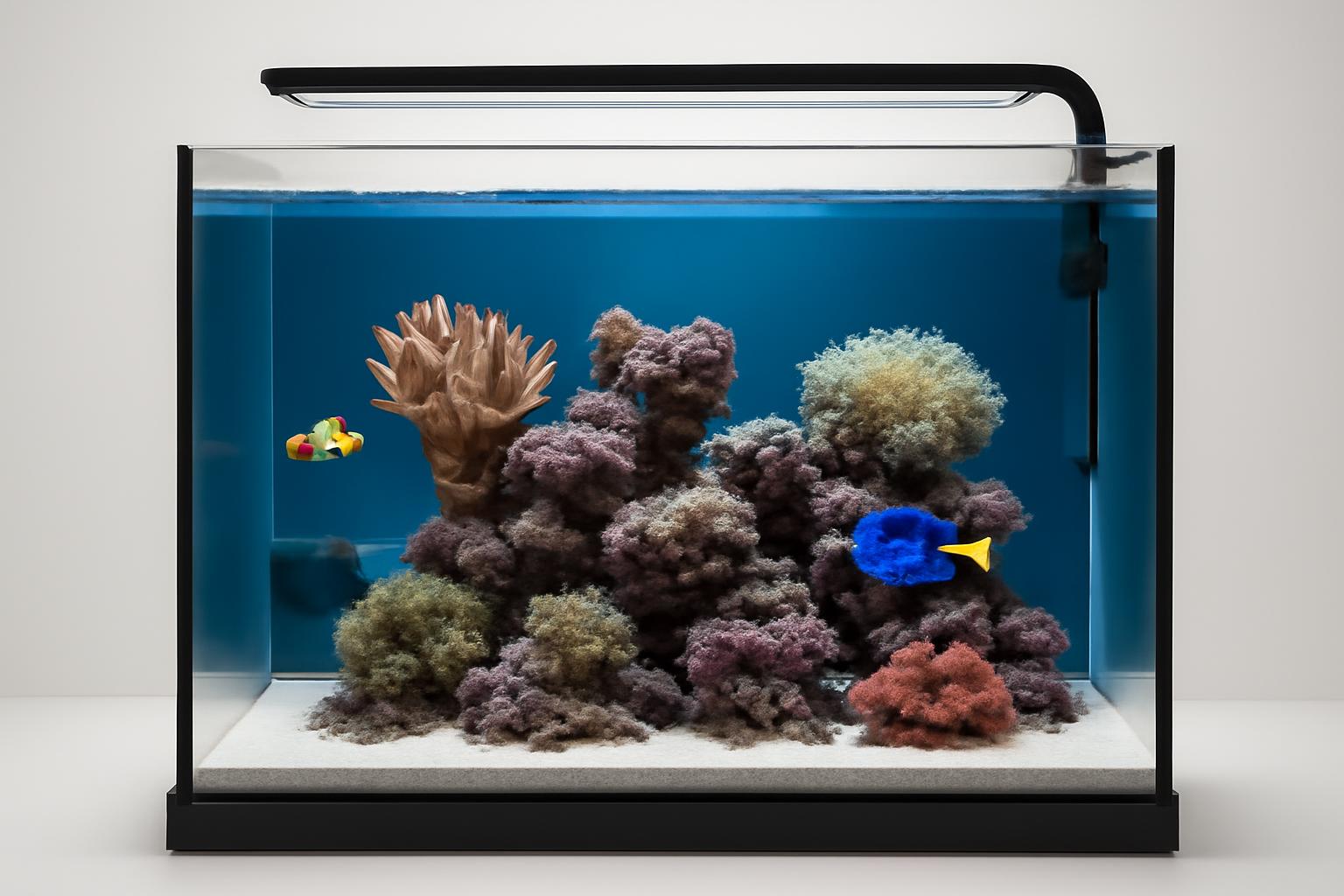
Compare programmable, connected, monitored and automated equipment by the problem it solves and how clearly each function is documented.
A worthwhile smart aquarium starts with the same foundations as any successful aquarium: an appropriate habitat, adequate water volume, reliable filtration, suitable circulation and informed maintenance. An app cannot compensate for an unsuitable tank, an incomplete nitrogen cycle or neglected equipment.
The useful buying question is not simply, “Is this aquarium smart?” It is: What does the technology measure or control, what problem does that solve, and what happens when it fails?
That distinction matters especially in saltwater and reef systems. Automation can make repetitive work more consistent, improve visibility while you are away and provide earlier warning of a problem. It can also create false confidence if an owner trusts a sensor, feeder or cloud service without verification and backups.
This guide compares product categories and provides a purchasing framework; it does not validate or rank current models. Marketplace specifications are seller-supplied unless stated otherwise, and the available evidence does not establish current warranties, subscriptions, outage behavior, replacement-part support or long-term reliability. Those details must be confirmed in current manuals, privacy policies and manufacturer support documents before purchase.
What makes an aquarium genuinely smart?
“Smart aquarium” has no consistent market definition. Retailers and manufacturers use the label for everything from color-changing lights and digital temperature displays to connected sensor networks that operate pumps or feeders.
A practical way to compare products is to place each function in one or more of four tiers:
| Tier | What it does | Typical examples |
|---|---|---|
| Programmable | Follows a stored schedule or setting | Light timer, scheduled feeder, preset pump mode |
| Connected | Provides app, network or remote access | Wi-Fi camera, app-controlled light, cloud dashboard |
| Monitored | Collects sensor data and may generate alerts | Temperature probe, pH monitor, out-of-range notification |
| Automated | Uses an actuator to change an aquarium function | Feeder motor, heater controller, dosing pump, circulation or water-management control |
A product can occupy one tier or several. A programmable light is still useful if it has no internet connection. A Wi-Fi camera is connected but does not monitor water chemistry. A temperature sensor may record data without controlling a heater. None of these products necessarily constitutes a complete smart-aquarium system.
It also helps to separate four actions that advertising often blends together:
- Observation: A camera lets you look at the aquarium.
- Detection: A sensor measures a condition.
- Notification: An app, message or alarm communicates a reading.
- Correction: An actuator changes something in response.
For example, a temperature display may show that the water is warm. That does not prove it can send an alert, switch off a heater or activate cooling. Buyers should verify every step independently.
Commonly advertised functions include scheduled feeding, programmable lighting, temperature or water-condition monitoring, remote viewing, alerts, filtration management and pump control. Some commercial descriptions also refer to central apps that connect multiple devices. The existence of an app, however, does not establish sensor accuracy, cross-brand interoperability or reliable local operation.
Treat visual and interface features accordingly. RGB lighting, a touch panel and a digital display may improve usability or appearance, but they are not evidence of remote connectivity. Likewise, names containing “SMART” or “SmartClean” do not establish that a product has sensors, alerts, Wi-Fi or automatic intervention.
The most useful definition is therefore functional rather than promotional: a smart aquarium uses programmable, connected, monitored or automated equipment to solve defined aquarium-management problems—and clearly documents which functions it actually provides.
The smart-aquarium market includes several different product categories
Search results for “smart aquarium” mix products that should not be compared directly. A complete tank, a conventional kit with an electronic light, a Wi-Fi camera and a DIY controller solve different problems.
| Product category | What is normally included | What to verify |
|---|---|---|
| Complete connected tank | Aquarium plus some combination of filtration, lighting, feeder, app or monitoring | Usable volume, filtration design, local controls, sensors, outage behavior and replacement parts |
| Electronically equipped starter kit | Tank, filter, light and perhaps a temperature display or timer | Whether functions are merely electronic or genuinely connected |
| Smart-branded conventional kit | A kit with “Smart,” “SMART” or similar wording in its name | The exact technical meaning of the branding |
| Standalone camera | Remote video, recording or motion features | That it observes the tank but does not directly measure water conditions |
| Modular lights and feeders | Programmable or app-enabled equipment added separately | Local scheduling, mounting compatibility and failure behavior |
| Sensor-and-controller system | Probes, controller, alerts and potentially switched outlets or actuators | Calibration, control limits, internet dependence and manual overrides |
| DIY build | User-selected controller, sensors, software and actuators | Electrical skill, validation, maintenance, fail-safes and long-term support |
Retail pages can illustrate how loosely these categories are grouped, but they are not reliable product rankings. The research capture supplied for this guide did not preserve an observation date, so its exact counts and prices cannot be treated as current or reproducible offers.
In that undated Walmart capture, the category displayed 153 results. Visible complete kits were primarily compact tanks from 1.2 to 5 gallons, with displayed prices ranging from $29.99 to $129.99. Several listings were sponsored or promotional. One seller-listed SPECSTAR 2-gallon kit advertised app control, an automatic feeder, RGB lighting, filtration and a temperature display. All of those capabilities were seller-supplied and unverified; the listing did not establish whether schedules ran locally, how feeder output was limited or whether the temperature display could issue alerts.The undated Walmart marketplace capture contains the result count, size and price ranges, and SPECSTAR listing claims.
The undated Chewy capture showed a sponsored 2.5-gallon Aqueon LED MiniBow SmartClean kit at $56.99 and a sponsored 14-gallon Coralife Silicone SMART BioCube Jr. at $269.99. The supplied descriptions did not establish app connectivity, sensor monitoring or remote automation for either product. The names alone therefore do not make them equivalent to connected control systems.The Chewy category capture provides the smart-branded names, capacities and snapshot prices.
The visible sponsored Amazon result was not a tank at all. It was a 3 MP/2K aquarium and terrarium camera advertised with dual-band Wi-Fi, autofocus and continuous recording. Those seller-supplied features could make it a useful connected accessory, but the camera did not directly measure temperature, pH, salinity or other water conditions.Amazon’s marketplace results illustrate how a connected camera can appear under the “smart aquarium” search term.
These snapshots are examples, not recommendations. Sponsored placement is advertising rather than evidence of quality. Bestseller labels, star ratings, discounts and result counts also do not establish reliability, animal suitability or accurate product claims. Compare products within the correct category before comparing prices.
Choose the aquarium for its livestock before evaluating the technology
The safest decision order is:
- Intended livestock and habitat
- Appropriate usable water volume and dimensions
- Biological and mechanical filtration
- Circulation and gas exchange
- Heating or cooling needs
- Lighting requirements
- Access for cleaning and equipment service
- Connected conveniences and automation
This sequence prevents an attractive app or low purchase price from determining the habitat. The compact desktop tanks prominent in retail results may fit easily in a room, but capacity alone cannot establish suitability for a fish, coral or invertebrate. Species behavior, adult size, territorial needs, substrate, flow, shelter, compatibility and waste production all matter.
Small aquariums deserve particular caution. They may cost less and occupy less space, but lower water volume provides less buffering against temperature and chemistry changes. A given amount of evaporation, waste or accidental addition represents a larger proportional change in a small system.
For a reef aquarium, the foundational equipment described in the available manufacturer-authored husbandry guidance includes suitable lighting, filtration, circulation, heating, temperature and salinity measurement, and water testing. The precise equipment must match the system, but those needs do not disappear because filtration chambers or controls are integrated into the enclosure.
An all-in-one aquarium can make equipment placement neater and setup more convenient. It does not automatically cycle the tank, establish suitable stocking, maintain chemistry or remove the need to inspect inaccessible chambers.
Livestock-first rule
Reject any candidate aquarium that fails the intended livestock’s space and habitat needs—regardless of its app, lighting effects, discount or automation features.
Only after a tank passes that test should smart features influence the choice. Technology should support a suitable aquarium, not be used to justify an unsuitable one.
Evaluate each feature by what it actually does
A feature list becomes useful when every item is tied to its hardware, maintenance needs and possible failure modes.
| Capability | Practical use | Necessary hardware | What it does not prove | Routine maintenance | Illustrative failure mode |
|---|---|---|---|---|---|
| Programmable lighting | Creates repeatable timing and intensity | Fixture, timer or controller | Water-quality monitoring, remote access or livestock suitability | Clean fixture; review schedule and intensity | Lost schedule, failed channel or unsuitable output |
| Automatic feeder | Dispenses scheduled portions | Food hopper, motor and timer or controller | Consistent portions under every food and storage condition | Keep dry, clear outlet and test portions | Jam, empty hopper or unintended dispense |
| Camera | Enables remote visual inspection | Camera, power and network connection | Direct measurement of chemistry or temperature | Clean lens; check angle, privacy and storage | Lost connection, blocked view or misleading image |
| Temperature display | Shows a temperature reading | Probe and display | Alerts or equipment control | Compare with an independent instrument | Drift, poor probe placement or display failure |
| Connected controller | Logs data, sends alerts or switches equipment | Probe, controller, outlets and connectivity | Accurate probes or safe corrective logic | Calibrate, inspect and test alerts | Bad reading, service outage or incorrect switching |
| Pump or filtration control | Schedules or adjusts flow and operation | Pump, controller and suitable plumbing | Effective filtration or “silent” operation | Clean impeller; inspect intake and real flow | Blockage, stalled pump or lost settings |
| Water-management automation | Operates top-off, transfer or other water functions | Sensors, pumps, reservoirs and safeguards | Correct chemistry or protection from every leak | Clean sensors; inspect tubing and limits | Bad sensor, empty reservoir or unintended transfer |
Programmable lighting is useful because consistency can be difficult to achieve manually. The Coralife Seascape SMART LED is described in the available manufacturer guide as dimmable in 1% increments with programmable 24/7 scheduling. That source does not establish remote monitoring, sensor integration or broader automated control, and programming does not prove that a spectrum or intensity suits a particular coral.Coralife’s guide identifies the named fixture and its 1% dimming and 24/7 scheduling specifications.
Automatic feeders can support a conservative schedule, but “automatic” should not be confused with verified portion consistency. A blockage may prevent feeding, while an unintended extra operation may dispense too much. These are illustrative failure scenarios rather than documented behavior of every feeder. Test the actual food and portion before relying on a device.
Cameras answer questions such as whether the lights are on, whether water appears to be moving and whether livestock is in its usual location. They cannot directly measure pH, salinity, ammonia, nitrate or other chemistry.
Temperature functions require careful reading. A display reports a value. A monitor may record it. An app may notify the owner. A controller may switch a heater or fan. Verify which functions exist, whether the probe is replaceable and whether switching logic runs without a cloud connection.
Pump, filtration and water-management controls can operate useful equipment, but they do not validate promotional terms. “Silent” has no consistent marketplace performance definition.
Unless documentation specifies what is cleaned, where the waste goes and what work remains, interpret “self-cleaning” as a maintenance-reduction claim, not a maintenance-free promise. Expect to inspect filtration, remove waste, clean surfaces and service equipment.
Match monitoring to the aquarium instead of chasing sensor counts
Temperature, pH, total dissolved solids and turbidity are commonly discussed in smart-aquarium designs. That does not mean every commercial product measures them or that all four are equally useful in every aquarium.
More sensors do not automatically create better monitoring. A measurement needs to be:
- Relevant to the aquarium and the decision being made
- Accurate and precise enough for that decision
- Taken from a sensible location
- Maintained and calibrated appropriately
- Interpreted in context
- Verifiable when the result is surprising
A freshwater monitoring package cannot be assumed to cover reef requirements. Saltwater and reef systems also need salinity or specific-gravity measurement, while applicable testing may include ammonia, nitrite, nitrate, pH, calcium and phosphate. The appropriate tests vary with tank age, livestock and the problem being investigated.
TDS and turbidity are not complete substitutes for reef-specific chemistry testing. Neither reading alone establishes whether a particular reef parameter requires correction.
Establish a manual baseline before setting alert thresholds. Learn how the aquarium behaves across its normal lighting, feeding and maintenance cycle.
Any automated reading that is surprising—or that would justify a major intervention—should be checked with an appropriate independent test. This is particularly important before changing chemistry, stopping circulation or altering heating in response to a single input.
Probe ownership also creates recurring work. Ask how each sensor is cleaned, calibrated and replaced; whether calibration solutions are required; how fouling may affect it; and what the device does when a reading becomes implausible. The available evidence does not establish universal schedules or current replacement costs for commercial probes, so obtain model-specific instructions.
Raw data becomes an actionable alert only when the owner knows:
- What the reading represents
- Whether the change is credible
- How urgently it requires attention
- How to verify it
- What response is proportionate
Notification design matters too. One ESP32 prototype used configurable alert cooldowns to reduce repetitive notifications. That is a design approach, not proof that cooldowns are appropriate for every system. A cooldown must not conceal a condition that remains critical; a useful interface distinguishes “acknowledged” from “resolved.”
Automation reduces repetitive work; it does not eliminate aquarium maintenance
The dividing line is not between manual and automatic aquariums. It is between tasks that can be delegated within safe limits and responsibilities that still require observation and judgment.
| Potentially automatable | Owner responsibility |
|---|---|
| Lighting schedules | Selecting suitable lighting and reviewing livestock response |
| Conservative feeding schedules | Confirming actual delivery and adjusting intake |
| Remote viewing | Direct livestock observation |
| Data logging | Understanding trends and verifying questionable readings |
| Threshold alerts | Deciding whether and how to intervene |
| Selected pump controls | Cleaning pumps and confirming actual flow |
| Temperature notifications | Checking temperature independently and inspecting heating equipment |
| Limited, bounded controller actions | Setting limits and retaining manual overrides |
Cycling, cleaning, water changes, substrate care, filter inspection, sensor maintenance and corrective judgment remain owner tasks. Automation can remind an owner that maintenance is due, but it cannot confirm that waste was removed properly or that an animal’s behavior has been interpreted correctly.
For a new saltwater aquarium, the available manufacturer guidance describes a sequence that includes leak and electrical checks, an appropriate outage test, salinity adjustment, circulation and cycling. It advises adding animals gradually only after ammonia and nitrite are not measurable under the selected test method. The same source recommends daily monitoring during the first month and weekly testing after the system is stable, alongside regular equipment and aquarium inspection. That is source-specific guidance rather than a universal schedule for every aquarium.The Coralife setup guide provides the outage-test sequence and its stated first-month and stable-system testing cadence.
Automation creates false confidence when receiving data is mistaken for understanding the system. A clear camera image may not reveal deteriorating chemistry.
Reject descriptions that imply a smart aquarium is maintenance-free, self-sustaining, guaranteed to prevent a crash or inherently safe to leave unattended. Connected equipment can reduce repetitive work; it cannot remove biological uncertainty, equipment wear or the need for informed care.
Integrated tank, modular retrofit, or DIY controller?
There are three broad ways to build a smart aquarium. The right choice depends on whether you already own a suitable tank, how much technical work you want and how much vendor dependence you will accept.
| Factor | Integrated tank | Modular retrofit | DIY controller |
|---|---|---|---|
| Setup effort | Usually lower initially | Incremental and moderate | Highest |
| Expandability | Depends on ecosystem and ports | Potentially high | High if designed for it |
| Repairability | May depend on proprietary assemblies | Individual components may be replaceable | User handles diagnosis and repair |
| Vendor dependence | Often concentrated in one app or platform | Spread across selected products | Depends on chosen hardware, software and services |
| App convenience | Potentially one interface | Multiple apps or controls may be required | Customizable but user-managed |
| Technical skill | Low to moderate | Moderate | High |
| Failure isolation | One fault may affect integrated functions | Components can often be separated | Depends on architecture and safeguards |
An integrated system can be convenient for buyers who want a coordinated enclosure and one interface. The tradeoff is possible reliance on proprietary filters, pumps, probes, applications or cloud support. These are evaluation concerns, not established defects of any named product. Ask what happens if one integrated component fails and whether the aquarium can accept a conventional replacement.
A modular retrofit lets an owner keep an appropriate existing aquarium and add functions incrementally. Start with reliable filtration and essential environmental control. Then add programmable lighting, feeding, temperature alerts, cameras, controllers or justified sensors where they solve a defined problem.
Two products having Wi-Fi or mobile apps does not mean they exchange data, share automation rules or operate through the same local hub.
A DIY controller offers the greatest design freedom and places the greatest responsibility on the builder. A January 2026 arXiv preprint described a 10-liter test aquarium built around an ESP32 and the Blynk cloud platform, using pH, TDS, temperature and turbidity sensors plus a servo feeder and water pump. Its authors reported 96% average sensor accuracy, a 1.2-second anomaly response and 97% operational reliability for automated feeding and circulation. These are unverified author claims from a small prototype—not independent validation or evidence of commercial performance—and should not be extrapolated to a larger reef aquarium. The paper does not demonstrate an AI-driven or self-learning system.The ESP32 preprint describes the 10-liter architecture and reports the 96%, 1.2-second and 97% results.
In practical terms:
- Choose integrated when one interface matters and you accept ecosystem dependence.
- Choose retrofit when tank suitability, incremental spending and replaceable components are priorities.
- Choose DIY when you can validate sensors, manage electrical and software work, maintain the system and design safe failure behavior.
Plan for failure before connecting livestock-critical equipment
Every connected function should be evaluated under failure, not only during a successful demonstration.
| Failure | What may continue locally? | What may stop? | How should the owner know? | Override or backup to seek |
|---|---|---|---|---|
| Power loss | Powered functions generally stop unless backed up; passive or gravity-driven behavior must be assessed separately | Pumps, heaters, lights, network equipment and controllers | Independent outage notification where available | A tested, tank-specific outage plan |
| Wi-Fi loss | Local schedules may continue if stored on the device | Remote viewing, cloud logging, notifications or app commands | Local indicator or separate network alert | Physical controls and documented local operation |
| Cloud or app downtime | On-device control may continue | Dashboard access, notifications and remote changes | Service status plus local indicators | Local interface and manual settings |
| Sensor drift | A controller may continue acting on an incorrect value | Reliable monitoring and safe decisions | Comparison with an independent test | Ability to disable dependent automation |
| Stuck feeder | Unrelated functions may continue | Correct food delivery | Visual inspection or operation alert | Manual feeding and conservative hopper loading |
| Pump failure | Other equipment may remain powered | Intended circulation, filtration or transfer | Direct inspection or documented monitoring feature | Spare pump or replacement procedure |
| Heater malfunction | Monitoring may remain available | Stable temperature control | Independent temperature check or alarm | Manual shutoff and replacement equipment |
| Incorrect automated correction | The system may continue following its rule | Stable chemistry or water level | Alert showing the reading and action | Hard limits, shutoff and manual confirmation |
Ask the same four questions for every function:
- What continues locally?
- What stops?
- How will the owner be alerted?
- What manual override or backup remains available?
Prefer local schedules and physical controls where manufacturers provide them. Remote access should not be the only way to operate equipment the aquarium needs. “App-controlled” is incomplete information unless documentation explains what happens during internet, account and cloud outages.
The following are conservative editorial risk-management practices rather than validated safeguards for any named product:
- Limit feeder capacity and test the smallest practical portion.
- Constrain controller settings within deliberately chosen bounds.
- Require manual verification before major chemistry changes.
- Check temperature with an independent instrument before acting on a surprising reading.
- Make automatic actions easy to disable without shutting down unrelated equipment.
Monitoring and automatic correction should be evaluated separately. A questionable sensor reading may justify an alert without justifying an immediate or repeated response.
Outage-readiness checklist
- Disconnect internet access and test what still runs locally.
- Perform an outage test appropriate to the installed aquarium.
- Observe passive drainage, backflow or gravity-driven behavior as well as powered equipment.
- Document how to operate each critical device manually.
- Maintain a manual feeding fallback.
- Record controller limits and shutdown procedures.
- Ensure another caretaker can understand critical alerts.
- Keep necessary replacement equipment accessible.
- Retest after app, firmware, network or equipment changes.
The available retail evidence does not confirm outage behavior or safety protections for the named products. Buyers should obtain those answers from current manuals and manufacturer support before connecting livestock-critical functions.
A buying checklist that looks beyond the word “smart”
Use this checklist for a complete system, retrofit component or controller.
Aquarium and livestock
- [ ] Is the tank suitable for the intended livestock and habitat?
- [ ] What is the usable water volume after substrate, rock and equipment?
- [ ] Are the tank’s dimensions appropriate for the intended use?
- [ ] Is biological and mechanical filtration adequate?
- [ ] Is circulation appropriate and observable?
- [ ] Are heating and cooling needs addressed?
- [ ] Is the lighting suitable rather than merely decorative?
- [ ] Can filters, pumps, probes and chambers be reached for service?
Feature classification
- [ ] Which functions are programmable?
- [ ] Which functions are connected?
- [ ] Which conditions are directly monitored?
- [ ] Which functions can act automatically?
- [ ] Does the documentation distinguish display, alert and control?
- [ ] Are touch controls, RGB effects and digital readouts being presented as more than they are?
Sensors and alerts
- [ ] Which parameters are measured directly?
- [ ] What accuracy, range and resolution does the manufacturer claim?
- [ ] How is each probe calibrated and cleaned?
- [ ] When should probes be replaced?
- [ ] What independent test can verify each reading?
- [ ] Can alert limits and cooldowns be configured?
- [ ] Does the system identify failed or implausible readings?
- [ ] Can an alert be acknowledged without suppressing a continuing condition?
Connectivity and control
- [ ] Do essential schedules continue without internet access?
- [ ] What happens during cloud or app downtime?
- [ ] Are physical controls available?
- [ ] Can one automated action be disabled without stopping unrelated equipment?
- [ ] Does the device preserve settings after a power interruption?
- [ ] Are control limits stored locally?
- [ ] Is remote access optional or mandatory?
Accounts, privacy and support
- [ ] Is an account mandatory?
- [ ] Is a subscription required for alerts, history, video or automation?
- [ ] Are there paid feature tiers?
- [ ] Where are sensor and camera data stored?
- [ ] Who can access camera feeds?
- [ ] Can recordings be disabled or stored locally?
- [ ] How are security updates delivered?
- [ ] What happens if cloud service is discontinued?
- [ ] Can data be exported before an account is closed?
The supplied retail and commercial material does not answer these questions consistently for current products. Obtain written answers from current manuals, privacy policies and support documentation rather than relying on a retailer title.
Parts and support
- [ ] Are replacement filters, pumps, probes and feeders available?
- [ ] Are calibration solutions or proprietary consumables required?
- [ ] Can ordinary components replace integrated ones?
- [ ] What does the warranty cover?
- [ ] How long is app and hardware support anticipated?
- [ ] Are replacement and calibration procedures documented?
- [ ] Can the aquarium remain functional if the vendor’s app or service disappears?
Total ownership cost worksheet
Do not compare systems by tank price alone. Record current, documented figures for each candidate:
| Cost category | Integrated tank | Modular retrofit | DIY controller |
|---|---|---|---|
| Tank or base hardware | Confirm current price | Existing tank or upgrade cost | Tank plus controller hardware |
| Required accessories | List anything not included | List each added module | Sensors, relays, enclosures and wiring |
| Filters and consumables | Confirm type and replacement requirements | Record by component | Record by selected equipment |
| Probe calibration materials | Confirm requirements | Confirm per sensor | Confirm per sensor |
| Replacement probes or pumps | Check current availability and price | Check each manufacturer | Check compatible parts |
| Subscription or cloud fees | Confirm free and paid functions | Record for each app | Record platform or hosting costs |
| Energy use | Obtain documented power ratings | Add ratings across modules | Add controller and actuator ratings |
| Warranty and support | Record term and exclusions | Record by component | Record hardware and software dependencies |
| Expected support dependency | App, account and proprietary parts | Multiple vendors or platforms | Builder-maintained software and hardware |
If a manufacturer does not publish a required recurring cost, replacement interval or support commitment, mark it unverified rather than estimating it.
Finally, distinguish manufacturer documentation from marketplace signals. Retailer titles, sponsored placement, discounts, star ratings and bestseller labels can help locate products, but they do not verify performance, reliability or livestock suitability.
Use three possible outcomes:
- Buy now when the aquarium suits the livestock and its maintenance requirements, outage behavior, controls, ownership costs and support are adequately documented.
- Retrofit when the existing aquarium is appropriate and modular technology solves clearly defined problems.
- Wait when critical specifications, replacement support, recurring costs or safeguards cannot be verified.
The smartest aquarium is not the one with the longest feature list. It is the one whose habitat and filtration suit the livestock, whose automation has clear limits and whose failures are predictable. Choose biological stability first, verify seller claims against current documentation, and retain manual tests, controls and backups for every critical function.
Editorial disclosure: Reef Directory states that it does not sell equipment, accept sponsored posts or maintain affiliate relationships with livestock vendors. No product described here was represented as hands-on tested.
Frequently asked questions
Are smart aquariums really self-cleaning?
Not in the maintenance-free sense. “Self-cleaning” may describe a feature that moves debris, simplifies water removal or reduces one cleaning task, but the term has no consistent marketplace definition.
Owners should still expect to inspect filtration, remove accumulated waste, clean surfaces and equipment, perform appropriate water changes, test water and maintain sensors. Ask the manufacturer exactly what is cleaned, where the waste goes and what manual work remains.
Can I turn an existing fish tank into a smart aquarium?
Yes. A suitable existing aquarium can be upgraded incrementally with programmable lighting, an automatic feeder, a camera, temperature alerts, controllers or relevant sensors.
Keep biological needs ahead of connectivity. Begin with reliable filtration, circulation and environmental control, then add technology that addresses a defined problem. Verify physical compatibility and local operation for each component; do not assume products from different brands will interoperate.
Can a smart aquarium run safely without Wi-Fi?
It depends on the specific equipment. Commercial guidance itself identifies dependence on power, connectivity, sensors and applications as a limitation, but it does not establish the behavior of any particular model.Seaoura’s commercial buyer guide discusses connectivity dependence and the continued need for aquarium maintenance.
Before purchase, confirm which functions operate locally and whether physical controls remain usable. Test the installed system by disconnecting internet access. Essential functions should not depend solely on reaching an app, and loss of electrical power requires a separate plan.
Which water parameters should a smart reef aquarium monitor?
Temperature and pH are commonly monitored electronically, and some systems also discuss TDS or turbidity. A reef aquarium additionally requires salinity or specific-gravity measurement and applicable chemistry testing such as ammonia, nitrite, nitrate, calcium and phosphate.
The appropriate set depends on the aquarium’s age, livestock and maintenance method. TDS and turbidity are not substitutes for reef-specific testing. Establish a manual baseline, maintain probes and independently verify a surprising reading before making a major correction.
Is a small smart aquarium a good choice for a beginner?
Not necessarily. Compact systems may cost less, fit more easily and package equipment neatly, but their lower water volume provides less buffering against temperature and chemistry changes. An app does not remove that constraint.
A beginner should select the aquarium around the intended livestock, habitat and realistic maintenance capacity—not desktop size or smart branding. If a small tank is otherwise suitable, conservative stocking, close observation, reliable equipment and disciplined testing matter more than the number of connected features.