
Pea Puffer Companions: Navigating Territorial Risks in Community Tanks
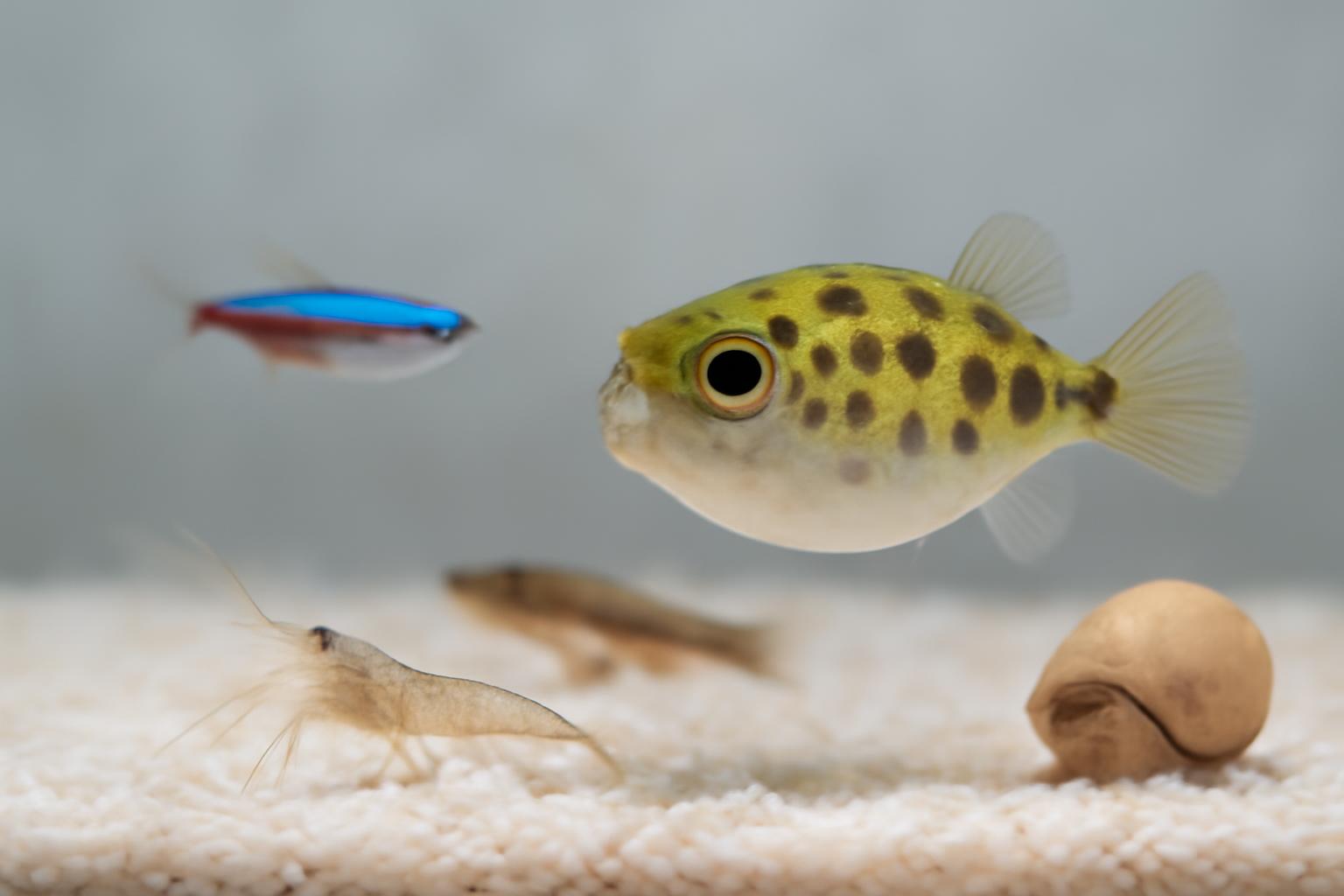
For any chance of stable coexistence, a 20-gallon long is a much more realistic starting point than a standard 10-gallon.
If you are researching pea puffer tank mates, the most honest answer is still not a neat stocking list. It is a risk profile.
Pea puffers are tiny, charismatic, and unusually interactive for their size, which is why so many aquarists want to build a planted community around them. The problem is that their personality does not scale down with their body. A fish barely longer than your thumb joint can still dominate a small aquarium, harass slower species, and turn shrimp and snails into food.
That does not mean mixed tanks never work. It means they work inconsistently, often temporarily, and usually because the tank is large and structured, the individual puffers are unusually tolerant, and the keeper is ready to intervene fast. For most hobbyists, a species-only setup is the reliable path. For people determined to try companions, the most defensible approach is a larger, heavily planted tank, modest expectations, and a backup plan from day one.
Related: Horned Nerite Snail Care: Tank Setup, Water Parameters, Diet & Compatibility.
Understanding Pea Puffer Behavior and Compatibility Challenges
Pea puffers, Carinotetraodon travancoricus, stay small at about 1 to 1.5 inches, but hobby care sources consistently describe them as territorial, nippy fish rather than easy nano-community residents (Aquatic Arts).
The harder part is not just aggression. It is variability. Two pea puffers kept under similar conditions may behave very differently: one may ignore neighbors, another may chase constantly, and a third may seem peaceful until maturity, feeding competition, or simple boredom changes the pattern. That basic unpredictability shows up again and again in forum discussions, which is why community outcomes are usually described as gambles rather than plans (Aquarium Co-Op forum discussion).
That is also why experienced keepers so often default to species-only advice. Even when hobbyists report successful mixed tanks, the same discussions usually add the same warning: things can go well for a while and still turn abruptly.
Interestingly, “species-only” does not necessarily mean “single fish.” A modern care sheet notes that pea puffers occur in loose groups in heavily vegetated habitats and argues that keeping them with their own kind can support more natural foraging and reduce stress. But that wild context should not be stretched too far. Sharing rivers and wetlands with other species in Kerala does not prove those same combinations are aquarium-safe in a home tank, where the space is far smaller and escape options are limited (Pufferfish Enthusiasts Worldwide).
That distinction clears up much of the confusion around pea puffers. They may benefit from living with other pea puffers under the right conditions, yet still remain poor candidates for a mixed-species community.
The Safest Option: Species-Only Pea Puffer Tanks
If your goal is reliable long-term success rather than experimentation, a species-only pea puffer tank remains the strongest recommendation. It lets you solve for the fish’s actual behavior instead of negotiating between a territorial micropredator and whatever else you hope to keep beside it.
The basic design principle is visual separation. Pea puffers do better in tanks packed with stems, moss, wood, roots, caves, floating cover, and other obstacles that break line of sight. In practice, the more often fish can disappear from one another’s view, the less pressure builds from constant inspection and chasing.
Hobby guidance on space is inconsistent, so it is best treated as heuristic, not law. Common conservative starting points are about 10 gallons for one fish and 20 gallons or more for a group, with roughly 1 pea puffer per 5 gallons often repeated as a cautious baseline rather than a guaranteed rule (Aquarium Store Depot).
Grouping is another area where hobby consensus exists, but not hard proof. In forum discussions, keepers often prefer small groups rather than solitary fish and sometimes favor odd-numbered groups such as 3 to 5, especially in planted tanks of about 20 gallons or more. That is useful as a community-derived idea, but it should still be read as anecdotal practice, not a verified formula (Aquarium Advice forum thread).
Sex ratio advice should be read with the same caution. One forum discussion repeats a hobby rule of thumb of roughly 1 male to 2 females, and many keepers broadly agree that more space, more cover, and fewer male rivalries usually reduce conflict. But this is still informal husbandry guidance, not a dependable way to neutralize aggression, and sexing juveniles is not always straightforward (Fishlore forum discussion).
Once the aquarium gets much larger, the species-only model becomes even more compelling. In a planted 180-gallon forum discussion, hobbyists floated estimates ranging from about 20 to 60 pea puffers for a display built entirely around peas. That wide spread is less a stocking recommendation than a reminder of how speculative density advice becomes at scale. What is useful there is the broader point: if you want more peas, a bigger structured tank without other species is far easier to justify than a compromise community.
For most keepers, the practical translation is simple: if you love pea puffers for their behavior, build the aquarium around them instead of around the hope that they will ignore everyone else.
Potential Fish Tank Mates: Fast Swimmers Only
When aquarists do attempt pea puffer tank mates, the recurring pattern is clear: choose fast, plain, unobtrusive fish that can evade attention and do not advertise themselves with flowing fins. “Fast swimmers only” is not a promise of compatibility, but it is the narrow category with the most consistent anecdotal support.
Otocinclus catfish are among the most commonly suggested options. The argument is practical rather than magical. That does not make them safe, but it does make them one of the more frequently tolerated fish in hobby reports and care guides (Aquatic Arts).
Zebra danios are another recurring suggestion because they are active and difficult to corner. Harlequin rasboras and other small, quick schooling fish also appear in some hobby lists. But this is where the evidence becomes visibly contradictory. One guide suggests rasboras; another explicitly puts rasboras on the avoid list. That does not prove rasboras are impossible, but it does show how thin the confidence should be. Danios are easier to defend than rasboras because the speed-based rationale is more consistent across sources (Aquatic Arts; Aquarium Store Depot).
White cloud mountain minnows deserve even more caution. One hobby guide gives white clouds a preferred range of about 57 to 72°F while placing pea puffers at about 72 to 82°F, which means the temperature overlap is awkward before aggression even enters the conversation (Aquarium Store Depot).
If you try fish companions at all, the most repeated tactics are also the most conservative ones: use at least a 20-gallon tank, preferably larger; introduce the puffers after the other fish have settled; and keep the puffers regularly fed so every moving object is less likely to register as an opportunity. Those tactics may improve the odds, but none of them changes the underlying reality that “compatible” usually means “sometimes tolerated,” not “safe.”
The most useful mindset is to treat every candidate fish as an experiment with a shelf life you cannot predict. A species that survives beside one pea puffer may be chased relentlessly by another.
Invertebrates as Tank Mates: High-Risk Prey Items
Shrimp and snails are where many community plans break down, because pea puffers are not just territorial fish. They are also small predators.
Shrimp can persist with pea puffers in some dense planted tanks, but the pattern across forum reports is still high risk and highly inconsistent. Keepers describe cherry shrimp, Amano shrimp, and ghost shrimp surviving for months in tanks with moss, wood, and heavy cover. The same threads also document shrinking shrimp populations, missing shrimplets, and setups where puffers gradually reduced oto and Amano numbers over time. That does not add up to “shrimp safe.” It adds up to “sometimes not immediately disastrous” (Aquarium Co-Op thread on mixed shrimp outcomes).
The most vulnerable stage is the smallest one. Even hobbyists who describe shrimp coexistence as successful often add the qualifier that baby shrimp disappear. So if your real goal is a breeding shrimp colony, pea puffers are usually the wrong fish to introduce.
Snails are more straightforward. Small snails such as ramshorns, bladder snails, and Malaysian trumpet snails are commonly treated as part of the puffer’s diet, and hobby care sources often recommend them for natural shell-based feeding and tooth wear. That is why display snails, especially prized ones such as nerites or mystery snails, should not be assumed safe (Aquatic Arts; Aquarium Co-Op; Aquarium Advice).
The practical consequence is that the usual “cleanup crew” logic does not translate well here. In a pea puffer tank, invertebrates are often prey first and utility animals second. If you want a steady supply of small snails, the cleaner solution is a separate snail culture that you can harvest from rather than hoping your display tank will sustain them.
So the best framing is blunt but accurate: shrimp are trial animals in this context, not dependable partners, and small snails are more often feeder stock than tank mates.
Fish to Strictly Avoid with Pea Puffers
If fast, plain fish are the least risky options, then slow, decorative, or delicate fish are the worst bets.
Guppies and bettas are the clearest examples because their extended fins invite pecking and fin-nipping. Retail care guides and forum advice are unusually consistent on this point, even when those same sources disagree about other species. Long fins give the puffer something visible to chase, and repeated nipping can turn even a technically surviving fish into a chronically stressed one (Aquatic Arts; Aquarium Store Depot).
Livebearers such as mollies and platies sit in a murkier category. Some forum hobbyists report short-term peace in larger aquariums, especially 40-gallon setups, but those anecdotes run against the broader warning that active, visible, finned fish are still more exposed than compact, evasive companions. That is why isolated success stories should not be mistaken for dependable guidance (Aquarium Co-Op forum).
Corydoras are worth discussing separately because they show how conflicted pea puffer advice can get. One hobby guide ranks corys highly, while other hobby sources specifically warn against slow bottom dwellers that may be harassed, nipped, or outcompeted. When the evidence is this contradictory, the safer editorial conclusion is not “corys are good.” It is “do not treat corys as reliable” (Aquatic Arts; Aquarium Store Depot; Aquarium Advice).
Neon tetras, ember tetras, and some rasboras are often suggested because they move quickly, yet forum reports also describe embers disappearing and apparently peaceful arrangements deteriorating over time. With pea puffers, timeline matters. “Fine for now” is much weaker evidence than it sounds.
So the avoid list is better understood by vulnerability than by taxonomy. Avoid fish that are slow to escape, easy to nip, flashy enough to attract attention, or delicate enough that repeated chasing becomes a chronic stress problem before obvious injuries appear.
Essential Tank Setup for Any Pea Puffer Community
If you attempt companions at all, setup matters at least as much as species choice.
Start with structure. A mixed pea puffer tank should be heavily planted and visually broken up from end to end. Tall stems, floating cover, moss, branchy wood, roots, caves, and dense thickets all help create blind corners and escape routes.
Tank size matters more once other species enter the picture. While small species-only setups are commonly discussed for single peas, hobby sources that even entertain companions usually move toward a 20-gallon long or larger as the realistic starting point. That extra footprint matters because it creates more than raw water volume: it creates separation, alternative feeding zones, and room for one fish to leave another fish’s orbit (Aquarium Store Depot).
Temperature guidance is similarly broad rather than precise. One often-cited hobby range for pea puffers is about 72 to 82°F, which overlaps with some candidate fish but not all. The more useful lesson is not that one exact number solves compatibility. It is that a possible tank mate should fit comfortably inside the same general range rather than forcing one species to live at an edge condition (Aquarium Store Depot).
In one forum discussion, a keeper reported their pea puffers disliking a hang-on-back filter and doing better after a switch to a sponge filter. That is anecdotal, but it matches the broader pattern of calmer, heavily structured pea puffer setups. The same discussion also highlights favorite foods such as bloodworms and Malaysian trumpet snails, which aligns with the wider hobby emphasis on small, regular carnivorous feedings (Fishlore forum discussion).
A covered tank is also sensible. Even though the stronger day-to-day issue with peas is chasing rather than documented jumpiness in the evidence pack, a tank with sudden darting behavior, live or frozen feeding responses, and active companions is still not a setup where leaving open gaps is wise.
Underfeeding makes everything worse. Bloodworms, brine shrimp, and suitable snails are repeatedly mentioned across hobby sources as staple foods. Feeding well does not turn a territorial puffer into a peaceful fish, but it does remove one obvious reason for opportunistic hunting.
Stocking Density, Grouping, and Water Parameters
Stocking guidance for pea puffers is messy, and that is exactly why conservative planning beats confident formulas.
A commonly repeated hobby baseline is about 1 pea puffer per 5 gallons, with about 10 gallons often cited for a single fish and 20 gallons or more for a small group. But those numbers are not universal. Other hobby discussions argue for denser arrangements, including looser estimates closer to 2 to 3 gallons per fish. That spread is the real lesson: these are not precision standards, and once tank mates are involved, the conservative end is the only sensible end (Aquarium Store Depot; Fishlore).
Grouping changes behavior, but not in a simple way. A solitary pea puffer may become overly fixated on everything in the tank, while a group may spread attention and encourage more natural movement. At the same time, groups also create hierarchy, territorial boundaries, and feeding competition. Adding more peas does not remove risk; it redistributes it.
The commonly repeated ratio of about 1 male to 2 females belongs in the same bucket as odd-number group advice: useful as a hobby starting point, but not a dependable control switch for aggression (Fishlore).
On water conditions, the safest strategy is to think in terms of overlap and stability, not optimization by slogan. The evidence pack supports a broad temperature window of about 72 to 82°F for pea puffers, while candidate companions vary around that. Some keepers favor planted freshwater conditions on the softer, slightly acidic side, but the stronger practical point is to avoid pairing peas with species whose preferred conditions clearly pull in another direction (Aquarium Store Depot; Pufferfish Enthusiasts Worldwide).
Larger tanks help here for reasons beyond aggression. None of that guarantees peace, but it makes the system more forgiving.
Monitoring Aggression and Troubleshooting Issues
The most important skill in a pea puffer community is not stocking. It is observation.
Watch first for the obvious signs: repeated chasing, torn fins, missing shrimp, fish that stop feeding when the puffers appear, or tank mates pinned into corners. But also watch for the quieter signs of failure. A mixed tank can be going badly before any fish looks shredded. If another species only comes out after feeding ends, if otos are thinning, or if one puffer has effectively claimed the best route through the aquarium, the system is already under strain.
Time is part of the problem. Forum threads repeatedly note that pea puffers may tolerate companions when young and become more aggressive with maturity. Hunger and feeding competition can worsen that. A fish that coexists peacefully for weeks may begin hunting after it settles into the tank, establishes a favored feeding lane, or simply grows bolder. That is why “they’ve been fine so far” is weak evidence with this species (Aquarium Advice thread on maturity and aggression).
Intervention should be early, not dramatic. The moment chasing becomes repetitive or another fish shows persistent stress, damage, or weight loss, separate someone. Multiple hobby discussions emphasize the same point: if you try community housing, you should do it only with a spare tank, divider, or some other immediate fallback already available (Aquarium Advice forum thread).
Feeding tactics can help at the margins. Multiple feeding points, target feeding, and careful observation during meals may reduce direct conflict. Heavy planting and broken sightlines help too. But none of those methods overrules temperament.
That is the real troubleshooting framework for pea puffers: individual variability beats lists. A supposedly good companion can fail because your puffer is unusually aggressive. A pairing widely described as impossible can look calm for months until it does not. Your job is not to find a magical compatibility chart. It is to build the most forgiving tank you can, monitor it closely, and react faster than the fish can escalate.
The least exciting conclusion remains the strongest one: species-only tanks are the safe play. If you try companions anyway, keep expectations modest, the tank large and planted, and the exit plan ready from the start.
Are Otocinclus safe tank mates for pea puffers?
They are among the more commonly suggested anecdotal options, but not truly “safe.” Otocinclus appear often in pea puffer discussions because they are quick, not flashy, and usually occupied with grazing. That makes them one of the better fish to trial in a heavily planted tank of about 20 gallons or more, but they can still be chased, stressed, or gradually lost in the wrong setup (Aquatic Arts; Aquarium Store Depot; Aquarium Advice).
Can Amano or cherry shrimp survive with pea puffers?
Sometimes, especially in dense planted tanks with moss and hardscape, but they should be treated as vulnerable prey rather than dependable companions. Adult Amanos usually have better odds than cherry shrimp because of their size, while shrimplets are especially likely to be eaten. If your main goal is keeping or breeding shrimp, pea puffers are usually the wrong fish to mix in (Aquatic Arts; Aquarium Co-Op; Aquarium Advice).
What tank size is needed for pea puffers with companions?
A practical floor in hobby guidance is about 20 gallons, and larger is better. Small species-only pea puffer tanks are discussed below that size, but community attempts need room for broken sightlines, separate feeding zones, and escape space. A 20-gallon long is a much more realistic starting point than a standard 10-gallon if you want any chance of stable coexistence (Aquarium Store Depot; Aquarium Advice; Aquarium Co-Op).
Do pea puffers eat snails, and which are okay?
Yes. Small snails are commonly eaten and are often offered intentionally as food. Ramshorn, bladder, and Malaysian trumpet snails are the usual examples in hobby care discussions. “Okay” here means acceptable as feeders, not reliably protected as tank mates, so ornamental snails should be assumed at risk (Aquatic Arts; Aquarium Co-Op; Aquarium Advice).
Why avoid Corydoras or guppies with pea puffers?
For different reasons. Guppies are high-risk because their fins invite nipping. Some hobbyists report exceptions, but the broader pattern is caution, not confidence (Aquatic Arts; Aquarium Store Depot; Aquarium Advice).