
Essential Guide to Horned Nerite Snails: Algae Control Without the Overpopulation Hassle
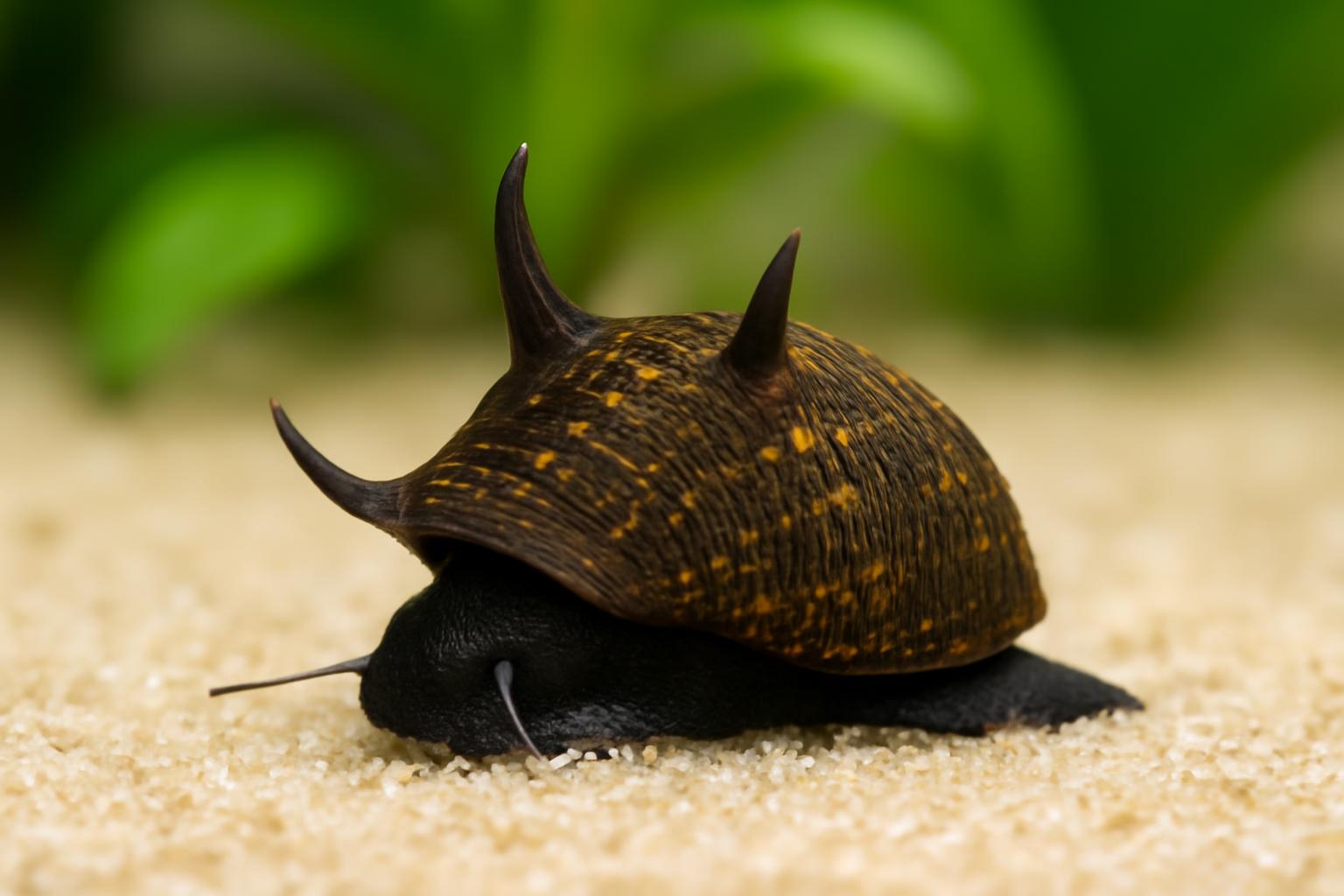
Horned nerites do best in a stable, cycled aquarium with natural grazing. Check care limits, feeding, water chemistry and tank fit.
If you want an algae-grazing snail for a freshwater aquarium without the usual risk of a population explosion, the horned nerite snail is one of the better options available. In the right tank, it spends much of its time scraping film algae, diatoms, and biofilm from glass, rocks, driftwood, and other hard surfaces. It is also widely treated as peaceful, plant-safe, and suitable for shrimp-focused or small community aquariums.
That “easy” reputation has limits. Horned nerites do best in a stable, cycled aquarium that already offers natural grazing. They are sensitive to copper, can struggle in chronically soft or acidic water, and may climb out of uncovered tanks. So the practical picture is not “drop in one snail and forget it,” but rather “useful, low-conflict grazer for a mature setup that already has decent husbandry.”
Identification and Natural History
In aquarium shops, horned nerite snail is usually a trade name rather than a perfectly consistent species label. The animals sold under that name are commonly linked to Clithon snails, and listings may use names such as:
- Clithon sp.
- Clithon cf. diadema
- Clithon diadema
- Clithon corona
For most hobbyists, the important takeaway is simple: the common name is usually more stable than the scientific labeling in the trade.
Appearance varies a lot. Horned nerites are often described as polymorphic, meaning shell shape, pattern, and spine development can differ noticeably from one individual to another. Adults are small, usually somewhere around 0.5 to 1 inch, with many sold closer to the lower end of that range.
Common color and pattern descriptions include:
- brownish-black
- dark green
- reddish-brown
- yellow-tinted
- striped
- dotted
- mixed patterns
The trait that gives them their name is the shell’s horns, spikes, or thorn-like bumps. Even that feature is inconsistent. Some snails have obvious protrusions, while others have much shorter stubs or appear almost smooth. Those horns can break off easily, and that alone is not usually treated as a sign of poor health.
Origin is best kept broad. Trade and care sources place horned nerites across Asia and the Indo-Pacific, including Indonesia and parts of the south to southwest Pacific. Because the common name may cover multiple closely related forms, exact geographic detail is less useful than the habitat pattern: these snails are associated with freshwater environments but also with a brackish-water connection. That helps explain a point that matters in captivity: they live well in freshwater aquariums, but their life cycle is not fully freshwater.
Another practical point for buyers is that horned nerites are commonly sold as wild-caught. That helps explain why two snails sold under the same name may differ in:
- color
- striping
- horn length
- overall shell condition
Minor shell wear is therefore not unusual at purchase.
For quick identification, the beginner checklist looks like this:
- a small nerite snail, usually under 1 inch
- earthy to dark shell colors, sometimes with yellow highlights
- visible horns, spines, or bumps on the shell
- sold for freshwater planted or community tanks
- marketed as an algae and biofilm grazer that does not overpopulate freshwater aquariums
Tank Setup and Water Parameters
Horned nerite snails are best kept in a stable, cycled freshwater tank with some natural algae or biofilm already present. They are often sold as beginner-friendly, but that really means beginner-friendly in an established aquarium, not in an immature or recently scrubbed-clean setup.
A practical minimum is 5 gallons, while 10 gallons or more is easier to manage. Some listings go smaller, but the broader care guidance clusters around 5-10 gallons or higher. The reason is not just swimming room. It is mainly about:
- more stable water chemistry
- more surface area for grazing
- lower risk of sudden swings
- a better chance that enough biofilm exists to support the snail
Recommended setup at a glance
| Care point | Practical target |
|---|---|
| Tank size | 5 gallons as a practical floor; 10+ gallons is more forgiving |
| Stocking | Start conservatively and match snail numbers to visible algae and mature surface area |
| pH | About 7.0-8.4 |
| Temperature | About 72-82°F |
| KH | Roughly 3-14 |
| GH | Roughly 3-18 |
| Ammonia/Nitrite | 0 |
| Cover | Strongly recommended |
| Tank maturity | Fully cycled, with natural grazing surfaces |
| Copper | Avoid |
| Substrate and lighting | General nerite best practice favors smooth substrate and moderate rather than extreme lighting |
A better beginner stocking rule of thumb
Stocking advice for horned nerites is not perfectly consistent. Different care pages suggest anything from about 1 per 10 gallons to much denser stocking. Rather than treating any one number as a hard rule, it is safer to start with fewer snails than you think you need.
A practical beginner approach is:
- start with one snail in a mature small tank
- add more only if the tank clearly produces enough algae and biofilm to support them
- base your decision more on food availability and stability than on gallons alone
That matters because the most common mistake is not under-cleaning a tank. It is putting too many grazers into a tank that looks spotless but does not actually produce enough food.
pH, hardness, and shell health
Water chemistry matters most where the shell is concerned. Across the available care guidance, horned nerites do better in stable, alkaline-leaning water with enough mineral content to support shell health.
A reasonable working range is:
- pH 7.0-8.4
- avoid keeping them below 6.5 long-term
- KH roughly 3-14
- GH roughly 3-18
You do not need one exact target in the middle. Stability matters more. But chronically soft or acidic water is a recurring risk in horned nerite care. Low pH can gradually wear shell material away, and low hardness can leave the snail with poor support for shell maintenance.
If you run injected CO2 in a planted tank, keep that in mind. Horned nerites can live in planted aquariums, but soft water, excess CO2, and pH swings together can make shell wear more likely.
Temperature
Most guidance overlaps comfortably around 72-82°F, though broader published ranges extend somewhat outside that. For most aquarists, a normal tropical community-tank temperature works well.
A simple target is the mid-70s to upper-70s Fahrenheit range, provided the tank stays stable.
Substrate and decor
Horned nerites spend most of their visible time on:
- glass
- driftwood
- rocks
- plant leaves
- filter surfaces
- other hardscape
Substrate still matters, though. General nerite care guidance favors smooth sand or rounded gravel over sharp, abrasive materials.
Good decor choices are anything that increases safe grazing area, such as:
- driftwood
- smooth stones
- planted hardscape
- broad-leaved plants
- surfaces that collect light algae and biofilm
Filtration, cycling, and tank maturity
A fully cycled tank is essential. Ammonia and nitrite should be zero. Horned nerites are not a good first animal for a tank still establishing its nitrogen cycle.
Just as important, the tank should not be sterile. These snails usually do better in an aquarium that looks a little lived-in than one that has had every surface polished spotless. Thin film algae and biofilm are often a benefit, not a flaw, when you are keeping a grazer.
Use a lid
Horned nerites are known for climbing. Some waterline exploration is normal, especially after introduction, but an open tank creates obvious risk. A lid or tight cover is strongly recommended.
If a snail repeatedly spends time above the waterline, check for:
- poor water quality
- unstable pH or hardness
- recent chemical changes
- temperature swings
- gaps in the lid or rimless setup
Copper and chemical sensitivity
Horned nerites are repeatedly described as sensitive to copper. Be cautious with:
- fish medications
- plant treatments
- parasite remedies
- “all-purpose” additives
- any product that lists copper as an active ingredient
Use a dechlorinator with tap water, and do not assume a product is safe just because it is sold for aquariums. If it is not clearly snail-safe, it is better not to guess.
Diet and Feeding
Horned nerite snails are grazers, not animals that wait for a single daily feeding. In a suitable tank they spend much of their time moving from surface to surface and scraping up edible growth.
Their main foods are:
- film algae
- diatoms
- biofilm
- soft surface growth
- detritus and organic residue
They are particularly useful on:
- glass
- rocks
- driftwood
- substrate surfaces
- plant leaves with light surface growth
The important limit is this: a horned nerite is not a cure for every algae problem. Some seller pages describe them eating tougher nuisance algae, including filamentous growth, but hobby guidance is mixed. The safest expectation is that they are best at film algae, diatoms, and biofilm, not at solving every stubborn algae outbreak on their own.
The most common feeding mistake: a tank that is too clean
A horned nerite can slowly decline in a tank that looks excellent to the owner. This usually happens when:
- the aquarium is new
- every pane and hard surface is scrubbed too often
- there are too many grazers competing for the same food
- the tank is heavily manicured and produces little visible film
- the snail arrived already stressed or underfed
That is why horned nerites usually do better in mature tanks with some natural growth than in tanks kept visually spotless at all times.
How to supplement when algae is scarce
If the tank does not naturally produce enough food, supplementation becomes important. Common backup foods mentioned across care sources include:
- algae wafers
- sinking pellets
- blanched zucchini
- blanched spinach
- nori
- other algae-based prepared foods
Not every individual accepts prepared foods right away. Many newly purchased nerites prefer natural surfaces first. Still, offering supplemental food is far better than assuming the snail will “find something.”
Helpful feeding approaches include:
- Place prepared food near surfaces the snail already visits.
- Feed when the tank is quieter or dimmer if the snail is shy.
- Remove leftover vegetables before they foul the water.
- Leave some algae on selected glass or hardscape instead of cleaning everything.
- Rotate in algae-covered stones or wood from another aquarium if you keep more than one tank.
Some keepers even grow algae intentionally on spare rocks or decor pieces and move those into the aquarium as needed. That may sound excessive, but it matches the basic husbandry reality: horned nerites need ongoing grazing access.
Daily activity pattern
Horned nerites are often described as active throughout the day, but many keepers also report more movement in dimmer periods or at night. So a snail that is less visible under bright light is not automatically unhealthy.
What matters more is whether it shows normal behavior over time:
- attaching securely to surfaces
- grazing at least during part of the day or evening
- changing position over time
- not remaining upside down and inactive for prolonged periods
A healthy horned nerite is not dramatic. Most of its work is slow, repetitive grazing.
Temperament and Tankmates
Horned nerite snails are widely regarded as peaceful, non-aggressive, and community-safe. They do not harass other animals, and they are generally treated as plant-safe.
That makes them a common choice for:
- planted aquariums
- shrimp tanks
- nano community setups
- peaceful tropical freshwater tanks
They are commonly paired with:
- shrimp
- small tetras
- guppies
- corydoras
- other calm community fish
Good tankmate profile
The best tankmates are animals that ignore snails. In practice that means:
- shrimp colonies
- peaceful nano fish
- mild livebearers
- gentle bottom dwellers
The ideal community is one where the snail can graze slowly without being flipped, pecked, or stressed.
Tankmates to avoid
Avoid fish that are known to prey on snails or repeatedly harass them, including many:
- loaches
- puffers
- cichlids
- goldfish
Some guidance also specifically warns against Botia lohachata and other snail-eating loaches.
The shell, operculum, and horned appearance do not make a horned nerite safe from determined predators.
Behavior in the aquarium
Horned nerites are not social in a schooling sense, but they are also not territorial. They mostly ignore one another and go about grazing. Many care sources describe them as non-aggressive and at least somewhat nocturnal or crepuscular.
The behavior that concerns beginners most is climbing. Some climbing is normal. Persistent escape behavior is not something to shrug off. Treat it as a prompt to review water quality, recent chemical changes, and lid security.
Reproduction and Population Control
For many aquarists, the biggest appeal of the horned nerite snail is simple: it does not successfully reproduce in a standard freshwater aquarium.
That does not mean eggs never appear. It means the life cycle does not normally complete in freshwater. Across the available care guidance, the usual explanation is that the larval stage requires brackish water, which prevents a home freshwater tank from turning into a horned nerite nursery.
For anyone who has dealt with ramshorn or bladder snail overpopulation, that is a real advantage.
What eggs look like
Females may still lay eggs in freshwater. These are usually described as small white, hard, flat eggs attached to hard surfaces such as:
- glass
- rocks
- driftwood
- filter parts
- decor
In most freshwater tanks, those eggs are mainly a cosmetic issue, not a population problem.
Can you tell males from females?
Not reliably by ordinary observation. In hobby care guidance, horned nerite sexes are generally treated as externally indistinguishable.
So if you buy a group, you should assume eggs are possible even though baby snails are not likely to follow in freshwater.
Acclimation, Purchase, and Availability
Horned nerites are commonly available through:
- local fish stores
- planted-tank vendors
- online livestock shops
- general aquarium retailers
Retail listings show that they are usually sold either singly or in small packs, but pricing and stock change quickly, especially with live-animal shipping and seasonal weather restrictions. For evergreen care purposes, the more useful point is availability pattern rather than any one price snapshot: they are usually obtainable, but not always consistently in stock.
Wild-caught reality
Horned nerites are commonly presented as wild-caught. That matters because it helps explain several common purchase outcomes:
- Shells may arrive imperfect. Minor wear does not always reflect current care.
- Shipping stress can be significant. Collection, holding, and transit all add strain.
- Adjustment can vary. Two healthy-looking snails may settle very differently.
When choosing one in person, look for:
- a present, intact operculum
- responsiveness when touched
- attachment to surfaces rather than lying limp
- no foul odor
- no severe shell collapse
Local purchase versus shipped snails
Buying locally can reduce one major variable: shipping stress. If the snails are already active in a store tank, that is useful information.
Online ordering can still be reasonable, but it is smart to check:
- live-arrival policies
- weather holds
- whether shipment may be delayed for heat or cold
- whether the item is actually in stock or sold as a pre-order
- expected transit time
Acclimation: what the evidence really supports
This is one area where the guidance is mostly hobby practice, not strong controlled evidence. Forum discussion and keeper experience show more than one workable approach.
Two methods appear often:
- temperature-match, then transfer the snail out of shipping water promptly
- temperature-match, then add some tank water gradually over a short period
For shipped snails, many hobbyists favor the first approach because shipping water may already be degraded. For locally purchased snails with short transit time, a brief gradual mix is also commonly used.
The cautious takeaway is not that one method is proven best. It is that long, elaborate acclimation is not clearly supported, especially if the shipping water is already in poor condition.
After introduction, do not panic if the snail disappears for a while. Temporary hiding is common. What is more concerning is a snail that never begins grazing, falls repeatedly, or stays inactive for an extended period.
How long should you expect to keep one?
Reported lifespan is inconsistent across seller pages and hobby reports. Some sources imply periodic replacement is common, while hobbyists with mature tanks sometimes report much longer success. The safest editorial conclusion is not to promise a lifespan number.
Instead, focus on the factors most likely to influence survival:
- buy active specimens
- minimize shipping stress when possible
- place them in a mature tank
- provide enough natural or supplemental food
- keep water stable and shell-friendly
- avoid copper
Common Problems and Troubleshooting
Most horned nerite problems fall into four broad categories:
- shell deterioration
- starvation
- purchase, shipping, or acclimation stress
- unsafe chemistry, especially copper
Shell erosion, pitting, or dullness
If the shell looks rough, chalky, pitted, or increasingly worn, water chemistry is the first place to look. Repeatedly cited contributors include:
- low pH
- low KH
- soft water
- poor mineral support overall
Because many horned nerites are wild-caught, some damage can predate purchase. The key question is whether the shell continues getting worse in your tank.
Check:
- pH
- KH
- GH
- overall stability over time
Long-term acidic conditions can slowly dissolve shell material. In planted tanks, review CO2 use as well if the water is already soft.
Losses soon after purchase
A horned nerite that dies soon after introduction may have been affected by:
- shipping stress
- poor condition before sale
- starvation before purchase
- rapid parameter mismatch
- copper exposure
- poor water quality in the receiving tank
This is one reason these snails can feel “easy” in one aquarium and frustrating in another. Good tank conditions help, but they cannot fully undo earlier stress.
Starvation in clean tanks
This is one of the most common slow problems. A snail may seem fine at first, then gradually weaken because the aquarium simply does not produce enough food.
Warning signs can include:
- reduced roaming
- long inactive periods
- repeated falls
- decline after an initially active start
- competition from other grazers
If the tank shows very little visible film algae or biofilm, begin supplementing early rather than waiting for obvious collapse.
Climbing out or hanging at the rim
A horned nerite at the waterline may just be exploring, especially during the first days. Persistent escape behavior can also suggest:
- unstable parameters
- unsuitable pH or hardness
- water-quality issues
- recent chemical changes
- acclimation stress
A lid is your insurance here.
Copper toxicity
Copper is a serious hazard for snails. Be especially cautious with:
- fish medications
- parasite treatments
- mixed-purpose additives
- any product that is not clearly labeled safe for snails and shrimp
If you are unsure, do not dose first and research later.
Preventive maintenance
General nerite husbandry guidance supports a simple, consistent routine:
- perform modest partial water changes on a regular schedule
- test water parameters routinely
- keep ammonia and nitrite at zero
- avoid sudden changes in pH and hardness
- do not strip every surface of edible film
- use dechlorinator with tap water
- research medications before using them in a display tank
The exact water-change schedule can vary by tank, but consistency matters more than chasing a rigid formula.
Horned Nerite vs. Other Nerite Varieties
In everyday care, horned nerite snails are more similar than different compared with zebra nerites and other common nerite varieties. The core husbandry stays the same:
- stable freshwater conditions
- enough hardness for shell health
- a mature tank with algae and biofilm
- no copper
- no successful reproduction in freshwater
- peaceful community compatibility
The most obvious difference is appearance. Horned nerites have the spines or horns that give them their name. Other nerites are more often chosen for smooth shells, stripes, or bold patterning.
Do horned nerites clean better?
There is no strong evidence that horned nerites are meaningfully better algae eaters than other common nerite types. Hobby discussion usually treats the difference as mostly aesthetic rather than functional.
So the choice is usually about what you want to look at:
- horned nerite for the spiky shell
- zebra or other nerites for smoother, banded shells
Are they harder to find or more expensive?
Sometimes, yes. Some general nerite guidance suggests horned forms may be a bit pricier or less common in retail, with difficulty breeding and raising nerites in captivity offered as part of that explanation. In practice, availability and local stock often matter more than any dramatic price difference.
Which is better for a beginner?
The best beginner choice is the healthiest nerite you can source for a mature tank. Husbandry matters more than the variety name. A healthy zebra nerite in a stable aquarium will outperform a stressed horned nerite dropped into a brand-new, spotless tank.
Frequently Asked Questions
Do horned nerite snails reproduce in freshwater tanks?
No, not successfully. Horned nerite snails may lay eggs in freshwater, but the life cycle does not normally complete there because the larval stage is tied to brackish conditions. That is why they are popular with aquarists who want snail grazing without a freshwater population boom.
You may still see small white eggs on hard surfaces, but those eggs do not usually turn into baby snails in a standard freshwater tank.
What water parameters are best for horned nerite snails?
A practical target is:
- pH: 7.0-8.4
- temperature: 72-82°F
- KH: roughly 3-14
- GH: roughly 3-18
More important than hitting one exact number is keeping the aquarium stable, cycled, and not chronically soft or acidic. Ammonia and nitrite should be zero, and copper should be avoided.
Are horned nerite snails safe for planted tanks and shrimp?
Yes. They are widely treated as plant-safe and compatible with shrimp and peaceful community fish. Their normal behavior is to graze algae and biofilm from surfaces rather than chew healthy plant tissue.
They should still be kept away from obvious snail predators such as puffers, many loaches, goldfish, and aggressive cichlids.
What should I feed horned nerite snails besides algae?
If the tank does not grow enough natural algae and biofilm, offer:
- algae wafers
- sinking pellets
- blanched zucchini
- blanched spinach
- nori
The key is to supplement before the snail is already weakening, especially in very clean aquariums.
Why are my horned nerite snail’s shell deteriorating?
Shell deterioration usually points to water chemistry issues, especially:
- low pH
- low KH
- soft water
- poor mineral support
Some shell wear may also predate purchase, especially in wild-caught animals. The goal is to stop further decline by improving stability, avoiding chronically acidic conditions, and keeping copper out of the tank.
Horned nerite snails are at their best when treated as specialized grazers for an established aquarium, not as a shortcut around tank maintenance. Give them stable water, enough natural food, and protection from copper and shell-damaging conditions, and they can be a very useful way to add algae support without creating a freshwater snail infestation.