
What Reddit Gets Right—and Leaves Unanswered—About Red Slime
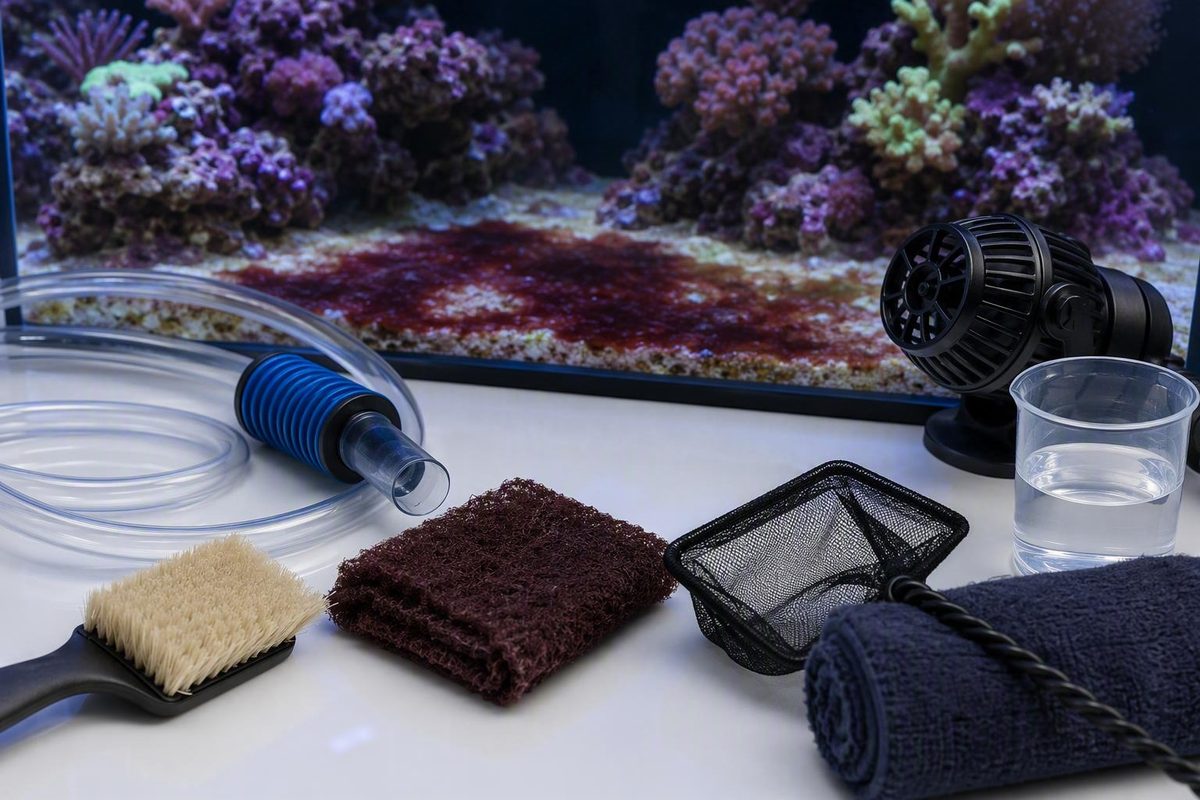
Across three threads, recurring advice includes siphoning, better-directed circulation and blackouts. The next step hinges on identification and severity.
Search Reddit for reef tank cyanobacteria and a familiar list of remedies appears: siphon it, increase flow, reduce feeding, change water, black out the tank, or use ChemiClean. The most useful part is not any single cure. It is the practical sequence beneath the comments: identify the material, document the tank, remove loose biomass, inspect local conditions, monitor the response, and escalate cautiously.
Here, “gets right” means that this sequence is a defensible troubleshooting framework—not that Reddit has proved which treatment works best. The threads are uncontrolled personal reports. Tank age, measured parameters, livestock, actual water volume, dose, equipment configuration, and long-term follow-up are frequently absent. Many commenters also changed several things at once, making it impossible to know which measure produced the reported result.
The short answer: what Reddit reef keepers recommend most often
If you have red, purple, brown, or otherwise slimy growth in a reef tank, start here:
- Photograph the affected areas before disturbing them.
- Record water parameters and relevant tank conditions.
- Gently disturb one small patch with a turkey baster.
- Siphon out material that lifts easily.
- Inspect the affected location for settled debris and weak circulation.
- Review feeding, filtration, skimming, source water, and recent changes.
- Observe the response before adding a chemical.
Across the three Reddit discussions, recurring nonchemical suggestions included manual removal with siphon tubing or a turkey baster, water changes, stronger or better-directed circulation, restrained feeding, effective skimming, and temporary blackouts.
ChemiClean was the commercial treatment mentioned most consistently. Unverified Reddit anecdotes ranged from rapid visible clearance and months without reported recurrence to concerns about later nuisance algae, prolonged tank disruption, and suspected coral harm. The negative events were not proved to have been caused by the product, just as the positive reports do not establish universal effectiveness or safety.
The central limitation is that these are anecdotes, not comparative trials. A tank that received siphoning, a blackout, several water changes, increased flow, reduced feeding, carbon, phosphate-control media, and a red-slime remover did not test one treatment. It tested a bundle.
That makes two questions essential:
- What cleared the visible mat?
- What reduced the likelihood of recurrence?
They are not necessarily answered by the same intervention. Siphoning can make a tank look better immediately. Darkness may suppress photosynthetic growth. A red-slime remover may reduce visible biomass. None of those outcomes demonstrates that detritus traps, local circulation, source-water problems, inconsistent maintenance, or another relevant condition has been corrected.
The best reading of Reddit is therefore conservative: use the threads as a map of possibilities, not proof of a cure.
Confirm the growth before treating the tank
Cyanobacteria are photosynthetic bacteria commonly called “red slime algae” in aquarium keeping. In reef tanks, suspected cyanobacteria are commonly described as soft, slimy, stringy, velvet-like, or sheet-forming coatings across sand, rock, glass, equipment, and sometimes coral surfaces.
Color helps describe the material, but it does not settle the identification. Aquarium guides describe cyanobacteria as red or purple as well as brown, black, green, orange, and blue-green. One commercial guide describes thin patches that may develop into easily displaced sheets or clumps while emphasizing this broad color range in its cyanobacteria identification overview.
Use the baster test as a clue, not a verdict
A practical Reddit suggestion is to direct a gentle stream from a turkey baster at one small patch:
- Material that lifts, peels, or blows away is more consistent with a soft cyanobacterial mat.
- Hard growth that remains firmly encrusted may be coralline algae.
- Brown, mucus-like strands with numerous attached bubbles should raise the possibility of dinoflagellates.
This test provides information about attachment and texture. It does not identify a microorganism.
| Possible identification | Attachment | Texture | Common appearance | Response to gentle disturbance | Next step |
|---|---|---|---|---|---|
| Likely cyanobacteria | Usually loose or moderately attached | Slimy, soft, velvet-like, stringy, or sheet-forming | Often red or purple, but potentially several other colors | May lift, peel, fragment, or blow away | Siphon a sample, document the tank, and begin low-risk troubleshooting |
| Encrusted coralline algae | Firmly bonded to rock, glass, or equipment | Hard, crust-like, calcified | Commonly pink, purple, or red | Usually remains fixed under gentle baster pressure | Do not use a cyanobacteria treatment based only on color |
| Suspected dinoflagellates | Variable; may form strings over sand and rock | Often mucus-like or snot-like | Frequently brown, sometimes with many attached bubbles | May break apart or disperse and resemble cyanobacteria | Reassess the identification before choosing treatment |
A commercial Bulk Reef Supply guide similarly describes cyanobacteria as generally red and stringy or slimy, while dinoflagellates are often brown, snot-like, and covered with bubbles. It also acknowledges that distinguishing them by appearance can be difficult in its comparison of cyanobacteria and dinoflagellates.
Treatment response can add information, but nonresponse does not prove that the organism is something else. If presumed cyanobacteria remains unchanged after careful removal and a properly executed cyanobacteria-focused intervention, stop repeating the same assumption. Reconsider its texture, attachment, distribution, daily pattern, and response to disturbance.
Record the tank context Reddit posts often omit
A picture of red slime invites quick answers, but the tank surrounding it matters more than color alone. Before deciding why the bloom appeared—or whether it needs aggressive treatment—complete a short worksheet.
Pre-treatment worksheet
- Tank age
- Approximate actual water volume
- Date the outbreak first appeared
- Locations affected: sand, rock, glass, equipment, shaded areas, or coral surfaces
- Nitrate
- Phosphate
- Alkalinity
- pH
- Salinity
- Temperature and recent temperature range
- Source-water type
- Source-water TDS, if available
- Lighting schedule and recent lighting changes
- Feeding type, amount, and frequency
- Filtration in use
- Protein-skimmer operation and recent performance
- Circulation pattern
- Places where debris or surface film accumulates
- Fish, corals, anemones, shrimp, snails, and other livestock
- Water-change and substrate-cleaning history
- Recent additions, losses, dosing changes, equipment changes, or maintenance disruptions
- Previous treatments and how the growth responded
Tank age is worth recording because Reddit commenters and commercial aquarium guides sometimes associate blooms with immature systems. A young tank may be undergoing ecological change, but age alone does not prove that an outbreak is harmless, correctly identified, or certain to disappear.
Nitrate and phosphate deserve particular attention. Commenters in two of the supplied discussions asked for those measurements before trying to explain the outbreak. The December 2022 SaltwaterAquariumClub thread then produced conflicting interpretations: some unidentified commenters blamed excess input, while another argued that very low readings could favor cyanobacteria and suggested raising nutrients.
That disagreement should not be converted into a universal dosing rule. A nitrate or phosphate result is context, not a verdict.
An elevated result does not prove that nutrients caused the bloom. An undetectable result does not prove that the tank has no nutrient input or that the reading itself caused cyanobacteria. Test limitations, timing, uptake within the aquarium, feeding, detritus, filtration, and recent maintenance may all affect interpretation. These are troubleshooting considerations rather than a demonstrated explanation for any particular tank.
Before making a large correction:
- Check that the test has not expired and was performed correctly.
- Repeat an unexpected result.
- Compare it with recent trends rather than relying on one measurement.
- Review feeding and organic-waste accumulation.
- Inspect mechanical filtration and skimmer performance.
- Check source water where practical.
- Consider what changed before the outbreak began.
The supplied sources do not justify driving nitrate and phosphate to zero, dosing nutrients solely because both read zero, reducing feeding to a fixed weekly frequency, or chasing one commenter’s alkalinity or calcium target. Those decisions depend on the tank, livestock, test quality, recent trends, and broader husbandry plan.
A low-risk first response for the next several days
For a small or moderate patch, the first objective is not to sterilize the aquarium. It is to gather useful information while reducing visible biomass and obvious waste accumulation.
First 24 hours
- Take clear photographs from angles you can reproduce later.
- Record current measurements and the time each was taken.
- Test one patch gently with a turkey baster.
- Siphon removable material during a water change.
- Remove visible detritus trapped beneath or around the mat.
- Inspect nearby flow and surface movement.
- Check whether the growth is touching or covering corals.
- Observe livestock for unusual behavior or visible distress.
- Write down every intervention rather than relying on memory.
Remove it without merely redistributing it
Instead, work on a limited area. Hold siphon tubing nearby, gently loosen the edge of the mat, and capture as much material as practical as it detaches.
Some sand may enter the siphon. Avoid aggressive stirring around stressed corals, and do not scrape delicate tissue in an attempt to remove every trace. The aim is controlled export, not perfect cosmetic cleanup in one session.
Water changes can support that export by removing loosened material and accumulated waste. A visual improvement after a water change does not prove that excess dissolved nutrients caused the outbreak; physical removal alone can account for part of the result.
Map flow instead of chasing a pump rating
“Add more flow” is incomplete advice. Total pump output does not reveal what happens behind rockwork, along the substrate, or inside a sheltered corner.
Look for:
- Debris repeatedly collecting in one location
- Persistent surface film
- Mats beginning in the same sheltered pocket
- Weak movement behind or beneath rockwork
- Strong movement near the pump but little circulation at the problem area
Correcting flow means adjusting direction, placement, timing, or obstructions so waste is less likely to remain trapped. It does not mean directing a harsh jet at coral tissue or pushing debris from one stagnant area into another.
Review feeding and export without destabilizing the tank
Check for obvious excess food, uneaten particles, neglected mechanical filtration, or a skimmer that is not operating as intended. Make proportionate corrections.
When livestock safety permits, change one variable at a time and document the result. For example:
- Siphon the patch and clean trapped debris.
- Correct the local flow pattern.
- Keep the rest of the routine stable.
- Photograph the same location daily.
- Recheck relevant parameter trends.
- Escalate only if the patch rapidly returns or expands.
A small localized patch with apparently unaffected livestock allows more room for observation. Mats spreading across multiple surfaces, repeatedly covering corals, returning rapidly after removal, or accompanying visible livestock distress warrant a more urgent, tank-specific assessment.
Heavy growth is not merely cosmetic. A retailer-authored aquarium guide warns that extensive mats can cover corals, obstruct light or flow, trap debris, and contribute to nighttime oxygen concerns. These are general concerns described in the Charterhouse Aquatics cyanobacteria guide, not quantified risks for every tank.
What Reddit reports about blackouts
Blackouts are popular because they can produce an obvious visual change. That does not mean every reef tank should be wrapped and left dark for a fixed period.
The supplied Reddit anecdotes include a three-day blackout used with manual removal, another three-day blackout combined with several husbandry and filtration changes, and an unidentified commenter’s report that a five-day blackout worked. The January 2018 r/ReefTank discussion includes the three-day approaches and a specific warning that wrapping a tank can retain heat.
The December 2020 r/ReefTank discussion contains the five-day success report, alongside water-change advice, ChemiClean recommendations, and an unverified account of suspected coral loss during chemical treatment. Missing tank details and limited follow-up mean these reports cannot establish three or five days as optimal or universally safe.
A blackout also does not identify the organism or resolve every condition associated with recurrence. If the material persists, that may reflect an incorrect identification, an incomplete intervention, or conditions that support rapid regrowth. It does not automatically prove dinoflagellates or another specific diagnosis.
Blackout precautions
Treat a blackout as an optional, monitored escalation rather than a harmless default.
- Temperature: Monitor it closely, especially if the tank is physically covered. Heat retention is the specific blackout concern documented in the Reddit evidence.
- Normal equipment operation: Avoid blocking vents or otherwise interfering with equipment while excluding light.
- Livestock response: As general precautionary practice, observe the tank and stop if animals show a marked adverse response.
- The suspected mat: Photograph whether it shrinks, remains unchanged, or rapidly returns after normal lighting resumes.
The supplied evidence does not document the safety of blackout durations across different corals and other photosynthetic livestock. Absence of a reported problem in one Reddit tank is not evidence that another aquarium will respond the same way.
Stop and reassess if temperature becomes unstable, livestock shows significant stress, or the suspected cyanobacteria does not respond as expected. The supplied evidence does not establish an optimal blackout duration or prove that any fixed duration is safe for every reef.
ChemiClean and Red Cyano RX: a balanced reading of the Reddit anecdotes
The three Reddit threads contain positive, negative, and mixed accounts of red-slime removers. Their value lies in showing the range of reported experiences—not in estimating a success rate.
| Thread and source | Product or approach | Other interventions reported | Reported clearance and follow-up | Recurrence | Reported adverse event | Safety note and missing details |
|---|---|---|---|---|---|---|
| January 2018 r/ReefTank thread | ChemiClean; Red Cyano RX; manual removal with blackout | The Red Cyano RX account also included siphoning, filter replacement, water changes, a three-day blackout, carbon, and phosphate-control media. Another account combined siphoning, darkness, a larger water change, feeding or skimming changes, increased flow, and filtration media. | One ChemiClean user reported about three months without recurrence. The bundled manual-removal approach was reported to have maintained control for about nine months. The Red Cyano RX user reported no visible cyanobacteria for weeks. | None reported within those stated periods | None reported | Wrapping the tank was described as a heat-retention precaution, not an observed adverse event. Parameters, actual volume, doses, livestock, and equipment details were largely missing. |
| December 2022 SaltwaterAquariumClub thread | ChemiClean | A subsequent water change was mentioned in one account; other treatment details were incomplete. | One unidentified commenter reported complete visible removal within 48 hours. Another reported about ten months without cyanobacteria. The elapsed post-treatment follow-up for the 48-hour account was unclear; the commenter separately described the tank as being around five months old at treatment and seven months old at posting. | No immediate cyanobacteria recurrence was described in the rapid-clearance account | Green hair algae was reported afterward, but causation was not established | Dose, actual volume, parameters, aeration, complete livestock list, and equipment configuration were missing. |
| December 2020 r/ReefTank thread | ChemiClean; five-day blackout | Other conditions were not adequately described. | An unidentified commenter said ChemiClean removed the cyanobacteria and that it had not returned, without a clear follow-up duration. Another said a five-day blackout worked, also without long-term follow-up. | Not reported clearly enough to generalize | One commenter suspected an Acropora loss during ChemiClean treatment but explicitly said causation could not be proved; other listed corals were reportedly unaffected. | Dose, aeration, actual water volume, parameters, coral condition, livestock, temperature, and alternative explanations were missing. |
These reports are encouraging in some individual cases, but they do not isolate treatment effects. In particular, the January 2018 Red Cyano RX account combined the product with multiple removal, husbandry, blackout, and filtration measures.
The later green hair algae described in the December 2022 discussion is an association, not proof that ChemiClean caused the outbreak. Likewise, the suspected Acropora loss in the December 2020 discussion does not establish product causation. The commenter explicitly acknowledged that uncertainty.
Reddit also contains claims that ChemiClean is an antibiotic or that it disrupts a reef microbiome for months. The supplied evidence does not substantiate those claims. It also does not establish that the product caused coral death, replacement algae, or any other later ecological change.
What commercial guidance adds—and what it cannot prove
The supplied commercial aquarium articles recommend red-slime removers while discussing accurate dosing, oxygenation, temporary changes to skimmer operation, water changes, carbon, and removal of heavy mats before treatment. For example, Melev’s Reef describes manual and chemical approaches and specifically advises attention to oxygenation when normal skimmer operation is interrupted.
That guidance can identify practical questions to check, but it is not controlled proof of effectiveness or species-specific safety. The article sells or links to a relevant product, relies substantially on author experience, and does not provide comparative tank data.
The supplied evidence pack does not include current first-party manufacturer labels for ChemiClean or Red Cyano RX. It therefore cannot verify current product-specific dosing, equipment, aeration, contraindication, or cleanup instructions.
Before using a red-slime remover:
- Be reasonably confident that the target is cyanobacteria.
- Remove as much heavy loose material as practical.
- Calculate actual water volume rather than relying only on nominal tank size.
- Obtain and read the current manufacturer label in full.
- Follow that label exactly, including equipment and aeration directions.
- Do not improvise or increase the dose.
- Monitor the aquarium closely during treatment.
- Stop and reassess if the organism or livestock responds unexpectedly.
Do not copy a dosing quantity, skimmer-off interval, aeration arrangement, carbon schedule, or post-treatment water-change percentage from a forum comment or unrelated article and assume it applies universally.
The supplied commercial guidance raises this concern, but it does not quantify the risk for a particular tank.
The balanced conclusion is narrow: rapid visual clearance is plausible in individual reports. Universal safety, predictable clearance, and durable prevention are not established.
Why cyanobacteria returns after it disappears
Visible biomass removal and recurrence control are separate tasks.
Siphoning removes material from the system. A blackout may suppress photosynthetic growth. A red-slime remover may clear the visible mat. None of these actions necessarily resolves the conditions under which the growth developed.
Areas worth investigating include:
- Detritus trapped in or behind rockwork
- Localized low-flow areas
- Uneaten food and organic loading
- Inconsistent maintenance
- Ineffective mechanical filtration or skimming
- Source-water quality
- Recent changes in lighting intensity or schedule
- Tank maturity
- Parameter instability
- Nutrient results interpreted without trends or context
The supplied sources do not establish one universal formula for cyanobacteria. Some commercial guides emphasize excess nutrients and accumulated waste. Another commercial guide takes a more qualified position, arguing from company experience that high nitrate or phosphate is not necessarily a direct cause and warning against pursuing absolute zero. Neither view is supported in the supplied material by controlled comparative data.
The practical response is not to choose a slogan—“nutrients are too high” or “nutrients are too low”—and force every tank into it. Track trends, verify unusual results, and compare measurements with observable conditions.
For example:
- If nitrate and phosphate rise while feeding increases and detritus accumulates, review maintenance and export proportionately.
- If both readings unexpectedly fall to zero, verify the tests and review recent filtration, feeding, and system changes before adding or removing nutrients.
- If the same patch returns behind one rock after every siphoning session, investigate that location’s flow and waste accumulation.
- If the mat spreads despite stable husbandry, reconsider both the diagnosis and the escalation plan.
These are troubleshooting branches, not proof that any listed factor caused a particular outbreak.
Post-treatment monitoring
After the visible mat clears:
- Repeat photographs from the same locations.
- Track nitrate and phosphate as trends, not isolated verdicts.
- Record coral extension, color, tissue condition, and other observable responses.
- Watch for rapid cyanobacteria recurrence.
- Note any different nuisance growth that appears.
- Keep feeding, lighting, maintenance, and equipment records.
- Avoid introducing several new corrective measures unless immediate livestock protection requires it.
One Reddit user reported green hair algae after ChemiClean. That sequence is worth documenting, but it does not show that the treatment caused the algae. The later growth could reflect unresolved tank conditions, a change in competition, unrelated husbandry, or another unrecorded factor.
If growth returns immediately, do not assume the answer is simply another dose. Rapid rebound may mean loose biomass was removed without changing local conditions. It may also mean the original identification was wrong. Material that remains unchanged after a properly executed cyanobacteria-focused intervention should send you back to the identification step.
A decision tree for choosing the next step
Use the following sequence to choose among observation, husbandry changes, a monitored blackout, and chemical treatment. These thresholds are a cautious synthesis of the supplied material, not experimentally established treatment rules.
1. How confident is the identification?
The growth is hard and encrusted
- Do not treat it as cyanobacteria based on red or purple color.
- Compare it with coralline algae.
- Observe its growth pattern and attachment before acting.
The growth is brown, snot-like, and covered with attached bubbles
- Reassess for possible dinoflagellates.
- Do not assume a red-slime treatment is appropriate.
- Gather clearer photographs and observations.
The growth forms loose, slimy, removable mats
- Cyanobacteria is more plausible.
- Proceed to severity and tank-context checks.
- Keep the identification provisional.
2. How severe is it?
Small and localized
- Photograph and monitor it.
- Siphon removable material.
- Maintain stable husbandry.
- Inspect the immediate area for detritus and weak circulation.
- Avoid aggressive intervention solely for cosmetic perfection.
Recurring or expanding
- Remove the mat in a controlled way.
- Map flow and clean detritus traps.
- Review parameter trends, source water, feeding, filtration, and maintenance.
- Document changes individually where practical.
Extensive or covering corals
- Prioritize prompt physical removal without damaging coral tissue.
- Consider how any escalation will affect normal equipment operation.
- Seek tank-specific help using complete measurements and livestock details.
- Do not delay solely because the aquarium is young.
3. What does the tank context suggest?
A small bloom in a young tank may justify patient maintenance and observation when livestock appears unaffected. Tank age alone does not prove that the organism is harmless or that it will resolve on a predictable schedule.
Regardless of age, place these steps before aggressive intervention:
- Manual removal
- Flow mapping
- Detritus cleanup
- Parameter and test review
- Feeding and filtration review
- Stable maintenance
- Documented observation
4. Is a blackout appropriate?
Consider a blackout only as an optional, evidence-limited escalation. Do not assume a particular duration is safe because it worked in one Reddit tank.
If the tank is covered, monitor temperature and avoid obstructing equipment or ventilation. Observe livestock and stop if the aquarium becomes unstable, animals show a marked adverse response, or the suspected cyanobacteria does not respond as expected.
5. Is chemical treatment justified?
Reserve a red-slime remover for a reasonably confident identification and an outbreak that is severe, persistent, rapidly recurring, or threatening livestock—and only when you have obtained the current manufacturer label and can comply with its dosing, equipment, and aeration requirements.
Do not repeat treatment blindly if:
- Livestock reacts poorly
- The organism does not respond
- Actual water volume is uncertain
- The diagnosis remains unclear
- You cannot comply with the current label
- You do not understand the required equipment changes
The evidence hierarchy is straightforward. Direct observations and measurements describe your aquarium. Reddit provides hypotheses and personal experiences. Commercial aquarium guides offer attributed practices, often alongside commercial interests. None of the supplied sources provides controlled proof of a single best treatment.
Frequently asked questions
Can cyanobacteria grow when nitrate or phosphate reads zero?
A cyanobacteria-like mat can be present while one or both hobbyist tests read zero, according to the supplied Reddit and commercial aquarium material. That result does not prove that the system has no nutrient input, and it does not establish that zero readings caused the bloom.
Verify the tests, repeat unexpected readings, review recent trends, and consider feeding, detritus, filtration, and source water. Biological uptake is one possible interpretation discussed in aquarium guidance, but the supplied evidence does not demonstrate that mechanism in any individual tank. Do not automatically strip nutrients further or begin dosing them based solely on one result.
How can I tell cyanobacteria from coralline algae or dinoflagellates?
Cyanobacteria are more likely to form a soft, slimy, velvet-like, or sheet-forming mat that lifts under gentle disturbance. Coralline algae are hard and encrusted. Suspected dinoflagellates are often described as brown, snot-like strings with attached bubbles.
These are clues rather than definitive tests. If the material does not behave or respond as expected, reconsider the identification before escalating treatment.
Is ChemiClean safe for corals, shrimp, snails, and anemones?
The supplied Reddit anecdotes and commercial guidance do not establish universal safety for every coral or invertebrate. Some users reported treatment without livestock loss, while one unidentified Reddit commenter suspected an Acropora loss and explicitly said causation could not be proved.
Species, tank condition, actual water volume, dose, biomass, aeration, and equipment operation may all be relevant. Remove heavy loose mats first, calculate actual water volume, obtain the current manufacturer label, follow it exactly, and monitor the aquarium. Do not describe the treatment as harmless or guaranteed reef-safe on the strength of forum reports.
How long should I black out a reef tank for cyanobacteria?
The Reddit threads contain reports involving three-day and five-day blackouts, often combined with other measures. They do not establish an optimal or universally safe duration.
If you use a blackout, treat it as a monitored escalation rather than a default response. Watch temperature, avoid obstructing equipment, and observe livestock. Stop and reassess if the tank becomes unstable, animals show significant stress, or the presumed cyanobacteria does not respond.
What should I do if cyanobacteria returns immediately after treatment?
Return to diagnosis and tank context rather than automatically repeating the treatment.
Photograph the rebound, verify whether the growth is still soft and removable, recheck parameter trends, inspect the exact location for detritus and weak flow, and review feeding, filtration, source water, lighting, and recent changes. If the material remained unchanged through a properly executed cyanobacteria-focused intervention, reconsider whether it is cyanobacteria at all.
The most defensible lesson from Reddit is not that one product, blackout length, or nutrient target cures red slime. It is that careful identification, documented tank data, controlled removal, local troubleshooting, and cautious escalation provide a better path than increasingly aggressive guesswork.