
What Reef Keepers Get Right—and Wrong—About Fighting Dinos
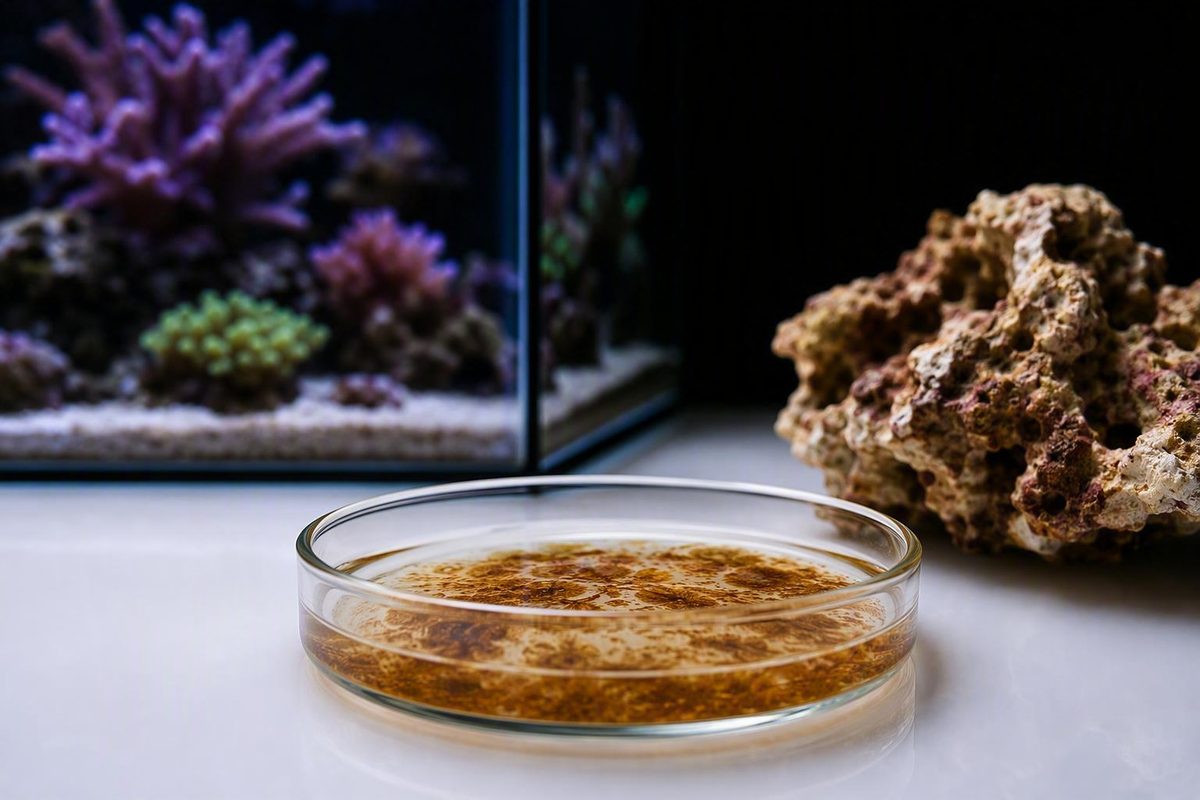
Nighttime thinning can point to better UV exposure, but it neither confirms the organism nor guarantees that sterilization will work.
Search for “dinoflagellates reef tank Reddit” and you will find nearly every conceivable remedy: raise nutrients, stop water changes, add UV, dose bacteria, add copepods, feed phytoplankton, turn off the lights, siphon daily, or use a commercial chemical.
Some of that advice reflects a plausible mechanism. Some describes a treatment that happened before one aquarium improved. Some can be unhelpful—or unnecessarily disruptive—when applied to the wrong bloom.
Reddit does not reveal a universal dinoflagellate cure. Its recurring successes, failures, and disagreements instead support a cautious decision framework: confirm the organism as far as practical, review measured nutrients and recent system changes, separate biomass removal from ecological recovery, and reserve UV or light reduction for blooms whose observed behavior makes those interventions plausible.
The Reddit consensus is a pattern, not a proven protocol
Three r/ReefTank discussions capture both the practical value and the limitations of community advice.
A July 2021 treatment discussion repeatedly recommends correcting deficient nutrients, using UV, adding bacteria or phytoplankton, cleaning continuously, and sometimes reducing light. Several commenters describe a multifactor response rather than reliance on one remedy. Some report improvement after adding UV, but UV commonly accompanied nutrient dosing, cleaning, or other changes.
A July 2024 personal-experience report describes a bloom that appeared after nitrate and phosphate became very low. Increased feeding, stopped water changes, nutrient dosing, manual removal, and heavy live-phytoplankton dosing did not visibly control it during the documented period. The keeper then installed inline UV, but the supplied post ends during that discussion. Despite its success-oriented title, the available text cannot establish the final outcome.
A June 2024 advice thread contains the same broad recommendations: investigate low or unstable nutrients, remove growth, consider UV when the bloom diminishes after dark, add copepods or phytoplankton, and allow a young aquarium time to mature. It also illustrates the uncertainty behind the advice. One commenter proposing a blackout-and-UV combination explicitly says they are not sure of the mechanism.
Across these discussions, five recommendations recur:
- Review nitrate and phosphate, particularly if either has repeatedly fallen below the test’s reporting range.
- Remove visible biomass by siphoning or mechanical capture.
- Consider UV if suspected cells appear to enter the water column.
- Encourage ecological recovery, whether through stable husbandry or additions such as bacteria, phytoplankton, copepods, or mature material.
- Sometimes reduce light, either modestly or through a blackout.
These are useful hypotheses, not validated instructions. If a keeper raises nutrients, installs UV, performs a blackout, siphons daily, and adds bacteria in the same week, subsequent improvement cannot confidently be attributed to any one step. A young aquarium may also be maturing independently.
Counterexamples deserve equal weight. Some aquariums had UV running without resolution. Blackouts reportedly provided only temporary relief in some cases and coincided with coral losses in others. Manual cleaning was followed by rapid regrowth. Phytoplankton produced no visible change during one documented interval. Several reports ended too early to distinguish temporary suppression from durable recovery.
Comments, repetition, and upvotes indicate how prevalent or appealing an idea is within a community. They do not measure scientific reliability. A popular comment may still rest on visual misidentification, incomplete tank data, coincidental timing, or a mechanism that does not fit another bloom.
The evidence in this guide is therefore treated in four ways:
- Repeated Reddit pattern: The recommendation or observation appears across multiple discussions.
- Individual anecdote: One keeper reports an outcome in one aquarium.
- Third-party husbandry guidance: A published aquarium guide offers a structured explanation, but not necessarily controlled evidence.
- Unresolved question: Reports conflict, end prematurely, or provide too little information for a general conclusion.
These labels matter because most of the available material consists of anonymous hobbyist reports, retailer guidance, and an affiliate-supported husbandry article—not controlled treatment studies or independent technical standards. The appropriate result is a conservative troubleshooting framework, not a comprehensive clinical or engineering protocol.
First determine whether the bloom is actually dinoflagellates
Brown, bubbly slime is a reason to investigate, not a diagnosis.
Commonly reported clues include tan or brown mucus-like strings, trapped bubbles, daytime regrowth, and mats that become less prominent after dark. Growth may coat sand, rock, glass, coral bases, or several surfaces at once.
Cyanobacteria, diatoms, chrysophytes, and ordinary algae can look similar. Cyanobacteria are often described as forming cohesive sheets or mats, while diatoms more often resemble a fine dusty coating. Those contrasts can help organize observations, but texture and color are not definitive tests. Retailer-authored guidance similarly recommends considering appearance, day-night behavior, disturbance response, and microscopy together rather than relying on one visible feature (Bulk Reef Supply’s identification overview).
Before choosing a treatment, document the bloom:
- Photograph the same areas near the beginning and end of the lighting period.
- Note whether it favors sand, rock, high-light surfaces, low-flow areas, or coral tissue.
- Record how quickly it returns after siphoning.
- Check whether it thins, disappears, or remains equally dense several hours after lights-out.
- Record fish behavior, coral extension, and invertebrate activity.
- Observe whether disturbance produces dust, sheets, strands, or suspended mucus.
Microscopy is a stronger practical identification method than visual inspection alone. Collect a sample when the bloom is most prominent and compare its cells and movement with suitable identification material. The present evidence pack does not contain an independent technical microscopy reference capable of supporting reliable genus-level self-identification, so species labels obtained from community footage should remain tentative.
Apparent spinning or erratic movement can strengthen a dinoflagellate hypothesis because dinoflagellates possess flagella associated with movement. It does not conclusively establish Ostreopsis, Amphidinium, or another type. In one crowdsourced identification discussion, commenters suggested Ostreopsis from apparent spinning, but the original video was unavailable for independent review and no laboratory confirmation was supplied. That is an example of a tentative Reddit identification, not a confirmed result.
Do not force a species-level answer when the sample or reference material cannot support one. Behavioral descriptions may be sufficient to frame the first treatment question:
- Water-column-like: Surface coverage diminishes substantially after dark, or many suspected cells appear suspended.
- Surface-attached: Growth remains dense on rock or other surfaces overnight.
- Sand-associated: Growth remains concentrated predominantly in or on the substrate.
- Uncertain: Observations conflict or adequate identification is unavailable.
These labels are not taxonomic identifications. They generate exposure hypotheses. A water-column-like bloom has a more plausible path through a UV sterilizer than material that remains embedded in sand.
Audit nutrients, export, tank age, and recent changes before dosing
Multiple Reddit accounts associate suspected blooms with nitrate or phosphate reaching zero or falling below a test’s reporting range. Others mention young systems, low apparent biodiversity, or strong export through skimming, reactors, filter media, refugia, or similar methods. These are recurring associations, not proof that low nutrients cause every bloom.
Start with a written history rather than an immediate dose. Record:
- Repeated nitrate and phosphate results, including dates
- Test methods and their reliable reporting ranges
- Tank age and major livestock additions
- Feeding amounts and recent feeding changes
- Water-change history
- Skimmer operation
- Filter socks, rollers, and other mechanical filtration
- Phosphate-removal or other chemical media
- Refugium, algae-reactor, or biomedia-reactor operation
- Organic carbon dosing, if used
- Recent lighting changes
- Rock, sand, medication, additive, or equipment changes
- Disruptions involving circulation, temperature, or salinity
One zero result is not enough to diagnose a nutrient deficiency. The concentration may be below the test’s reliable range, the method may lack sufficient resolution, or organisms may be taking nutrients up quickly. Trends and system history are more informative than an isolated result.
If repeated, reliable measurements support a genuine deficiency, restore detectable and stable nutrients gradually. That may involve cautiously moderating excessive export, adjusting feeding, or making a measured dosing decision. The purpose is not to hit a supposed dino-killing number overnight. It is to correct documented instability without exchanging one imbalance for another.
If nitrate and phosphate are already measurable or elevated, the available evidence does not justify raising them merely because low nutrients are frequently discussed on Reddit. One crowdsourced microscopy thread involved an aquarium whose owner said both nutrients were already high; generic advice to increase them was therefore poorly matched to the reported conditions.
The July 2024 experience report adds a useful warning about interpreting sequences. The keeper dosed nitrate and phosphate toward the aquarium’s previous levels, after which the visible bloom became much larger. The same account says manually removed material returned within 24 hours and heavy cultured-phytoplankton dosing produced no visible improvement during the period described (the keeper’s July 2024 report). That sequence does not demonstrate that nutrient dosing caused the expansion. The population may already have been accelerating, the organism was not confirmed before treatment, and several ecological changes overlapped.
A retailer guide suggests nitrate of 5–10 ppm and phosphate of 0.02–0.06 ppm, but it supplies no controlled evidence establishing those figures as cure thresholds (the retailer’s published treatment ranges). Treat them as commercial husbandry targets, not universal goals. The same guide warns that overcorrection can promote algae and other problems.
A defensible decision rule is:
- Repeatedly below the test’s reliable range: Investigate excessive export and restore stability gradually.
- Detectable and relatively stable: Do not increase nutrients reflexively; prioritize identification and treatment fit.
- Elevated or rising: Do not add more solely to follow a low-nutrient narrative.
- Erratic: Investigate the cause of instability before chasing a specific number.
Nutrient stabilization may help re-establish conditions in which a broader community competes for space and resources. It is not a direct guarantee that an established bloom will disappear.
Separate immediate biomass control from long-term recovery
Siphoning can reduce visible material. It does not necessarily correct the conditions associated with the bloom.
That distinction explains why growth may return by the next lighting cycle. Rapid regrowth does not prove that removal was useless; it shows that removal alone was insufficient during the observed period.
A cautious, nontechnical removal sequence is:
- Siphon accessible mats and strings rather than deliberately dispersing all visible growth.
- Mechanically capture material that becomes suspended.
- Remove or clean loaded capture media promptly.
- Discard removed material instead of returning it to the aquarium.
- Observe livestock during and after the process.
- Avoid destabilizing salinity, temperature, circulation, or other basic conditions while cleaning.
Some Reddit users report blowing growth from rock or sand into suspension in an attempt to increase its passage through UV. That is an intended mechanism, not a demonstrated benefit.
An affiliate-supported husbandry guide advises gloves, ventilation, avoidance of splashing or aerosolization, safe disposal of removed material, and continued operation of basic life support when dealing with an unidentified suspected bloom (handling and life-support precautions). These should be understood as general precautions from a hobbyist source—not evidence that every aquarium dinoflagellate is toxic.
Unless a tank-specific problem requires otherwise, avoid disabling circulation, return flow, oxygenation, temperature control, or biological filtration merely to fight a visual nuisance. Observe fish, corals, snails, shrimp, and other invertebrates rather than judging the intervention solely by whether the rock looks clean.
The same husbandry source presents fresh activated carbon as a possible way to adsorb dissolved irritants when livestock appears affected. That is not a validated dinoflagellate cure, and it should not be confused with organic carbon dosing:
- Activated carbon is filtration media intended to adsorb some dissolved compounds.
This distinction matters when nitrate or phosphate is already persistently deficient. Increasing nutrient export is not an obvious response to a documented nutrient shortage.
If livestock condition deteriorates during treatment, prioritize stable life support and appropriately qualified aquarium or aquatic-animal assistance over continued cosmetic cleaning. The supplied sources do not support diagnostic symptom thresholds or species-specific medical advice.
UV is most plausible when the cells reach the water column
UV has a limited exposure pathway: it can affect organisms only when aquarium water carrying them passes through the sterilizer. It cannot irradiate a mat that remains on the sand or rock.
That mechanism helps reconcile conflicting Reddit outcomes. Some keepers report rapid improvement after adding UV, often while also stabilizing nutrients, cleaning manually, or reducing light. Other aquariums had UV operating without resolution. Some reports lack follow-up, while others combine too many interventions to identify which change mattered.
Nighttime thinning is a useful clue. If a substantial portion of the growth leaves surfaces after lights-out, more of the suspected population may be entering moving water and becoming available to the sterilizer. This does not prove species identity or guarantee success.
By contrast, growth that remains thick on rock or concentrated in sand overnight may receive less UV exposure. Aquarium discussions sometimes use Amphidinium-like to describe strongly sand-associated behavior and Ostreopsis-like for cells thought more likely to enter the water column. These are practical hypotheses, not laboratory identifications.
Before expecting UV to help, ask:
- Is the unit enclosed and intended for aquarium use?
- Does display-tank water pass through it?
- Is the bloom’s observed behavior consistent with meaningful water-column exposure?
- Is the lamp functional and maintained according to its manufacturer’s guidance?
- Is the sleeve being maintained as instructed?
- Can results be evaluated without simultaneously changing several other major variables?
The available evidence does not establish a universal wattage, watts-per-gallon ratio, flow rate, brand, plumbing arrangement, or operating schedule. Reddit setup claims remain individual anecdotes, not transferable engineering standards.
One commenter in the 2021 discussion reported success after using an unshielded lamp. That anecdote must not be converted into a recommendation. The defensible precaution is to use a properly enclosed aquarium sterilizer and follow its manufacturer’s installation, operation, and maintenance instructions.
UV is best framed as a behavior-matched control measure. It may reduce suspected cells that repeatedly travel through treated water.
Blackouts, pods, phyto, bacteria, and chemicals have mixed records
Popular alternatives differ in their proposed purpose, plausible fit, supporting evidence, and risk. None is established here as a universal prescription.
| Intervention | Proposed role | Best-fit situation | Reddit outcome pattern | Evidence limitation | Principal risk or concern |
|---|---|---|---|---|---|
| Light reduction or blackout | Suppress light-responsive growth; possibly increase time spent away from surfaces | A suspected light-responsive bloom after coral sensitivity is considered | Repeated Reddit pattern: short-term clearing, no durable effect, and combined blackout-plus-UV reports | Different organisms may respond differently; simultaneous UV or cleaning prevents attribution | Reported coral stress or loss; temporary suppression mistaken for recovery |
| Copepods | Support grazing pressure, food webs, or broader biodiversity | A young or low-diversity system where the addition has a defined husbandry purpose | Repeated recommendation; mixed anecdotes | Claims that pods directly eliminate dinos are not established | Added complexity without correcting measured instability |
| Live phytoplankton | Support food webs or possible competition | A deliberate biodiversity strategy | Repeated recommendation; one detailed report found no visible change | Dosing often overlaps with maturation, pods, UV, or nutrient changes | Unclear effect and difficulty interpreting stacked treatments |
| Bottled bacteria | Support microbial competition or recovery after disruption | A disrupted or low-diversity system | Individual anecdotes: credited in some recoveries | Products, organisms, and tank conditions vary | Additional uncontrolled variables |
| Live sand or mature microbial material | Increase ecological diversity | A young or disrupted aquarium | Mixed individual anecdotes | Maturation is a major confounder | Unwanted system changes without a clear need |
| Refugium | Support long-term nutrient management and system diversity | A planned husbandry strategy rather than an emergency reaction | Isolated reports | No basis for crediting it independently when several measures changed | Possible mismatch if nutrient export is already excessive |
| Silicate dosing | Encourage competing organisms such as diatoms | A specialized, informed experiment | Isolated suggestion | Insufficient support for general use | Another bloom or chemical imbalance |
| Temperature elevation | Attempt to alter bloom competitiveness | No supported general use case in this evidence | Contradictory personal reports | No validated temperature protocol or type-specific evidence | Livestock stress |
| Dino X | Chemical suppression | Product-specific decision after diagnosis and risk review | Mixed opinions and incomplete outcomes | Reddit does not establish safety or efficacy | Livestock effects and treatment interactions remain unresolved |
| Hydrogen peroxide | Direct oxidative treatment | Not supported here as a routine response | Higher-risk anecdotal suggestion | No supported dosing protocol in the evidence | Commenters specifically raised concern about invertebrates |
Blackouts
Reducing light may suppress a strongly light-responsive bloom, and some Reddit users hope darkness will increase water-column exposure for UV. Not all suspected dinoflagellates can safely be assumed to depend entirely on light, however, so a blackout is not a universal remedy.
Reddit reports include recurrence after the lights return, no meaningful improvement, coral stress, and coral loss. In one update, an aquarium owner reported that UV had already been running for two months and that a five-day blackout had not resolved the apparent outbreak before they considered Dino X (the Reddit update describing those prior treatments). This does not prove that UV or blackouts never work. It demonstrates that neither intervention is universally effective.
No universally safe blackout duration can be established from these anecdotes. Any reduction in lighting should have a specific purpose, an observation plan, and consideration of the livestock being kept.
Biodiversity additions
Copepods, live phytoplankton, bacteria, live sand, and other microbial additions are more accurately described as proposed recovery support than as direct eradication tools. Their intended role is ecological competition, broader biodiversity, or food-web support.
The July 2024 keeper reported that heavy cultured-phytoplankton dosing produced no visible change during the documented period. Other users credit pods, bacteria, or mature material with improvement, but these additions often occur while young tanks are naturally changing.
Refugia, silicate dosing, and temperature elevation appear as isolated or inconsistent anecdotes. The supplied evidence does not support recommending them generally, especially when the aquarium’s nutrient history and bloom identity remain uncertain.
Chemicals
Dino X appears in Reddit discussions with mixed opinions, uncertain type-dependent results, and incomplete safety information. The anecdotes do not establish that it will work or that it is safe for a particular reef. Any use should be based on current product instructions, a tank-specific risk assessment, and careful monitoring—not a comment thread.
Hydrogen peroxide warrants still greater caution. Reddit commenters themselves note danger to invertebrates, and the evidence pack provides no adequate dosing or safety basis. It should not be presented as an improvised first-line treatment.
Avoid stacking a blackout, nutrient dosing, UV installation, peroxide, and commercial chemicals at the same time unless an immediate livestock problem requires broader action. Stacking interventions increases uncertainty and makes it difficult to determine whether improvement, deterioration, or no change resulted from any particular measure.
A conservative order of operations for a suspected outbreak
This sequence is a decision framework, not a guaranteed treatment recipe.
Stage one: Document the system
Photograph representative areas and record:
- Bloom color, texture, coverage, and location
- Morning, peak-light, and nighttime appearance
- Regrowth after removal
- Fish, coral, and invertebrate condition
- Repeated nitrate and phosphate measurements
- Temperature, salinity, and pH
- Lighting schedule and recent changes
- Export equipment and media
- Tank age
- Feeding, water-change, and dosing history
- Recent disruptions or equipment changes
A short daily log is more reliable than memory and makes it easier to identify whether the bloom is genuinely changing.
Stage two: Confirm as far as practical
Examine a sample microscopically when the bloom is strongest. Use cell appearance and movement to test the dinoflagellate hypothesis, but retain uncertainty when the available reference material cannot support a specific identification.
If observations instead suggest cyanobacteria, diatoms, or another organism, reconsider the treatment plan.
Stage three: Protect life support and reduce biomass
Keep essential circulation, return flow, biological filtration, temperature control, and oxygenation functioning unless a tank-specific safety problem requires a different response.
Use conservative handling precautions, siphon accessible material, capture what becomes suspended, and remove loaded capture media. Do not pursue a spotless appearance at the expense of stable aquarium conditions.
Stage four: Correct only documented instability
If nitrate or phosphate is repeatedly below the test’s reliable range, review export and restore detectable stability gradually. If an aggressive media change, reactor, feeding reduction, or other disruption preceded the bloom, address that specific change thoughtfully.
Do not dose nutrients to a fixed cure target when they are already measurable or high. Do not disable several filtration systems blindly.
Stage five: Match UV to plausible exposure
Consider enclosed UV when nighttime observations or microscopy suggest that a meaningful portion of the suspected population enters the water column. Set lower expectations when growth remains concentrated in sand or firmly attached overnight.
Follow the manufacturer’s installation and maintenance instructions. Do not adopt unsupported Reddit formulas for wattage or flow, and do not operate an exposed lamp as an improvised treatment.
Stage six: Evaluate light reduction cautiously
Consider reduced intensity or duration only after reviewing the bloom’s apparent response to light and the sensitivity of the aquarium’s livestock. The evidence does not establish a universally safe or effective blackout duration.
A lighting change should have a stated purpose, an observation plan, and a stop condition. A brown-looking tank alone does not identify the organism or establish that darkness is appropriate.
Stage seven: Reserve higher-risk interventions
Peroxide and commercial chemicals require informed, product-specific decisions beyond what these anecdotes can support. Restarting the aquarium is not normally the logical first response to an unconfirmed bloom. Revisit identification, measurements, system history, and treatment exposure before dismantling a functioning biological system.
When livestock condition permits, change one major variable at a time. Record the date, the intended mechanism, and the observed result before adding another intervention.
Stop routine experimentation if basic water quality or life support cannot be maintained, livestock condition is worsening, or handling the material causes skin or airway irritation. Stabilize the system and seek appropriately qualified help. The available sources support precaution, not a diagnosis of toxicity or a veterinary treatment protocol.
Track durable recovery instead of chasing one clear-looking day
Use a weekly log that separates appearance from system stability:
| Field | What to record |
|---|---|
| Bloom coverage | Estimated area affected and main locations |
| Regrowth | How quickly material returns after removal |
| Day-night change | Whether growth thins, remains attached, or changes location |
| Microscopy | Cell appearance and movement, with images if available |
| Nitrate | Result, method, and uncertainty near the test limit |
| Phosphate | Result, method, and uncertainty near the test limit |
| Lighting | Schedule, intensity changes, and lights-off periods |
| UV | Installation path, operation, maintenance, and changes |
| Livestock response | Fish behavior, coral extension, and invertebrate activity |
| Removal | Areas siphoned and capture media used |
| Interventions | Every nutrient, bacterial, phytoplankton, chemical, or equipment change |
| Confounders | Water changes, new livestock, feeding changes, and normal maturation |
Define progress as a repeated trend:
- Less total coverage
- Slower regrowth after removal
- Improving livestock behavior
- Stable, measurable parameters
- Less frequent need for siphoning
- Microscopic observations consistent with declining abundance, when available
One clear day after a blackout, cleaning session, or chemical dose does not demonstrate durable recovery. Improvement may also be uneven. Manual removal can be followed by rapid regrowth before a longer-term decline becomes visible.
Young aquariums introduce another confounder: normal maturation continues while the keeper is intervening. If a bloom recedes after pods, bacteria, live sand, or another addition, timing alone cannot separate the additive’s effect from broader ecological succession.
Reassess when the bloom contradicts the treatment hypothesis. If UV was chosen because suspected cells were expected to enter the water column but the material remains concentrated in sand every night, continuing to expect UV alone to solve it is not evidence-based persistence. It is a reason to revisit identification and exposure.
There is no defensible universal deadline for declaring success or failure. Use repeated observations, livestock condition, and system stability. Let Reddit experiences generate hypotheses, then test those hypotheses against the aquarium’s measurements, habitat, and day-night behavior.
Frequently asked questions
Does brown bubbly slime prove that my reef tank has dinoflagellates?
No. Brown mucus, bubbles, strings, daytime regrowth, and nighttime reduction are useful clues, but cyanobacteria, diatoms, chrysophytes, and algae can look similar.
Document texture, location, regrowth, day-night change, and livestock response. Microscopy provides stronger practical evidence than appearance alone, but crowdsourced genus or species identification should remain tentative unless the sample and reference criteria clearly support it.
Should I raise nitrate and phosphate to get rid of dinos?
Only when repeated, reliable measurements and system history indicate a genuine deficiency. Restore detectable stability gradually rather than chasing a fixed cure number.
Do not raise nutrients that are already measurable or elevated solely because Reddit frequently associates suspected dinos with zero nutrients. Nutrient stabilization addresses one possible ecological association; it does not guarantee eradication.
Will a UV sterilizer kill reef-tank dinoflagellates?
UV may affect suspected cells that enter aquarium water and pass through a properly enclosed, functioning sterilizer. It is less plausible for material that remains attached to rock or concentrated in sand.
Nighttime thinning can suggest better exposure, but it does not prove the organism’s identity or guarantee success. Use an enclosed aquarium unit, route display water through it, and follow the manufacturer’s instructions. The supplied Reddit discussions do not establish a universal wattage, flow rate, or plumbing formula.
Does a blackout permanently eliminate dinoflagellates?
Not reliably. Reddit accounts include temporary suppression, no meaningful improvement, recurrence after lighting resumes, and reported coral stress or loss.
A blackout may be considered cautiously for a plausible light-responsive bloom, but not every suspected dinoflagellate can safely be assumed to depend entirely on light. One clear-looking day afterward is not proof of permanent recovery.
Are copepods, phytoplankton, or bottled bacteria proven dino treatments?
No. They are commonly proposed as ways to support biodiversity, food webs, or ecological competition. Outcomes are inconsistent, and additions frequently coincide with UV, nutrient changes, manual cleaning, or normal tank maturation.
Treat them as possible recovery support rather than proven eradication tools. They should not replace identification, measurement, cautious biomass control, or correction of documented instability.
The useful lesson from Reddit is not that one product or parameter defeats every bloom. Outcomes vary with identification, nutrient history, cell habitat, tank maturity, and whether a treatment can physically reach the organism. Document first, confirm as far as practical, protect livestock and life support, remove biomass cautiously, correct only verified instability, match UV or light reduction to observed behavior, and judge recovery from repeated trends rather than one anecdote or one clear-looking day.