
A Diagnosis-First Plan for Controlling Reef-Tank Hair Algae
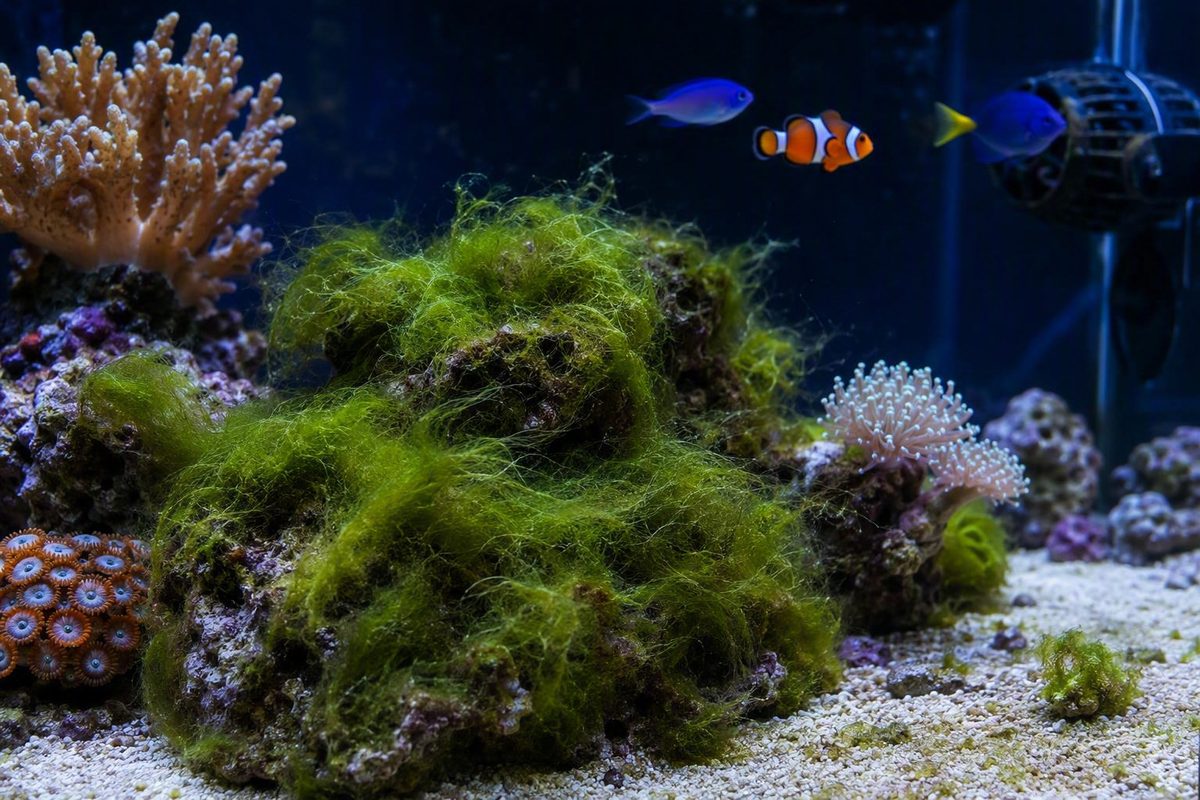
Verify the organism, export mature growth, track nutrient and source-water trends, then use compatible grazers only to limit short regrowth.
Green hair algae in a reef tank is rarely controlled by one animal, one parameter change, or one treatment. The visible growth is biomass that already exists; the conditions allowing it to regrow are a separate problem. Effective control therefore has two tracks: export mature algae now, then investigate why replacement growth is outpacing the aquarium’s normal maintenance and grazing.
Begin by confirming that the organism is likely ordinary green hair algae rather than Bryopsis, turf algae, or filamentous cyanobacteria. Remove as much mature growth as practical while capturing detached strands. Then examine nutrient throughput, source water, feeding, trapped waste, filtration, lighting changes, and export capacity using recorded trends—not one reassuring test result.
Compatible grazers may help maintain shortened growth, but they are supporting livestock rather than guaranteed cures. The practical objective is not a permanently sterile aquarium. It is a stable reef in which algae regrows slowly enough to be exported or grazed before it competes seriously with coral.
The available evidence for aquarium hair-algae control is limited. Much of it comes from retailer guidance, experienced hobbyist articles, and uncontrolled forum reports rather than comparative studies. This guide therefore distinguishes broadly useful troubleshooting steps from anecdotal livestock and treatment outcomes and avoids universal nutrient targets, stocking formulas, and dosing protocols.
Confirm What Is Growing Before Treating It
Likely green hair algae is soft, green, filamentous growth that forms strands or tufts. It may colonize rock, sand, pumps, overflow components, frag plugs, and exposed coral skeletons. Mature patches can wave in the current or merge into dense mats.
That description supports a working diagnosis, not a taxonomic identification. Several unrelated organisms receive the informal “hair algae” label, so color and filamentous growth do not establish a genus such as Derbesia.
Commercial aquarium guidance commonly contrasts soft, stringy hair algae with Bryopsis that is stiffer, visibly feather-like, more firmly anchored, and harder to pull free. These are useful clues, but not definitive identification criteria according to Bulk Reef Supply’s identification guide.
Use this checklist before buying livestock or selecting an organism-specific treatment:
- Texture: Is the growth soft and flowing, wiry and stiff, or slippery and mucous-like?
- Attachment: Can it be pinched or pulled away with moderate effort, or does it resist removal and leave a strongly anchored base?
- Branching: Are the filaments mostly plain, or do they show a fern- or feather-like structure?
- Growth form: Does it make loose tufts, a short dense turf, or a cohesive slimy mat?
- Location: Is it concentrated on illuminated rock, in detritus traps, on equipment, across sand, or beside damaged coral tissue?
- Regrowth: How quickly does a cleaned patch become visibly colonized again?
- Grazer response: Do plausible herbivores crop shortened growth, or do several animals consistently avoid it?
- Photographs: Do you have sharply focused close-ups under neutral white or daylight-style illumination rather than only blue reef lighting?
Slimy sheets, unusual branching, exceptionally strong attachment, or persistent refusal by several plausible grazers should prompt reassessment. Grazer refusal alone does not prove misidentification. Long strands may be difficult to bite, alternative food may be abundant, or the patch may be inaccessible. It is nevertheless useful diagnostic information.
Take three types of photograph:
- A full-tank image showing distribution.
- A medium-distance image showing the affected structure.
- A close-up showing individual filaments and branching.
Use the same angles after removal so that regrowth can be compared rather than estimated from memory. A ruler or familiar object can provide scale when practical.
When photographs remain ambiguous, inspect a fresh sample under better magnification or seek experienced identification. Microscopy may be needed to separate some visually similar algae from filamentous cyanobacteria; participants in one persistent-outbreak discussion specifically requested microscopic identification when ordinary photographs and the reported response to control measures remained inconclusive in the Nano-Reef case discussion.
Identification matters because an intervention aimed at the wrong organism can appear inexplicably ineffective. A snail that ignores suspected hair algae may instead be encountering tough turf, Bryopsis, filamentous cyanobacteria, inaccessible mature strands, or an unappealing individual patch. Likewise, an anecdotal treatment associated with one organism should not be expected to work against every green filamentous growth.
Until the diagnosis is reasonably clear, favor reversible actions that are useful across several possibilities: photograph the growth, record water results, export loose biomass, remove trapped waste, and review recent system changes. Pause organism-specific chemical treatment when the texture or structure does not fit the assumed diagnosis.
Why Hair Algae Can Thrive When Nutrient Tests Look Low
A nitrate or phosphate test measures the concentration in one water sample at one moment. It does not directly measure how much nitrogen and phosphorus entered during the preceding day, how quickly organisms absorbed them, or how much remains incorporated in food, detritus, sediment, microbes, and algal biomass.
This is the distinction between nutrient concentration and nutrient throughput.
Food enters the aquarium. Livestock consume some of it, release waste, and leave particles behind. Uneaten food and detritus decompose. Dissolved nutrients become available and may then be taken up by algae and other organisms or removed through filtration and maintenance. A later test can show a low concentration even while nutrients continue moving through the system.
An established algae mass may consume available nitrate and phosphate rapidly. That does not prove that algae has hidden every nutrient, and its appearance cannot reveal the aquarium’s original nutrient input. It means only that a low result does not rule out continuing input or inadequate waste processing.
For example, one aquarist reported a substantial outbreak while phosphate measured 0.03 ppm and nitrate measured 0.75 ppm. The tank later improved after manual removal, feeding changes, water changes, and carbon dosing were used together, so the case cannot identify one cause or remedy in the Reef2Reef outbreak account. It demonstrates the limitation of a single reading, not a universal nutrient mechanism or target.
The practical response is better logging rather than more aggressive guessing. Record actual numbers instead of descriptions such as “fine,” “perfect,” or “within range.” At minimum, track:
- Nitrate result, method, and date
- Phosphate result, method, and date
- Salinity and temperature
- TDS from freshly produced source water
- Feeding type, quantity, and frequency
- Water-change dates and approximate volume
- Mechanical-filter servicing dates
- Skimmer cleaning and operational changes
- Lighting schedule and recent fixture or intensity changes
- Approximate algae coverage
- Amount of algae removed during each session
- Livestock additions, losses, and feeding changes
- Coral condition near affected areas
For broader testing context, Reef Directory’s saltwater aquarium water-parameters guide can be used alongside this outbreak log.
Test under reasonably comparable conditions, such as at a similar time relative to feeding. Record changes in test kits, reagents, sampling methods, or laboratories. If a result is surprising or inconsistent with the recent trend, repeat it before making a major correction.
Do not react to green hair algae by indiscriminately forcing nitrate and phosphate to zero. The supplied sources do not establish one universal nutrient concentration or ratio for every reef. Abruptly changing several nutrient-control methods also makes the tank’s response harder to interpret.
Interpret nutrient results alongside:
- The speed of recolonization after cleaning
- Whether algae is spreading to new surfaces
- Fish and coral condition
- The amount of food entering the tank
- Detritus accumulation
- The frequency with which captured waste is removed
- Source-water performance
- Algae-removal volume over time
- The capacity and consistency of existing export equipment
The goal is not the smallest possible number in a test vial. It is stable water quality, appropriately nourished livestock, and a continuing decline in nuisance-algae growth and removal burden.
Remove the Existing Biomass Without Leaving It in the Tank
Physical export is the immediate first step because correcting feeding, filtration, or source water does not instantly remove mature strands already covering surfaces. Removing it also creates a clean reference area for measuring regrowth.
A siphon-assisted workflow offers controlled removal:
- Prepare a bucket, siphon hose, and clean forceps or another small gripping tool.
- If useful for fragment control, stop or reduce circulation only for the removal session.
- Position the siphon intake directly beside the target patch.
- Grasp the algae close to its base rather than pulling only the loose ends.
- Pinch, twist, or pull a manageable clump free.
- Capture the detached growth immediately with the siphon.
- Finish one limited section before moving to another.
- Inspect nearby rock, pump guards, and overflow teeth for escaped strands.
- Restore the normal equipment configuration after the session.
- Clean or replace mechanical media that captured loosened material.
During a conventional water change, route the siphon to a bucket. This exports algae, suspended particles, and aquarium water together.
Some hobbyists instead recirculate siphoned water through a fine net or filter sock into the sump. Treat this only as a reported option, not as a universally suitable method. It depends on dependable debris capture; cloudy, fragment-filled water should not be returned through inadequate media.
For a few isolated patches, a full siphon session may be unnecessary. Pinch out each clump and withdraw your hand or tool while still holding it. Rinse your fingers or tool in a separate container before returning to the display. This repeated pinch-and-rinse method is described in Melev’s Reef’s manual-removal procedure.
Work in manageable sections. Prioritize algae touching coral, dense mats, and patches likely to shed fragments. Avoid dismantling the entire aquascape simply to reach every filament in one session. A staged process preserves a useful comparison between cleaned and untreated areas and reduces unnecessary disturbance.
Long, mature strands are often poor test targets for cleanup animals. Shortening them does not guarantee grazing, but it allows you to observe whether existing herbivores crop the exposed base or fresh regrowth. Visible bite paths, shortened filaments, and rock remaining exposed are more informative than an animal merely spending time near the patch.
Brushing remains disputed within the available aquarium material. Some retailer guidance warns that brushing can scatter fragments, while hobbyist reports describe temporary improvement after scrubbing. No supplied controlled comparison establishes that brushing is always harmful or that scrubbing is consistently effective.
If brushing is used, limit it to a small area and capture loosened material immediately where practical. Removable equipment can usually be cleaned outside the display more controllably than rock fixed into the aquascape.
Exercise particular care where algae meets living coral tissue. Do not scrape, pinch, or abrade the coral in an attempt to remove every filament. Export only what can be reached without contacting living tissue, then keep the remaining patch short. The evidence pack does not establish one universal coral-safe removal technique for every coral type, attachment site, or degree of tissue damage.
Afterward, clean or replace filter floss, socks, pads, or other collection media. Otherwise, material deliberately captured during removal remains in the system as stored organic waste.
Manual removal is not evidence that nutrient management has failed. It exports biomass that system corrections cannot remove instantly. Physical removal addresses the existing growth; import and export corrections determine how quickly it returns.
Find the Imbalance: Inputs, Waste, Source Water, Light, and Export
Persistent regrowth is best investigated as an import-and-export problem rather than blamed automatically on one parameter. Ask:
- What enters the aquarium?
- Where do uneaten material and waste accumulate?
- Which processes actually remove that material from the system?
Review nutrient import. Record feeding amount and frequency instead of calling them “light” or “normal.” Look for food entering overflows, settling behind rock, remaining on the substrate, or being ignored. Note whether the outbreak followed a livestock addition, a new food, increased fish feeding, or more frequent coral feeding.
If avoidable excess is evident, reduce it gradually while confirming that fish and corals continue receiving suitable nutrition. A heavily stocked aquarium may require substantial feeding and therefore proportionately effective export. The goal is to reduce waste, not to starve livestock.
Inspect waste storage. Detritus may accumulate beneath ledges, in low-circulation corners, within coarse substrate, inside overflow boxes, and in sump compartments. Remove accumulated material in stages rather than stirring every substrate and rockwork area at once.
Verify source water. Test freshly produced RO/DI water rather than assuming that the membrane, resin, plumbing, or meter is functioning correctly. Check the water actually used for top-off and saltwater preparation. In one forum case, an aquarist troubleshooting persistent growth later reported source water at 18 TDS, illustrating why direct verification belongs early in the process in the Humble.Fish discussion.
Service the skimmer. Inspect the collection cup, neck, pump, impeller, air intake, tubing, and operating water level. Record any maintenance or operational change so that later improvement is not attributed vaguely to “better filtration.”
Check mechanical filtration. Determine where algae fragments and detritus are being caught, whether water bypasses the media, and how often the captured material is removed. Socks, pads, floss, fleece rollers, and other mechanical filters differ in operation, but their shared purpose in this plan is export rather than indefinite storage.
Examine flow and distribution. Pump ratings do not show how water moves through the actual aquascape. Look for recurring detritus piles, stagnant crevices, and places where food settles. Growth concentrated in one area may reflect a combination of illumination, surface condition, waste accumulation, and poor access for grazers.
Review lighting changes. Note recent adjustments to photoperiod, intensity, spectrum, bulbs, fixture height, lens cleanliness, and aquascape placement. If the outbreak followed a major lighting change, consider moderating that specific change while observing coral condition. Do not assume that lighting is the root cause while ignoring feeding, source water, and waste storage.
Evaluate water changes in context. Water changes can export dissolved and suspended waste, particularly when combined with siphoning. They may disappoint when replacement water is compromised, ongoing inputs remain unchanged, detritus is left in place, or mature biomass remains in the display. Increasing frequency without checking source water can simply repeat an unidentified problem.
Assess export capacity. If routine maintenance cannot keep pace with feeding and waste production, evaluate whether the system needs stronger or more consistent export. Refugiums, algae scrubbers, macroalgae reactors, improved mechanical filtration, and skimming are presented in commercial aquarium guidance as possible system components rather than guaranteed cures in CoralVue’s overview.
When livestock safety permits, change one major variable at a time. If you simultaneously cut feeding, replace RO/DI filters, add grazers, install equipment, change lighting, and begin dosing, later improvement cannot identify which action mattered. Urgent conditions may require several corrections, but record each one and its date.
Choose Grazers as Support, Not as a Guaranteed Cure
No grazer is guaranteed to eat a suspected green hair algae patch. Reported appetite varies with the organism’s identity, strand length, individual animal, competing food, access, health, predators, and aquarium conditions.
The table below is a screening list, not a stocking guide. The categories come primarily from retailer recommendations and hobbyist reports rather than controlled species comparisons. Sources also conflict: one commercial guide favors cerith snails and urchins while describing trochus snails as comparatively poor consumers of hair algae on rock in AlgaeBarn’s grazer overview.
| Grazer category | Commonly suggested examples | Reported or proposed role | Selection constraints | Practical risks | Post-outbreak plan |
|---|---|---|---|---|---|
| Snails | Mexican turbo, Astraea, cerith, selected trochus | Crop accessible film, short growth, or regrowth; performance varies by source and individual | Confirm species, temperature suitability, available surfaces, predators, and food supply | Large animals may disturb loose objects; some individuals ignore mature strands | Provide suitable food if natural growth becomes scarce; avoid buying more animals than the system can support |
| Urchins | Tuxedo and pincushion urchins | Commonly suggested for grazing accessible hard surfaces | Consider tank maturity, predators, aquascape stability, coral placement, and long-term food | May lift, carry, or displace unsecured frags and decor | Plan appropriate supplemental feeding or rehoming before algae becomes scarce |
| Blennies | Lawnmower and starry blennies | Possible browsing on short or weakened growth | Consider species needs, compatibility, established food sources, and individual behavior | May prefer prepared food or ignore the target patch | Maintain a complete feeding plan rather than relying on nuisance algae |
| Larger herbivorous fish | Selected tangs, rabbitfish, and foxfaces | Ongoing browsing in suitable systems | Adult size, swimming room, diet, tankmates, and species-specific care must fit permanently | Inappropriate for many aquariums and may still ignore the target growth | Keep only as permanent livestock with suitable long-term care |
| Specialized or temporary grazers | Sea hares and other specialized herbivores | Sometimes reported to consume substantial visible growth | Exact species, acclimation, predators, food supply, system conditions, and rehoming access | Outcomes include rapid clearing, poor performance, animal loss, and recurrence after removal | Arrange feeding or responsible rehoming before the outbreak is depleted |
If you are considering an emerald crab, first review what emerald crabs eat and how to support them, because they are omnivorous scavengers rather than guaranteed hair-algae specialists.
Large snails, abalones, and urchins have been reported to lift or dislodge aquarium objects, so secure loose frags and unstable decor before adding them as discussed in the Humble.Fish cleanup-crew thread.
Lawnmower and starry blennies may help, but the common name does not guarantee behavior. Some individuals browse visible growth; others favor prepared food or different material on rock surfaces. Select the fish only if the aquarium can meet its complete husbandry needs.
Tangs, rabbitfish, and foxfaces belong only in systems suitable for their permanent care. Do not add a large fish to a small aquarium to solve a temporary outbreak, and do not treat it as disposable once the display clears.
Sea hares require particular caution. Forum outcomes range from rapid clearing to temporary control, immediate recurrence, and animal loss. In one uncontrolled case, a sea hare reportedly died after about two weeks, while the effects of several other grazers remained uncertain in the Reef2Reef account. Such reports cannot predict performance in another aquarium, but they show why a sea hare should be treated as livestock rather than an algae-removal product.
Before judging an existing cleanup crew, shorten the mature strands. Then observe the same cleaned patches for several days. Look for:
- Clear bite or scrape paths
- Shortened filaments
- Newly exposed rock
- Slower maturation of regrowth
- Increased grazing after prepared food is no longer present
- Areas that remain untouched despite good access
If grazing is absent, reconsider identification, accessibility, competing food, predators, and animal condition before adding more livestock.
Reject formulas based only on gallons. Two tanks of equal volume can differ in algae biomass, rock area, temperature, predators, maturity, detritus, and long-term food supply. Stocking must be species-specific and welfare-based.
Before any purchase, answer:
- Is this animal compatible with the aquarium now and at adult size?
- What will it eat after visible algae declines?
- Can it be supplemented or responsibly rehomed if the aquarium cannot support it?
If those questions do not have satisfactory answers, continue physical export and system correction rather than turning an algae problem into a livestock problem.
A Four-Week Green Hair Algae Control Plan
Four weeks is a structured observation period, not an eradication deadline. It is long enough to establish a baseline, repeat targeted export, correct obvious maintenance failures, and judge whether regrowth is changing direction.
Day 1: Establish the baseline
Photograph the full display and several representative patches under neutral or daylight-style illumination. Mark or remember the camera position so later images show comparable areas.
Record:
- Nitrate and phosphate
- Salinity and temperature
- Source-water TDS
- Feeding type, quantity, and frequency
- Lighting schedule and recent changes
- Water-change and filter-maintenance schedule
- Recent livestock, equipment, or aquascape changes
- Approximate algae coverage
- Coral condition near affected areas
Handle a small patch if it can be done without contacting coral. Determine whether it is soft and pullable or stiff, feathered, slimy, unusually branched, or exceptionally well anchored. Pause organism-specific treatment if the diagnosis is doubtful.
Days 1–3: Complete the first removal session
Choose one manageable zone, prioritizing algae nearest coral or dense growth likely to shed fragments. Reduce circulation if appropriate, place the siphon beside the patch, remove clumps near their bases, and export the captured material.
Clean the mechanical media that catches loosened algae. Remove accessible detritus and clean affected removable equipment, but do not dismantle the entire reef or deep-clean every compartment at once.
Record the approximate amount removed. A consistent rough measure—such as a loosely filled cup or a wet mass measured in the same way each time—is more useful than writing “a lot.”
Week 1: Verify support systems
Test freshly produced RO/DI water. Inspect the purification system if the TDS reading is unexpected or has changed.
Check the skimmer neck, cup, pump, air intake, and operating water level. Inspect filter socks, floss, pads, roller media, overflow areas, and sump compartments. Remove waste that is being stored rather than exported.
Review feeding. If obvious excess is present, make a modest adjustment and confirm that livestock still receive appropriate nutrition.
Inspect pumps and recurring detritus deposits. Review recent lighting changes rather than making an arbitrary reduction solely because algae is present.
Assess existing grazers before buying more. After shortening mature strands, observe whether they crop the exposed base or fresh regrowth.
Week 2: Compare, remove, and refine
Retake photographs from the original positions. Repeat nitrate, phosphate, salinity, temperature, and source-water checks under comparable conditions.
Perform another targeted removal where needed. Compare the amount exported with the first session and note whether:
- The same patch returned more slowly
- New surfaces became colonized
- Grazers created visibly cropped areas
- Detritus returned to the same locations
- Coral tissue beside the algae improved, remained stable, or declined
Correct one clear issue at a time where practical. Examples include shortening filter-service intervals, correcting source-water performance, improving access to a detritus trap, or reversing a recent increase in feeding.
Week 3: Evaluate the trend
Repeat targeted removal before strands mature into dense mats. Do not judge progress solely by the latest nitrate or phosphate result.
Useful indicators include:
- Slower regrowth at photographed locations
- Less algae removed per session
- Fewer newly colonized surfaces
- More rock remaining visible
- Stable rather than erratic nutrient trends
- Less accumulation in recurring detritus traps
- Healthy or improving coral tissue
- Grazers maintaining short growth after manual removal
If one location remains much worse than the rest, investigate local conditions such as strong illumination, exposed skeleton, trapped waste, poor grazer access, or a different organism.
Week 4: Continue or reassess
The tank does not need to be algae-free by the fourth week. If regrowth is slower, removal volume is falling, and coral remains healthy, continue the process. Extend the interval between sessions only when growth remains manageable.
Repeated effort over several weeks is consistent with experienced hobbyist guidance, which describes control as an ongoing process rather than a one-time intervention in Melev’s Reef’s account.
If growth is not slowing, revisit the diagnosis and data:
- Are the photographs sharp enough for identification?
- Does the texture fit ordinary hair algae?
- Are test methods and reagents reliable?
- Is source water tested at the point of use?
- Is detritus accumulating beneath rock or in the sump?
- Is actual feeding higher than estimated?
- Is mechanical media retaining waste?
- Is export capacity matched to the aquarium’s feeding and bioload?
- Did multiple simultaneous changes obscure the result?
Success means ecological control: less mature biomass, less competition with coral, slower regrowth, and a maintenance burden the system can sustain.
When to Escalate—and Why Quick Fixes Require Caution
Chemical and aggressive interventions belong after identification, physical export, measurement, and correction of clear husbandry failures. Treatment may suppress visible growth without explaining why it developed, and an incorrect diagnosis can expose non-target organisms without addressing the actual problem.
Fluconazole reports are conflicting. Some forum participants reported substantial algae removal, while another supplied case reported no benefit. Organism identity, treatment conditions, and simultaneous interventions were not controlled. The same discussion includes a warning from one participant that refugium macroalgae may be affected; this is an anecdotal caution, not a universal outcome in the Reef2Reef treatment thread.
Hydrogen peroxide and scrubbing should likewise be treated as reported interventions rather than established protocols. In one persistent case, the owner reported that peroxide treatment and scrubbing suppressed visible growth for about six months before it returned. The report does not establish a universally effective or coral-safe method in the Nano-Reef case history.
Reports involving GFO, other phosphate-removal products, carbon dosing, and algaecides are also inconsistent. In the supplied cases, these methods were usually combined with manual removal, water changes, feeding adjustments, or livestock additions. The outcomes therefore cannot isolate the effect of one intervention.
This guide does not provide dosing instructions. The evidence pack does not establish treatment-specific contraindications, interactions, species sensitivities, monitoring requirements, or emergency procedures well enough to justify a universal protocol.
Before dosing, obtain treatment-specific guidance that accounts for:
- The best available organism identification
- Current nitrate and phosphate results and trends
- Actual aquarium water volume rather than nominal tank capacity alone
- Fish, coral, mobile invertebrates, and other sensitive livestock
- Refugium macroalgae and other non-target photosynthetic organisms
- Current filtration and aeration
- Other medications, supplements, and nutrient-control methods
- A monitoring and contingency plan
These reports do not prove that every treatment causes harm, but they are sufficient reason not to improvise a universal dose from an isolated success story.
Escalation is more defensible when:
- The organism has been identified as confidently as practical.
- Mature biomass has already been reduced.
- Numerical water and source-water trends are available.
- Clear feeding, detritus, filtration, and maintenance failures have been addressed.
- Growth continues spreading or threatening coral.
- The intervention’s intended target and limitations are understood.
- A monitoring and response plan is in place.
Be skeptical of “kitchen sink” success stories. If removal, feeding reduction, water changes, carbon dosing, phosphate media, and several grazers are introduced together, later clearing cannot establish which action worked. Escalation should reduce uncertainty rather than simply add another variable.
Prevent Recurrence and Know When to Reassess the Diagnosis
Once the display improves, continue inspecting the surfaces where outbreaks tend to restart:
- Brightly illuminated rock
- Detritus traps
- Pump housings
- Overflow components
- Frag plugs
- Exposed coral skeletons
A small tuft is easier to export than a mature mat. Continue using the same log for nutrient trends, feeding, source-water TDS, filter servicing, skimmer maintenance, water changes, algae coverage, and removal volume. This can reveal whether recurrence followed a feeding increase, missed maintenance, source-water change, livestock addition, or lighting adjustment.
Keep export equipment functional. Service the skimmer and remove captured material from mechanical filtration before it becomes long-term waste storage. Siphon recurring detritus traps before the material is buried or redistributed.
Inspect new wet materials before they enter the display. Retailer guidance identifies live rock, live sand, coral frags, and newly introduced snails as possible routes by which algae may enter an aquarium. Examine rock, plugs, coral bases, shells, and equipment under neutral lighting, removing visible nuisance growth when that can be done without damaging livestock.
Inspection and quarantine cannot guarantee that algae will never enter the aquarium. Small fragments may be difficult to detect, and established reef systems already contain many photosynthetic organisms. The practical goal is to reduce introductions, avoid transferring mature patches, and detect new growth early.
Reassess the diagnosis when growth remains:
- Stiff or wiry rather than soft
- Clearly feathered or unusually branched
- Slimy or mat-forming
- Exceptionally difficult to detach
- Unchanged after repeated conservative management
- Untouched by multiple otherwise plausible grazers
- Concentrated in a pattern inconsistent with the original explanation
At that point, obtain sharper close-up photographs, inspect a fresh sample under magnification, or seek experienced microscopic identification. Do this before buying more animals or selecting a treatment aimed at a particular organism.
Recurrence does not prove that manual removal was pointless. Exporting mature algae reduced immediate biomass and competition.
The durable sequence is straightforward: verify the organism, export mature growth, measure nutrient and source-water trends, correct clear input or maintenance problems, and use compatible grazers to limit short regrowth. If progress stalls, reassess identification and system data before adding livestock or escalating to treatments whose effectiveness and safety remain uncertain.
Can green hair algae grow when nitrate and phosphate test at zero?
Yes. A zero or very low result is a snapshot of dissolved concentration in the sample, not a direct measurement of nutrient throughput. Food and decomposing waste may continue releasing nutrients while algae and other organisms absorb them.
A forum case documented visible growth alongside reported nitrate of 0 and phosphate of 0.02 ppm, although the uncontrolled report cannot establish why the outbreak occurred in the Reef2Reef discussion. Repeat unexpected results and interpret them alongside feeding, detritus, source water, export capacity, growth rate, and livestock condition. Do not assume either that nutrients are irrelevant or that they must be forced lower.
Should I remove green hair algae by hand before adding snails or urchins?
Usually, yes. Physical removal exports mature biomass immediately and shortens strands that may be difficult or unattractive for grazers. Pinch or pull near the base while holding a siphon beside the patch, then remove the detached material.
Afterward, observe whether grazers crop the exposed base and new growth. Secure loose frags before adding large snails or urchins, and plan how the animals will be fed or rehomed if natural growth becomes scarce.
How can I tell green hair algae from Bryopsis?
Likely ordinary green hair algae is commonly described as soft, stringy, and relatively easy to pinch or pull away. Bryopsis is commonly described as stiffer, feather-like, and more firmly anchored in Bulk Reef Supply’s comparison.
These are working clues, not a definitive species identification. Examine texture, attachment, branching, growth form, location, and regrowth under neutral lighting. Seek magnified or microscopic identification if the structure remains ambiguous.
Will a cleanup crew eliminate green hair algae permanently?
No cleanup crew can guarantee permanent elimination. Snails, urchins, blennies, and suitable herbivorous fish may limit accessible short growth, but performance varies by algae identity, individual behavior, competing food, tank conditions, and access.
Commercial recommendations also conflict about which animals reliably consume mature hair algae as illustrated by AlgaeBarn’s species discussion. Select every animal for compatibility and long-term welfare rather than applying a fixed animals-per-gallon formula.
When should I consider a chemical treatment for green hair algae?
Consider escalation only after improving identification, exporting mature biomass, recording numerical trends, verifying source water, and correcting clear feeding, detritus, filtration, or maintenance problems. It becomes more defensible when growth still spreads or threatens coral despite those measures.
Obtain treatment-specific guidance based on actual water volume, livestock, refugium organisms, water results, filtration, and other dosing. Commercial treatment claims in the available material are not accompanied by sufficient safety, contraindication, interaction, or emergency-procedure information to support a universal protocol as illustrated by CoralVue’s treatment overview. Avoid combining several aggressive interventions unless necessary, because simultaneous changes make both adverse effects and later improvement harder to interpret.