
How to Feed an Emerald Crab Without Guessing
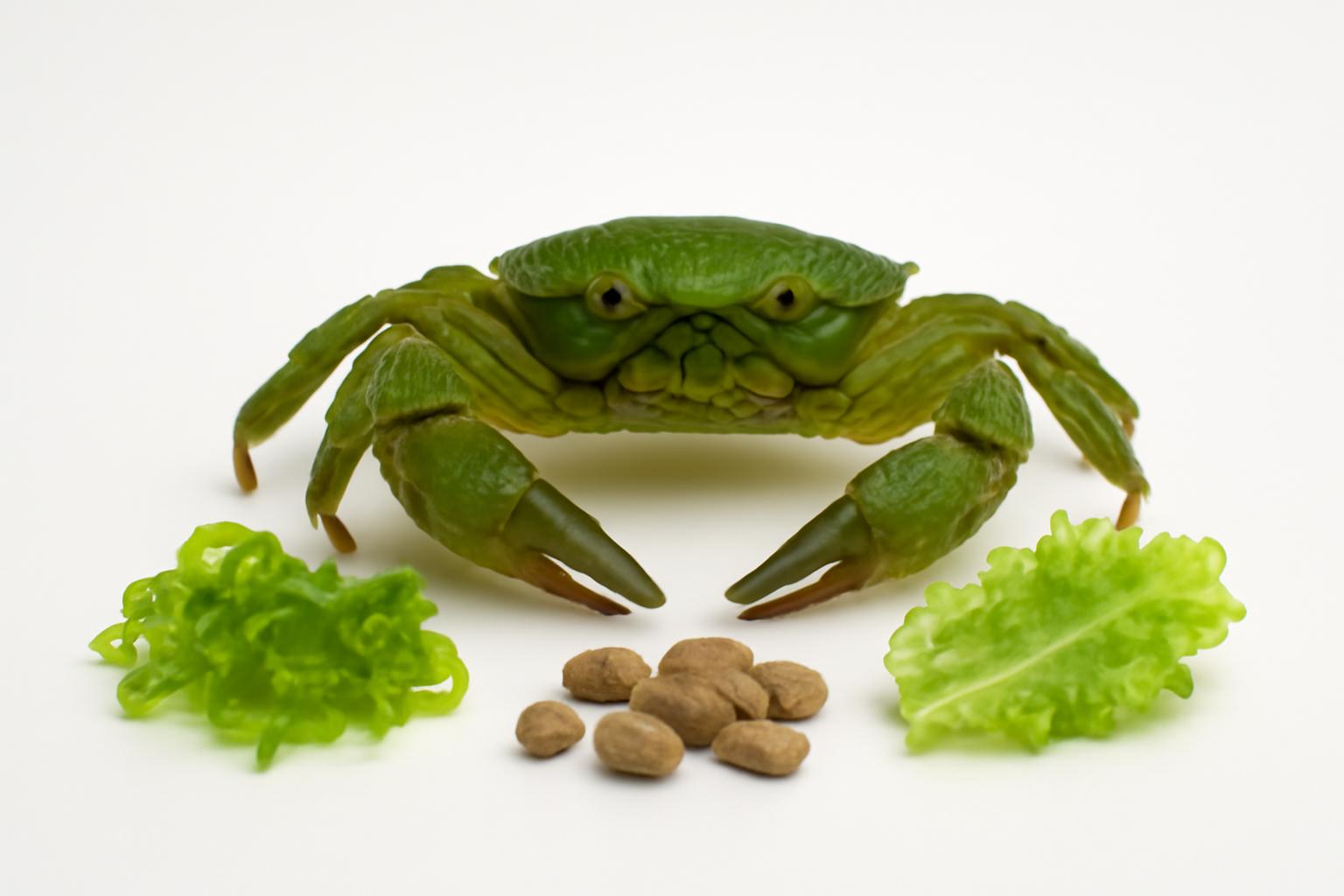
If natural forage runs low, start with a small, accessible algae-based supplement such as nori, a sinking wafer or a suitable sinking pellet.
Emerald crabs are best treated as algae-focused omnivorous scavengers, not animals that live on bubble algae alone. In a reef aquarium, they may graze several kinds of algae, pick through material on rock and sand, and consume fish food or other edible scraps that reach the bottom.
If natural forage becomes scarce, start with a small, accessible algae-based supplement such as nori, a sinking algae wafer, or a suitable sinking pellet. Occasionally rotate in a modest amount of mysis, brine shrimp, chopped shrimp, or another appropriately sized meaty food. Adjust the routine according to what the crab actually reaches and consumes.
This conditional approach is more defensible than a rigid feeding calendar. Feeding does not guarantee bubble-algae control, and a well-fed emerald crab is not automatically safe around every coral or tankmate.
The evidence behind these recommendations is limited. Available sources consist mainly of aquarium care guides, retailer profiles, hobby articles, and forum observations rather than controlled nutritional research. They can identify commonly accepted foods and practical feeding methods, but they do not establish exact nutrient requirements, a scientifically complete diet, or universal portions.
The short answer: what emerald crabs eat
Emerald crabs are commonly described as opportunistic omnivorous scavengers. Those terms describe different parts of the same feeding behavior:
- Algae grazer: Much of the crab’s visible activity involves picking at rock and other aquarium surfaces.
- Scavenger: It uses detritus, scraps, and other edible material already present in the tank.
- Omnivore: It may consume both algae-derived and animal-derived foods.
Reported aquarium foods include bubble algae, hair algae, film algae, macroalgae, material found on live rock or the sand bed, and uneaten fish food. Aquarium profiles consequently describe a diet centered on algae but broader than strict herbivory; one retailer, for example, lists hair algae, macroalgae, bubble algae, and uneaten fish food among the foods emerald crabs may consume (Salty Underground’s emerald crab profile).
A crab that is not eating visible bubble algae may still be feeding. Film algae can be difficult to see, edible material may collect inside rockwork, and scraps can reach the substrate after fish feeding. Conversely, a tank may appear to contain plenty of food while offering little that the crab can access—especially when fish, shrimp, hermit crabs, or other scavengers arrive first.
A useful quick-reference framework is:
| Feeding role | What it includes | How to use it |
|---|---|---|
| Natural forage | Algae on rock and other surfaces, detritus, material in the sand bed, fish-food scraps | Let the crab graze when forage is plentiful and accessible |
| Primary supplements | Nori or other dried seaweed, sinking algae wafers, suitable herbivorous-invertebrate pellets | Offer a small portion when natural forage appears limited |
| Occasional meaty supplements | Mysis shrimp, brine shrimp, finely chopped shrimp, suitable omnivore pellets | Rotate in modestly instead of making meat the default supplement |
This hierarchy does not mean that any single item—or the rotation as a whole—is a scientifically demonstrated complete diet. It is a practical way to favor the crab’s reported algae-grazing behavior while accounting for its broader scavenging habits.
A practical emerald crab food hierarchy
A flat food list can make nori, detritus, frozen shrimp, and bubble algae appear interchangeable. They are not equally useful in every situation. A three-tier hierarchy makes it easier to choose emerald crab food without turning each feeding into a large mixed meal.
Tier one: natural forage
Natural forage is material the crab finds without deliberate target feeding:
- Algae growing on rock, glass, equipment, and other surfaces
- Detritus and edible organic material within the aquascape
- Food scraps that settle on rock or the substrate
- Bubble, hair, film, and some macroalgae
Assess this tier by access, not appearance alone. Visible algae is useful evidence, but a crab may also forage in crevices or behind rockwork. Likewise, fish food added to the aquarium does not benefit the crab if other animals eat it before it sinks.
A mature aquarium with abundant accessible forage may support an emerald crab without routine target feeding. That does not demonstrate that algae alone is a complete long-term diet. It means the aquarium may already provide a mixture of algae, detritus, and leftovers.
Tier two: algae-based supplements
When natural forage declines, begin with an algae-oriented food:
- Plain dried seaweed or nori
- Sinking algae wafers
- Sinking pellets formulated for herbivorous marine invertebrates
- Another appropriately sized algae-based sinking food
These foods match the crab’s commonly reported grazing emphasis and are relatively easy to place near its shelter. One care guide recommends nori, algae wafers, and sinking herbivorous-invertebrate pellets when aquarium algae is limited (Saltwater Aquarium Blog’s emerald crab care guide).
Do not assume that a package labeled for herbivores, crabs, or cleanup animals is automatically a complete diet for an emerald crab. The available evidence supports these products as practical supplements, not scientifically validated sole rations.
Tier three: occasional meaty foods
Suitable animal-derived options include:
- Mysis shrimp
- Brine shrimp
- Finely chopped shrimp or similar seafood
- A small sinking omnivore pellet
- Another appropriately sized meaty aquarium food
Meaty foods reflect the crab’s omnivorous scavenging behavior, but they need not become the primary supplement. Retail care guidance describes emerald crabs as eating both algae and leftover meaty foods and suggests dried seaweed alongside chopped shrimp, other meaty items, or pellets when supplementation is needed (LiveAquaria’s emerald crab profile).
A sensible sequence is:
- Let the crab use natural forage while it remains plentiful.
- Add a small algae-based supplement when forage appears limited.
- Rotate in a modest meaty item occasionally.
- Continue foods the crab consumes and reduce or replace those it ignores.
| Food category | Examples | When to use it | Serving method | Principal caution |
|---|---|---|---|---|
| Natural forage | Film algae, hair algae, bubble algae, detritus, scraps | When the aquarium provides enough accessible material | Allow normal grazing and observe the rockwork and substrate | Visible bubble algae is not the only possible food |
| Dried algae | Nori or other plain dried seaweed | When algae growth has declined | Secure underwater near the crab’s shelter | Loose sheets may drift away or be taken by tankmates |
| Sinking algae food | Algae wafer, herbivorous-invertebrate pellet | For a controllable test portion | Place close to the crab rather than broadcasting it | A whole wafer may be excessive for one crab |
| Sinking omnivore food | Suitable small omnivore pellet | As part of a varied rotation | Place it where the crab can grasp it | Fish and shrimp may intercept it |
| Frozen meaty food | Mysis or brine shrimp | Occasionally, especially when the crab accepts animal-derived scraps | Thaw and place a small portion near the crab | A whole frozen cube is not a default portion for one crab |
| Fresh or frozen seafood | Finely chopped shrimp or similar food | As an occasional alternative | Offer a small piece the crab can handle | Large pieces may become leftovers or attract competitors |
Does an emerald crab need supplemental or target feeding?
Not necessarily. Deliberate target feeding may be unnecessary when an established aquarium supplies abundant algae, detritus, and leftover food that the crab can reach. Participants in a 2009 hobbyist discussion reported different practices: some intentionally offered algae or pellets, while others did not target-feed crabs in tanks with sufficient forage. These are anecdotal observations, but the disagreement supports a tank-specific decision rather than a universal rule (Nano-Reef’s emerald crab feeding discussion).
Supplementation becomes more relevant when:
- Visible algae has declined substantially
- The aquarium is new, unusually clean, or naturally low in algae
- Fish consume nearly all food in the water column
- Shrimp, hermit crabs, snails, other emerald crabs, or other scavengers intercept sinking food
- The crab repeatedly attempts to take food from other animals
- A small test portion is quickly found and consumed
Use this decision sequence:
- Assess visible forage. Examine rockwork, shaded surfaces, the substrate, and areas around the crab’s shelter. Do not evaluate bubble algae alone.
- Watch ordinary fish feeding. Determine whether edible scraps reach the crab.
- Account for competition. Total food entering the aquarium is not the same as food available to one crab.
- Offer a small test portion if food appears scarce. Place an algae-based item within easy reach.
- Observe the result. Confirm whether the crab eats it, ignores it, or loses it to another animal.
- Improve access before quantity. Change placement or timing before adding substantially more food.
The absence of visible bubble algae does not prove that the crab has no food. It may be grazing film algae, detritus, or concealed material. Equally, a tank with visible algae may not provide enough accessible forage for every scavenger in the aquarium.
Hiding during the day is also not proof of underfeeding. Retail and hobby care profiles describe emerald crabs as more active after lights-out, while noting that acclimated individuals may also forage during the day. The useful question is therefore not simply, “Do I see the crab?” but “When it is active, does it encounter and consume suitable food?”
How often and how much to feed when forage is limited
When natural forage appears limited, a small accessible portion two or three times per week is a cautious starting routine. It is not a scientifically established requirement and should be adjusted according to algae availability, competition, consumption, and leftovers (Saltwater Aquarium Blog’s feeding recommendations).
Anecdotal schedules vary. Participants in one archived aquarium discussion reported feeding every three days, once weekly, or once or twice per week. That range shows how aquarists adapt feeding to different tanks; it does not establish an optimal interval (Nano-Reef’s supplemental-feeding discussion).
Avoid universal formulas such as:
- A fixed number of pellets per crab
- A standard nori square
- A prescribed food weight
- A serving calculated only from aquarium volume
The suitable amount may vary with crab size, tank maturity, natural algae growth, ordinary fish feeding, and competition. The available sources do not support a numerical equation for those variables.
Instead, use practical portioning:
- Start with a small amount.
- Put it where the crab can reach it.
- Confirm that the crab—not a fish or shrimp—takes the food.
- Check for uneaten material.
- Reduce the next serving if leftovers repeatedly remain.
- If the food disappears before the crab reaches it, improve placement or timing before increasing the total amount.
- If one food is consistently ignored, try another suitable texture or category.
A nearby morsel that the crab actually grasps may be more useful than a larger broadcast feeding intercepted by competitors.
One-week observation template
Use a simple log for one week before making a major change. “None seen” is a valid entry; the purpose is to separate observation from assumption.
| Day | Food offered | Did the crab eat it? | Competing animals | Leftovers observed? | Notable behavior |
|---|---|---|---|---|---|
| Day 1 | |||||
| Day 2 | |||||
| Day 3 | |||||
| Day 4 | |||||
| Day 5 | |||||
| Day 6 | |||||
| Day 7 |
Useful notes include:
- Stayed hidden during the observation
- Emerged after lights-out
- Grasped and carried the food away
- Lost the food to a shrimp, fish, or hermit crab
- Ignored the supplement but continued grazing rock
- Repeatedly picked at a coral or tankmate
- Left part of the supplement uneaten
One week may reveal a pattern, but it cannot diagnose nutritional status or establish why a crab behaves in a particular way. Continue monitoring if the results are inconsistent.
How to serve nori, wafers, pellets, and frozen food
Placement matters because emerald crabs often forage in and around rockwork. If the crab remains hidden during daylight, try offering food shortly after lights-out. Watch from a distance or under dim room light so you can see whether the crab takes the food without driving it farther into shelter.
An acclimated individual may also feed during the day, so follow the crab’s observed activity rather than imposing a strict nocturnal schedule.
Serving nori
Nori is useful only if it stays underwater and within reach. You can:
- Hold it with a weighted algae clip
- Secure it beneath a small reef-safe weight
- Attach it to a small piece of rubble
- Place it beside the crab’s usual shelter or feeding route
Aquarists have reported attaching nori to rubble or anchoring it near rock so emerald crabs can reach it. These are practical hobby observations rather than controlled feeding trials (Reef2Reef’s supplemental-feeding discussion).
Do not place nori only at the top of the aquarium and assume the crab will find it. A fish or snail may consume it first, or the sheet may detach and drift into an inaccessible area.
Serving algae wafers and pellets
Choose a sinking food and place it near the substrate, rockwork, or shelter where the crab usually emerges. If fish intercept pellets during the descent, use feeding tongs or a suitable delivery tube to position the food lower in the aquarium.
Watch whether the crab can handle the portion. Breaking off a smaller test portion provides better control than repeatedly adding food until some reaches the bottom.
Serving frozen mysis or brine shrimp
Thaw the food and place only a small portion where the crab can reach it. A whole frozen cube should not be treated as the default serving for one emerald crab.
If the crab already participates in the aquarium’s ordinary frozen-food feeding, extra target feeding may be unnecessary. Confirm that it obtains food rather than assuming broadcast feeding provides an adequate share.
What to do when food is ignored
If the crab does not eat a supplement:
- Determine whether it noticed the food.
- Place the next portion closer to its shelter.
- Try feeding after lights-out.
- Test a different texture, such as nori instead of a hard wafer.
- Try another algae-based option before moving to a small meaty item.
- Remove visible excess instead of adding more food on top of it.
The available sources do not establish an exact safe duration for leaving nori, pellets, wafers, or seafood in a reef aquarium. Use visible leftovers and normal aquarium maintenance as practical guides rather than relying on a universal deadline.
Bubble algae control is possible, not guaranteed
Bubble algae is repeatedly reported as part of the emerald crab’s aquarium diet. Care profiles also describe these crabs as scavenging or foraging on live rock and the sand bed (FishLore’s emerald crab profile).
That species-level reputation does not predict every individual’s behavior. Some hobbyists report crabs clearing visible bubble algae, while other accounts describe crabs that showed little or no visible interest. A crab may instead favor film algae, scraps, another algae species, or an easily obtained prepared food.
Adding an emerald crab therefore does not guarantee that it will:
- Select bubble algae over other foods
- Find every patch within the aquascape
- Clear an established infestation
- Prevent regrowth
- Provide complete long-term control
Do not treat bubble algae as the crab’s only required food. A crab that clears visible bubbles may still have film algae, detritus, and scraps available. Conversely, if the target algae declines and other forage also appears scarce, assess the crab’s access to food and offer a small supplement if needed.
Withholding all other food in an attempt to force bubble-algae consumption cannot guarantee that the crab will select it. A crab purchased for algae control remains livestock after the target algae declines, and its ongoing care should depend on accessible forage, observed feeding, competition, leftovers, and behavior—not a promised cleanup result or unsupported crab-per-gallon formula.
Coral picking, food stealing, and possible hunger signals
Seeing an emerald crab’s claws on a coral is concerning, but contact alone does not prove that it is eating healthy coral tissue. The crab might be:
- Grazing algae or biofilm beside the coral
- Taking trapped fish food
- Stealing food from the coral
- Scavenging already damaged tissue
- Removing apparently healthy tissue
Visible tissue loss, repeated visits, and damage that repeatedly coincides with the crab’s activity are useful risk-management clues, but they cannot reliably reveal the crab’s motive or prove causation. They can, however, justify precautionary separation when apparently healthy tissue continues to be damaged.
Some care guides propose increased roaming, persistent picking at surfaces without obvious algae, food stealing, and attempts to eat coral as possible signs that food is scarce. These are suggested clues, not validated indicators or a diagnosis of hunger.
Food scarcity is only one plausible contributor. Other possibilities include:
- Individual temperament
- Competition among cleanup animals
- The number of crabs in the aquarium
- Easy access to a slow or vulnerable tankmate
- Food trapped within coral tissue
- A coral that is already damaged
- Other aquarium conditions unrelated to feeding
Use a structured troubleshooting sequence:
- Document the behavior. Record the time, location, duration, and visible condition of the coral.
- Inspect available forage. Look beyond bubble algae and examine less visible surfaces.
- Check competition. Observe whether other animals take food before the crab can reach it.
- Offer a small accessible supplement. Begin with an algae-based item near the crab.
- Inspect the coral afterward. Note whether damage continues and whether it repeatedly coincides with the crab’s activity.
- Treat the observations as clues, not proof. Feeding response and repeated contact cannot reliably distinguish grazing, theft, scavenging, or predation.
- Separate the crab if damage continues. Isolation, removal, or rehoming is more responsible than indefinitely increasing food when apparently healthy coral or tankmates remain at risk. Forum participants have likewise recommended removing or isolating crabs associated with persistent coral damage, although that advice is anecdotal (Reef2Reef’s emerald crab discussion).
Supplemental feeding may reduce food scarcity, but it cannot guarantee an end to coral disturbance, food theft, snail predation, or attacks on other animals.
Do not attribute missing limbs, death, failed molts, or aggression solely to starvation. Hobby discussions propose several possible explanations for such events, but the supplied evidence does not provide a reliable way to distinguish starvation, conflict, molting complications, or unrelated aquarium problems.
Adjust feeding for competition, leftovers, and individual behavior
Emerald crab feeding should be an observation-and-adjustment process rather than a fixed calendar.
Start with four questions:
- Is suitable natural forage available?
- Does ordinary aquarium food reach the crab?
- Does the crab consume the supplement offered?
- Is uneaten food accumulating?
Competition can make the answers difficult to judge. Fish may take food before it sinks. Shrimp may pull away a wafer. Hermit crabs and snails may gather around algae-based food. Another emerald crab may occupy the best feeding area. Total food entering the aquarium says little about the individual crab unless you observe access.
When competitors repeatedly take the supplement, improve placement and timing before increasing quantity:
- Feed close to the crab’s shelter.
- Wait until fish have finished their main feeding.
- Offer the food after lights-out.
- Use a sinking food instead of a floating or slowly sinking one.
- Secure nori where the crab can grasp it.
- Watch until the crab takes possession of the portion.
Use leftovers as a practical signal. If the same food repeatedly remains uneaten, reduce the next portion or stop offering that item. You do not need an exact nutrient calculation or universal removal time to conclude that a repeatedly rejected portion is unnecessary.
Individual preference also matters. One emerald crab may consume bubble algae but reject nori. Another may accept a wafer while ignoring visible algae. A third may take mysis but leave a particular pellet. The appropriate response is to test another suitable food, texture, placement, or feeding time—not continually enlarge the rejected portion.
Use this final decision checklist:
- Adequate natural forage, access to scraps, and stable behavior: Do not add food automatically.
- Limited forage or strong competition: Offer a small, accessible algae-based test portion.
- Crab takes the food: Continue cautiously and monitor leftovers.
- Competitors take it first: Improve placement or timing before increasing quantity.
- Persistent leftovers: Offer less or choose another food.
- Supplement is ignored while the crab continues grazing: Do not assume starvation.
- Repeated coral or tankmate damage: Isolate, remove, or rehome the crab rather than relying on heavier feeding.
Exact nutritional requirements, scientifically complete diets, and crab-size-specific portions have not been established by the supplied aquarium sources. The most defensible routine therefore remains conditional and observation-led.
Frequently asked questions
Can emerald crabs live on algae and leftover fish food alone?
Possibly, when an established aquarium supplies enough varied algae, detritus, and leftover food that the crab can access. Some aquarists report keeping emerald crabs without intentional target feeding under those conditions.
That does not establish that algae and scraps form a nutritionally complete long-term diet. Focus on observable forage, actual food access, consumption, competition, leftovers, and harmful behavior. The available evidence does not establish a validated body-condition test for diagnosing underfeeding in emerald crabs.
Are nori and algae wafers suitable foods for an emerald crab?
Yes. Nori, other plain dried seaweed, and sinking algae wafers are commonly recommended supplements when natural algae is scarce. Secure nori underwater near the crab’s shelter, or place a small wafer portion where the crab can reach it from the substrate.
Neither food is a scientifically proven complete diet. Use it as part of a conditional feeding routine and reduce the amount if it is repeatedly left uneaten.
Can emerald crabs eat mysis shrimp or brine shrimp?
Yes. They are best used as small, occasional supplements rather than the default primary diet.
Thaw frozen food and place a modest portion near the crab. Do not assume that one whole frozen cube is an appropriate serving for a single animal.
How often should I feed an emerald crab after it clears the visible algae?
First determine whether other forage and fish-food scraps remain available. Clearing visible bubble algae does not necessarily mean that the crab has nothing else to eat.
If overall forage appears limited, a small accessible portion two or three times per week is a cautious starting point, not a universal requirement. Track consumption, competition, and leftovers, and improve placement if tankmates take the food first.
Will feeding stop an emerald crab from picking at coral?
Not necessarily. Feeding may reduce food scarcity, but it cannot guarantee that coral picking will stop. The crab may be grazing nearby, stealing food, scavenging damaged tissue, or removing apparently healthy tissue.
Document the behavior, provide a small accessible supplement, and inspect the coral for continuing damage. These observations cannot reliably prove the crab’s motive, but repeated damage that coincides with its activity justifies precautionary separation. If apparently healthy coral or tankmates remain at risk, isolate, remove, or rehome the crab rather than continually increasing the amount fed.
The practical routine is simple: let the crab use natural forage when it is plentiful, add a small algae-based portion when forage is scarce, occasionally rotate in a modest meaty food, and place every supplement where the crab can reach it. Adjust according to consumption, competition, and leftovers.
Feeding is husbandry, not a guarantee of bubble-algae control or permanently reef-safe behavior. If an emerald crab repeatedly damages apparently healthy coral or attacks tankmates, separation is the appropriate next step.