
How to Successfully Keep Blue Leg Hermit Crabs as Reef Cleanup Crew
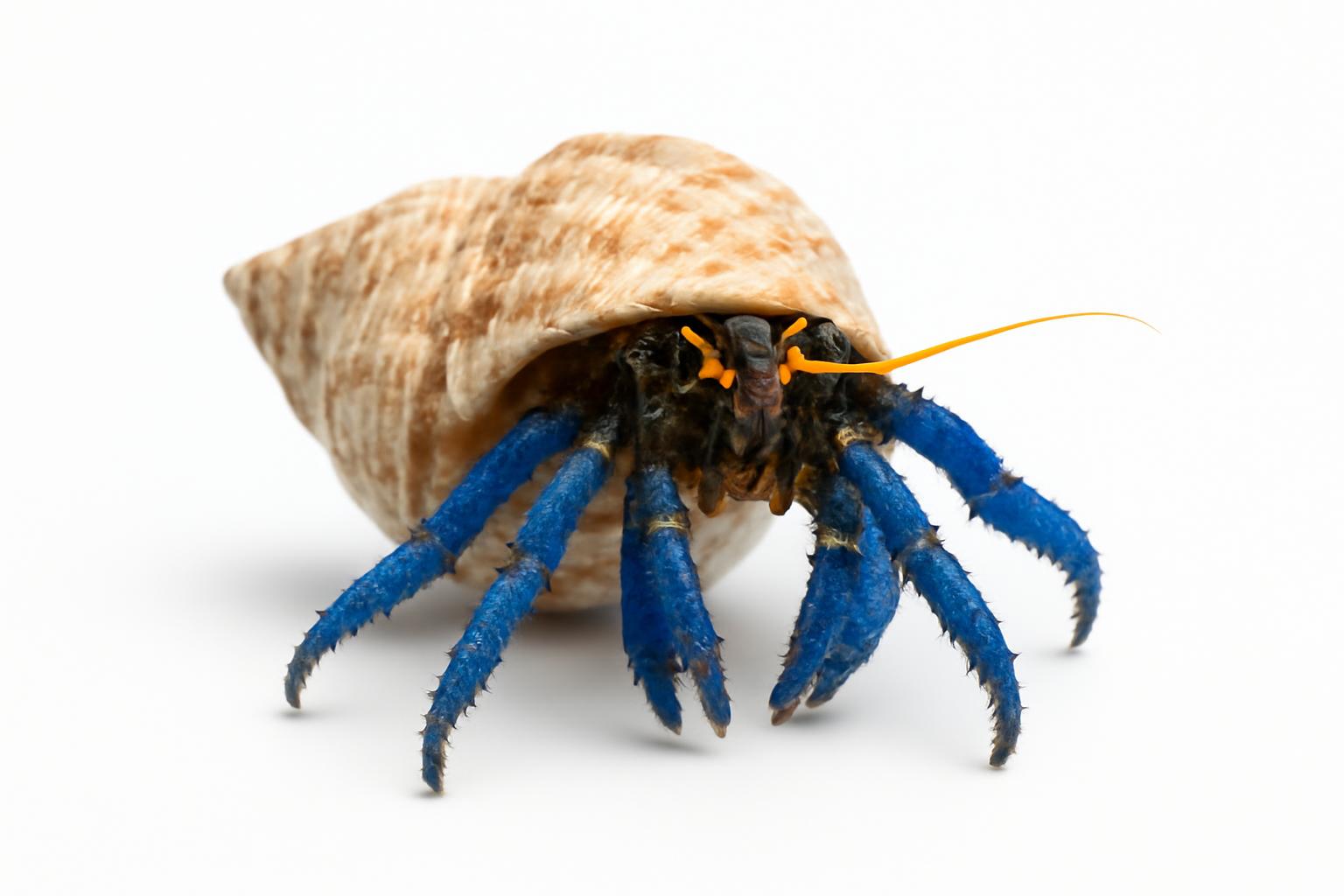
In home aquariums, blue leg hermits may kill snails or fight other hermits when suitable shell options are limited.
The blue hermit crab most reef keepers mean is the blue leg hermit crab, Clibanarius tricolor. It is popular because it is small, widely sold, and useful in established marine tanks as a scavenger that picks at nuisance algae, leftover food, and light detritus.
That usefulness comes with an important caveat: blue leg hermits are not disposable “set and forget” cleanup pieces. They do best in a fully cycled, stable reef system, and their main downside is well known across care sheets, seller guides, and hobby reports: they compete for shells. In some tanks, that means harassing or killing small snails.
The broadest points of agreement in the available evidence are straightforward:
- Buy the correct species: blue leg hermit crab = Clibanarius tricolor
- Add them only to a cycled, stable marine tank
- Expect them to eat algae, detritus, and leftovers, not just one problem food
- Keep empty shells available
- Stock and feed them conservatively, because exact shell counts and stocking rules are hobby heuristics, not hard species laws
Because the evidence base for this animal is dominated by retailer care pages, general hobby references, and forum experience rather than controlled aquarium studies, this guide distinguishes between broad consensus and common hobby practice whenever the advice gets more specific.
| Care point | Practical starting point |
|---|---|
| Scientific name | Clibanarius tricolor |
| Typical trade size | Often sold very small; adult shell size commonly described around 1/2-1 inch |
| Minimum tank | 10 gallons is a practical starting point |
| Best tank type | Established marine or reef tank with live rock and sand |
| Temperature | 72-80°F |
| pH | 8.1-8.4 |
| Specific gravity | 1.023-1.026 works well as a reef target |
| Alkalinity | 8-12 dKH |
| Calcium | 400-450 ppm |
| Magnesium | 1250-1350 ppm |
| Diet | Algae, detritus, leftovers, with supplemental feeding if natural forage is limited |
| Main risk | Shell competition and possible small-snail predation |
Identifying the Blue Hermit Crab
The “blue hermit crab” in the aquarium trade is usually the blue leg hermit crab, Clibanarius tricolor. Common trade names include:
- Blue leg hermit crab
- Tricolor hermit crab
- Blueleg reef hermit
- Dwarf blue leg hermit
That scientific name matters because common names in the marine trade are loose. If a seller lists only “blue hermit crab,” the care advice may not match the actual species being sold.
A true blue leg hermit is commonly described as having:
- Blue legs
- Red or reddish banding between leg segments
- Orange antennae
- A small adult size, usually around 1/2 to 1 inch in shell-occupied size
That combination is the standard hobby image of the species. In practice, though, many specimens sold online arrive much smaller than shoppers expect. Reviews and product listings repeatedly show “tiny” individuals in the 1/4-inch to 3/4-inch range, so it is wise to expect juveniles rather than photo-ready adults.
The biggest identification mix-up is with the electric blue hermit, Calcinus elegans. It is not the same animal.
Here is the key distinction:
- Blue leg hermit crab: Clibanarius tricolor, a Caribbean species
- Electric blue hermit crab: Calcinus elegans, an Indo-Pacific species
Both may show bright blue legs and orange antennae. That is why color alone is not enough. Hobby and seller descriptions also commonly portray the electric blue hermit as larger and more aggressive than the blue leg hermit, although those temperament descriptions still come mostly from trade and hobby sources rather than controlled comparison.
A practical buyer’s checklist is:
- Confirm the scientific name
- Ask whether it is the small Caribbean species
- Assume the shipped crab may be smaller than the photo suggests
If your goal is a small cleanup-crew hermit for a reef tank, Clibanarius tricolor is the species this guide addresses.
Natural Habitat and Biology
Clibanarius tricolor is reported from the Caribbean, where hobby and reference sources place it in shallow coastal waters associated with sand and mud bottoms, seagrass beds, and reef areas. Some references extend that habitat description down to roughly 300 feet, but depth figures are less important for home care than the broader ecological picture: this is a marine hermit from warm, saline, structured coastal habitat.
That wild background explains much of its aquarium behavior.
Blue leg hermits are commonly described as:
- Detritivores and scavengers
- More active at night, or at least often feeding nocturnally
- Frequent users of rock crevices and shell shelter
- Small crabs that disturb the sand surface as they move
In aquarium terms, that makes them useful but modest cleanup workers. As they crawl, they drag their shells across the substrate and can stir the upper sand surface, which may help keep light debris from settling undisturbed. That is best understood as a side benefit, not a substitute for adequate flow, export, or maintenance.
Their diet is broad. Across sources, blue leg hermits are reported to eat:
- Detritus
- Dead plant and animal matter
- Hair algae
- Diatoms
- Film or nuisance algae
- Leftover fish food
- Cyanobacteria, at least opportunistically according to multiple hobby-oriented sources
That last point needs the right framing. It is reasonable to say blue leg hermits may pick at cyanobacteria, because several care sheets and product guides repeat it. It is not reasonable to promise that they will solve a cyano outbreak.
Shell use is central to the species. Like other hermit crabs, Clibanarius tricolor protects its soft abdomen in a borrowed shell and must move into larger shells as it grows. Observational material on the species describes shell disputes that can involve flipping or evicting rivals. In home aquariums, that biology is the basis for the familiar warning that blue leg hermits may kill snails or fight other hermits when suitable shell options are limited.
A few additional biological points appear repeatedly in the evidence, but they are lower priority for husbandry and should be treated as reported rather than ironclad:
- Males are reported to grow larger than females
- A 2-4 year lifespan is commonly listed in care sheets
- Activity may be more nocturnal, with daytime hiding or resting
For aquarists, the most useful takeaway is simple: the blue leg hermit is not a specialized algae machine. It is a small opportunistic scavenger. That is exactly why it can help a reef tank—and exactly why it can create shell-related problems if the tank is too clean, too crowded, or poorly provisioned.
Tank Setup and Water Parameters
A blue leg hermit crab is small, but it still belongs in a real marine setup, not an immature experiment. A 10-gallon tank is the most defensible practical minimum in the evidence pack. Some sellers mention smaller tanks, but 10 gallons gives more stability and matches the stronger cross-source guidance better.
The best home is an established marine or reef tank with:
- Stable salinity and pH
- Rockwork for grazing and cover
- Sand or established substrate
- Enough natural forage or supplemental food to support the cleanup crew
Why “established” matters
Blue leg hermits should be added after the tank has cycled, not during the cycle. The first-party reef setup guidance in the evidence pack recommends 6-8 weeks as a minimum cycle window before livestock, but that should be read as a site principle for patient reef setup, not a guarantee that every tank is ready on a calendar date.
The real standard is biochemical, not just chronological:
- Ammonia must be zero
- Nitrite must be zero
- The tank should show basic stability before animals are added
Cleanup crew often goes in before fish and corals, but still after cycling is complete.
Recommended parameters
The strongest agreement across sources supports standard reef-like conditions. A practical target range is:
| Parameter | Practical range |
|---|---|
| Temperature | 72-80°F |
| pH | 8.1-8.4 |
| Specific gravity | 1.023-1.026 |
| Alkalinity | 8-12 dKH |
| Calcium | 400-450 ppm |
| Magnesium | 1250-1350 ppm |
Some sources give narrower ranges, especially for salinity and temperature. Rather than chase a single “perfect” number, focus on stability. Like many marine invertebrates, hermits are more vulnerable to sudden shifts than to sitting somewhere within a normal reef range.
Substrate and aquascape
A sand-and-rock environment fits both the species’ reported behavior and general reef practice. Product and care guides often suggest fine sand and live rock or established rockwork. Some hobby-oriented sources specifically suggest 2-3 inches of fine or live sand, but that level of precision is better treated as a common setup heuristic than a species-specific requirement proven by strong evidence.
More important than exact depth is that the tank offers:
- Substrate the crab can traverse easily
- Rockwork with crevices and shaded retreats
- Surfaces with film algae and detritus to graze
Flow and placement
Normal reef circulation is generally appropriate. One practical caution comes from repeated buyer reports: blue leg hermits are often sold extremely small. Tiny new arrivals may be more vulnerable to strong direct flow than a chunky adult hermit in a larger shell.
So while “low-flow acclimation zones” are not a formal species requirement, it is sensible to place new crabs near sand or rock cover, not directly in front of aggressive pump output.
Cover and escape prevention
Species-specific evidence on escape is limited, but general marine crab care references note that crabs can climb. A secure cover or protected openings are therefore best viewed as a prudent precaution, especially on tanks with plumbing gaps or rim openings.
Spare shells belong in the setup from day one
This is one area where broad agreement exists on the direction of care, even if exact numbers are not strongly established: keep empty shells available before problems start.
Many guides suggest a specific count, often 3-5 spare shells per crab, but that figure is better treated as a common hobby recommendation, not a proven rule. The stronger conclusion is simpler:
- Provide multiple empty shells
- Include slightly larger options
- Offer more than one shape or opening style if possible
The goal is to reduce shell competition, not to hit a mathematically exact shell ratio.
Diet and Feeding Guide
Blue leg hermits are best understood as omnivorous scavengers with algae-grazing value. They are useful cleanup animals, but they are not selective enough to be called single-purpose algae specialists.
In aquariums, they are commonly reported to eat:
- Hair algae
- Diatoms
- Film and nuisance algae
- Detritus
- Uneaten fish food
- Organic debris on rock and sand
- Cyanobacteria, at least sometimes
Their small size helps them work narrow spaces that larger snails or crabs may miss. That is a real advantage in mixed cleanup crews.
The main feeding mistake: assuming the tank always provides enough
Blue leg hermits help most in tanks that actually produce edible material. In a very clean reef, a new tank, or a deliberately low-nutrient system, they can run short on natural forage. When that happens, you are more likely to see:
- Increased shell competition
- Greater interest in snail shells
- General opportunistic scavenging behavior
That does not mean every underfed hermit will turn predatory, but it does mean the cleanup crew can become a source of stress instead of benefit.
When to supplement
Several care sources recommend supplemental feeding in new, low-algae, or very clean tanks. Common suggestions include:
- Dried seaweed
- Nori
- Mysis shrimp
- Algae-based prepared foods
- Small marine leftovers
Exact schedules vary. Some guides suggest 2-3 feedings per week, but that is best framed as a starting practice used by hobbyists, not a species-set law. The right frequency depends on:
- How much algae the tank actually produces
- Whether fish feedings leave edible leftovers
- How many hermits and other scavengers you keep
How to feed without creating a nutrient problem
A cleanup crew should not become a reason your nutrients climb.
Practical feeding principles are:
- Offer small amounts
- Observe whether the crabs actually find and consume the food
- Remove or stop if food sits uneaten
- If keeping a group, spread food into more than one spot to reduce crowding
That last point is a sensible husbandry measure, not a guaranteed fix. Group feeding may reduce direct competition at one feeding point, but it will not eliminate shell disputes if the deeper issue is limited shells or overstocking.
Do they really control algae?
Sometimes, yes. Completely and predictably, no.
The evidence supports calling blue leg hermits useful algae pickers, especially for light nuisance growth, detritus, and leftovers. It does not support treating them as a guaranteed cure for every algae problem.
If algae is persistent or severe, the more likely underlying causes are still:
- Nutrient imbalance
- Excess import relative to export
- Weak flow in problem areas
- Lighting imbalance
- Inconsistent maintenance
A blue hermit crab can help with symptoms at the margins. It does not replace system control.
A note on cyanobacteria
Multiple hobby-facing sources say blue leg hermits may eat or pick at cyanobacteria. That is credible enough to mention as a possible behavior. But if cyanobacteria is spreading across the tank, treat it as a water-quality and system-balance problem first, not as a cleanup-crew shopping problem.
Reef Compatibility and Temperament
Blue leg hermits are usually described as peaceful to semi-aggressive and reef compatible with caveats. That is probably the fairest summary the evidence allows.
The encouraging part:
- They are commonly kept in reef tanks
- They are generally considered coral-compatible
- They usually spend their time scavenging rock, glass, and substrate
The cautions:
- They may steal shells
- They may kill small snails
- They may fight other hermits
- They can dislodge unsecured frags simply by climbing over them
- Risk appears to rise when tanks are crowded, underfed, or short on suitable shells
So are they reef safe? Usually, with limitations. Are they risk free? No.
Snails are the main compatibility concern
Across retailer caveats, hobby articles, and forum reports, the most repeated issue is conflict with small snails, especially when the hermit wants the shell.
That is why “I feed them well” is not a complete safeguard. Food shortage may worsen opportunism, but shell competition has its own logic. A well-fed hermit can still want a better home.
How to reduce shell fights
The best-supported guidance is directional rather than numerical: offer multiple empty shells before aggression starts.
Many sources recommend 3-5 spare shells per crab, but because that exact count rests mostly on seller guidance and hobby repetition, it is better used as a common starting heuristic than a proven best practice.
What matters more than the exact count is quality and variety:
- More than one spare shell
- Sizes a bit larger than current shells
- A range of shapes or openings if available
- Clean, marine-safe shells placed where the crabs can encounter them
This may reduce conflict. It does not guarantee peace.
Keeping them in groups
Blue leg hermits are often sold in packs or lots, and they can be kept in groups, especially in larger systems. The benefit is broader cleanup coverage. The tradeoff is simple: each additional hermit increases demand for food and shells.
That means group success depends less on a universal “right number” than on whether the tank can support them. A lightly fed, low-algae reef full of snails may support fewer blue leg hermits than a dirtier, more established system with more film algae and detritus.
Compared with electric blue hermits
If the alternative is Calcinus elegans, the blue leg hermit is generally the smaller and lower-risk choice for a mixed reef cleanup role. The electric blue hermit is commonly described in trade sources as larger and more aggressive.
That still does not make the blue leg harmless. It just means species identification matters.
Coral safety in practice
Most keepers use blue leg hermits without major coral damage. Still, the right reading of “reef safe” is usually compatible under normal conditions, not “cannot create problems.”
Watch for issues if:
- Frags are loosely placed
- Hermits are crowded
- The tank is short on food or shells
- The cleanup crew is oversized for the system
Behavior matters more than badges on a sales page.
Acclimation, Stocking, and Maintenance
Blue leg hermits are often described as hardy once settled, but they are still marine invertebrates. The evidence supports caution with acclimation, copper, and abrupt chemistry changes more strongly than it supports exact acclimation formulas.
Acclimation
Multiple care sources recommend slow acclimation for hermits to reduce shock from differences in salinity and pH. Some specifically suggest a slow drip acclimation lasting an hour or more, but that precision should be read as common invert-care practice, not a species-specific threshold proven for Clibanarius tricolor.
The practical principle is stronger than the exact timing:
- Avoid abrupt changes in salinity
- Avoid abrupt changes in pH
- Match temperature sensibly
- Do not rush newly shipped invertebrates straight into display water
A cautious hobby method is:
- Equalize temperature briefly
- Transfer the crab and shipping water to a container
- Add tank water gradually over time
- Move the crab gently into the tank once chemistry differences are reduced
The exact pace can vary, but “slow and chemistry-conscious” is more defensible than pretending a single duration fits every shipment.
Quarantine and medication cautions
If possible, an invert-safe observation or quarantine setup is a reasonable precaution. Whether you quarantine or not, one point is strongly supported:
Do not expose blue leg hermits to copper medications.
Multiple sources flag copper as dangerous to hermits and other invertebrates.
When to add them
Blue leg hermits are commonly added as part of the first cleanup crew wave, which fits the general reef sequence in the evidence pack:
- Cycle the tank completely
- Confirm basic parameter stability
- Add cleanup crew first
- Add other livestock gradually
Again, “cleanup crew first” still means after cycling, not during an ammonia or nitrite phase.
How many to stock
This is one of the weakest areas for exact numbers.
The evidence includes hobby and seller heuristics such as:
- About 1 per gallon
- Roughly 12-20+ in a 30-gallon tank
Those can be useful as examples of common trade guidance, but they should not be presented as universal stocking rules. The right number depends on:
- Available algae and detritus
- Total cleanup-crew competition
- Snail population you want to protect
- Feeding intensity
- Tank size and maturity
A practical approach is:
- Start lighter in clean or small tanks
- Add gradually if the tank has enough forage
- Reassess if you see shell disputes or unexplained snail losses
For beginners, conservative stocking is easier to correct than overstocking.
Day-to-day care
Long-term maintenance is simple when the tank itself is healthy:
- Keep parameters stable
- Maintain shell options
- Supplement food when natural forage is sparse
- Watch behavior, especially around snails
- Avoid unsafe medications, especially copper
Molting
Blue leg hermits may hide, become inactive, or disappear when molting. Common signs reported in general hermit care include:
- Extended hiding
- Reduced activity
- Staying under rock or in substrate
- A shed exoskeleton that looks like a dead crab
After molting, they are vulnerable. Hermits may also consume the old exoskeleton, which is normal behavior.
A missing hermit is not automatically a dead hermit.
Tiny arrivals deserve extra caution
This point is unusually well supported by buyer experience: some shipped blue leg hermits arrive very small, sometimes smaller than customers expected from listing photos.
That matters because tiny crabs may be more vulnerable to:
- Shipping stress
- Rough acclimation
- Strong direct flow
- Predation
- Food scarcity in very clean tanks
If your shipment arrives miniature, treat placement and early observation more carefully.
Common Issues and Troubleshooting
Most blue leg hermit problems reduce to four themes:
- Too few usable shells
- Too little food
- Unstable or immature tank conditions
- Too many hermits for the system
Snails are dying or disappearing
The leading suspect is shell competition.
What to do:
- Add multiple empty shells right away
- Include options slightly larger than the crabs’ current shells
- Review whether the cleanup crew is too hermit-heavy
- Supplement feeding if the tank is very clean
If the problem continues, reduce confidence in the idea that your current stocking level is appropriate. Shell aggression often reflects a mismatch between population and resources.
The crabs are not controlling algae well
Possible reasons include:
- The algae is not especially palatable
- The outbreak is too large for the cleanup crew to matter much
- There are too few crabs to make a visible dent
- The real problem is nutrient and system imbalance
Check the basics first:
- Stable salinity and pH
- Reasonable maintenance
- Adequate flow
- Feeding that is neither starved nor excessive
Then adjust expectations. Blue leg hermits can contribute to algae management, but they are not a stand-alone algae solution.
The crabs seem inactive or hungry
In a new or ultra-clean tank, natural forage may simply be limited. Try small supplemental offerings such as:
- Nori
- Dried seaweed
- Tiny portions of mysis
- Suitable prepared marine foods
If activity improves after feeding, the system may not be producing enough edible material for the number of hermits present.
New arrivals die quickly
Short-term losses after arrival can stem from several plausible causes:
- Shipping stress
- Abrupt chemistry changes
- Poor acclimation
- Very small specimen size
- Immediate exposure to strong flow
The most sensible response is not to memorize a rigid protocol, but to improve the controllable variables: slower acclimation, gentler placement, and realistic expectations about how tiny some cleanup-crew shipments can be.
A crab vanished
Before assuming the worst, consider:
- Molting
- Deep hiding in rockwork
- Daytime inactivity
Wait and observe unless there is clear evidence of a system problem.
The crabs are bothering each other or corals
This usually means competition is too high for the tank’s conditions.
Common triggers:
- Overstocking
- Too few shells
- Sparse natural food
- Loose frags being climbed over
The first fixes are practical and low-risk:
- Add more shell choices
- Feed lightly but consistently if forage is limited
- Reduce future stocking pressure
- Secure coral frags better
Blue vs. Scarlet Hermit Crabs: Key Differences
This comparison needs careful framing because the evidence is mostly hobby anecdote, not controlled comparative study.
The scarlet hermit most aquarists mean is Paguristes cadenati. In forums and hobby discussion, scarlets are often described as more peaceful, especially around snails, while blue leg hermits are often described as more opportunistic. That pattern is common enough to mention—but not strong enough to state as settled biological fact.
Here is the most honest practical comparison:
| Trait | Blue leg hermit | Scarlet hermit |
|---|---|---|
| Common scientific name in trade | Clibanarius tricolor | Paguristes cadenati |
| General hobby reputation | Useful but sometimes opportunistic | Often described by hobbyists as gentler |
| Snail risk | Frequently reported in hobby experience | Often reported as lower, but not zero |
| Cleanup role | Algae, detritus, leftovers | Algae and detritus |
| Shell conflict | Common hobby concern | Also possible, though often described as less frequent |
| Availability | Very common | Common, often perceived as pricier |
Are blue legs more aggressive?
Many hobbyists say yes, especially around shells and small snails. But that answer is based heavily on anecdote and long-running forum consensus, not rigorous comparison. Some aquarists report trouble-free blue leg hermits; others report repeated snail losses.
So the safest wording is: blue legs are often regarded as higher-risk than scarlets in hobby practice, but individual outcomes vary.
Do scarlets clean better?
The evidence pack does not justify a confident claim that scarlets are objectively better cleaners. What it does support is that many hobbyists prefer scarlets because they believe the tradeoff between cleanup value and compatibility is better.
That is a perceived advantage, not a proven one.
Can you mix them?
Some hobbyists do; others report fighting. If you mix them:
- Stock conservatively
- Provide plenty of spare shells
- Watch for shell disputes
- Do not assume mixed species will self-balance peacefully
Which one should a beginner choose?
That depends on your priority.
- If you want cheap, common, and widely available, blue leg hermits are the usual choice.
- If you are especially concerned about protecting snails, scarlets are often suggested by hobbyists as the more conservative option.
But the evidence does not support turning that into an absolute rule. In either case, a modest cleanup crew matched to the tank is more important than choosing a “perfect” hermit species on paper.
FAQ
Do blue hermit crabs eat cyanobacteria?
They sometimes do. Multiple hobby-oriented care sources describe blue leg hermits as eating or at least picking at cyanobacteria, often called red slime algae. Treat that as a possible bonus behavior, not a reliable cure. If cyanobacteria is persistent, the main fix is still correcting the tank conditions that allow it to spread.
How many blue hermit crabs for my tank size?
Use seller and hobby numbers only as rough starting heuristics. You will see guidance like 1 per gallon or 12-20+ for a 30-gallon tank, but those are not universal stocking rules. The better question is whether your tank has enough forage, how many snails and other cleanup animals are already present, and how much risk of shell competition you are willing to accept. In most beginner systems, starting lighter is safer.
Are blue hermit crabs safe with corals and snails?
They are usually compatible with corals, though they can still disturb loose frags by climbing. Snails are the bigger concern. Blue leg hermits may kill small snails for shells, and that risk is widely reported across care guides and hobby experience. So the best summary is: generally reef compatible, but not fully snail-safe.
What shells should I provide for blue hermit crabs?
Provide multiple empty shells, not just one token spare. Many care guides suggest 3-5 shells per crab, but that exact number is better treated as a hobby recommendation than a proven requirement. More important than the count is offering shells that are:
- Slightly larger than the current shell
- Available in more than one shape if possible
- Clean and safe for marine use
Can blue hermit crabs go in new uncycled tanks?
No. They should be added only after the marine tank has fully cycled and basic parameters are stable. Some reef guidance uses 6-8 weeks as a patient setup window, but the real test is not the calendar alone. Add them only when ammonia and nitrite are zero and the system is behaving like a stable marine tank.
Blue leg hermits can be very useful cleanup crew animals when they are treated as living invertebrates with real limits, not as disposable algae tools. Put them in a cycled tank, keep reef parameters stable, stock them modestly, and keep empty shells available. Do that, and the blue hermit crab is much more likely to act like the helpful little scavenger hobbyists want—rather than the snail-hunting problem they warn each other about.