
Start With the Crab: Matching Species to Water, Habitat, and Tankmates
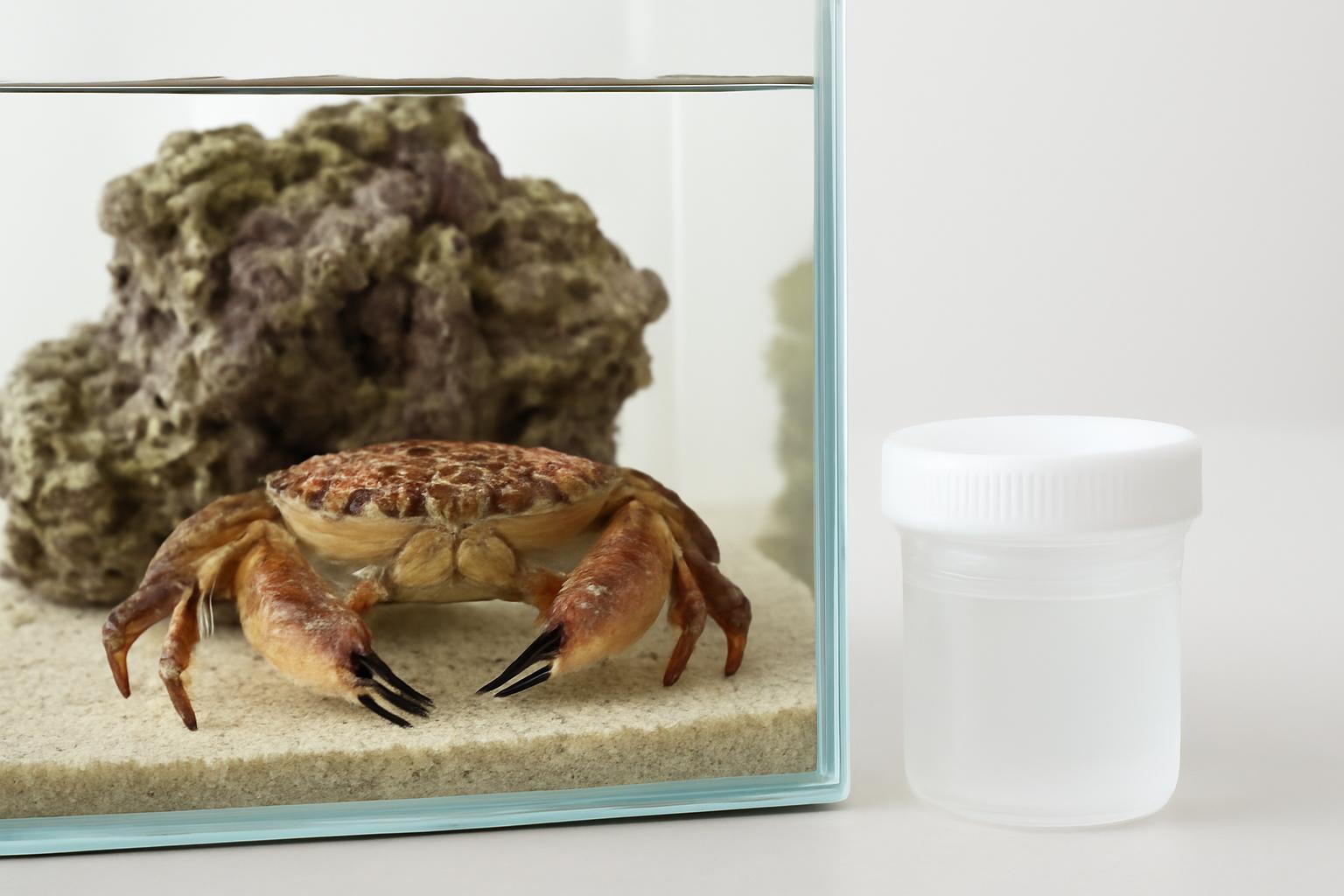
Specific gravity is the measured outcome, not the mixing ratio. Identify the crab's habitat, then use guidance written for that species.
“Crab salt water” can refer to two very different things: seawater for a fully aquatic aquarium crab or salt water provided to a terrestrial hermit crab in a land enclosure. This guide primarily addresses fully aquatic marine aquarium crabs and marine hermit crabs. If the animal lives on land or normally moves between water and shore, do not apply reef-aquarium instructions to it.
There is no universal salt recipe, temperature, habitat, or reef-safety rule for every animal sold as a crab. Use this sequence instead:
- Identify the animal.
- Determine whether it is marine, brackish, freshwater, intertidal, or terrestrial.
- Find guidance written for that species.
- Establish the appropriate habitat before adding the animal.
- Prepare water with a product intended for that habitat.
- Measure the result.
- Evaluate adult size, diet, behavior, and tankmate risk before purchase.
First determine which kind of crab you have
The retail label “crab” covers animals with substantially different biology. It may refer to true crabs, marine hermit crabs, porcelain crabs, terrestrial or intertidal species, and even horseshoe crabs. These animals are not interchangeable.
True crabs are crustaceans. Porcelain crabs and hermit crabs are related crustaceans but are not true crabs, while horseshoe crabs are chelicerates. The distinction matters because animals grouped together on a retail page can differ in adult size, feeding, digging, predation, and habitat requirements. Horseshoe crabs, for example, are generally described as unsuitable for a typical reef aquarium because of their size and disruptive behavior, not merely because of taxonomy (Reefs.com’s overview of marine aquarium crabs).
Many crabs sold specifically for marine aquariums remain underwater. That does not mean every crab found on a beach, shoreline, or pet-store shelf belongs in a conventional reef tank. Fiddler crabs normally occupy intertidal environments and spend substantial time outside the water. They require a specialized habitat with access beyond a fully submerged aquarium.
Marine hermit crabs also should not be confused with terrestrial hermit crabs. The common name “hermit crab” spans distinct marine and land-adapted lineages with different ways of life. A care article written for a small marine hermit in a reef system therefore cannot be transferred automatically to a terrestrial hermit kept in a land enclosure. Specialist hobby literature similarly distinguishes ocean-dwelling hermits from land-living groups (Tropical Fish Hobbyist’s hermit-crab account).
Use this decision path before preparing water:
- Obtain the scientific name. Ask the seller, check the invoice, or take clear photographs for identification. Common names such as “red crab,” “reef crab,” and “hermit crab” can cover more than one species.
- Classify the habitat. Determine whether the species is marine, brackish, freshwater, intertidal, or terrestrial.
- Confirm whether it remains submerged. A marine or brackish label does not necessarily mean the animal should be underwater continuously.
- Consult species-specific guidance. Check adult size, temperature, salinity, land-access needs, diet, substrate, shelter, and compatibility.
- Do not improvise while identification is uncertain. An unidentified shore crab, beach crab, or aquarium hitchhiker should not be placed in a reef merely because it resembles a crab sold for marine tanks.
Commercial saltwater products marketed for terrestrial hermit-crab bowls create another source of confusion. Premixed solutions may be sold for drinking, bathing, or replenishing shell water, but that intended use does not establish that the product can support a fully aquatic marine aquarium. One such terrestrial hermit-crab saltwater solution is described for hermit-crab use but does not provide enough salinity or composition detail on the cited page to treat it as replacement seawater for a reef system.
Practical rule: if you do not know the scientific name and habitat type, you do not yet know what water the crab needs.
Salt water requirements for a marine aquarium crab
For the collection of fully aquatic species covered by its multi-species care sheet, Petco recommends a specific gravity of 1.023–1.025 and a temperature of 74–80°F. These are retailer-authored starting points for several marine crabs and hermit crabs, not universal physiological requirements for every species sold as a crab (Petco’s marine-crab care sheet).
A separate commercial marine-hermit guide recommends 72–78°F, a specific gravity of 1.023–1.025, and pH of 8.1–8.4. The shared specific-gravity range may be a useful general reference, but the difference in temperature guidance reinforces the need for species-level research. These remain retailer recommendations rather than independent scientific standards (Foxy Saltwater Tropicals’ marine-hermit guide).
| Parameter | Broad retailer guidance | What still requires confirmation |
|---|---|---|
| Specific gravity | 1.023–1.025 in the cited multi-species guides | Species target, measurement conditions, and tolerance for change |
| Temperature | 74–80°F in Petco’s broad marine-crab sheet; 72–78°F in the marine-hermit guide | Exact target for the identified species |
| pH | 8.1–8.4 in the cited marine-hermit retailer guide | Requirements of the species and complete aquarium system |
| Ammonia and nitrite | Included among the parameters that should remain stable and be tested | Whether the aquarium has been established and is ready for livestock |
| Nitrate | Monitor as part of water-quality management | Appropriate conditions for all livestock in the system |
| Oxygenation and circulation | Commercial care guidance calls for good oxygenation and species-appropriate circulation | Flow strength and habitat design for the individual species |
| Land access | Not part of the normal setup for fully aquatic aquarium species | Must be verified for fiddler, shore, intertidal, and terrestrial animals |
Specific gravity is a measured result, not a mixing recipe. A target of 1.024 describes what the prepared water should measure. It does not specify how many cups or scoops of salt to use. The required amount depends on the product, actual water volume, preparation conditions, and measurement. Follow the salt manufacturer’s label and then verify the resulting water with a suitable instrument.
Petco’s care sheet also recommends that specific gravity not move by more than 0.001 in either direction within 24 hours. Treat this as conservative retailer guidance, not as a scientifically established limit for every marine crab. The defensible general lesson is to avoid abrupt, unmeasured changes, particularly when an animal is already stressed.
Do not combine terrestrial bowl-product directions with marine-aquarium targets. A seller may provide a premeasured quantity or a different pictured range for one hermit-crab product, but that does not establish a salinity standard for reef aquariums or a transferable recipe for other salt mixes.
How to prepare and measure marine salt water
Use a marine aquarium salt mix intended to reproduce seawater. Table salt, generic aquarium salt, water conditioner, dry marine salt mix, and premixed saltwater are different product categories. Similar words on their labels do not make them interchangeable.
Before preparing water, confirm that the aquarium itself is established and suitable for the identified species. Mixing salt water does not instantly create a livestock-ready marine habitat. The available retailer guidance calls for stable systems, filtration, testing, and control of parameters including ammonia and nitrite. It does not support a universal cycling duration, so this article does not prescribe one. If you cannot verify that the aquarium is established, pause before purchasing or adding the crab.
A cautious preparation workflow is:
- Evaluate the source water. Follow the marine-salt manufacturer’s directions and determine whether the source requires treatment. The available evidence does not establish that conditioned tap water is always suitable or that reverse-osmosis/deionized water is always mandatory.
- Measure the actual water volume. Use the volume being prepared rather than relying solely on the nominal capacity of a bucket or aquarium.
- Add marine aquarium salt according to that product’s label. Do not transfer a scoop, cup, or bag quantity from another brand.
- Mix as directed by the manufacturer. Use clean containers and equipment that have not been exposed to household residues.
- Bring the prepared water to the intended habitat temperature.
- Measure specific gravity before the water reaches the crab.
- Compare the temperature and specific gravity with the identified species’ target and the aquarium conditions.
Petco’s multi-species care sheet lists the following among the suggested supplies for marine-crab care:
- Marine aquarium salt
- Water conditioner when appropriate for the source water
- A heater
- Filtration
- A water test kit
- A refractometer
- Mixing and transfer containers
This guide does not prescribe a universal number of cups per gallon because the supplied multi-species care guidance provides a target specific gravity but no universal mixing ratio. Product-specific directions are the starting instruction; measurement determines the result.
Marketplace listings do not change that principle. A seller-specific bag or dose said to make a particular volume of water is an instruction for that product and listing, not evidence that the same quantity works for another salt mix. Ratings, reviews, bestseller labels, and sales volume do not validate a water recipe.
Read the intended use on every label:
- Marine salt mix is a dry product intended to create seawater when mixed with suitable water.
- Premixed saltwater is already in solution, although its measured salinity still must suit the intended habitat.
- Water conditioner treats one or more aspects of source water; it is not automatically a complete seawater mix.
- Terrestrial hermit-crab solution may be intended for a bowl or pool in a land enclosure, not a continuously filtered marine aquarium.
- Generic aquarium salt should not be presumed to reproduce seawater.
Pre-water-change check
Before adding prepared water:
- Confirm that the container and tools are clean and free of household residues.
- Verify that the salt product is intended for marine aquarium use.
- Complete any source-water treatment required by the product directions.
- Check the prepared water’s temperature.
- Measure and record its specific gravity.
- Compare both readings with the aquarium and the identified species’ target.
- Pause if a reading differs unexpectedly rather than alternating unmeasured additions of salt and freshwater.
This is a verification checklist, not a universal acclimation or salinity-correction protocol. The appropriate response to a mismatch depends on its size, cause, the animal involved, and whether the measurement is reliable.
Keep the water stable after the crab is added
Correct salinity alone does not make an aquarium ready or safe. A marine crab also depends on an established system with filtration, suitable temperature, oxygenation, and controlled nitrogenous waste.
Monitor the parameters identified in the broad marine-crab care guidance:
- Specific gravity
- Temperature
- pH
- Ammonia
- Nitrite
- Nitrate
For the species covered by its care sheet, Petco recommends inspecting equipment and temperature daily, testing water quality at least weekly, and changing 10–25% of the water every two to four weeks or as measured conditions require. These are general retailer recommendations rather than a fixed schedule for every aquarium. Actual maintenance varies with species, system volume, filtration, feeding, bioload, and test results (Petco’s maintenance guidance).
| Frequency | General check |
|---|---|
| Daily | Temperature, heater and filter operation, circulation, leaks, and visible animal behavior |
| At least weekly | Specific gravity, pH, ammonia, nitrite, nitrate, and food or waste accumulation |
| Before a water change | Temperature and specific gravity of the prepared water |
| After livestock or feeding changes | Watch measurements more closely for changes in waste production |
| When behavior changes | Verify equipment and measured parameters before assuming disease or aggression |
A list of tests is not a substitute for understanding aquarium cycling. The cited commercial guidance treats stable ammonia, nitrite, nitrate, pH, temperature, and specific gravity as important, but the evidence pack does not support a complete beginner protocol for interpreting or correcting every result. If you cannot determine whether the aquarium is biologically established or what a test result means, obtain dedicated cycling guidance before adding livestock.
Some retailer guidance also calls for low nitrate, good oxygenation, a stable system, and sufficient hiding places. Those are useful planning considerations, but they should not be converted into one numerical rule for all crabs. A small marine hermit, a filter-feeding porcelain crab, and a larger opportunistic true crab do not place identical demands on an aquarium.
If a parameter moves rapidly, pause and investigate the measurement, equipment, recent additions, mixing process, and actual water volume.
Crabs also cannot replace aquarium maintenance. Consuming leftover food does not remove all resulting nutrients from the system, and an animal sold as an algae eater does not replace filtration, controlled feeding, testing, or water changes.
Choose a crab by feeding behavior and compatibility—not its cleanup label
Aquarium crabs are often sold according to a task: bubble-algae eater, detritus scavenger, sand stirrer, or bristle-worm predator. These labels describe possible feeding behavior, not dependable performance. A crab may ignore the target food, consume something else, or threaten desirable livestock.
The following table uses retail groupings rather than definitive species identifications. Its feeding and compatibility summaries reflect a specialist overview of common marine-aquarium crabs, but the scientific name still must determine final care.
| Retail grouping | Reported feeding mode or behavior | Principal compatibility concern | Conventional fully aquatic marine setup? |
|---|---|---|---|
| Emerald or “Mithrax-type” crabs | Algae-associated omnivores that may also scavenge or consume animal matter | May switch foods or disturb vulnerable livestock | Commonly sold for marine systems; confirm species |
| Small marine hermit crabs | Graze and scavenge algae, detritus, leftovers, and animal foods | May compete for shells, attack snails, steal food, or disturb corals | Yes, for confirmed marine species |
| Porcelain crabs | Primarily filter feeders | Need appropriate feeding opportunities; requirements vary by species | Generally, with species-specific planning |
| Pom Pom crabs | Carry anemones used in defense and food collection; opportunistic feeding is also reported | Small size does not guarantee compatibility | Commonly sold for fully aquatic marine aquariums |
| Arrow crabs | Carnivorous; take meaty foods and may eat worms or other small invertebrates | Can consume desirable feather-duster worms and other animals | Yes, but not automatically suitable for a community reef |
| Sally Lightfoot crabs | Algae-associated omnivores and scavengers | May become more opportunistic toward animal foods or tankmates | Sold for marine systems; compatibility requires scrutiny |
| Fiddler crabs | Intertidal foragers | Require access outside the water and a specialized habitat | No—not a conventional fully submerged reef setup |
Emerald and Sally Lightfoot crabs are associated with algae feeding, but both are opportunistic enough that “algae eater” should not be read as “eats only algae.” Porcelain crabs use specialized appendages to collect suspended food, while arrow crabs are carnivorous and may consume small invertebrates, including bristle worms and feather-duster worms. These distinctions—and the need to treat fiddler crabs as intertidal animals—are summarized in marine-crab feeding and compatibility guidance.
Small marine hermits may graze film, pick through detritus, and consume leftovers. They remain omnivores rather than guaranteed algae-removal machines. If the aquarium does not provide enough forage, they may require supplemental food.
Pom Pom crabs carry small anemones that are used in defense and food collection. That notable behavior does not establish that every individual is harmless to every coral, shrimp, snail, fish, or other invertebrate.
Horseshoe crabs belong outside this purchasing comparison. They are chelicerates rather than true crabs and are described as generally unsuitable for typical reef aquariums because of their eventual size and disruptive digging or movement.
There is not enough evidence here to rank one “best” crab for bubble algae or bristle worms. Choose an animal because its complete husbandry profile fits the aquarium, not because one possible food appears on a sales label.
What reef-safe really means for a crab
“Reef-safe” is a conditional husbandry judgment, not a guarantee. At most, it means a species or individual is considered less likely to damage corals or selected tankmates under suitable conditions.
Risk varies with:
- Correct species identification
- Individual behavior
- Adult size
- Food availability
- Available territory and shelter
- Shell availability for hermit crabs
- Tankmate size and vulnerability
- Rockwork and coral placement
- Competition with other crabs
- The aquarium’s maturity and natural food supply
Reported concerns include killing snails for food or shells, eating worms and other invertebrates, stealing food, disturbing corals, and dislodging unsecured rocks or coral fragments. Larger hermit species can physically damage coral or move unstable structures. Specialist hobby literature emphasizes that these outcomes vary by species and individual rather than following a universal “safe” or “unsafe” label (Tropical Fish Hobbyist).
Nominal algae eaters may also switch foods when algae is scarce. Supplemental feeding may reduce pressure on tankmates, but it cannot eliminate predatory tendencies, shell competition, territorial behavior, or individual variation. “Keep it well fed” is risk management, not a compatibility guarantee.
Before adding any crab:
- Identify it by scientific name.
- Research adult size rather than relying on sale size.
- List vulnerable tankmates, including snails, shrimp, feather-duster worms, small fish, anemones, and delicate corals.
- Secure rockwork and avoid unstable piles.
- Attach coral fragments rather than leaving them loosely balanced.
- Provide species-appropriate shelter.
- Observe whether the crab actually receives food.
- Monitor the animal after introduction.
- Have a removal or relocation plan if the individual proves incompatible.
Unknown hitchhiking crabs deserve particular caution. Color and claw shape may assist identification, but a visual guess alone is not enough to assign diet or reef safety. Identify the animal before deciding whether it can remain with valuable or vulnerable livestock.
Marine hermit crabs need food and spare shells
Hermit crabs mainly use the shells of gastropod mollusks Hermit Crab Care | Tropical Fish Hobbyist Magazine. As a hermit grows, it needs access to suitable replacement shells. A shortage of usable options can increase competition, but shell scarcity is not the only possible reason a hermit may attack a snail.
Provide spare shells that are:
- Clean
- Unpainted
- Untreated
- Free from sharp damage
- Appropriate in opening shape
- Available in several suitable sizes
One commercial marine-hermit guide recommends three to five spare shells per crab as a starting point. That figure is retailer guidance, not a validated universal requirement. The more important principle is to offer genuine choice in usable shapes and sizes rather than one decorative shell the animal may reject (Foxy Saltwater Tropicals’ marine-hermit guide).
Marine hermits are omnivores. Depending on species and opportunity, they may consume algae, biofilm, detritus, leftover food, carrion, or small animal material. A clean or immature aquarium may not produce enough natural food to support every hermit added as part of a cleanup crew.
Possible supplemental foods reported in commercial care guidance include:
- Algae-based marine foods
- Dried marine algae
- Suitable sinking prepared foods
- Small portions of meaty marine foods
There is no universal feeding amount in the supplied evidence. Feed according to the identified species, body size, competition, and what the aquarium already provides. Observe whether the hermit obtains food and reduce excess rather than turning supplemental feeding into chronic overfeeding.
Avoid fixed crab-per-gallon formulas. Published retailer and hobbyist recommendations conflict because tank volume alone does not describe available food, territory, shell supply, adult size, filtration, or vulnerable livestock. Adding too many hermits may exhaust the forage they were expected to consume and increase competition.
Hiding or inactivity may occur during molting. Hermit crabs shed their exoskeletons as they grow, and a discarded molt can be mistaken for a dead crab. Do not remove or disturb a hidden hermit solely because it has become inactive. Check the aquarium’s measured conditions and avoid dismantling stable rockwork merely to force the animal into view.
Safety mistakes to avoid
Copper warning: Petco states that copper-based medications are toxic to crustaceans, while Top Shelf Aquatics warns that copper treatments can harm saltwater aquarium crabs. Verify that every medication is safe for invertebrates and obtain an appropriate treatment plan rather than dosing a crab-containing display aquarium with copper (Top Shelf Aquatics’ crab guidance).
Other common mistakes include:
- Adding a crab to newly mixed water rather than an established aquarium. Prepared seawater is not the same as a stable, filtered marine system.
- Using table salt to make “seawater.” Table salt is not a substitute for a marine aquarium salt mix formulated for that purpose.
- Treating unlike products as interchangeable. Generic aquarium salt, conditioner, marine salt mix, and premixed seawater may have different purposes and compositions.
- Using a terrestrial hermit-crab bowl product in a marine aquarium without verification. Its intended use, composition, and measured salinity must suit the fully aquatic system.
- Following a universal cups-per-gallon recipe. Follow the specific salt product’s directions and measure the result.
- Buying by marketplace popularity. Reviews, ratings, bestseller badges, price, and stock status do not demonstrate husbandry safety or effectiveness.
- Buying a crab as an emergency algae or pest cure. Identify the species, investigate adult behavior, and check vulnerable livestock first.
- Trusting a universal reef-safe claim. Compatibility remains conditional even when a species has a favorable reputation.
- Applying fixed stocking formulas. Adult size, food, territory, filtration, and tankmate risk matter more than a crab-per-gallon slogan.
- Assuming spare shells prevent every snail attack. Shell choice may reduce one source of competition but cannot override diet or individual behavior.
- Using a crab to replace nutrient management. Scavenging does not eliminate the need for filtration, testing, controlled feeding, and maintenance.
Before buying, complete this checklist:
- [ ] Scientific name confirmed
- [ ] Marine, brackish, freshwater, intertidal, or terrestrial habitat identified
- [ ] Fully aquatic or land-access requirement confirmed
- [ ] Adult size checked in a species-specific source
- [ ] Aquarium established and suitability verified before livestock introduction
- [ ] Temperature and measured salinity target established
- [ ] Diet and supplemental-feeding needs understood
- [ ] Vulnerable corals, snails, shrimp, worms, fish, and other crabs considered
- [ ] Rockwork and coral fragments secured
- [ ] Spare-shell needs assessed for a marine hermit
- [ ] Medication and copper risks understood
- [ ] A plan exists if the individual proves incompatible
Frequently asked questions
What specific gravity should salt water for a marine crab have?
Petco’s multi-species marine-crab guide and a separate marine-hermit retailer guide recommend 1.023–1.025. Treat that range as broad commercial guidance rather than a universal target for every species. Confirm the scientific name and use species-specific requirements when available.
Specific gravity is the measured outcome, not the mixing ratio. Follow the marine-salt label and test the prepared water before use.
Can I use table salt or ordinary aquarium salt for a marine crab?
Do not treat either as a substitute for marine aquarium salt intended to reproduce seawater. Table salt, generic aquarium salt, water conditioner, and marine salt mix are different product categories.
Confirm the product’s intended application and measure the resulting specific gravity rather than relying on the word “salt” on the package.
Does a land hermit crab need the same salt water as a marine aquarium crab?
Do not assume so. A terrestrial hermit crab and a fully aquatic marine hermit occupy different habitats, and their enclosure requirements are not interchangeable.
Commercial solutions and dry mixes are sold for terrestrial hermit-crab bowls, but those listings do not establish suitability for a continuously filtered marine aquarium. Identify the species and follow guidance written for its habitat.
Are saltwater crabs safe with corals and snails?
Some may be compatible, but none should be treated as universally safe. Risk depends on species, individual behavior, adult size, food, space, shell availability, habitat design, and tankmates.
Crabs may kill snails, eat worms or other invertebrates, steal food, disturb corals, or dislodge unsecured fragments. Research the exact species, secure the aquascape, provide appropriate food and shelter, and monitor the individual after introduction.
Why do marine hermit crabs need spare shells?
A marine hermit protects its soft abdomen inside a shell and needs suitable replacement options as it grows. Several clean, unpainted, untreated shells in appropriate shapes and sizes provide meaningful choice and may reduce competition.
Spare shells cannot guarantee that a hermit will leave snails alone. Species, hunger, relative size, opportunity, and individual behavior can also contribute to attacks.
The central decision is identification. For a confirmed fully aquatic marine species, establish a suitable aquarium before purchase, use marine aquarium salt according to its label, verify the resulting specific gravity, maintain stable water quality, and assess diet and compatibility. For an intertidal or terrestrial animal, stop and obtain species-specific habitat guidance rather than adapting marine-aquarium instructions or relying on a retail saltwater product alone.