
“Premium” Does Not Tell You Whether a Sea Salt Fits Your Reef
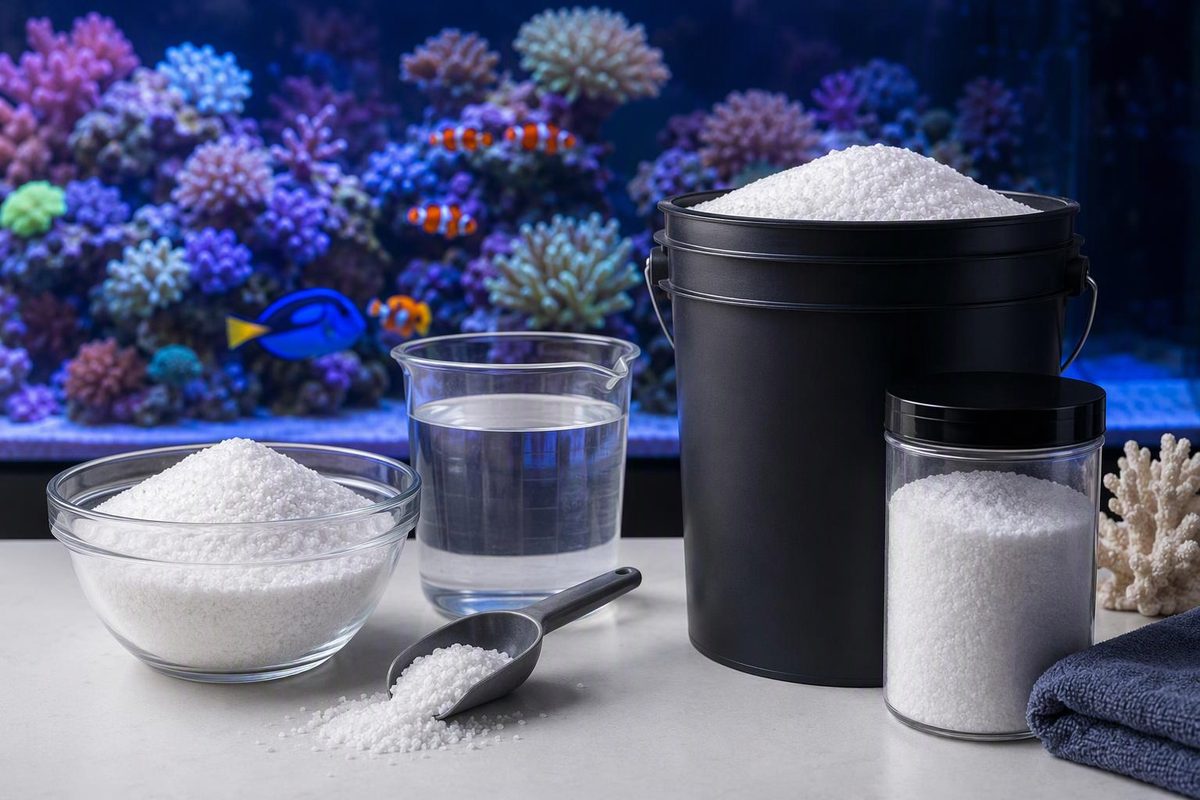
Choose reef salt by salinity, alkalinity, consistency and mixing instructions—not “premium” claims or the highest numbers.
“Premium sea salt” is not enough information to choose a reef salt. Premium is marketing language, not a standard alkalinity, calcium level or mixing method.
The useful question is: Will this complete marine salt mix make new water that closely matches the reef you maintain?
Do not use culinary sea salt in a reef tank
A reef needs a complete marine aquarium salt mix—not table salt, cooking salt, pool salt or a product labeled only “natural sea salt.” NASA notes that unrefined sea salt is about 98% sodium chloride, while seawater is a complex solution of mineral salts (NASA Salinity). By contrast, complete aquarium mixes are formulated with the major, minor and trace elements intended for marine systems; Fritz describes that formulation for its Reef Pro Mix (Fritz Reef Pro Mix).
Salt mix also cannot correct unsuitable source water. Use RO/DI, distilled or another suitably purified water as the fresh-water base. Distilled water is not used alone to fill a reef; see how distilled water should be used in a reef tank.
Compare the chemistry, not the adjective
Products presented as premium can produce substantially different water. Red Sea specifies 8 dKH for Red Sea Salt and 12 dKH for Coral Pro at the company’s stated mixing conditions (Red Sea Salt; Coral Pro Salt). Neither number is automatically better.
A 12 dKH mix may fit a reef deliberately maintained near that level. It is a poor match for an 8 dKH system if large water changes repeatedly drive alkalinity upward. An approximately 8 dKH mix may be a closer fit for that tank. A high-demand reef may still need routine supplementation, but that need is determined by measured consumption—not by choosing the salt with the highest advertised alkalinity.
Use this order of importance:
- Complete marine-aquarium formulation. The package should explicitly say that the mix makes water for marine or reef aquariums.
- Alkalinity near the tank’s normal level. This is often the most consequential advertised difference between reef formulas.
- Calcium and magnesium compatible with your maintained targets. Compare specifications at the same salinity because concentrations change with salinity.
- Instructions that fit your mixing routine. Temperature, mixing time and storage guidance differ among formulas.
- Traceable quality control. A lot number or available batch analysis is more useful than an unsupported purity adjective. Aquaforest says it samples each production batch and makes ICP-OES results available online (Aquaforest Reef Salt).
- Reliable availability and practical cost per batch. Consistency is easier when you can keep using a suitable formula rather than changing with every sale.
Treat trace-element and growth claims as secondary. They do not compensate for unstable salinity or a large alkalinity mismatch.
Estimate the alkalinity change before switching
For a simple water-change estimate, use decimal fractions for the volume left and replaced:
Estimated new dKH = (tank dKH × fraction left) + (new-water dKH × fraction replaced)
If a tank is at 8 dKH and a 10% water change uses new water at 12 dKH:
(8 × 0.90) + (12 × 0.10) = 8.4 dKH
With a 25% change, the same inputs produce approximately 9 dKH. The calculation assumes complete mixing and does not account for ongoing consumption, but it shows why both the chemistry gap and change volume matter.
If the new salt differs substantially from the old one, introduce it through smaller routine changes and test between them. Red Sea recommends weekly changes of no more than 15% while converting to its salts, including a move from its lower-alkalinity formula to Coral Pro (Red Sea switching guidance). That is manufacturer guidance for those products, not a universal safe limit. Choose the change size from the actual parameter difference, tank volume and livestock response.
Follow the exact mix’s instructions
There is no universal rule that every salt should mix overnight. Aquaforest directs users to mix Reef Salt for about 15 minutes and use the prepared water within three days. Brightwell says NeoMarine can be used after one hour but strongly recommends at least 24 hours before adding it to an established aquarium (Aquaforest instructions; Brightwell NeoMarine instructions). Follow the current directions for the exact formula and do not transfer one brand’s procedure to another.
A practical workflow is:
- Put the full volume of purified water in a clean, dedicated container.
- Start circulation and add the salt gradually. Never add dry mix directly to an aquarium containing livestock.
- Follow the manufacturer’s specified water temperature, mixing intensity and minimum time.
- Once the mix is clear or otherwise ready under those instructions, measure salinity with a calibrated instrument. Make small adjustments in the mixing container with additional mix or purified water, allow it to dissolve, then retest.
- Check alkalinity before the first use of a new formula or lot. Check calcium and magnesium as well if the results would alter the dosing plan.
- Match the new water’s temperature to the aquarium before the change.
Fritz explains why salinity comes before interpreting the other tests: calcium, magnesium and alkalinity will all read lower when its mix is prepared below the salinity used for its published specifications (Fritz Reef Pro Mix). A group of unexpectedly low results may therefore indicate diluted saltwater or a salinity-measurement problem rather than a defective batch.
Store dry mix tightly sealed and away from moisture. To keep the source water consistent, replace RO/DI stages according to measured performance rather than the calendar alone; this reef RO/DI filter guide explains how pressure, chlorine and TDS readings inform that decision.
The practical premium salt is the one that repeatedly produces water close to your chosen salinity and chemistry, with instructions you can follow and results you can verify. A higher price, higher dKH or longer ingredient list does not make a salt a better match for every reef.