
How to Choose the Right Large-Format Whole-House Filter
Service life varies with media, water use and sediment burden, and with the point when treatment or household flow becomes unacceptable.
A Big Blue water filter can be a useful whole-house treatment platform, but the blue housing is only one part of the system. Its color and size do not tell you what the installed cartridge reduces, how much filtered water it can deliver, or when the cartridge will require replacement.
Treat this as a selection primer rather than a substitute for cartridge-specific engineering data. Start with a water test and a defined treatment objective. Then determine peak flow, incoming pressure, acceptable pressure loss, plumbing size, available space, and maintenance constraints. Only after those questions are answered should you choose the cartridge media, housing length, and number of stages.
What a Big Blue water filter is—and what it is not
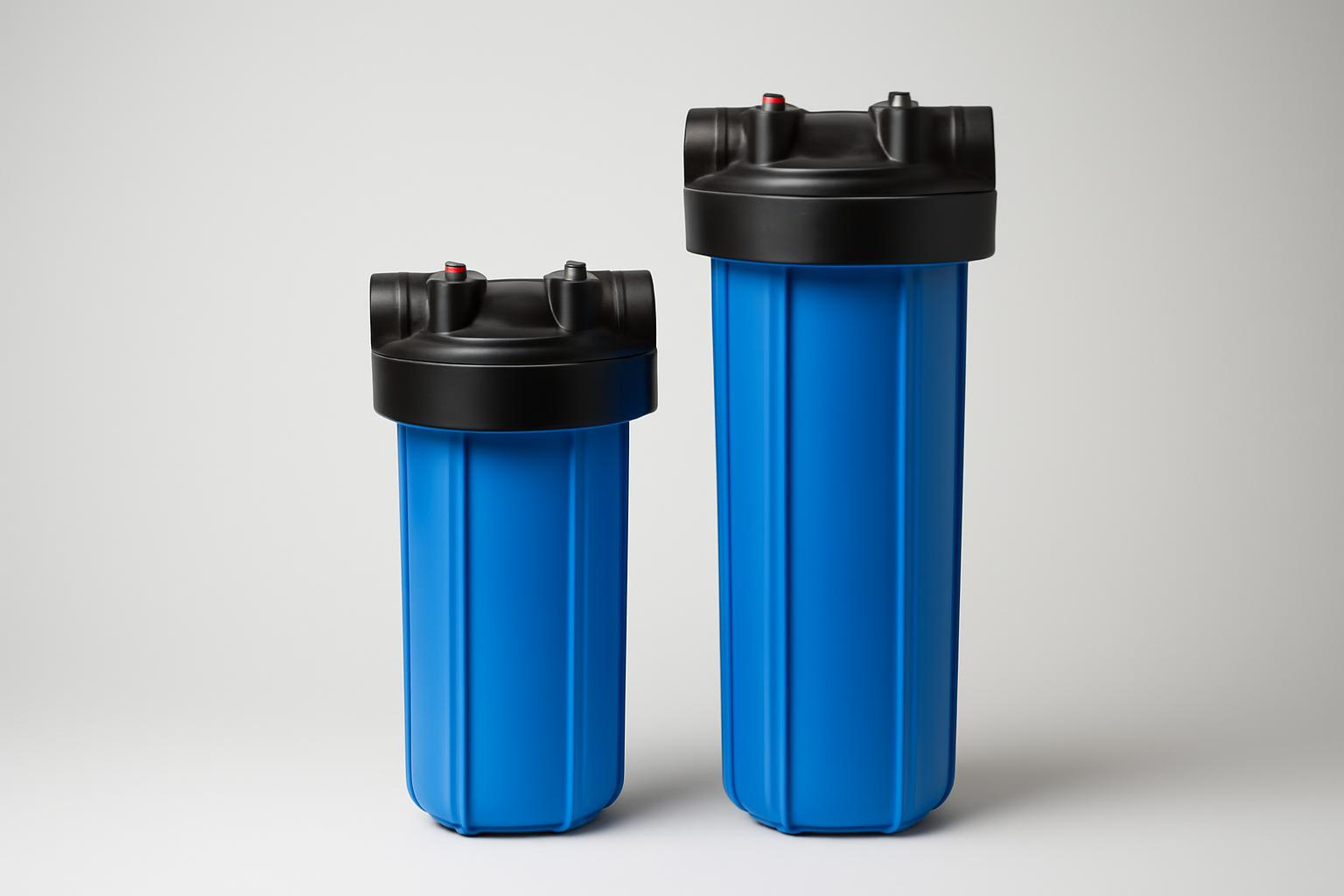
“Big Blue” commonly refers to a large-format cartridge housing associated with Pentek and now used more broadly for housings that accept cartridges approximately 4.5 inches in diameter. Pentair’s current line includes nominal 10-inch and 20-inch housings with several NPT port options. Pentair describes the available Big Blue housing formats and port sizes.
A housing is not necessarily a complete filter system. Shoppers commonly encounter three products under similar names:
- A bare housing: Usually a cap or head, removable bowl, and O-ring. The bracket, wrench, cartridge, gauges, valves, and fittings may be separate.
- A replacement cartridge: The consumable element placed inside the housing.
- A complete system or kit: One or more housings supplied with some combination of cartridges, brackets, wrenches, gauges, connectors, valves, or service parts.
Read the included-components list instead of assuming the product photograph shows everything supplied. One retailer’s compact systems, for example, include a housing, bracket, wrench, and cartridge, while replacement cartridges and O-rings are sold separately. The retailer also identifies its compact cartridge category as approximately 4.5 by 9.75 inches, commonly rounded to 4.5 by 10 inches.
The two common nominal housing lengths are 10 and 20 inches. Matching cartridges may be listed as approximately 4.5 by 9.75 inches, 4.5 by 10 inches, or 4.5 by 20 inches. These are product categories, not proof that every nominally similar cartridge fits every housing.
Inside an assembled filter, water is directed through the installed cartridge before leaving through the outlet. The housing provides containment, a flow path, and a serviceable connection to the plumbing. The cartridge provides the treatment media. Consequently:
- A compatible housing fitted with a sediment cartridge becomes a sediment-filtration stage.
- The same housing fitted with a carbon cartridge becomes a carbon-treatment stage.
- A specialty cartridge may provide another documented function.
- An empty housing provides no cartridge treatment.
- The blue bowl itself does not establish contaminant reduction.
A single-stage system has one housing and cartridge. Double- and triple-housing systems place two or three cartridges in sequence. Additional stages allow different media to perform different tasks, but they also add purchase cost, service work, physical size, seals, joints, and hydraulic resistance.
Multihousing cartridge systems should also be distinguished from broader treatment equipment. UV reactors, water softeners, salt-free conditioners, oxidation systems, and backwashing filters are not simply different Big Blue cartridges. They may be installed before or after cartridge filtration as parts of a larger treatment train.
The central buying rule is therefore straightforward: evaluate the housing and cartridge separately.
- The housing must fit the plumbing and cartridge, tolerate the site’s pressure and temperature, and provide safe service access.
- The cartridge must have documented treatment performance, capacity, service flow, pressure loss, and replacement criteria for the intended application.
What Big Blue cartridges can—and cannot—treat
Organize the options by the media inside the cartridge—not by housing color, product-family name, or retailer category.
Sediment cartridges
Sediment cartridges physically capture suspended material. Depending on their construction and particle rating, they may be intended for:
- Sand
- Silt
- Rust particles
- Pipe scale
- Other suspended debris
Common constructions include melt-blown or spun polypropylene, string-wound media, and pleated media.
A conventional sediment cartridge does not inherently treat hardness, acidity, bacteria, hydrogen sulfide, or dissolved iron and manganese. Commercial guidance for these housings makes the same distinction between captured particles and dissolved or microbial water-quality problems. Mid Atlantic Water summarizes the treatment limits of large-format sediment cartridges.
That distinction is especially important with well water. Orange staining does not by itself prove that a sediment cartridge is the complete solution. Existing iron particles may be captured, while iron present in dissolved form may require a different treatment process. Choose treatment from test results and water chemistry rather than color or staining alone.
Carbon block and granular activated carbon
Carbon cartridges are commonly marketed for taste, odor, chlorine, and related treatment objectives. Two broad formats appear in large-format systems:
- Carbon block: Carbon is formed into a dense block. Depending on the exact design, the cartridge may combine adsorption with particulate filtration, but a dense block may also be restrictive at higher flow.
“Carbon,” “CTO,” and “taste and odor” are category labels, not complete performance specifications. Compare the exact cartridge model’s documented claim, capacity, maximum service flow, test conditions, pressure loss, and replacement criteria. Do not extend the claims of one tested carbon cartridge to every activated-carbon product.
Specialty treatment and separate equipment
Retailers place cartridges or systems for arsenic, fluoride, metals, alkalinity adjustment, scale control, sediment, carbon treatment, UV, and conditioning in the same broad whole-house category. That demonstrates the range of products sold, but it does not establish that the technologies are equivalent or interchangeable. WECO’s category, for example, includes cartridge systems alongside UV and conditioning equipment.
For arsenic, fluoride, lead, PFAS, microbial contamination, or another health-related concern, do not rely on a retailer category or cartridge name. Obtain documentation for the exact cartridge and verify:
- The contaminant and chemical form covered by the claim
- The certification standard and precise scope
- Influent concentration and other test conditions
- Rated contaminant capacity
- Maximum service flow
- Replacement trigger
- Applicable pH or water-chemistry limits
- Required pretreatment or contact conditions
- Known exclusions and limitations
If the documentation does not identify the exact cartridge and operating conditions, it is not adequate evidence for a health-related purchasing decision.
Micron ratings need context
A micron label concerns particle filtration, but the number alone is incomplete. Manufacturers may use different efficiency definitions and test methods, and the supplied commercial sources do not provide an authoritative basis for treating every nominally similar rating as equivalent.
Ask the cartridge manufacturer for:
- The stated particle-removal efficiency
- The test method and operating conditions
- Whether the rating is described as nominal, absolute, or another category
- Pressure-drop data at the intended flow
- Loading or end-of-life criteria
A smaller micron number within a comparable product family generally indicates finer particle filtration, but it may also increase restriction or accelerate loading. Do not treat a sediment cartridge’s micron label as evidence of disinfection or microbiological safety. Any microbial claim should be supported by documentation specifically covering the organism and treatment process involved.
Contaminant-to-treatment guide
| Water problem or objective | Treatment approach to investigate | Important limitation |
|---|---|---|
| Sand, silt, rust, or pipe scale | Sediment cartridge; possibly staged coarse-to-fine filtration | Does not inherently treat dissolved contaminants |
| Chlorine-related taste or odor | Carbon block or granular activated-carbon cartridge with a verified claim | Confirm the exact claim, capacity, service flow, and test conditions |
| Arsenic, fluoride, lead, PFAS, or another specific chemical | Appropriate specialty adsorption media or another validated technology | Require contaminant-specific documentation for the exact product |
| Hardness or scale | Softening or a defined conditioning or scale-control process | Sediment filtration does not remove dissolved hardness |
| Dissolved iron, manganese, or hydrogen sulfide | Water-chemistry-dependent oxidation, filtration, or other specialized treatment | A sediment cartridge may capture existing particles without treating the dissolved form |
| Bacteria or another microbial concern | A treatment process with organism-specific validated performance and appropriate pretreatment | Cartridge size or micron labeling alone is insufficient evidence |
| Multiple confirmed problems | A designed treatment train combining compatible processes | More stages are not automatically better; sequence and hydraulics matter |
This table is a screening tool, not a household-specific prescription. Final treatment selection depends on test results, concentrations, water chemistry, required flow, and product-level performance data.
10-inch vs. 20-inch Big Blue housings
Housing length primarily affects physical size and the amount of cartridge media or filtration area that can fit inside. It does not determine filtration quality.
| Comparison point | 10-inch Big Blue | 20-inch Big Blue |
|---|---|---|
| Nominal cartridge category | Approximately 4.5 × 9.75 or 4.5 × 10 inches | Approximately 4.5 × 20 inches |
| Installation footprint | Shorter; easier to place in restricted spaces | Taller; requires more wall and service clearance |
| Potential media capacity | Lower within an otherwise comparable cartridge family | More room for media or filtration area |
| Typical application to investigate | Lighter loads, modest demand, polishing, or space-limited installations | Greater demand, heavier sediment, or reduced service frequency |
| Upfront cost category | Generally lower for comparable housing and cartridge lines | Generally higher |
| Service considerations | Smaller bowl and cartridge, but potentially more frequent changes | Potentially longer intervals, but a larger wet cartridge and bowl |
| Main undersizing risk | Rapid loading or unacceptable pressure loss | — |
| Main selection mistake | Assuming compact size will meet peak demand | Assuming larger size guarantees better treatment or a fixed service-life increase |
Dimension and capacity context: Pentair lists 10-inch and 20-inch housings that accept cartridges up to approximately 4.5 inches in diameter. Actual cartridge dimensions, capacity, and pressure loss remain model-specific.
When a 10-inch housing makes sense
A 10-inch housing may be appropriate when:
- Vertical space is restricted.
- The sediment or contaminant burden is relatively light.
- Peak water demand is modest.
- The stage is used for secondary polishing.
- Lower initial cartridge cost is important.
- The owner accepts the possibility of more frequent service.
Its smaller bowl and cartridge may be easier to handle. That advantage disappears if the cartridge loads so quickly that maintenance becomes burdensome or household flow becomes unacceptable.
When a 20-inch housing makes sense
A 20-inch housing provides room for more media or filtration area than a comparable 10-inch format. That creates a potential capacity advantage where demand or sediment loading is greater. Manufacturers consequently position 20-inch large-capacity housings for higher-flow or heavy-sediment applications. APEC’s housing range illustrates the intended distinction between compact 10-inch and larger-capacity 20-inch formats.
Do not assume a 20-inch cartridge will last exactly twice as long. Service life depends on:
- Media type and construction
- Particle rating
- Particle size and concentration
- Water consumption
- Peak and average flow
- Incoming pressure
- Plumbing restrictions
- Cartridge capacity
- The minimum acceptable household flow
A 20-inch housing also does not automatically create less pressure loss. A dense 20-inch carbon block can behave very differently from a coarse 10-inch sediment cartridge.
A practical size decision checklist
Before choosing either length, record:
- Available vertical space: Include the head, bowl, bracket, fittings, gauges, and room needed to lower the bowl.
- Measured peak demand: Account for simultaneous showers, faucets, toilets, irrigation, and appliances.
- Sediment burden: Use testing and operating history where possible, not only visual observation.
- Acceptable change frequency: Decide how often cartridge service is realistic.
- Replacement-cartridge price: Compare estimated annual cost, not only one cartridge’s purchase price.
- Service access: Keep shutoffs, the pressure-release control, bowl, wrench, and gauges reachable.
- Cartridge data: Review service flow, clean pressure loss, capacity, and loading criteria.
Household-size recommendations are only rough starting points. Two homes with the same number of occupants can have different peak flow, source-water quality, plumbing, and pressure. A correctly selected 10-inch cartridge may meet a defined objective better than an unsuitable 20-inch cartridge.
Size the system for flow, pressure, ports, and compatibility
A whole-house filter must deliver sufficient water during peak use without exceeding the exact housing’s operating limits or causing unacceptable pressure loss.
Use this sequence:
- Measure or credibly estimate peak simultaneous flow.
- Measure incoming static and flowing pressure.
- Define the maximum acceptable pressure loss.
- Confirm the main plumbing diameter and connection arrangement.
- Select a housing with appropriate ports and operating limits.
- Select a cartridge capable of the required filtered service flow.
- Account for increasing pressure loss as the cartridge loads.
- Verify that treatment capacity remains adequate at the intended flow.
Housing maximum flow is not cartridge flow
A housing’s maximum-flow figure describes the housing under specified conditions. It does not guarantee that every installed cartridge will deliver that flow.
A vendor-issued DB10/DB20 manual provides a useful model-specific example. It lists 1-inch female NPT ports, feed pressure of 25–90 PSI, a maximum operating pressure of 90 PSI, and a housing maximum flow of 20 GPM. Those figures apply to the models covered by that document and must not be generalized to other housings. See the DB10/DB20 operating specifications in the vendor-issued technical manual.
Filtered flow may be lower because the cartridge can become the limiting component. A coarse sediment cartridge may initially impose relatively little restriction, while a fine carbon block or densely packed specialty cartridge may need more pressure to deliver the same flow. Each additional stage contributes further resistance.
When peak flow is important, request:
- A clean-cartridge pressure-drop curve
- Pressure-drop data at several flow rates
- Rated service flow for the treatment claim
- Loaded or end-of-life pressure criteria
- Capacity data at the intended operating flow
A single maximum-GPM figure is not a complete hydraulic design.
Port size and thread type
Pentair lists Big Blue configurations with 3/4-inch, 1-inch, and 1-1/2-inch NPT ports. A larger port can reduce restriction through the housing cap, but it cannot make a restrictive cartridge free-flowing.
Separate the connection questions clearly:
- What is the nominal port size?
- What thread standard does the exact model specify?
- Is the port male or female?
- Are reducers, adapters, or unions required?
- Will the fittings create a bottleneck?
- Does the connection arrangement follow the applicable plumbing plan?
Use the exact terminology in the housing documentation.
Pressure limits vary by model
There is no universal Big Blue pressure rating. The supplied product documents show model limits of approximately 80, 90, and 100 PSI: one retailer installation guide states approximately 80 PSI for its systems, while another Pentek listing gives 100 PSI for specified 10-inch housings and 90 PSI for specified 20-inch housings. The Pentek retailer listing demonstrates that pressure and temperature limits can vary even within one housing line.
Use the specification sheet and official manual for the exact model being purchased. If source pressure or temporary surges could exceed the rating, the plumbing design must address pressure regulation and surge conditions. Never transfer a limit from another housing merely because the bowls look similar.
Compatibility checklist
Nominal dimensions narrow the search but do not guarantee fit. Verify:
- Exact cartridge diameter and length
- Nominal versus actual dimensions
- End-cap, gasket, fin, seal, and centering arrangement
- Housing manufacturer and model
- Standpipe or internal support geometry
- Nominal port size and stated thread specification
- Male or female connection
- Maximum operating pressure
- Permitted temperature range
- Approved water application
- Bracket compatibility
- Correct wrench and O-ring
- Replacement-bowl and pressure-relief-part availability
- Continued availability of compatible cartridges
If a seller says a nominal cartridge “fits Big Blue,” request a written compatibility statement naming the housing model. Cross-brand compatibility may be possible, but diameter and length alone do not prove it.
Choose the cartridge and number of stages from a water test
Start with evidence about the water, not with a preassembled bundle.
Record:
- Whether the source is municipal water, a private well, spring water, rainwater, or another supply
- Tested contaminants and concentrations
- Visible sediment and seasonal changes
- Taste, odor, staining, or scale symptoms
- The treatment objective for each problem
- Required peak service flow
- Incoming pressure and acceptable pressure loss
For a private supply or health-related concern, use an appropriate laboratory and sampling method. Visual clarity and pleasant taste do not establish contaminant absence.
Decision path for common situations
Sediment only: If testing and observation identify suspended particles as the defined problem, one sediment cartridge may be sufficient. Select its construction and particle rating according to the observed burden, required flow, and acceptable replacement frequency.
Sediment followed by carbon: A two-stage system can place sediment filtration before carbon. The first stage may reduce particulate loading on the more restrictive or expensive downstream cartridge. This arrangement does not prove that the carbon stage satisfies a chemical-reduction objective; that requires documentation for the exact carbon cartridge.
Verified specialty media: Consider a specialty cartridge only when its media, capacity, service flow, replacement conditions, and documented performance match the tested contaminant and water chemistry.
Separate treatment equipment: Hardness may call for softening or a defined conditioning process. Dissolved iron, manganese, or sulfur problems may require oxidation and filtration or another specialized process. A microbial concern may require a separately validated treatment process. Cartridge housings can serve as prefilters or polishing stages without being the primary treatment.
How many stages?
A single-stage system is suitable only when one cartridge can address the defined objective at the required flow and capacity. It offers lower cost, less space consumption, fewer seals, and less cumulative pressure loss.
A two-stage system can be useful when the first cartridge protects or complements the second. Sediment followed by carbon is a common commercial configuration, but the correct sequence depends on water chemistry and the complete system design.
A three-stage system can combine additional sediment grades, carbon, or specialty media. It is not automatically superior. Every cartridge adds maintenance and hydraulic restriction. Poorly selected stages can duplicate functions, increase annual cost, or cause avoidable pressure loss.
Retail listings include single-, double-, and triple-housing systems as well as configurations sold with specialty labels or optional UV equipment. That breadth illustrates how loosely “Big Blue system” can be used; it does not establish performance for any contaminant. Crystal Quest’s collection shows these different system categories and stage counts.
For every proposed cartridge, obtain:
- Exact model number
- Certification scope
- Rated capacity
- Maximum service flow
- Pressure loss at the required flow
- Replacement conditions
- Applicable pH or chemistry limits
- Test-water concentration
- Known limitations
Do not infer arsenic, fluoride, lead, chlorine, metal, PFAS, or microbial performance from a retailer category or the number of housings.
Buyer worksheet
Duplicate this form for every candidate cartridge or treatment stage.
| Field | Buyer’s entry |
|---|---|
| Water source | |
| Laboratory result and test date | |
| Target contaminant or aesthetic problem | |
| Measured concentration or observed burden | |
| Selected treatment technology | |
| Cartridge manufacturer and model | |
| Housing manufacturer and model | |
| Certification and exact claim | |
| Rated service flow | |
| Clean pressure loss at peak flow | |
| Loaded or end-of-life pressure criterion | |
| Rated contaminant or sediment capacity | |
| Required replacement condition | |
| Cartridge purchase price | |
| Estimated annual replacement cost | |
| Used-cartridge disposal requirement | |
| Important test limitations |
A blank field is a question to resolve before purchase—not an invitation to substitute a marketing claim.
Installation planning and safe startup
Treat installation as a model-specific plumbing project. The following is a planning framework, not universal DIY instruction. Use the official installation manual for the exact housing and comply with applicable plumbing and electrical requirements.
Location and treatment order
The vendor-issued DB10/DB20 manual depicts installation on the incoming cold-water supply after the municipal meter or, for a well, after the pressure tank. That is a model-specific example rather than a universal treatment sequence.
The final location relative to an oxidation filter, softener, UV reactor, storage tank, booster pump, or irrigation branch depends on which water requires treatment and what each process needs. If irrigation does not require filtration, placing its branch upstream may reduce cartridge consumption. If irrigation does require treatment, that arrangement would be inappropriate.
Required support and service access
A water-filled housing is heavy and should be secured to an appropriate wall bracket or anchored frame rather than supported by the pipes. Multiple housings need a structure capable of supporting the entire filled assembly.
Allow enough space to:
- Operate shutoff and bypass valves
- Reach the pressure-release control
- Position the specified housing wrench
- Unscrew and lower the bowl
- Remove a wet cartridge
- Inspect and clean the sealing surfaces
The DB10/DB20 vendor manual calls for at least 2 inches below its bowl, but practical clearance may need to be greater to lower the bowl and use the wrench safely. Follow the exact housing’s dimensional drawing and service instructions.
Valves, bypass, and gauges
Consider planning for:
- An inlet shutoff
- An outlet shutoff
- An optional bypass
- An upstream pressure gauge
- A downstream pressure gauge
- A pressure regulator where required by the system design
- Drainage or spill control during service
Two gauges allow the owner to establish a clean-filter pressure difference and monitor loading. Clear valve labeling reduces the risk of accidental bypass operation.
Flow direction and assembly
Connect incoming water to the port marked IN and treated water to OUT. Do not infer direction from bracket orientation.
Before installation, inspect the housing and supplied components for damage. Use only the thread-sealing method specified for the exact model, keep tape and debris out of the water path, avoid cross-threading, and do not overtighten plastic ports. A retailer installation guide for its systems also calls for structural support, slow filling, air bleeding, flushing, and leak inspection. The MWF guide summarizes those model-specific installation precautions and lists an approximately 80 PSI maximum for the systems it covers.
Operating environment and electrical considerations
Confirm the exact model’s:
- Maximum and minimum pressure
- Cold-water-only restriction
- Temperature range
- Allowable installation location
- Freeze and sunlight protection
- Chemical compatibility
- Applicable code requirements
Do not install a cold-water housing on a hot-water line. Outdoor and unconditioned installations require whatever freeze and sunlight protection the official manual specifies.
Cutting into metal water piping can affect a building’s grounding or bonding arrangement. The DB10/DB20 vendor manual directs users to consult an electrician if the piping provides an electrical grounding path. That is a reason to have the site evaluated—not a substitute for jurisdiction-specific electrical requirements.
Safe startup sequence
Follow the exact housing and cartridge instructions. A typical model-specific startup plan may include:
- Confirm that the cartridge is upright and correctly seated.
- Inspect the O-ring, sealing surfaces, and bowl threads.
- Verify valve positions and flow direction.
- Introduce water slowly.
- Use the designated release control to vent trapped air.
- Flush for the period specified by the cartridge documentation.
- Inspect every joint, gauge, port, seal, and relief component.
- Recheck for slow leaks after full operating pressure is reached.
- Record upstream and downstream pressure at a repeatable representative flow.
Do not leave a newly pressurized assembly unattended before it has been inspected under operating conditions. Complex treatment trains, uncertain grounding arrangements, or local code requirements may warrant a licensed plumber and qualified electrician.
Cartridge changes, sanitation, and troubleshooting
There is no guaranteed universal replacement interval. Cartridge life varies with media, particle rating, water use, sediment burden, contaminant concentration, flow, pressure, and the point at which treatment or household flow becomes unacceptable.
The DB10/DB20 vendor manual gives an approximate 6–12-month interval depending on feed-water contamination. That is guidance for the products and conditions covered by that document, not a guaranteed lifespan for every cartridge.
Better replacement indicators
Consider replacement when one or more of the following occurs:
- Household flow has fallen unacceptably.
- Pressure loss has increased materially from the clean-filter baseline.
- The cartridge is visibly loaded where inspection is possible.
- The targeted taste, odor, or aesthetic problem returns.
- A documented contaminant-capacity limit has been reached.
- The cartridge reaches a mandatory manufacturer time limit.
- Sanitary condition is uncertain after a shutdown or contamination event.
Some commercial guidance uses a 5–10 PSI increase over the clean-filter pressure difference as a possible replacement signal. Treat that range as seller guidance, not a universal specification; the cartridge manufacturer’s criteria and the property’s flow requirements take priority.
Measure pressure while water is flowing at a repeatable rate.
Cartridge-change procedure
Use the exact model manual. A typical service plan includes:
- Shut off incoming water.
- Isolate the outlet or place the system in its designed bypass mode.
- Relieve pressure through the designated control and an appropriate downstream outlet.
- Protect the area from spilled water.
- Use the correct wrench to loosen the bowl.
- Lower the bowl carefully because it may remain full.
- Remove the used cartridge.
- Clean or sanitize the bowl as directed by the housing manual.
- Inspect the bowl for cracks, damaged threads, deformation, or deterioration.
- Remove, inspect, and correctly reseat the O-ring.
- Use only the specified lubricant if lubrication is required.
- Install the replacement cartridge upright and centered.
- Reassemble without overtightening.
- Restore water slowly and vent trapped air.
- Flush according to the cartridge instructions.
- Inspect for leaks and record a new pressure baseline.
The cited DB10/DB20 manual specifies bowl cleaning, O-ring inspection, silicone lubrication, flushing, and leak checks for its models. It also recommends precautionary bowl replacement every 5 years and excludes used cartridges from its limited housing warranty. Those requirements are detailed in the vendor-issued maintenance document.
Do not transfer that 5-year recommendation or sanitation procedure to another housing. Follow the official documentation for the exact product.
Troubleshooting pressure loss
If flow is poor after installation, check:
- Whether all service valves are fully open
- Whether the cartridge’s service flow is adequate
- Whether the cartridge is correctly seated
- Whether its media or particle rating is too restrictive
- Whether the cartridge was flushed as directed
- Whether adapters or undersized fittings create a bottleneck
- Whether incoming dynamic pressure is adequate
- Whether the cartridge loaded unusually quickly
- Whether multiple stages are causing cumulative restriction
Rapid loading may indicate that the system is undersized, the sediment burden is heavier than expected, or the site needs an upstream coarse stage or a different treatment process.
Troubleshooting leaks
Depressurize the system according to the exact manual before inspecting or disassembling it. For a bowl leak, examine:
- O-ring condition, cleanliness, and placement
- Bowl and cap sealing surfaces
- Bowl-thread alignment
- Use of the approved lubricant
- Cracks, clouding, or deformation
- Incorrect engagement or overtightening
- Excessive supply pressure
For leaks elsewhere, inspect threaded connections, gauges, adapters, valves, the pressure-relief component, and unsupported pipe loads. Do not attempt to tighten or disassemble a pressurized housing unless the official instructions expressly provide a safe procedure.
Black or discolored startup water
Black discharge after installing a carbon cartridge may be loose carbon material. Follow the cartridge’s flushing instructions until the manufacturer’s startup criteria are met. If discoloration persists beyond the specified flush or has an unexpected color or odor, stop and investigate rather than assuming it is harmless.
Used cartridges are consumable parts and may be excluded from housing warranties.
Compare prices and claims without buying the wrong product
Sort products into comparable categories before evaluating price:
- Bare housing
- Single-stage kit with cartridge and hardware
- Multistage cartridge system
- UV-equipped treatment system
- Water conditioner or softener
- Larger integrated treatment train
A bare housing cannot be compared directly with a kit containing a cartridge, bracket, wrench, gauges, valves, or installation hardware. A multistage cartridge system also cannot be compared directly with UV or conditioning equipment because the treatment functions differ.
In a retail snapshot reviewed July 30, 2026, listed Pentek bare-housing prices ranged from US$53.95 for a specified 10-inch, 3/4-inch-port model to US$81.95 for a specified 20-inch, 1-inch-port model. These were displayed prices for particular configurations, not current quotations or evidence of filtration performance.
Other supplied listings placed compact kits with cartridges and mounting hardware above the bare-housing prices, while multistage and UV-equipped products ranged from several hundred dollars to more than US$1,000. Prices, stock, product contents, and promotions can change, so compare exact models and included components on the same date.
Total-cost worksheet
| Cost item | Initial cost | Replacement interval | Estimated annual cost |
|---|---|---|---|
| Housing or complete system | |||
| Structural bracket or frame | |||
| Housing wrench | |||
| Spare O-rings and approved lubricant | |||
| Inlet and outlet shutoffs | |||
| Bypass assembly | |||
| Upstream and downstream gauges | |||
| Pressure regulator | |||
| Adapters, unions, and pipe | |||
| Plumbing labor and permits | |||
| Sediment cartridges | |||
| Carbon or specialty cartridges | |||
| Sanitation supplies | |||
| Replacement bowl or relief component | |||
| Laboratory testing | |||
| Disposal costs | |||
| Total |
Use a realistic range for cartridge frequency instead of the longest advertised interval. If local sediment conditions are unknown, calculate more than one annual-cost scenario.
Evidence to request before buying
Obtain and retain:
- Manufacturer specification sheet
- Official installation and service manual for the exact model
- Housing operating limits
- Included-components list
- Exact cartridge model
- Cartridge dimensions and sealing arrangement
- Contaminant-reduction certification, where applicable
- Rated capacity and replacement criteria
- Maximum service flow
- Pressure-drop curve
- Temperature and pressure limits
- Warranty and exclusions
- Replacement-part availability
- Current cartridge and bowl pricing
Be precise about certification scope. A housing may have evidence concerning material safety or structural integrity without proving that an installed cartridge reduces a specific contaminant. Housing validation and cartridge treatment certification answer different questions.
Retailer ratings, stock status, household-size labels, free-shipping offers, and sale prices are volatile commercial information. They do not demonstrate contaminant reduction, capacity, or hydraulic performance.
Final pre-purchase checklist
Do not order until each relevant item can be confirmed:
- [ ] The water problem is supported by current testing or a clearly defined aesthetic observation.
- [ ] The proposed treatment technology is appropriate for that problem.
- [ ] Performance is documented for the exact cartridge and contaminant.
- [ ] Certification scope and test limitations have been reviewed.
- [ ] Peak flow has been measured or credibly estimated.
- [ ] Clean and loaded pressure loss are acceptable.
- [ ] Housing ports match the plumbing plan.
- [ ] Exact cartridge compatibility has been confirmed.
- [ ] Pressure and temperature remain within model limits.
- [ ] Installation and bowl-removal clearance are adequate.
- [ ] The filled assembly will have structural support.
- [ ] Shutoffs, bypass, gauges, and pressure control have been planned.
- [ ] Replacement cartridges and service parts are available.
- [ ] Annual cartridge, sanitation, testing, and disposal costs are acceptable.
- [ ] Someone is responsible for inspection and scheduled service.
Frequently asked questions
Does a Big Blue housing include a filter cartridge?
Not necessarily. A bare housing may include only the head, bowl, O-ring, and selected service hardware. Some kits include a cartridge, bracket, and wrench; other listings sell those components separately.
Check the included-components list for the exact product rather than relying on the photograph or the phrase “water filter.”
Will any 4.5-by-10-inch or 4.5-by-20-inch cartridge fit any Big Blue housing?
No. Nominal diameter and length narrow the options but do not prove compatibility.
Verify actual dimensions, end-cap or gasket arrangement, centering geometry, standpipe design, housing model, and the seller’s or manufacturer’s compatibility statement. Also confirm that the cartridge’s pressure loss, service flow, and treatment purpose suit the application.
Can a Big Blue sediment filter remove iron, hardness, sulfur odor, or bacteria?
A conventional sediment cartridge targets suspended particles. It does not inherently treat hardness, dissolved iron, hydrogen sulfide, or bacteria.
It may capture oxidized iron particles already present, but dissolved iron usually requires another treatment process. Hardness may require softening or a defined conditioning method; sulfur problems may require oxidation or another specialized approach; and microbial concerns require product-specific validated treatment evidence.
How often should a Big Blue cartridge be replaced?
There is no universal interval. Use the exact cartridge’s capacity or mandatory time limit together with operating indicators such as rising pressure loss, reduced household flow, visible loading, return of the targeted aesthetic problem, and source-water conditions.
A calendar reminder is useful for inspection, but it should not override a certified capacity limit or evidence that the cartridge has loaded prematurely.
Will a Big Blue filter reduce household water pressure?
Every cartridge adds some resistance, and that resistance can increase as the media loads. Whether the reduction is noticeable depends on incoming pressure, peak flow, plumbing, port size, cartridge construction, particle rating, number of stages, and contaminant burden.
Request a cartridge pressure-drop curve, measure pressure before and after the system at a repeatable flow, and size the complete treatment train for peak demand rather than relying on the housing’s maximum-flow claim.
The best Big Blue water filter is not necessarily the largest housing or the product with the broadest contaminant list. Identify the actual water problem first, determine peak demand and acceptable pressure loss, choose the appropriate treatment technology, verify the exact cartridge’s evidence and compatibility, and only then select a 10-inch or 20-inch housing and stage count. The right choice is the documented housing-and-cartridge combination that fits the property’s tested water, plumbing, available space, service capacity, and maintenance budget.