
A Practical Guide to Choosing a Distiller Without the Purity Hype
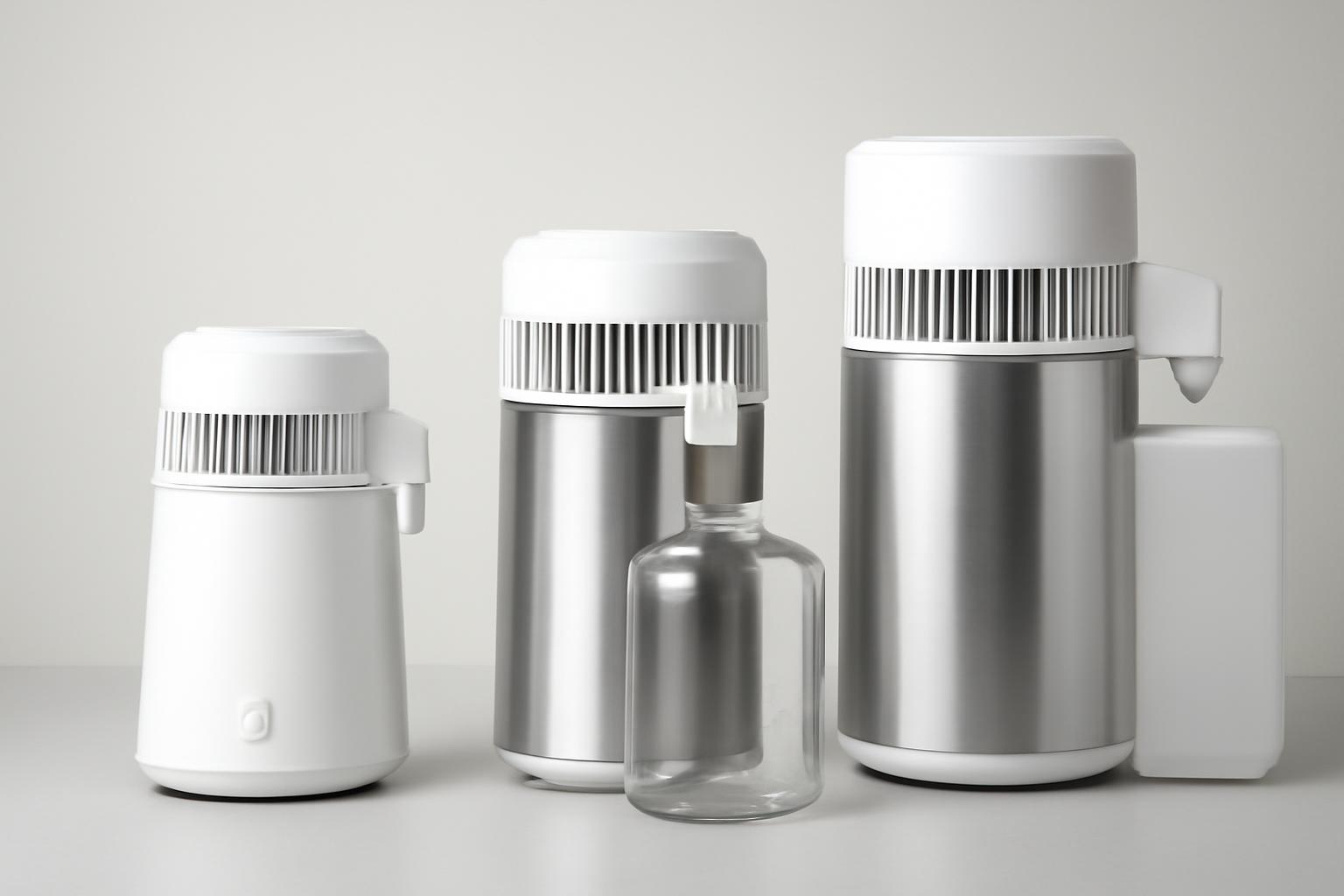
Mini Classic CT is listed to produce up to 3 liters, about 0.8 gallon, per 3.5-hour manually filled cycle. Output, handling and installation narrow the options.
Water distillers range from compact batch appliances to automatic systems with large reserve tanks. They also attract unusually broad marketing claims: “pure,” “laboratory-grade,” “99.9%,” and “contaminant-free” frequently appear without enough detail to establish what was tested, under which conditions, or by whom.
A better buying decision starts with practical questions: How many gallons do you need? How quickly do you need them? Where will the machine sit? What installation is possible? How much cleaning and batch handling will you actually perform? Post-filtration, electrical requirements, replacement parts, warranty exclusions, and model-specific evidence matter more than a category-wide purity slogan.
This guide does not identify a universal best water distiller. It compares manual countertop, automatic, non-electric, and commercial systems and explains when reverse osmosis may be more practical.
Editorial method: This is a specification-based buying framework, not a hands-on product ranking. Reef Directory has not conducted laboratory or appliance testing of water distillers. Named capacities, prices, warranties, and operating details are identified as seller-listed information. The available technical sources are predominantly manufacturers and treatment-equipment retailers, so their performance claims should not be treated as independent verification.
What a Water Distiller Does—and Where the Process Has Limits
A water distiller operates in three main stages:
- Water enters or is poured into a boiling chamber.
- The appliance heats the water and directs the resulting vapor away from that chamber.
- A condenser cools the separated vapor back into liquid, which flows into a collector or storage tank.
Many minerals, dissolved solids, and other nonvolatile substances do not travel with the vapor under ordinary operating conditions. They remain in the boiling chamber as concentrated residual water or deposits. This residue is why chamber cleaning and descaling are routine parts of ownership.
Ordinary boiling is not the same process. Boiling creates vapor, but distillation requires that the vapor be separated, cooled, and collected as condensed liquid. If it simply escapes into the room, no distilled water has been collected.
Why “removes everything” is the wrong claim
Distillation must not be presented as removing every possible contaminant. Some volatile compounds may travel with the vapor and enter the condensate. Performance can vary with the substance involved, source-water chemistry, appliance design, operation, maintenance, and any pre- or post-treatment. A water-treatment manufacturer’s comparison likewise acknowledges that volatile organic compounds may carry into condensate even while most minerals and other nonvolatile material remain in the chamber (Crystal Quest’s distillation and RO comparison).
This limitation helps explain why activated-carbon post-filters commonly appear on distillers. Depending on the filter and system design, carbon media may improve taste or odor and help address certain volatile compounds after condensation. It is not a universal polishing stage that removes every substance.
Before treating a post-filter as a meaningful feature, verify:
- The exact filter model included
- Whether it is standard or optional
- The substances or taste-and-odor issues it is intended to address
- Any testing for the complete filter-and-distiller configuration
- Its stated capacity or replacement trigger
- Preparation or flushing instructions
- Replacement cost and availability
Documentation for the complete system is more useful than a general statement that it “includes activated carbon.”
Purity percentages need context
Claims such as “99% pure,” “99.9% removal,” “contaminant-free,” and “laboratory-grade” may sound precise while communicating little. A removal percentage is meaningful only when accompanied by details such as:
- The substance tested
- Its starting concentration
- The test method
- The operating conditions
- The sample size
- The appliance and filter configuration
- The maintenance state
- The measured final result
“Laboratory-grade” is not a universal category created merely by distilling water. Laboratories, sterilizers, dental equipment, and other professional processes may have application-specific water requirements. The supplied evidence does not establish that any named household distiller complies with those requirements.
For drinking-water treatment, look for contaminant-specific results from an independent laboratory or an applicable certification for the exact model and configuration. Neither type of evidence should be inferred from customer ratings, bestseller labels, testimonials, or stainless-steel construction.
The practical distinction is:
- Process description: Water is heated, vapor is separated, and condensate is collected.
- Seller claim: The appliance removes a broad percentage of “impurities.”
- Useful model evidence: A named model and configuration were tested for specific contaminants under stated conditions, with accessible results.
The first explains how distillation works.
The Four Main Types of Water Distillers
The type of distiller determines how often you interact with it, what installation it needs, and how much water it can realistically provide.
Manual countertop distillers
A manual countertop distiller is a batch appliance. You fill its chamber by hand, position a carafe or jar beneath the outlet, start the cycle, and later empty or clean the chamber. Automatic shutoff at the end of a cycle does not mean automatic filling or continuous production.
These appliances generally require a suitable electrical outlet but no permanent supply or drain connection. That makes them attractive to renters, occasional users, and buyers who cannot alter plumbing.
Their central limitation is labor multiplied by cycle time. Each batch may involve:
- Filling the chamber
- Positioning the collector
- Starting the appliance
- Removing and storing the water
- Disposing of residual water
- Cleaning the chamber
- Restarting the next batch
A machine may theoretically complete several cycles in 24 hours, but practical output depends on whether someone will restart it at the necessary times.
As one representative example, the manufacturer lists the Mini Classic CT as producing up to 3 liters, or about 0.8 gallon, per 3.5-hour manually filled cycle. It requires no water-supply connection and uses a glass collection jar (Pure Water’s model overview). Those are seller-listed specifications, not independently measured output.
Automatic household systems
Automatic household distillers connect to a water supply and refill without the owner pouring every batch. They commonly use drainage and send finished water to an onboard or separate reserve tank. Some configurations can feed a dedicated faucet or appliance line.
Automation reduces repetitive filling and collector handling, but it introduces other requirements:
- A compatible cold-water connection
- Drain access
- Space for the distiller and reserve tank
- A suitable dispensing route
- Correct voltage and circuit capacity
- Cooling and service clearance
- Installation and leak inspection
The Midi Classic, for example, is seller-listed at up to 7 gallons per day with 5 gallons of onboard storage. The manufacturer presents it as a household model, but people-count recommendations are illustrations rather than universal sizing rules (Pure Water’s model comparison).
Automatic systems generally cost more than basic countertop units. That premium buys capacity, storage, and reduced handling—not automatic proof of superior contaminant reduction.
Be precise about the word “automatic.” Some automatic-fill distillers may still need manual shutdown when connected to incoming water without a compatible automatic reserve-tank control. Confirm how the complete configuration behaves, not merely whether the distiller head accepts a supply connection.
Non-electric distillers
Non-electric distillers form a distinct category, but the available evidence does not establish their routine production performance. A retailer may label a product portable or non-electric without disclosing enough information to determine whether it can meet ordinary household demand.
Before buying, obtain model-specific answers for:
- Finished volume per cycle
- Cycle duration
- Required heat source
- Fuel use
- Condenser or cooling requirements
- Supervision during operation
- Permitted operating location
- Replacement gaskets and other parts
Do not assume that “non-electric” means inexpensive to operate, fast, or suitable for everyday household production. Without verified output and operating details, it is better treated as an emergency or specialty option than as a substitute for a documented household system.
Commercial and professional systems
Commercial systems increase production and storage capacity. They may suit offices, workshops, high-volume households, or professional processes where repeated countertop batches are inadequate.
Durastill’s storefront organizes systems into seller-listed categories of 8, 12, 42, and 84 gallons per day, with reserve tanks extending to 150 gallons (Durastill’s system catalog). These are advertised capacities rather than independently verified outputs.
Larger systems raise additional questions:
- What electrical supply is required?
- How much heat must the room dissipate?
- How does buildup affect output?
- How much downtime can the operation tolerate?
- Is local or authorized service available?
- Which model-specific parts are stocked?
- Can the chamber and tank be accessed for service?
- What does the warranty exclude under commercial use?
For dental, medical, sterilizer, or laboratory applications, capacity is only one part of the decision. Obtain documentation showing that the delivered water and complete system satisfy the relevant equipment instructions or professional requirements. A retailer category labeled “medical” or “laboratory” does not establish compliance.
A quick type decision
Choose a manual countertop model when demand is modest, batch production is acceptable, and minimal installation matters.
Investigate an automatic household system when calculated demand exceeds the number of batches someone can realistically run or when reserve storage is essential.
Consider a non-electric model only after verifying production, heat-source, cooling, and supervision requirements.
Move to a commercial system when sustained throughput, reserve capacity, service continuity, or professional documentation—not merely a larger household label—justifies the added cost and installation.
How to Size a Distiller Using Output, Cycle Time, and Storage
Distiller listings commonly place several measurements side by side as though they were interchangeable. They are not.
Keep four specifications separate
- Gallons per cycle: The amount one batch is expected to produce.
- Hours per cycle: How long that batch takes.
- Maximum gallons per day: The seller’s stated daily production under its assumed schedule.
- Reserve-tank capacity: The amount of finished water that can be stored.
A one-gallon carafe describes collector capacity. It does not mean the appliance produces one gallon per hour or that one cycle can cover a household’s daily needs.
Likewise, a 10-gallon reserve tank does not mean the system makes 10 gallons per day. The tank can provide stored water during a short demand peak, but the distiller’s production rate determines how quickly that volume is replenished.
Calculate the actual requirement
Start with intended use rather than household size. List each daily or weekly demand:
- Drinking
- Cooking
- Coffee or tea
- Pet water
- Equipment for which the manufacturer specifies low-mineral or distilled water
- Aquarium or workshop processes
- Office staff and visitors
- Periodic process demand
- Emergency-reserve rotation
Estimate gallons per day for each use. Convert weekly uses to a daily average, but record peak-day demand separately. Add a reasonable allowance for cleaning interruptions, visitors, or unusually heavy use.
Then compare the result with realistic production rather than collector or tank size.
For a batch unit:
Practical daily output = batch volume × cycles you can realistically run per day
If a unit produces 0.8 gallon per cycle and your schedule allows two cycles:
0.8 gallon × 2 cycles = 1.6 gallons per day
That remains the practical result even if the machine could theoretically complete additional cycles during the night. A maximum that assumes immediate restarts may not represent normal ownership.
Normalize production rate
To compare different batch sizes, calculate:
Production rate = batch volume ÷ cycle hours
Using the seller-listed Mini Classic CT figures:
0.8 gallon ÷ 3.5 hours ≈ 0.23 gallon per hour
This calculated rate helps normalize specifications, but it is still based on advertised output.
An affiliate-supported Bob Vila comparison listed approximately four to six hours per gallon across several countertop products. The publisher reported testing four of seven recommended models, so the range should be treated as an editorial illustration rather than a category-wide benchmark (Bob Vila’s countertop comparison).
Account for storage and peak demand
Reserve capacity matters when water use is concentrated. An office might draw several gallons during business hours but allow the system to recover overnight. A household may use most of its treated water around meals.
A tank can bridge a peak when:
- Stored volume is large enough for the peak.
- The distiller can replenish it before the next one.
- The tank and dispensing components can be maintained as the manual requires.
- Installation leaves access for inspection and service.
Storage does not correct chronic undersizing. If consumption repeatedly exceeds production, a larger tank only postpones the shortage.
Treat people-count labels cautiously
Seller labels such as “for one to two people” may illustrate intended use, but they are not sizing standards. Two people using distilled water only for a small appliance may need much less than one person using it for drinking, cooking, and several devices.
Your volume calculation should overrule the household icon on the product page.
A normalized comparison
The table below shows how to compare representative seller-listed models without turning the exercise into a ranking. Figures and displayed prices were checked on July 30, 2026, and may change. “Not disclosed” means the supplied listing did not provide enough information; it should not be replaced with a guess.
| Model | Fill type | Batch volume | Cycle time | Calculated rate | Advertised daily maximum | Storage | Wattage / voltage | Plumbing and drainage | Collector | Displayed price |
|---|---|---|---|---|---|---|---|---|---|---|
| Mini Classic CT | Manual | 0.8 gal | 3.5 hr | ≈0.23 gal/hr | Not disclosed as a daily figure | Separate jar | Not disclosed in supplied listing | No supply connection stated | Glass | $795 |
| H2O Labs Model 200 | Manual | Not disclosed in supplied excerpt | Not disclosed | Not calculable | Not disclosed | Separate carafe | Not disclosed | Manual countertop configuration | Not disclosed in supplied excerpt | $229 |
| Durastill Dual-42C150 | Automatic | Not applicable as a batch listing | Not disclosed | Not calculable | 84 gal/day | 150 gal | Not disclosed in supplied listing | Installation details not disclosed | Tank system | $11,463 |
The Durastill row reflects a seller-listed current price and pre-order status as displayed on July 30, 2026; the storefront also showed conflicting promotional and featured-product prices for several smaller configurations, reinforcing the need to verify checkout terms (Durastill’s storefront).
Add columns for the exact filter, certification record, warranty, parts availability, freight, installation, and return terms when those factors differ. A modest specification with few unknowns is more useful than an impressive daily maximum surrounded by missing data.
Buying Criteria That Matter More Than Marketing Labels
Once output is adequate, compare how each appliance will fit everyday life. Features that appear minor in a listing can determine whether the distiller is used consistently.
Manual effort and automatic controls
Map every step needed to produce and store the required volume:
- Fill the chamber.
- Lift or carry the water.
- Position the collector.
- Start the cycle.
- Confirm that the collector remains aligned.
- Remove and store the finished water.
- Empty cooled residual water.
- Clean the chamber.
- Restart the next cycle.
Automatic shutoff reduces attention at the end of a batch. It does not eliminate filling, collector handling, cleaning, or restarting. Automatic-fill systems reduce more repetitive work when paired with compatible storage and controls, but they add plumbing, fittings, and installation requirements.
For an automatic system, ask:
- Does it stop when the tank is full?
- What happens if the supply is interrupted?
- Is a particular tank or float control required?
- Can it be connected directly to a faucet or appliance line?
- Which actions remain manual?
The answers should come from the manual for the exact configuration.
Construction materials
Stainless-steel boiling chambers are widely advertised. Stainless steel may be desirable for cleaning and general robustness, but the phrase alone does not prove contaminant reduction, electrical safety, workmanship, or service life.
Determine which components are actually stainless steel:
- Boiling chamber
- Lid
- Condensing coil
- Outlet
- Internal fasteners
- Storage tank
- Exterior housing
Grade, thickness, weld quality, seals, electrical design, and replacement-part availability may matter as much as the headline material.
For collection vessels, glass and BPA-free polypropylene have different practical tradeoffs. Glass is rigid and transparent but heavier and breakable. Polypropylene is lighter and less likely to shatter but may show wear over time. The evidence does not establish universal safety superiority for either.
Compare vessel shape, filled weight, grip, lid fit, pouring control, and replacement cost. A collector that is awkward to remove can become the most irritating part of ownership.
Bob Vila’s reviewer reported difficulty assembling a Vevor carafe handle and described spilling water after lifting the wrong handle. That observation does not establish a defect across all units, but it illustrates why handle placement, lid security, and collector alignment deserve inspection. The article is affiliate-supported, and its observations should be understood as one publisher’s experience rather than universal product evidence (Bob Vila’s review).
Electrical and spatial requirements
Before ordering, verify from the model manual:
- Rated wattage
- Voltage and plug type
- Outlet requirements
- Required circuit capacity
- Whether extension cords or power strips are prohibited
- Appliance dimensions
- Operating clearance
- Cooling inlet and exhaust position
- Space needed to remove the lid or chamber
- Filled lifting weight
- Service-panel access
A compact footprint can be misleading if the lid needs substantial overhead room or the unit cannot operate in an enclosed cabinet. Do not infer installation safety from plug compatibility alone.
Carbon-filter details
Confirm whether the carbon post-filter is included or optional. Then identify:
- Exact replacement part number
- Stated capacity
- Installation direction
- Preparation or flushing procedure
- Replacement trigger
- Package quantity
- Storage instructions
- Current availability
- Effect of third-party media on warranty coverage
A proprietary filter that becomes unavailable can reduce the usefulness of an otherwise serviceable appliance.
Certification and test evidence
Safety certification and contaminant-reduction evidence answer different questions.
An electrical-safety listing may indicate that the complete appliance was evaluated for applicable electrical concerns. It does not prove that the water meets a particular contaminant-reduction target. Conversely, a laboratory report about water quality does not establish electrical safety.
For either type of evidence:
- Obtain the complete listing or report.
- Match the exact model number and configuration.
- Check whether the result applies to the full appliance or only a component.
- Review operating and maintenance assumptions.
- Confirm that the evidence is current.
The research available for this guide did not establish an independent contaminant-reduction comparison across the named models. Seller summaries, ratings, and unsupported purity percentages should not be substituted for one.
Repairability and support
Distillers combine heaters, controls, cooling components, seals, and water pathways. Check whether the manufacturer or retailer supplies:
- A model-specific manual
- Parts diagrams
- Carbon filters
- Seals and gaskets
- Carafes and lids
- Switches and thermal controls
- Heating components
- Fans or condenser parts
- Tank and float components
- Authorized repair service
- Support for discontinued models
Waterwise identifies several older distillers as unavailable while stating that it continues to offer parts and support for legacy units. That is useful as a support signal, but buyers should still verify that the specific part they may need is currently stocked (Waterwise’s current and legacy model page).
Read the warranty in layers
Do not stop at the largest number in an advertisement. Separate coverage for:
- Stainless-steel components
- Electrical components
- Other parts
- Labor
- Diagnostic fees
- Shipping in both directions
- Scale-related damage
- Collector breakage
- Consumables
- Commercial use
- Installation errors
- Unauthorized cleaners, parts, or repairs
A long warranty for stainless components may coexist with much shorter electrical coverage. Determine who decides whether a failure resulted from scale, inadequate maintenance, or installation error.
Purchase Price Is Only the Start of the Cost
Water distillers occupy a wide price spectrum. Seller listings checked on July 30, 2026, ranged from hundreds of dollars for compact countertop or non-electric products to several thousand dollars for automatic systems.
H2O Labs displayed its entry-level Model 200 at $229 on that date. The same storefront advertised a one-year parts-and-labor warranty, although terms and prices may change (H2O Labs’ countertop listings).
WaterDistillers.com displayed a compact non-electric model at $179 on July 30, 2026. That was a retailer-listed sale price, not a market average or delivered-price guarantee; taxes, discounts, shipping, and availability may change at checkout (WaterDistillers.com’s storefront).
At the high end, the seller-listed Durastill 84-gallon-per-day system with a 150-gallon reserve appeared at $11,463 and was marked for pre-order. Its displayed price should not be treated as current without reconfirming the exact configuration, stock, freight, and checkout total.
Price verification matters even within one storefront. Durastill’s supplied listings included promotional banner prices that differed from featured-product prices for several configurations. Save the final quote and verify the complete delivered cost rather than relying on a banner or search-result figure.
Include recurring ownership costs
Budget for:
- Electricity
- Activated-carbon filters
- Descaler or other approved cleaning supplies
- Collection vessels and lids
- Seals and tubing
- Replacement parts
- Repair labor
- Shipping to a repair center
- Water used during cleaning
- Installation for automatic systems
- Tank and dispensing-component maintenance
Annualize the purchase price over a conservative expected service period. Do not infer decades of service merely because a cabinet or chamber is stainless steel.
Calculate electrical cost from the specification
If wattage and cycle duration are documented:
Kilowatt-hours per batch = (watts ÷ 1,000) × operating hours
Then:
Electricity cost per batch = kilowatt-hours per batch × local electricity price per kWh
Finally:
Electricity cost per gallon = electricity cost per batch ÷ gallons actually produced
For a purely illustrative calculation, a 750-watt unit running for four hours would use:
(750 ÷ 1,000) × 4 = 3 kWh per batch
That is a calculation method, not a universal distiller consumption rate. If the batch produces less than a gallon, divide by the measured output—not the nominal size of the carafe.
Estimate total cost per gallon
Use annual figures:
Annual ownership cost = annualized purchase price + electricity + filters + cleaners + parts + repair allowance
Then:
Total cost per gallon = annual ownership cost ÷ annual gallons produced
Include installation and expected replacement vessels where relevant. If actual production is lower than planned, fixed costs are spread over fewer gallons and the effective cost per gallon rises.
A defensible comparison with bottled distilled water or reverse osmosis requires:
- Current local bottled-water prices
- Local electricity rates
- Local water and sewer rates
- Verified or measured appliance consumption
- Actual annual volume
- Filter and membrane costs
- Cleaning and repair costs
- Expected service life
- Installation expenses
- Delivery or transportation costs
Commercial sources in the evidence pack disagree about whether distillation or reverse osmosis costs less over time. Neither side supplies a complete neutral model for every household. Calculate the comparison locally rather than accepting a universal break-even claim.
Installation and First-Run Checklist
A manual countertop distiller requires less installation than an automatic system, but setup still needs to follow the exact appliance manual.
Countertop placement
Before the first cycle:
- Put the appliance on the stable, level surface specified by the manual.
- Maintain the required clearance.
- Keep permitted cooling openings unobstructed.
- Ensure overhead cabinets do not prevent lid removal.
- Align the collector beneath the outlet.
- Confirm that the filled collector can be removed securely.
- Use the outlet and electrical configuration required by the manufacturer.
- Keep the cord positioned as the manual directs.
Do not assume that an extension cord or power strip is acceptable because the plug fits. My Pure Water’s setup guidance, for example, instructs users of its featured household systems to use a grounded outlet without an extension cord or power strip and to follow model-specific instructions (My Pure Water’s setup guide).
Automatic-system planning
Depending on the model, an automatic system may require:
- A cold-water supply
- A shutoff valve
- Drain access
- Reserve-tank placement
- A dispensing faucet or appliance line
- The specified voltage and circuit
- Space for ventilation
- Access to filters, fittings, controls, and the boiling chamber
Do not plan only for initial placement. Someone must later reach the service areas.
Confirm whether the distiller, tank, float controls, and dispensing equipment are sold as one compatible system. An automatic-fill distiller without the required tank control may still need manual intervention or shutdown.
First-run procedure
Follow the exact model instructions. Seller guidance for household systems commonly includes these steps:
- Inspect the appliance, collector, tubing, and accessible fittings for shipping damage.
- Remove packing materials and protective components as instructed.
- Seat or tighten fittings only as directed.
- Prepare the collection vessel.
- Install and flush or prepare the carbon filter according to the manual.
- Fill or connect the unit as instructed.
- Run the initial cycle.
- Discard the first batch if the manual requires it.
- Check collector alignment and accessible connections.
- Confirm that the unit shuts down or responds to its tank controls as described.
Stop using the appliance and consult authorized support if the initial operation differs materially from the manual, including uncontrolled leaking, overflow, or failure of the stated shutdown behavior.
Professional buyers should complete a documentation review before plumbing or electrical work makes a return difficult. Verify required water quality, realistic throughput, service response, spare parts, downtime procedures, and the applicable equipment instructions. A professional-use label is not a substitute for this qualification.
Cleaning, Descaling, Filter Changes, and Troubleshooting
Residue in the boiling chamber is an expected consequence of separating many nonvolatile substances from the collected condensate. The amount and appearance of buildup depend on source-water chemistry, usage, cycle design, and residual-water handling.
A task-based maintenance checklist
Use the model manual to determine which tasks are permitted and how they must be completed:
- Empty cooled residual water.
- Rinse or wipe the boiling chamber.
- Inspect the chamber for deposits.
- Descale at the specified trigger or interval.
- Wash and dry the collector and lid.
- Replace the correct carbon media.
- Check outlet and collector alignment.
- Remove dust from accessible vents only as permitted.
- Inspect user-accessible seals, cords, tubing, floats, and fittings.
- Confirm automatic shutdown or tank-control behavior.
- Store removable vessels as the manual directs.
Avoid converting this list into a universal calendar. The correct schedule depends on the appliance, filter, usage, and source-water conditions.
Electrical and cleaning precautions
Commercial maintenance guidance consistently begins with unplugging the appliance and allowing it to cool before chamber cleaning. It also calls for following the cleaner’s mixing instructions and rinsing the chamber after treatment (Ace Water Shop’s maintenance guide).
Use only procedures allowed by the model manual.
Vendor guidance mentions white vinegar, citric-acid products, and branded descalers, but a cleaner recommended for one machine is not automatically appropriate for another. Follow the model-specific dilution, fill level, soak time, heating instructions, and rinse procedure.
There is no universal maintenance calendar
Published seller schedules conflict. CO-Z’s commercial maintenance guide recommends carbon-filter replacement every two to three months or after 300 gallons and descaling every three to four months. Those figures are vendor guidance, not universal specifications (CO-Z’s maintenance guidance).
Other seller guidance ranges from monthly carbon replacement to intervals of three to six months. Descaling suggestions range from weekly in hard-water conditions to every few months. These schedules cannot be merged into one reliable rule.
A more defensible approach is to:
- Start with the schedule for the exact model and filter.
- Inspect the chamber during early ownership.
- Record how quickly deposits accumulate.
- Track gallons or cycles when the manufacturer uses a throughput limit.
- Adjust only within the manual’s instructions.
- Contact the manufacturer if output, taste, odor, or buildup changes unexpectedly.
Troubleshooting guide
The following table organizes questions to check; it is not a diagnostic substitute for the model manual.
| Symptom | User-checkable questions | Next step |
|---|---|---|
| Lower output or longer cycles | Is the chamber due for approved descaling? Are permitted cooling openings obstructed? | Follow the manual’s cleaning and placement checks |
| Off taste or odor | Is the correct carbon filter due for replacement? Was the collector rinsed after cleaning? | Replace or clean only as instructed |
| Water leaking | Is the collector aligned? Is a user-serviceable fitting or seal visibly displaced? | Stop operation and inspect only permitted components |
| Unit will not start | Is the specified outlet working? Does the manual describe a seating interlock or reset procedure? | Follow documented checks and allow required cooling time |
| Incorrect shutdown | Is the tank or control configuration compatible? | Stop use and contact authorized support |
| Unusual noise or heat | Are permitted vents blocked or is required clearance missing? | Unplug and seek service if the manual’s placement checks do not resolve it |
| Water misses the collector | Is the collector, lid, outlet, or nozzle positioned as specified? | Reposition only when the unit is safe to handle |
The evidence supplied for this guide does not support model-specific internal repair instructions.
Water Distillers vs. Reverse Osmosis: Which Fits the Job?
Distillation and reverse osmosis can both produce treated water, but they use different processes and impose different ownership demands.
Reverse osmosis uses water pressure, staged filtration, and a semipermeable membrane. A typical residential configuration may include sediment and carbon stages, the RO membrane, and a post-filter; some systems add remineralization. Distillation uses heat to create vapor, separates it from the boiling chamber, and condenses it.
Practical differences
| Decision factor | Countertop distiller | Typical under-sink RO system |
|---|---|---|
| Process | Heating, vapor separation, condensation | Pressure, staged filtration, membrane separation |
| Delivery pattern | Slow and batch-based | More continuous through a tank and faucet |
| Installation | Often no permanent plumbing | Usually requires supply, drain, faucet, and under-sink space |
| Primary resource tradeoff | Electricity for heating | Feed water, including reject water |
| Consumables | Carbon media, approved cleaner, and parts | Prefilters, post-filters, membrane, and sanitation supplies |
| Portability | Commonly portable | Usually fixed after installation |
| Mineral content | Generally very low | Depends on membrane and any remineralization stage |
| Likely practical fit | Modest volume or a specified low-mineral use | Frequent household drinking and cooking demand |
A countertop distiller may suit renters and lower-volume users because it commonly avoids permanent plumbing. Its tradeoffs are slow production and repeated batch handling. An under-sink RO system requires installation but can provide treated water more conveniently through a dedicated faucet.
Neither system is resource-free. Distillers consume electricity for heating. RO systems generate reject water and require periodic filter and membrane replacement. Actual electricity use, water use, and maintenance depend on the equipment and operating conditions, so neither technology should be declared universally cheaper or more sustainable.
A retailer’s technical overview describes RO as membrane-based treatment and distillation as boiling followed by condensation while emphasizing differences in speed, installation, taste, and intended use. Because the publisher sells treatment equipment, its practical comparison should be weighed against local calculations and exact-model documentation (Fresh Water Systems’ RO and distillation overview).
Taste and intended use
Very low-mineral distilled water may taste flat to some people; others prefer it. Taste is subjective and does not establish contaminant reduction. Some RO systems include a remineralization stage to change mineral content or flavor.
Distillation may be worth considering when equipment instructions specifically require very low-mineral or distilled water. Commercial comparisons commonly mention certain humidifiers, CPAP machines, steam irons, batteries, and laboratory procedures, but the applicable device manufacturer, healthcare professional, or professional standard must determine the required water—not a general household-distiller article (Crystal Quest’s application comparison).
Do not infer that a household distiller meets medical, dental, sterilizer, battery, aquarium, or laboratory specifications merely because it produces low-mineral water.
A neutral decision path
Use this sequence before choosing either technology:
- Define the use. Separate drinking and cooking from equipment, aquarium, office, emergency, or professional needs.
- Review available source-water information. Use an appropriate local report or testing process.
- Identify the contaminants or characteristics of concern. Do not choose treatment based only on taste or a total-dissolved-solids reading.
- Calculate daily and peak demand.
- Check installation constraints. Include plumbing, drainage, electrical requirements, space, heat, and service access.
- Compare exact-model evidence. Look for relevant testing, certification, and complete reports.
- Estimate operating costs locally.
- Examine maintenance and parts support.
- Confirm warranty and return terms before installation.
Final buyer checklist
Before buying a water distiller, confirm:
- [ ] Intended use is clearly defined.
- [ ] Required gallons per day include a reasonable buffer.
- [ ] Batch output and cycle time are documented separately.
- [ ] Advertised daily maximum is plausible for your schedule.
- [ ] Storage covers peak demand without being mistaken for production.
- [ ] Contaminant claims have exact-model evidence.
- [ ] Electrical-safety and treatment evidence are not being confused.
- [ ] Carbon-filter model, capacity, and availability are known.
- [ ] Wattage, voltage, outlet, and circuit requirements are acceptable.
- [ ] Plumbing and drainage requirements fit the property.
- [ ] Dimensions include operating and service clearance.
- [ ] Collector material and handling suit the user.
- [ ] Cleaning and descaling procedures are realistic.
- [ ] Filters, seals, vessels, and repair parts are available.
- [ ] Warranty terms separate components, labor, shipping, scale, and commercial use.
- [ ] Delivered price includes freight, tax, installation, and accessories.
- [ ] Return terms remain workable after opening or installation.
Begin with intended use and required volume, not a purity percentage. A modest countertop model may suit low-volume batch production with minimal installation. Sustained household or workplace demand may justify an automatic system—or make reverse osmosis worth comparing. The defensible recommendation is a documented selection process, not one universal “best” water distiller.
Frequently Asked Questions
How long does a countertop water distiller take to make one gallon?
Seller-listed countertop models commonly take several hours. One commercial comparison reports a typical range of approximately four to six hours per gallon, but actual output varies by appliance and operating conditions.
Compare batch volume and cycle time together. A model that makes 0.8 gallon in 3.5 hours is not making one gallon per cycle, per hour, or necessarily per day. Collector size is not a production specification.
Do water distillers remove all contaminants?
No. Distillation leaves many minerals, dissolved solids, and other nonvolatile substances in the boiling chamber, but some volatile compounds may travel with the vapor. Performance also depends on the appliance, operation, condition, post-filter, source water, and substance involved.
Look for contaminant-specific independent results or an applicable certification for the exact model and configuration. “99.9%,” “contaminant-free,” and “laboratory-grade” are not sufficient evidence by themselves.
Does a water distiller need an activated-carbon filter?
A distiller can perform evaporation and condensation without a carbon filter, but many models use activated-carbon post-filtration for taste, odor, or certain volatile compounds.
Whether that filter is appropriate depends on the distiller, source water, intended use, and contaminants of concern. Verify the exact replacement part, documented purpose, capacity, preparation procedure, and replacement trigger.
How often should a water distiller be cleaned or descaled?
There is no universal interval. Frequency depends on source-water hardness, usage, chamber design, residual-water handling, and the model instructions.
Seller schedules conflict substantially, so do not average them into one calendar. Follow the exact manual, inspect early buildup, and track cycles or gallons when the manufacturer specifies a throughput limit. Unplug the appliance and allow it to cool before performing cleaning steps described by the manual.
Is a water distiller better than reverse osmosis?
Not universally. A countertop distiller may be more practical when portability, minimal plumbing, modest batch demand, or a specified low-mineral use is the priority. Reverse osmosis may be more convenient when a household wants higher-volume delivery through a dedicated faucet and can accommodate supply and drain connections.
Distillers use electricity for heating. RO systems generate reject water and require filters and membrane replacement. Compare intended use, contaminants of concern, realistic output, installation, local utility costs, maintenance, parts support, and exact-model evidence before deciding.