
Keep Your Saltwater Aquarium Stable With a Practical Routine
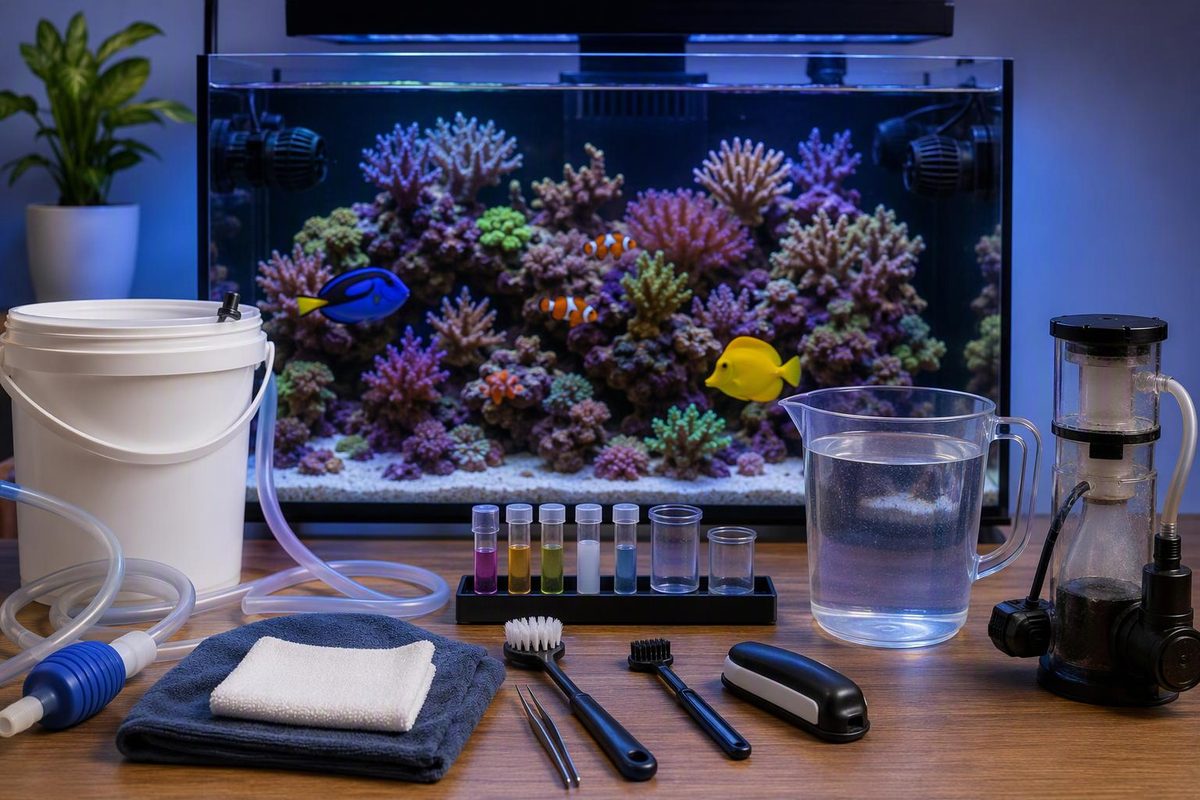
Use a daily, weekly and monthly saltwater tank schedule, calculate water-change volume, and adjust testing and equipment care to your reef’s needs.
Maintenance for a saltwater aquarium starts with daily livestock and equipment checks, regular water testing and roughly 10% weekly water changes for an established home reef. Adjust that baseline to measured consumption, nutrient trends and livestock condition. A 10% weekly change is Red Sea’s routine reef-care recommendation, not a requirement for every tank.
This schedule assumes the aquarium has completed its initial cycle. A tank still cycling needs a separate biofilter-establishment plan.
Enter your actual system water volume and planned change percentage to calculate how much saltwater to prepare.
Water-Change Volume Calculator
Include sump water; allow for rock and sand displacement.
Replacement Saltwater
5 gallons
50 gallons × 10% = 5 gallons.
10% weekly is a starting baseline for an established reef, not a rule for every tank.
Match salinity and bring replacement water close to tank temperature. This calculates volume, not whether your chosen percentage is safe.
Source: Red Sea mixing guidance recommends 10% weekly for routine reef care. Output uses your entered volume and percentage; estimated volume gives an estimated result.
Start With Daily Checks And Weekly Testing
The intervals below are a practical baseline. Bring a task forward when flow falls, filters clog or readings change. Weekly alkalinity testing is a starting point for a stable, low-demand reef—not a sufficient default for every coral-heavy or newly dosed system.
| When | What To Do | What To Check |
|---|---|---|
| Daily | Observe fish and corals; check temperature, circulation, leaks and water level; feed according to species needs | Appetite, breathing, unusual hiding, coral tissue condition and equipment operation |
| Daily or as needed | Replace evaporated water; inspect the automatic top-off reservoir if fitted | Reservoir level and whether the system maintains its normal water level |
| Every few days | Inspect filter floss, socks or sponges; empty the skimmer cup and clean its neck as needed | Clogging, bypassing water and changes in skimmate production |
| Weekly | Test and log salinity, alkalinity, nitrate and phosphate; clean viewing panes and overflow teeth; perform the planned water change | Compare with previous readings, not just a target chart |
| Monthly review | Check calcium and magnesium in a proven stable, low-demand reef; inspect pumps, heater, tubing, dosing lines and top-off sensors | Deposits, wear, reduced output and service due under each device’s manual |
Mechanical media needs attention before trapped waste sits and decomposes; fine pads may need replacement every few days. Biological media has a different job and should not be treated as disposable filter floss. This filtration guide explains the distinction.
Replace Evaporation With Freshwater
Replace evaporation with purified freshwater, normally RO/DI water. Replace water removed during a water change with mixed saltwater. Evaporation leaves the salt behind, so topping off with saltwater progressively raises salinity.
Check the water level even when an automatic top-off is installed. Automation does not remove the need to check its reservoir and operation. Red Sea’s MAX NANO XXL G2 aquarium manual calls for daily water-level checks and freshwater replacement for evaporation. A low level caused by a leak is a different problem: investigate rather than assuming all missing water evaporated.
Prepare And Replace The Planned Water Volume
Use an estimate of actual system water volume, including the sump but allowing for rock and sand displacement. If the system holds about 50 gallons of water, a 10% change is about 5 gallons. The calculation is replacement volume = actual system water volume × change percentage ÷ 100.
- Prepare replacement water separately. Use an aquarium-only container, purified water and marine salt. Follow that salt’s mixing and storage instructions; there is no universal overnight mixing rule.
- Measure before draining. Check both tank and replacement-water salinity with a calibrated instrument. Bring replacement water close to tank temperature. If tank salinity is already wrong, plan its correction separately rather than forcing an abrupt change during routine maintenance. See the refractometer calibration guide.
- Pause equipment safely. Disable the top-off so it does not replace deliberately removed saltwater with freshwater. Unplug submerged electrical equipment before putting your hands in the water. Unplug heaters before lowering the water below their minimum level, allowing any cooling time required by their instructions. Stop pumps or skimmers that would run dry or operate incorrectly. Eheim’s heater manual specifies disconnecting submerged appliances before hands enter the water and maintaining the heater’s minimum water level.
- Remove the planned volume. Siphon accessible loose debris while removing water. Avoid making a complete substrate overhaul part of an ordinary water change.
- Refill and restart deliberately. Add the prepared saltwater, confirm the normal operating level, then restore equipment and top-off operation according to their instructions. Check circulation, leaks, temperature and salinity before leaving the tank.
Red Sea’s mixing instructions linked above support checking tank and replacement-water salinity before adding the new batch. Randy Holmes-Farley’s water-change analysis explains why salinity and temperature mismatches matter more as the changed fraction increases.
Let Readings Determine Testing And Dosing
For a typical tropical reef, around 35 ppt salinity is a useful starting target. Alkalinity, calcium and magnesium also need appropriate levels, but a broad acceptable range is not permission to swing repeatedly between its ends. Holmes-Farley’s reef chemistry reference, updated in 2022, explains these parameters and why growing stony corals can require supplementation beyond water changes.
Test More Often When Consumption Changes
For new dosing or increasing coral growth, test alkalinity daily while establishing demand. Check calcium and magnesium more often until their trends are understood. Follow your supplement’s testing instructions; for example, Red Sea’s Foundation manual calls for weekly checks of all three when dosing daily.
For a stable, low-demand reef, keep the weekly alkalinity check. Extend calcium and magnesium testing only after repeated readings show stability, and shorten the interval again if consumption increases.
Investigate Nutrient Trends Before Adding Treatment
When nitrate or phosphate rises, inspect feeding, accumulated debris, mechanical filtration and skimmer operation before adding another nutrient-removal method. Check whether the readings are actually outside the range appropriate for your livestock; a rise alone does not establish a problem.
Repeat an unexpected test result and check technique, reagents or calibration before dosing a correction. Keep a simple log of dates, readings, water-change volumes, doses and observations. If animals suddenly decline, check equipment and water conditions immediately rather than waiting for the scheduled session.
Inspect Equipment Monthly And Clean When Needed
A monthly review is not a requirement to acid-clean every pump monthly. Reduced flow, deposits and the manufacturer’s service interval should determine cleaning frequency.
Unplug equipment before disassembly. Use only the cleaning method approved for that model, rinse thoroughly and confirm normal operation afterward. The Red Sea MAX NANO XXL G2 manual linked above describes cleaning its pump impellers and chambers, and notes that higher calcium and alkalinity can increase maintenance demands. Follow your own equipment manual rather than copying another pump’s soaking recipe.
Keep established biological media wet and gently rinse accumulated debris in saltwater when needed; do not replace it simply because it looks old. The filtration guide linked above emphasizes keeping biomedia wet and maintaining flow. The useful endpoint is reliable circulation and stable readings—not a sterile-looking reef.