
Choose A Refractometer You Can Trust At Reef Salinity
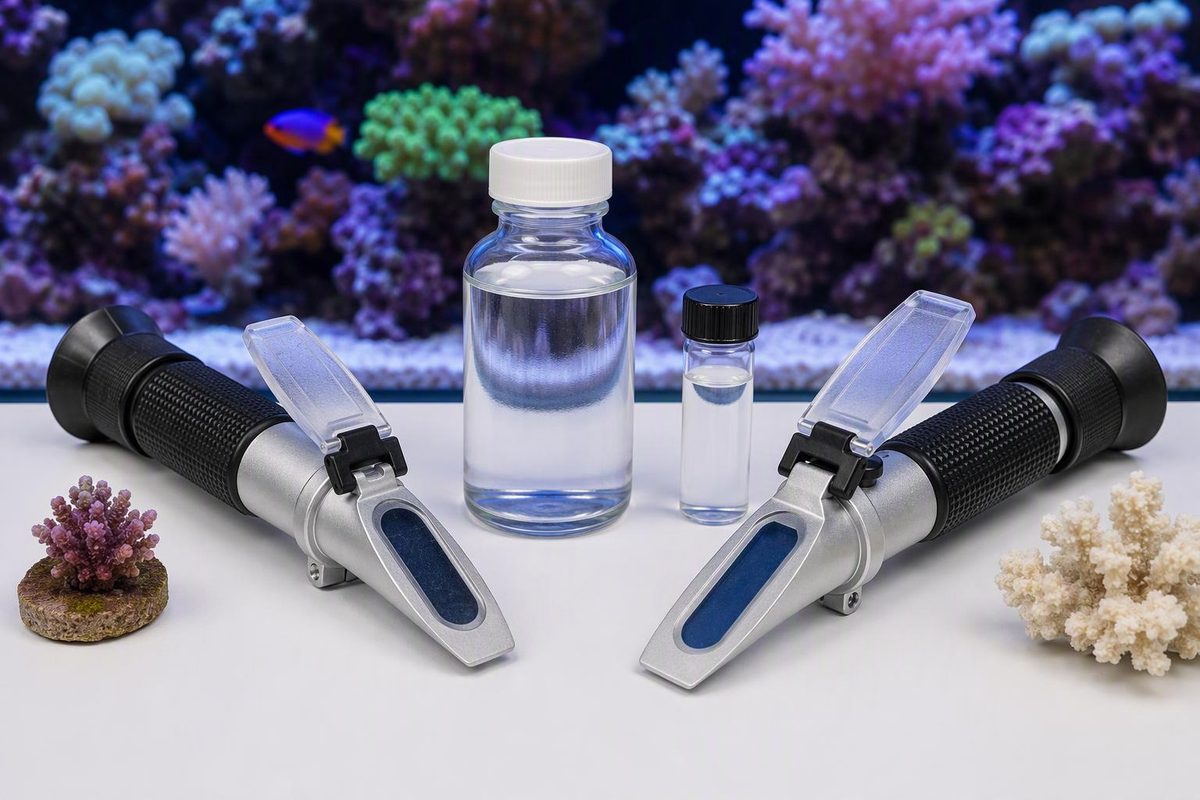
Compare seawater and brine refractometers, check accuracy with a compatible 35 ppt reference, and avoid calibration errors before changing tank salinity.
For a saltwater aquarium, choose a seawater refractometer with automatic temperature compensation (ATC), a readable salinity scale, and clear calibration instructions. Verify it with a reference solution that matches 35 ppt seawater. A freshwater reading of zero alone does not prove that it reads correctly at reef salinity. A manual optical model is a reasonable choice if you can read its boundary clearly; digital is useful when you prefer a numerical display, but it is not automatically more accurate.
Select your instrument, reference fluid, and check result to find the next calibration step.
Find Your Next Calibration Step
Get A Compatible Reference
Use a 35 ppt seawater-equivalent fluid explicitly suitable for refractometers. A freshwater zero alone does not verify accuracy at reef salinity.
Calibration Limits
A 53 mS/cm conductivity standard is not necessarily optically equivalent to seawater. A manual instrument adjusted at 35 ppt may no longer read freshwater at zero; this does not establish accuracy across its whole scale. Never put 35 ppt fluid into a digital freshwater ZERO procedure.
Sources: Holmes-Farley, D-D instructions, and Hanna HI96822 manual. Apply your model’s stated accuracy and temperature requirements.
For most mixed reefs, 35 ppt is a sensible salinity target. That corresponds to approximately 1.0264 specific gravity when both seawater and the freshwater reference density are at 25°C. Instruments can use different specific-gravity conventions, so recording salinity in ppt makes comparisons simpler. Reef chemist Randy Holmes-Farley explains the target and calibration limitations; D-D explains why specific-gravity scales can differ.
Choose A Seawater Scale, Not Just A Salt Scale
A refractometer measures refractive index—how light behaves in the sample—and converts it to salinity. That conversion must suit seawater, not just any salty liquid.
Look for an explicit statement that the instrument measures natural and artificial seawater. Brine models use a sodium-chloride scale: D-D gives an example in which 35 ppt seawater reads as 36.5 ppt brine. If you already own an adjustable brine model, calibration with a suitable seawater-equivalent reference can make it useful near 35 ppt; you do not automatically need to replace it. The D-D and Holmes-Farley sources above explain this scale difference and recalibration.
The region around 30–40 ppt should be easy to distinguish. Avoid a Brix-only brewing instrument or a clinical urine/protein refractometer: their displayed scales are not seawater salinity.
ATC is helpful, but it does not remove the need to let the instrument and sample equilibrate. Check the model’s documented operating and calibration temperatures rather than treating ATC as permission to measure immediately under any conditions.
Compare Accuracy, Not Display Digits
Digital models avoid judging a blue/white boundary, but more digits do not guarantee greater accuracy. For example, the Hanna HI96822 displays salinity in 1 ppt increments while specifying accuracy of ±2 ppt. Those are different specifications: resolution describes the displayed step; accuracy describes how closely the reading should match the actual value under the stated conditions. HI96822 manual
| Buying Check | What To Look For |
|---|---|
| Scale | Natural and artificial seawater |
| Readability | Clear markings near 30–40 ppt |
| Temperature | ATC plus documented conditions |
| Accuracy | A published accuracy specification |
Choose digital if the eyepiece is difficult to use or you prefer a numerical display—not because “digital” alone promises a better measurement.
Calibrate First, Then Verify At 35 Ppt
Calibration adjusts the instrument. Verification checks whether it reads a known sample correctly. Follow the model’s calibration procedure, then check it near the salinity you actually keep.
- Clean and dry the prism and cover or sample well. Residual freshwater dilutes the sample; dried salt contaminates the next reading. Rinse the dropper too.
- Let the instrument settle at the prescribed temperature. Red Sea, for example, specifies 30 minutes at 22–25°C before alignment. These conditions are model-specific. Red Sea manual
- Perform the manufacturer’s calibration. Many seawater models specify distilled or deionized water for zero calibration. Use the stated water type rather than assuming tap water is suitable.
- Measure a 35 ppt seawater-equivalent refractometer reference as an ordinary sample. It should read close to 35 ppt within the instrument’s stated accuracy.
Use a fluid explicitly suitable for refractometers. A conductivity standard marked “53 mS/cm” is not necessarily optically equivalent to seawater. Its label does not establish that it can verify your refractometer. Why reference-fluid compatibility matters
An Adjustable Manual Model May Need A Reef-Range Setting
If an adjustable manual instrument fails the check, first confirm that the reference fluid is suitable and repeat after cleaning.
Calibration against a reliable seawater-equivalent reference can improve accuracy near reef salinity: adjust the screw until that reference reads 35 ppt. D-D explicitly permits a suitable 35 ppt reference, with attention to its stated calibration temperature. D-D calibration instructions
After this adjustment, some instruments may no longer read freshwater at zero. Repeatedly switching between zero and 35 ppt adjustments can undo the useful setting. This setting supports measurements near reef salinity; it does not prove accuracy across the whole scale.
A Digital Freshwater ZERO Needs Freshwater
Do not use 35 ppt fluid for a digital meter’s freshwater ZERO calibration. The Hanna HI96822 requires distilled or deionized water for that operation. Use the 35 ppt fluid only to verify its sample reading.
If it fails after cleaning and recalibration, check the reference fluid and contact the manufacturer rather than forcing an unsupported adjustment. Other digital models need their own documented procedure; the HI96822 instructions do not establish the procedure for every meter. Hanna calibration procedure
Take A Repeatable Tank Reading
For a manual refractometer:
- Rinse the dropper with tank water and take a representative sample away from a freshwater top-off outlet.
- Hold the instrument horizontally, cover the prism with sample, and close the flap.
- Wait the specified equilibration time. Red Sea and D-D specify 15 seconds; other models may differ.
- Point toward a daylight-like light source, focus the eyepiece, and read where blue meets white.
- Clean, dry, and repeat with a fresh sample if the result is unexpected. Rinse and dry again before storage. Do not immerse the instrument in water.
These steps follow the Red Sea and D-D operating instructions linked above. Digital models have their own fill-volume and waiting requirements; Hanna advises about a minute when sample and instrument temperatures differ significantly.
Verify The Measurement Before Changing Salinity
If readings vary, first look for salt residue, leftover rinse water, incomplete prism coverage, or temperature differences. If two instruments disagree, test both against a compatible known reference. Do not average their readings and treat that as the truth.
Check calibration before consequential decisions such as adjusting tank salinity or preparing replacement water. Follow the manufacturer’s frequency: Hanna specifies daily calibration before measurements, while Red Sea calls for regular alignment checks.
Routine evaporation replacement uses freshwater, not saltwater. Use measured saltwater for water changes, and confirm tank salinity before deliberately changing it. Small deviations should not prompt a rapid correction based on one uncertain reading. Holmes-Farley’s beginner saltwater guide
Keep salinity in the same log as your other saltwater aquarium water parameters. Use repeatable readings to establish a dependable trend before deciding that the tank needs a correction.