
A Cautious, Step-by-Step Plan for Removing Bryopsis From a Reef Tank
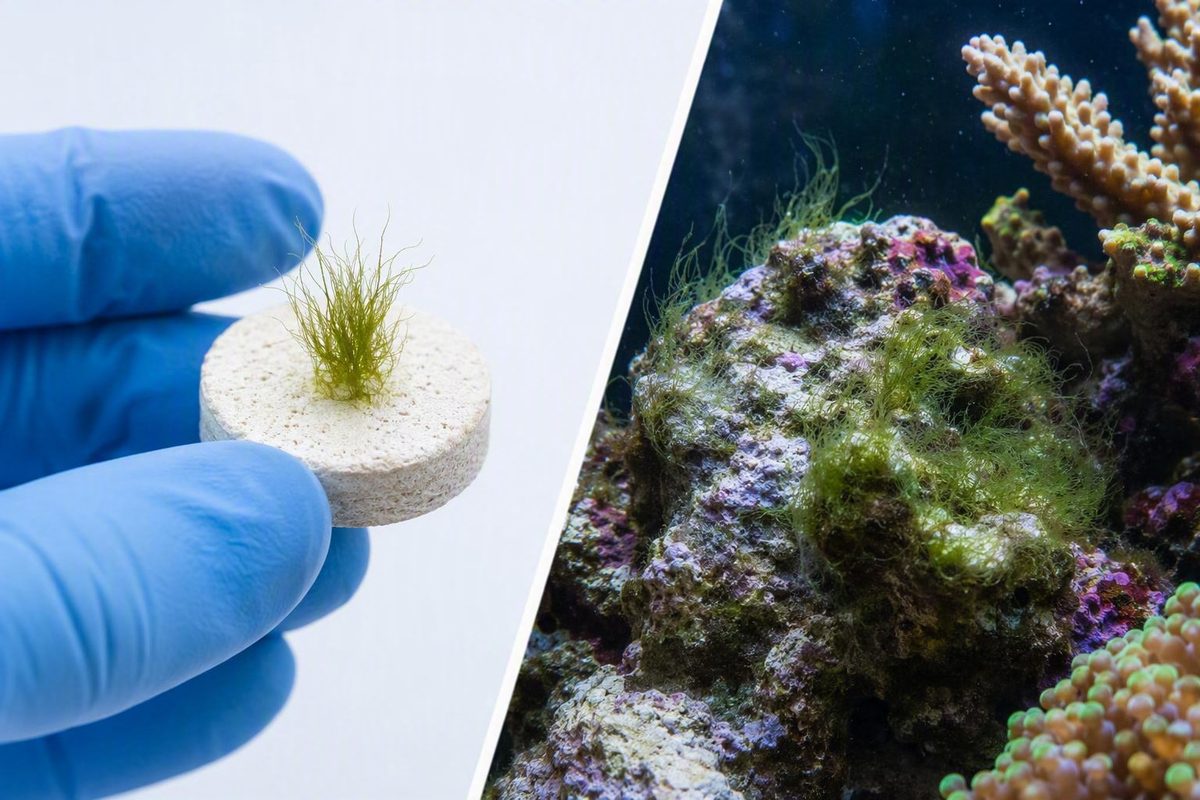
Confirm feathered branches, then remove reachable growth while siphoning fragments. If it remains after 14 days, don't automatically repeat a dose.
Bryopsis algae treatment should begin with diagnosis, not dosing. A small patch on a removable frag plug calls for a different response than growth embedded throughout fixed rockwork, and neither situation justifies exposing an unidentified green filament to a system-wide chemical treatment.
The practical sequence is:
- Confirm the characteristic feathered structure.
- Remove accessible biomass while controlling fragments.
- Review source water, waste accumulation, filtration, lighting, flow, and nutrient trends.
- Decide whether a whole-system intervention is proportionate.
- If considering fluconazole, verify the exact product, estimate net treated water volume, plan equipment changes, and prepare for algae die-off.
- Monitor livestock and water quality rather than assuming the treatment is harmless.
Fluconazole is the chemical option most consistently described in the supplied retailer guidance and hobbyist reports. That repetition should not be mistaken for controlled evidence or independent confirmation: protocols may derive from the same hobby practice, and no supplied controlled aquarium study establishes an optimal dose, treatment duration, retreatment schedule, stop threshold, or species-by-species safety profile.
This article therefore reviews commonly reported practices and conservative precautions. It is not a validated veterinary protocol, and the evidence pack does not include a current manufacturer-authored label or an aquatic-veterinary assessment of using fluconazole for Bryopsis.
Related: Emerald Crab Food: What to Feed, How Often, and Reef-Safe Tips.
Confirm That the Growth Is Bryopsis Before Treating the Tank
Start with a close inspection under white light. Suspected Bryopsis commonly has:
- Fine branches arranged like a feather or miniature fern
- A recognizable central frond or stem
- Strong attachment that resists casual pulling
- A holdfast-like base anchored to porous rock, coral plugs, shells, or equipment
- Dark- to medium-green growth appearing as individual fronds or dense tufts
The branching pattern is the most useful visual clue. Ordinary green hair algae generally appears as unstructured strands rather than miniature ferns. Cladophora is commonly described as coarser, stiffer, and more tangled, without the same orderly feather-like form. Turf algae may create short, dense mats that are difficult to pull, but strong attachment alone does not identify Bryopsis. Derbesia and mixed filamentous growth can also complicate identification, particularly when the fronds are small or damaged. A commercial identification guide illustrates the commonly described distinctions while acknowledging that visual diagnosis has limits (Manta Systems’ Bryopsis guide).
Whenever possible:
- Shift the aquarium temporarily toward a whiter viewing spectrum.
- Photograph an intact frond at close range.
- Include an object for scale.
- Examine the attachment point, not just the free end.
- Compare several patches because different algae can occupy the same rock.
- Use magnification when the branching pattern remains unclear.
If the result will determine whether an entire display is chemically treated, examination under magnification is a conservative way to reduce guesswork—not a guarantee of species-level identification.
Bryopsis may enter an aquarium on live rock, coral frags and plugs, macroalgae, snail shells, shared tools, transferred water, or debris from another system. Small remnants can remain inconspicuous until visible growth develops. Commercial aquarium guidance identifies rock, frags, macroalgae, equipment, and transferred materials as plausible introduction routes (Reefamorous’ nuisance-algae guide).
Do not use treatment response as an identification test. Fading after chemical exposure does not prove that an organism was Bryopsis, and nonresponse does not automatically disprove the identification.
Decision checkpoint: If you cannot find recognizable feathered branches growing from a central structure, pause. Reassess the organism before progressing from physical control to system-wide treatment.
Choose the Least Disruptive Response That Fits the Outbreak
Treatment intensity should reflect location, accessibility, and total biomass—not frustration alone. Use three practical levels of triage.
Level 1: One small, removable patch
A patch limited to a removable frag plug or isolated piece of rubble is primarily a containment problem.
Remove the item in a container of aquarium water and work away from the display so fragments cannot drift into the rockwork. If the coral can safely be transferred to a clean plug, replacing the contaminated plug may be more reliable than repeatedly pulling growth from its porous surface.
Inspect the coral skeleton and attachment point before returning the frag. Removing the obvious frond while leaving attached material behind can allow visible regrowth.
Level 2: Several accessible patches
When multiple patches remain reachable, combine:
- Slow physical removal with simultaneous siphoning
- Removal or replacement of affected plugs
- Inspection of adjacent crevices and equipment
- Cleaning or replacement of loaded mechanical filtration
- Review of source water, feeding, detritus, lighting, flow, and filtration
- Repeat photography to document regrowth
This stage does not automatically call for whole-system medication. A concentrated removal session followed by observation may show whether the algae is actively spreading or can be contained through localized intervention.
Level 3: Widespread or inaccessible growth
A system-wide treatment becomes more reasonable to investigate when confirmed Bryopsis:
- Extends through fixed porous rockwork
- Returns after repeated, careful removal
- Occupies crevices that cannot be reached safely
- Grows around coral bases or between encrusted colonies
- Continues spreading after obvious husbandry problems are addressed
This is where aquarists often begin considering fluconazole. It is still not an automatic next step. Retailer and hobbyist reports are not substitutes for primary product instructions, veterinary guidance, or controlled safety data.
Total biomass matters because treatment may leave a large amount of dying algae in the aquarium. Retailer directions specifically warn that the breakdown of Bryopsis or Caulerpa may increase nutrients, particularly when a refugium contains substantial algal growth (Reef Casa’s Reef Flux directions). Removing accessible material before treatment reduces the amount left to break down in the circulating system.
Before considering a whole-system intervention, inventory:
- Fish species and current behavior
- Coral species, extension, color, and tissue condition
- Shrimp, crabs, snails, stars, worms, urchins, and other invertebrates
- Refugium macroalgae
- Ornamental display macroalgae
- Algae turf scrubbers and algae reactors
- Sponges and other attached organisms
- Recent additions, illnesses, or unexplained livestock stress
Record anything already abnormal. Otherwise, an existing problem may be incorrectly attributed to treatment—or a developing reaction may be overlooked.
Visible severity does not establish why the growth became established. Review:
- Source-water quality
- Detritus in rockwork and sump chambers
- Feeding and food capture
- Mechanical-filter maintenance
- Skimmer performance
- Dead spots and circulation
- Lighting duration and intensity
- Nitrate and phosphate trends
- Recent changes to filtration or livestock
Low nutrient readings do not prove that nutrient input is absent. Growing algae may take up nitrogen and phosphorus as they become available, leaving relatively little in a water sample.
Remove Accessible Bryopsis Without Spreading Fragments
Manual removal is useful even if a chemical treatment is being considered. Its immediate purpose is to reduce biomass and contain the outbreak, not to guarantee eradication.
Use this sequence:
- Prepare a narrow siphon hose and waste bucket.
- Fit clean mechanical filtration if any siphoned water will be returned.
- Reduce or stop circulation so fragments do not cross the display.
- Position the siphon intake directly beside the patch.
- Grasp the algae close to its base with fingers or suitable forceps.
- Pull slowly instead of snapping the frond.
- Siphon the attachment point and every visible fragment.
- Check the surrounding area before restoring circulation.
Simultaneous siphoning is preferable to pulling all the algae first and collecting debris later. Small detached fragments can disappear into rock pores, coral branches, overflows, and pumps. Retailer guidance likewise recommends a pinch-and-siphon approach and warns that brushing Bryopsis inside the display may disperse fragments (Bulk Reef Supply’s manual-control guidance).
After removing the visible patch, inspect:
- Crevices around the attachment point
- Undersides of frag plugs
- Exposed coral skeleton
- Frag racks and magnets
- Snail and hermit shells
- Overflow teeth and boxes
- Pump guards and power cords
- Sump baffles and low-flow chambers
- Refugium walls and macroalgae
- Tools used during removal
Avoid aggressive brushing inside the display. If a removable, coral-free object can be cleaned outside the aquarium, external access can improve fragment control. That does not mean every attached organism, bacterium, or coralline surface will tolerate a chosen cleaning method.
Porous rock makes complete physical removal difficult. A visible frond may detach while embedded material remains. This limitation does not make manual removal pointless: any algae exported is material that cannot spread or decay inside the tank.
Rock removal also carries trade-offs. Moving established rock may disturb fish territories, damage encrusted corals, expose hidden invertebrates, destabilize the aquascape, or affect biological filtration if the rock is chemically treated or kept outside suitable saltwater. Do not remove load-bearing structures casually, and do not treat coral-bearing live rock as inert décor.
Compare Fluconazole, Peroxide, Magnesium, Nutrient Control, and Grazers
No method has the same role in every outbreak. A defensible plan often combines fragment-controlled biomass removal, correction of aquarium conditions, and—only when proportionate—careful evaluation of a localized or system-wide intervention.
| Method | Appropriate role | Evidence quality in the supplied material | Major limitation | Principal livestock or system risk |
|---|---|---|---|---|
| Manual removal with siphoning | Small patches, biomass reduction, fragment containment | Consistent practical aquarium guidance; no supplied controlled comparison | Embedded material may remain in porous surfaces | Fragment dispersal or accidental coral damage |
| Fluconazole | Confirmed, established, inaccessible Bryopsis after less disruptive measures are insufficient | Repeated seller protocols and uncontrolled hobbyist reports; no supplied controlled aquarium trial | Optimal dose, duration, recurrence, formulation equivalence, and species-specific safety are unsettled | Uncertain non-target effects, macroalgae loss, and water-quality problems associated with die-off |
| Nutrient and waste management | Recovery, recurrence reduction, correction of husbandry problems | Consistent husbandry guidance; not a direct treatment for attached holdfasts | Established growth may remain after conditions improve | Instability if nutrients are driven indiscriminately toward zero |
| Hydrogen peroxide | Localized treatment of carefully selected removable material | Conflicting commercial instructions; no universal protocol supported here | Published commercial ratios and contact times conflict | Damage to corals, invertebrates, coralline algae, microbes, and other rock life |
| Elevated magnesium | Historical or experimental approach | One uncontrolled aquarium report plus anecdotal claims | Active mechanism and dependable target are unresolved | Chemistry instability and stress to sensitive livestock |
| Grazers | Supplemental trimming or cleanup | Variable retailer and hobbyist reports | Animals may ignore Bryopsis or eat only exposed growth | Inappropriate stocking, starvation, bulldozing, or damage to other organisms |
Manual removal
Manual removal remains the first-line method for reachable growth and a useful preparation step before any whole-system intervention. Its limitation is the inability to verify that every attached remnant has been extracted from porous rock or a plug.
Fluconazole
Fluconazole is the most consistently reported chemical option in the supplied seller, retailer, and hobbyist material. That convergence warrants discussion, but it does not establish a controlled success rate, comparative superiority, or universal reef safety. Several accounts may repeat the same underlying hobby protocol rather than represent independent confirmation.
The appropriate description is therefore a commonly reported hobbyist option with material evidence gaps. No supplied aquatic-veterinary source, regulator, controlled comparative study, or primary manufacturer label independently validates its use against Bryopsis.
Nutrient management
Stable nutrient management supports recovery and may reduce recurrence. Correct source-water problems, improve waste export, prevent detritus accumulation, and maintain consistent filtration. These measures should not be promised to detach established growth from porous rock.
Do not respond to Bryopsis by forcing nitrate and phosphate to undetectable levels.
Grazers
Rabbitfish, turbo snails, trochus snails, and tuxedo urchins appear in aquarium guidance as possible Bryopsis grazers, but reported performance is inconsistent. An animal may trim exposed growth, ignore it, or prefer other food. Grazers are therefore supplemental controls, not dependable eradication tools.
Choose an animal because the aquarium can support its adult size, behavior, diet, and long-term care—not merely because nuisance algae is temporarily available.
Hydrogen peroxide
Hydrogen peroxide is sometimes proposed for localized spot treatment or for suitable material removed from the display. It should not be treated as a harmless, all-purpose dip.
The supplied commercial guide publishes materially different dilution ratios and exposure periods in different sections. That conflict prevents a defensible universal recipe. The concern is greatest for rock carrying corals, invertebrates, coralline algae, sponges, or important biological filtration, because a treatment tolerated by bare material may injure non-target life.
If peroxide is considered, restrict it to carefully selected external treatment supported by reliable directions for the exact product and substrate. Do not pour it casually into a display or immerse coral-bearing rock based on a copied recipe.
Elevated magnesium
Elevated-magnesium treatment remains uncertain. One uncontrolled report involving a system of about 70 gallons described visible decline after approximately 10 days and near-disappearance after four weeks, while measured magnesium increased from about 1,350 to 1,500 ppm. The account included no control aquarium, replication, formal biomass measurements, or proof that magnesium caused the change (Reef Builders’ Hydrat-MG report).
That observation does not validate 1,500 ppm—or any other concentration—as a universal treatment target. Historical speculation that certain magnesium products worked because of unidentified impurities also remains unresolved. Neither magnesium nor an impurity has been established here as the active cause.
Understand the Commonly Reported Fluconazole Protocol Before Dosing
Seller pages, commercial guidance, and hobbyist accounts commonly repeat a one-time fluconazole dose of 20 mg per gallon, with evaluation or exposure over approximately 10–14 days. This is a reported seller and hobby protocol, not a scientifically validated universal standard. One seller specifies a 200 mg capsule per 10 gallons, equivalent to 20 mg per gallon for that particular listed product, followed by at least a 30% water change after 14 days (Reef Casa’s product-specific directions).
A hobbyist FAQ extends the reported Bryopsis window to 14–21 days, illustrating that duration is not independently settled (Reef2Reef’s documented treatment log). That variation is not permission to extend exposure automatically.
Before performing any calculation, establish:
- The exact product name
- The active ingredient
- Active-ingredient amount per capsule, scoop, or other unit
- Formulation and listed inactive ingredients
- Whether primary manufacturer directions are available
- What the seller instructions actually state
- Expiration and storage condition
- Whether qualified veterinary or regulatory guidance is required where you live
The supplied evidence does not establish that every capsule, powder, brand, or formulation containing the word “fluconazole” is interchangeable. It also does not establish jurisdiction-specific legal status or disposal requirements.
Estimate net treated water volume
Use only water that will circulate through the treated system during exposure. Do not include a refugium, frag tank, or other vessel if it will be disconnected or isolated.
Choose one consistent estimation method:
Method A: actual-water estimate
Estimate the water physically present in each connected vessel at normal operating level. If these figures already account for rock, sand, equipment, and empty sump space, do not subtract displacement a second time.
| Connected component | Estimated actual water |
|---|---|
| Display water at normal operating level | ___ gallons |
| Sump water at normal operating level | ___ gallons |
| Connected refugium or frag system | ___ gallons |
| Other connected treatment vessel | ___ gallons |
| Estimated net treated water volume | ___ gallons |
Method B: gross-capacity estimate
If starting from gross geometric volume, subtract a conservative estimate for displacement and unused operating space once.
| Calculation | Volume |
|---|---|
| Gross volume of connected vessels | ___ gallons |
| Rock, sand, equipment, and unused-space displacement | − ___ gallons |
| Estimated net treated water volume | ___ gallons |
Advertised aquarium capacity can overstate the water actually present after rock, sand, equipment, and operating levels are considered. Rounding upward increases the risk of calculating too much active ingredient.
Use a dimensionally correct calculation
A medication calculation has two separate stages:
Verified active-ingredient dose rate × estimated net treated volume = required active ingredient
Then:
Required active ingredient ÷ verified active ingredient per product unit = number of product units
For example, “milligrams per gallon × gallons” produces milligrams of required active ingredient. Those milligrams can then be converted into capsules or other units only after verifying how many milligrams of active ingredient each unit contains.
Do not multiply product strength directly by aquarium volume. Do not use this worksheet unless the exact product directions support the dose rate, and do not copy a forum dose without independently checking both net volume and product strength.
One hobbyist reported administering 4,000 mg to an estimated 200-gallon system, photographing visible changes over 10 days, and showing no visible Bryopsis in an image posted eight months later. That is one uncontrolled account, not a general success-rate estimate or proof of long-term eradication.
Prepare Filtration, Skimming, and the Refugium for Treatment
Equipment instructions differ because each device performs a different function. They also differ among seller directions, retailer videos, and hobbyist practices. Do not merge those categories into one supposedly universal on/off list.
| Equipment or media | Function | Reported approach | Why the decision remains product-specific |
|---|---|---|---|
| Activated carbon | Adsorbs some dissolved compounds | Commonly removed during reported exposure | It may reduce treatment exposure; complete residual removal is not established |
| Other medication-removing media | Adsorption or chemical removal | Commonly suspended | Media composition and interaction with the product vary |
| Protein skimmer | Gas exchange and organic export | Reports range from disabling it temporarily to removing only the cup or restarting during die-off | Changing operation affects both exposure and aquarium aeration or export |
| GFO or phosphate media | Primarily binds phosphate | Some seller directions leave it installed; broader reactor guidance suspends it | The supplied sources conflict |
| Mechanical filtration | Captures particles | Usually retained and changed as it loads | It captures debris but does not perform carbon’s function |
| UV sterilizer | Exposes passing water to UV | Instructions vary or are incomplete | Compatibility was not resolved by the supplied evidence |
| Ozone | Oxidizes dissolved compounds | No supported universal instruction | It may change treatment exposure or water chemistry |
| Media reactor | Holds carbon, GFO, or other media | Decision depends on contents | “Reactor” identifies hardware, not the medium inside it |
| Algae scrubber or reactor | Cultivates algae for export | Retailer guidance commonly isolates or disconnects it | The cultivated algae may be affected |
| Refugium macroalgae | Nutrient uptake and habitat | Reported responses vary | Loss of substantial algal biomass may worsen water-quality management |
Carbon and chemical media
Seller and hobbyist protocols generally remove activated carbon and medication-removing chemical media during exposure because they may reduce the amount of fluconazole remaining in the water. That claim does not establish how quickly carbon acts, whether it removes all residual medication, or when every product should be restored.
Record when each medium is removed and replaced.
Protein skimmer
Reported instructions conflict. One seller directs users to turn off the skimmer for the first three days. One hobbyist account removed only the collection cup. Retailer-produced Flux Rx guidance recommends initially stopping skimming and restarting it when algae begins breaking down at approximately 72 hours (Bulk Reef Supply’s Flux Rx video).
These are separate operational protocols, not evidence that one timing rule is correct for every system. If product directions call for modified skimmer operation, plan another way to maintain circulation and gas exchange.
GFO, UV, ozone, and reactors
Some seller directions allow GFO or Phosban to remain because their principal purpose is phosphate removal. Broader retailer guidance recommends removing media reactors without always distinguishing the medium inside them. The conflict cannot be resolved from the supplied evidence.
Check GFO, UV, ozone, carbon reactors, algae reactors, and scrubbers separately. Do not assume that an instruction for one device answers what to do with another.
Mechanical filtration
Clean filter socks, fleece, pads, or similar mechanical media can capture detached algae. Inspect and replace them as they load so captured debris is physically exported rather than left in the circulating system. Retailer directions specifically recommend filter socks while warning that algae die-off may raise nutrients.
Have clean replacements ready before treatment begins.
Refugium and ornamental macroalgae
Macroalgae requires its own risk assessment. Hobbyist reports for Chaetomorpha range from apparent survival to whitening, halted growth, or limited die-off. Those observations come from different aquariums and do not establish safety for Chaetomorpha generally, much less for every ornamental species (Bay Area Reefers’ fluconazole discussion).
A refugium containing substantial Bryopsis or Caulerpa creates an added concern because seller guidance warns that treatment-related die-off may increase nutrients. When practical, preserving a visibly clean portion of valued macroalgae in a suitable separate system is a conservative precaution, not a guarantee of survival. Inspect isolated material carefully before it is returned so it does not reintroduce Bryopsis.
Written pre-dose checklist
Before proceeding, confirm that you have:
- [ ] A defensible Bryopsis identification
- [ ] The exact product and the most authoritative current directions available
- [ ] A consistent estimate of net treated water volume
- [ ] A dimensionally checked calculation, if the exact directions require one
- [ ] A livestock and macroalgae inventory
- [ ] Baseline photographs
- [ ] Baseline temperature, pH, ammonia, nitrate, and phosphate readings
- [ ] Notes on coral condition and animal behavior
- [ ] Prepared saltwater for a possible unplanned water change
- [ ] Clean mechanical-filter replacements
- [ ] A siphon and waste bucket
- [ ] A written plan for carbon, GFO, UV, reactors, and skimming
- [ ] An aeration and circulation contingency
- [ ] Product-specific guidance for responding to livestock distress
Monitor the Tank and Manage Bryopsis Die-Off
The following timeline reflects commonly reported observation windows, not validated biological milestones or universal stop points.
Before dosing
Photograph representative patches under repeatable lighting. Record:
- Date and time
- Product and active-ingredient strength
- Estimated net treated volume
- Equipment configuration
- Water parameters
- Livestock condition
- Approximate outbreak distribution
First 72 hours
Seller and retailer protocols often make equipment changes during the first three days or approximately 72 hours, so this period warrants close observation even though no supplied evidence establishes a universal monitoring threshold.
Watch for:
- Rapid fish breathing, surface gathering, hiding, or loss of balance
- Reduced coral extension or new tissue recession
- Abnormal snail, shrimp, crab, or urchin behavior
- Cloudy water or surface film
- Temperature change
- Reduced circulation
- Skimmer overflow when restarted
- Macroalgae paling or breaking apart
- Loosening Bryopsis
Do not expect immediate visible decline. Retailer and hobbyist descriptions commonly say visible changes may take several days.
Days 4 through 9
As algae loosens, siphon it out rather than allowing it to disappear into rockwork. Inspect mechanical filtration and replace it when loaded. Continue photographing the same locations.
The supplied seller and hobbyist material warns that substantial algae die-off may raise nutrients, and community reports associate larger outbreaks with greater water-quality concern. This supports conservative biomass removal and observation, but it does not establish a precise relationship between algal mass, oxygen demand, or a universal intervention threshold.
Around days 10 through 14
Commercial and hobbyist accounts commonly evaluate the broader response around 10–14 days, but they do not guarantee clearance within that period (Bulk Reef Supply’s Bryopsis guidance).
Assess:
- Strength of attachment
- Loss of intact feathered structure
- Presence or absence of new fronds
- Remaining green material in pores
- Livestock condition
- Water-quality trends
- Secondary microbial or algal growth
Tracking pH, ammonia, nitrate, and phosphate is a precautionary husbandry measure. The supplied evidence establishes no universal parameter at which treatment must stop, so interpret changes relative to the aquarium’s normal range, animal behavior, and reliable product-specific guidance.
Use each filtration tool for its actual function
- Filter socks, pads, and fleece capture particles and detached algae.
- Protein skimming contributes to gas exchange and exports some organic material.
- GFO principally removes phosphate; it is not a general medication-removal medium.
- Activated carbon adsorbs some dissolved compounds and may interfere with treatment exposure.
- Water changes dilute dissolved material and change medication concentration.
- Siphoning exports algae before it breaks down in place.
These tools are not interchangeable. A water change does not pull an attached tuft from a crevice. GFO does not provide aeration.
If livestock shows distress
The evidence does not supply a validated emergency protocol. The following is a conservative contingency rather than a proven treatment algorithm:
- Do not add another dose.
- Maintain or improve circulation and gas exchange.
- Verify temperature and salinity.
- Test water quality promptly.
- Siphon loose algae and decomposing material.
- Replace loaded mechanical filtration.
- Consult the most authoritative current directions available for the exact product.
- Prepare for a water change if supported by those directions or the aquarium’s condition.
- Seek help from a qualified aquatic veterinarian or appropriate local professional when livestock is at risk.
Forum participants have reported coral tissue loss, cyanobacteria, and dinoflagellate recurrence following fluconazole treatment. The tanks, doses, volumes, prior conditions, and additional interventions differed, so the reports do not prove that fluconazole caused those outcomes. They are reasons to monitor rather than evidence of a predictable adverse effect (Humble.Fish’s Reef Flux discussion).
Maintain a treatment log containing:
- Dates and times
- Product and active-ingredient strength
- Net-volume estimate
- Calculation method
- Equipment changes
- Water-test results
- Photographs
- Biomass removed
- Livestock observations
- Corrective actions
Finish the Protocol, Investigate Partial Response, and Prevent Recurrence
Finish according to the verified directions for the exact product rather than treating the end of a commonly reported window as permission to improvise.
Commercial and hobby guidance commonly describes a post-treatment water change of approximately 20–30%. One seller specifies at least 30% after 14 days, while retailer-produced guidance describes 20% after 14 days. These are attributed protocols, not independently validated universal requirements (Bulk Reef Supply’s Flux Rx video).
Restore filtration deliberately:
- Siphon loose dead algae.
- Replace loaded mechanical media.
- Complete any water change specified by the exact product directions.
- Restore carbon, reactors, UV, skimming, and other equipment according to those directions and the aquarium’s condition.
- Watch for skimmer overflow or abrupt changes in water clarity.
- Retest water quality.
- Inspect isolated equipment or macroalgae before reintroduction.
Staged restoration is a conservative troubleshooting practice rather than a validated requirement. Its practical advantage is that it makes abrupt changes easier to associate with a particular equipment adjustment.
Inspect likely reservoirs:
- Porous rock and shaded crevices
- Frag plugs and coral bases
- Snail and hermit shells
- Frag racks
- Overflow boxes
- Pump guards
- Sump baffles
- Refugium walls
- Shared tools and hoses
Visible disappearance is apparent clearance, not proof of eradication. Continue photographing the same areas under comparable lighting. Pale growth at day 10 is not the same as sustained absence of regrowth.
If Bryopsis remains, investigate four possibilities
1. Misidentification
Reinspect the branching structure. The remaining organism may be hair algae, Cladophora, turf algae, Derbesia, or a mixed growth. Treatment response does not settle the diagnosis.
2. Inaccurate net-volume estimation
Review whether the calculation used actual water volume or gross capacity. Check normal operating levels and make sure displacement was not omitted or subtracted twice. Confirm that only connected vessels were included.
Do not respond by rounding upward or substituting advertised tank capacity.
3. Inadequate or interrupted exposure
Check whether carbon, medication-removing media, water changes, disconnected plumbing, equipment operation, or incorrect product strength changed the reported protocol. This is a troubleshooting exercise, not an instruction to add medication.
4. Reinfestation or surviving attached material
Inspect untreated refugia, plugs, shells, tools, equipment, and rock pores. Surviving material may produce another frond even after most visible growth disappears.
The supplied evidence does not establish a validated redosing or extended-exposure protocol. Do not automatically repeat a dose when growth remains after 14 days. Reassess identity, net volume, product, equipment configuration, exposure, and livestock condition before seeking product-specific or qualified guidance.
Correct the conditions that support recurrence
Stable, measurable nutrients are preferable to indiscriminately forcing nitrate or phosphate to zero. Low readings can coexist with ongoing nutrient input because algae may consume available nutrients as they enter the system.
Review and correct:
- Excess food and trapped waste
- Infrequently changed mechanical filtration
- Detritus in sump or rockwork dead spots
- Inadequate source-water treatment
- Declining skimmer performance
- Poor circulation
- Unstable nutrient export
- Unnecessarily long or intense lighting
- Abrupt changes that destabilize the aquarium
Nutrient management will not reliably extract established material from porous rock, but it can support recovery and make recurrence less favorable.
Prevent another introduction
- Inspect or quarantine incoming coral, rock, and macroalgae.
- Examine frag-plug undersides and coral attachment points.
- Replace contaminated plugs when practical.
- Inspect snail and hermit shells.
- Clean and dry shared tools appropriately between systems.
- Avoid transferring suspect water, detritus, or used filtration media.
- Inspect isolated macroalgae before returning it.
- Remove new feathered patches while they remain localized.
A useful success definition is no visible regrowth during continued observation, stable water quality, and normal livestock condition—not merely pale algae at day 10.
Frequently Asked Questions
Is fluconazole proven to be safe for every reef tank?
No. Sellers and many hobbyists report successful use, but the supplied evidence contains no controlled, species-specific safety assessment covering every fish, coral, invertebrate, macroalga, sponge, or microbial community.
Seller statements that a particular product is “reef safe” are marketing or product claims tied to that seller’s formulation and directions. They should not be generalized to every brand, dose, duration, aquarium, or livestock collection.
How long does fluconazole usually take to affect Bryopsis?
Retailer and hobbyist sources commonly describe changes after several days and assess the broader result around 10–14 days. One hobbyist FAQ extends the reported window to 14–21 days, demonstrating that timing remains unsettled.
Do not promise complete clearance by a fixed date. Photograph the same patches, assess attachment and new growth, and follow the most authoritative directions available for the exact product.
Should activated carbon, GFO, and the protein skimmer stay on during treatment?
There is no universal answer for all three:
- Activated carbon: Commonly removed in seller and hobbyist protocols because it may reduce treatment exposure.
- GFO: Some seller directions allow it to remain, while broader retailer guidance suspends media reactors.
- Protein skimmer: Reported instructions range from turning it off temporarily to removing only the collection cup or restarting it when die-off begins.
Treat each device according to its function and the exact product directions. Maintain suitable circulation and gas exchange if normal skimmer operation is modified.
Can I eliminate Bryopsis by raising magnesium or adding algae-eating animals?
Neither method is dependable enough to promise elimination. The magnesium example in the supplied evidence is one uncontrolled aquarium observation and does not establish a universal target or prove that magnesium caused the reported decline.
Rabbitfish, turbo snails, trochus snails, and tuxedo urchins may consume some exposed growth, but performance varies. Stock grazers only when their long-term needs and behavior fit the aquarium.
What should I do if Bryopsis remains after 14 days?
Do not automatically redose. Recheck:
- Whether the organism is Bryopsis
- Whether net treated volume was estimated consistently
- Whether the exact product and active-ingredient strength were verified
- Whether carbon, water changes, disconnected vessels, or equipment altered exposure
- Whether attached material survived in porous surfaces
- Whether plugs, shells, macroalgae, equipment, or tools reintroduced it
Remove accessible remnants while siphoning and document the result. Persistent growth is a reason to improve diagnosis and troubleshooting—not to increase the dose or duration by guesswork.
A Diagnosis-First Action Summary
Confirm that the growth has recognizable feathered branches, a central structure, strong attachment, and a holdfast-like base. Remove accessible biomass while siphoning fragments, then correct obvious source-water, waste, filtration, flow, lighting, and nutrient-management problems.
Reserve consideration of whole-system treatment for confirmed Bryopsis that is established, inaccessible, or repeatedly returning. If fluconazole is being evaluated, treat the repeated 20 mg-per-gallon, 10–14-day regimen only as seller and hobbyist guidance—not a validated universal protocol. Verify the exact product, calculate from estimated net treated water volume, distinguish product strength from dose rate, plan equipment and macroalgae management, and monitor livestock and algae die-off closely.
Finally, treat visible disappearance as apparent clearance rather than proof of permanent eradication. If growth persists, reassess identification, volume, formulation, exposure, and reinfestation before considering any additional chemical treatment.