
Choose Pukani or Marco Rock With Fewer Surprises
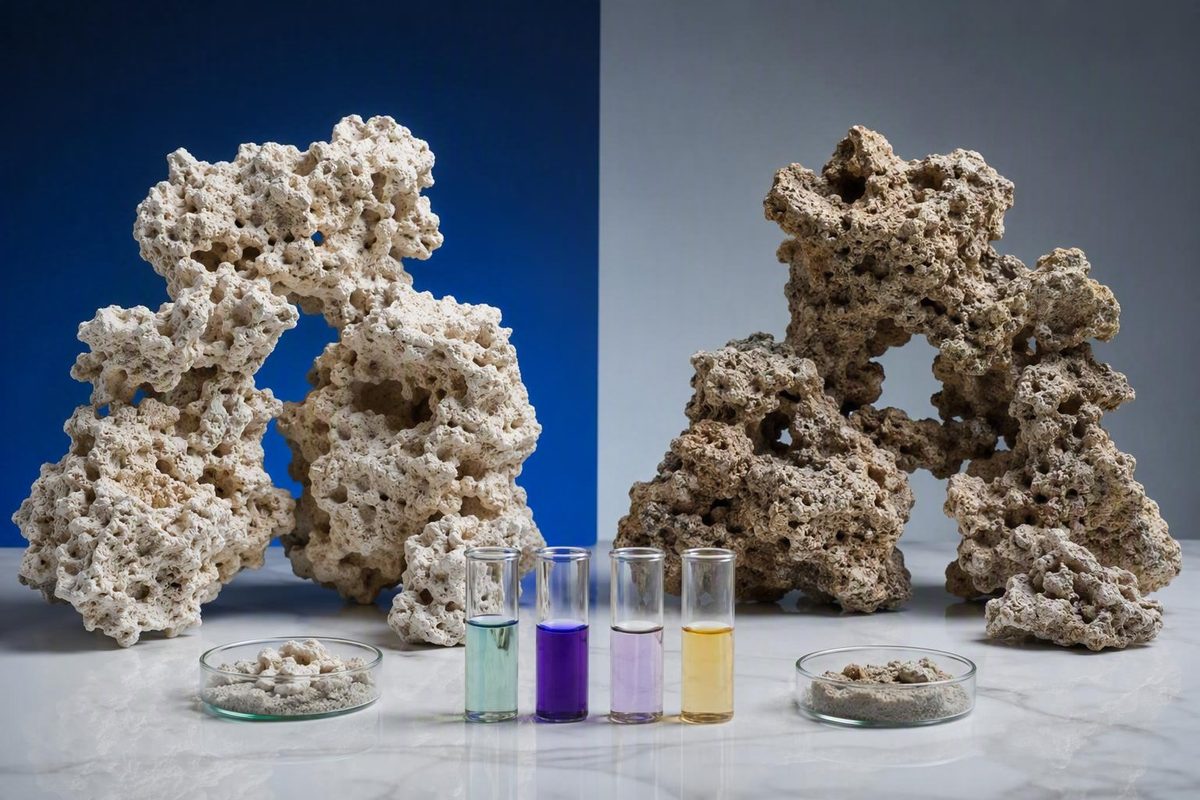
Compare Fiji Pukani and standard Marco dry rock by phosphate risk, aquascaping weight, current cost, and a test-driven curing plan before you buy.
Fiji Pukani is the higher-caution choice for phosphate, but no controlled evidence proves that it always leaches more than standard Marco rock. Pay the Pukani premium when its light, cavity-rich shapes reduce the weight needed for your aquascape and you can test it offline. Choose a named standard Marco product when predictable quarried forms or a simpler starting condition matter more. Neither label guarantees phosphate-free rock.
Fiji Pukani returned to sale in August 2026 for the first time since 2018, with an introductory price of $8.99 per pound. The seller also warns that nutrients retained in its pores may release phosphate after submersion. No comparable phosphate concentration, release rate, or controlled head-to-head result is available for Pukani and a named standard Marco product (Reef Builders’ return announcement).
Price per pound is not a fair comparison by itself. A retailer claims that 10 pounds of Pukani occupies approximately the same apparent volume as 20 pounds of regular Marco rock. That promotional approximation is not an independently verified density measurement, but it means Pukani can cost more per pound while requiring fewer pounds. The supplied evidence does not include a current standard-Marco price or a universal pounds-per-gallon requirement, so those figures must come from your supplier and aquascape plan.
Enter your tank size, planned rock density, and Marco quote; then record the curing checkpoints for your batch.
Pukani–Marco Rock Cost and Curing Calculator
The weight comparison uses the seller’s promotional claim that 10 lb of Pukani occupies approximately the same apparent volume as 20 lb of regular Marco rock. Enter your own dense-rock planning factor and current Marco quote.
Estimated Rock Weight and Cost
Enter tank gallons and your dense-rock pounds-per-gallon plan. Pukani is listed at $8.99/lb; standard Marco pricing is —.
| Rock | Planning Basis | Estimated Weight | Price Per Pound | Rock Cost | Rock Cost Per Gallon |
|---|---|---|---|---|---|
| Fiji Pukani | ~Half the dense-rock weight, based on the seller’s volume claim | — | $8.99 | — | — |
| Standard Marco | Your entered dense-rock plan | — | — | — | — |
Estimates exclude shipping, tax, breakage and unusable pieces. The Pukani conversion is promotional rather than independently verified.
Batch-Test Timeline
Sources: Reef Builders return coverage and current seller descriptions. The $8.99/lb Pukani price and ~10 lb-to-20 lb apparent-volume claim are supplied figures; standard-Marco price and universal curing duration are unknown.
Pukani’s Premium Buys Shape and Volume, Not Proven Cleanliness
“Pukani versus Marco rock” is potentially confusing because MarcoRocks now sells genuine Fiji Pukani. A box labeled MarcoRocks Genuine Fiji Pukani is still Pukani, not the company’s conventional quarried limestone. Retail listings identify it as natural Fiji Pukani sold under the MarcoRocks brand (Genuine Fiji Pukani listing).
In ordinary reef discussions, “standard Marco rock” may refer to Reef Saver, Foundation, Shelf Rock, or another quarried product. Those products have different forms, so the exact SKU matters.
| Factor | Fiji Pukani | Standard Marco Rock |
|---|---|---|
| Identity | Natural Fiji Pukani, including material sold by MarcoRocks | A broad category that must be narrowed to a named product |
| Structure | Lightweight, irregular and cavity-rich | Shape and density depend on the product |
| Apparent volume | Seller claims about twice the volume per pound of regular Marco rock | Promotional comparison suggests about half the apparent volume per pound |
| Workability | Described as comparatively easy to drill, break and shape | Depends on the selected form |
| Dried material | Deep openings may retain visible or hidden debris | Clean quarried pieces may contain less obvious marine debris, but this is not guaranteed |
| Phosphate evidence | Explicit seller warning and inconsistent hobby reports | Inconsistent hobby reports without a controlled comparative dataset |
| Current price in supplied evidence | $8.99/lb introductory price | Not supplied |
Pukani’s useful distinction is structural. Specialist coverage describes it as light and comparatively easy to drill, break or shape. Large cavities can create caves, ledges and fish passages without assembling every opening from several pieces. Individual pieces still vary, and shipping breakage or unusable shapes can reduce that advantage.
The retailer’s two-to-one volume comparison suggests a rough planning conversion: if an aquascape would use 80 pounds of denser rock, a similar apparent volume might require about 40 pounds of Pukani. This is an estimate, not a purchasing guarantee. The calculator applies that claim while leaving the dense-rock pounds-per-gallon factor under your control.
At $8.99 per pound, estimated Pukani rock cost is its calculated weight multiplied by $8.99. Shipping, tax, breakage and the proportion of useful pieces remain unknown. A standard-Marco cost comparison cannot be completed honestly until a current price for the exact product is entered.
The Phosphate Warning Is Real but Not Quantified
MarcoRocks states that nutrients bound within Pukani’s pores may release “slight” amounts of phosphate during its first few months underwater. It mentions GFO and lanthanum chloride as management options but supplies no validated dose or livestock-safety protocol (MarcoRocks’ Pukani warning).
“First few months” is not a guaranteed curing duration. The product information provides no phosphate concentration, release rate, affected-batch percentage, test method, water volume or comparison with standard Marco rock. There is therefore no evidence-based number of curing weeks or universal display-ready threshold.
Dried biological material in Pukani’s cavities is one plausible source of initial nutrient release. It may soften or decompose after submersion. Porosity itself does not create phosphate, however, and pores may be empty, clean or filled with debris. Condition can differ among pieces in one shipment.
Hobby reports are mixed for both materials. Pukani users have described discolored curing water, debris, algae, prolonged treatment and phosphate rebound after removal media was withdrawn. Other Pukani systems reportedly maintained low water-column phosphate. Standard Marco rock has also been suspected in nutrient problems, while other keepers report low readings or no issue attributable to it.
These observations cannot establish a winner. Feeding, sand, source water, lighting, previous aquarium exposure, biological uptake and test uncertainty commonly confound them. One discussion involving old Pukani lacked a rock-free control and concerned material that had reportedly spent more than a decade in a store sump, making it a poor predictor of new retail rock (phosphate and aquarium-rock discussion).
| Evidence | Supported Conclusion | Unsupported Conclusion |
|---|---|---|
| Pukani seller warning | Initial phosphate release is a recognized possibility | Every batch will release a particular amount |
| Pukani hobby reports | Some pieces have coincided with difficult curing or phosphate concerns | All Pukani behaves identically |
| Marco hobby reports | New, cured or reused rock has sometimes been suspected | Standard Marco rock is always a source or always clean |
| Controlled comparison | None was supplied | A universal phosphate ranking |
The defensible conclusion is narrow: Pukani carries the clearer documented warning, while the magnitude and consistency of any difference remain unknown.
Rock Condition Can Matter More Than the Brand
Clean new rock with documented storage presents less uncertainty than old rock with an unknown aquarium and treatment history. This applies to Pukani and Marco products alike.
| Condition | Practical Risk Assessment |
|---|---|
| Clean, unused dry rock | Lowest uncertainty, though inspection and testing are still warranted |
| New rock with dried debris | Requires physical cleaning and offline observation |
| Used rock with a documented low-nutrient history | Previous exposure matters, but the history helps interpretation |
| Used rock with unknown exposure or treatment | Highest uncertainty regardless of brand |
Unknown-history rock may have spent years in nutrient-rich water, stagnant storage or repeated wet-and-dry cycles. It may also have received acid, bleach, lanthanum chloride or another undocumented treatment. That history is more informative than the product name alone.
For an established low-nutrient reef, tested Pukani can be a safer decision than unknown used Marco rock. Clean new Marco rock can likewise be less uncertain than visibly debris-filled Pukani. Rejecting material is reasonable when contamination or chemical history cannot be established.
A Control Container Makes Batch Testing More Useful
Test uncertain rock outside the display with known water, clean circulation equipment and no livestock. Record the exact product, dry mass, water volume, temperature, cleaning performed and previous use.
Start by testing the water before adding rock. Place the rock in a separate container and, when practical, run a rock-free control with the same water and comparable equipment. If phosphate rises in every container, investigate the water, salt, vessel or equipment. A repeatable rise confined to the rock container makes that batch a more plausible contributor.
When comparing Pukani with denser Marco rock, equal weight is misleading because Pukani is sold on its greater apparent volume per pound. Equal practical displaced volume is a better hobby comparison, although trapped air and accessible cavities make displacement imperfect. Soak and rotate both materials consistently and document the procedure.
Use the same phosphate test and sampling method each time. The evidence supplies no universal sampling interval, curing duration or acceptable endpoint. What matters is the pattern:
- Measure the source water before adding rock.
- Inspect and remove loose debris from the rock.
- Take repeated readings from the rock container and control.
- Replace some or all of the curing water and test for a renewed rise.
- If removal media is used, record when it is added and test again after withdrawal.
- Keep the rock offline while a repeated increase or rebound remains unexplained.
A zero reading does not prove that the rock is finished releasing phosphate. Algae, microbes, GFO or chemical precipitation may remove phosphate from the water column while input continues. Physical cleanliness, repeated measurements and behavior after water replacement or media withdrawal provide a stronger readiness case than one test.
Record visible debris, odor, cloudiness and discoloration alongside phosphate measurements. Those observations do not replace testing, but they help distinguish ongoing decomposition from a clean, stable soak.
Use GFO Only as Part of a Measured Offline Process
Begin with physical cleaning, rinsing and an offline soak. Water replacement exports phosphate and decomposition products already in the water, but it does not prevent further release. GFO removes phosphate from the water column, so a low result while GFO is installed may conceal a continuing source.
If phosphate repeatedly rises relative to the control, GFO is an available offline management option mentioned by the seller. Record its use and check for rebound after removal. The supplied evidence does not establish a universal quantity, schedule or endpoint.
Lanthanum chloride is also mentioned by the seller, but no validated dosing, filtration or livestock-safety procedure is supplied. It produces precipitated material that must be managed. Do not transfer an improvised forum dose into an occupied aquarium.
Bleach and acid address different problems and are not routine remedies for every batch. They introduce handling hazards and can alter the material. Never mix bleach with acid or ammonia-containing substances. Rejecting questionable rock is safer than attempting undocumented chemical treatment beyond your experience.
Curing the rock and completing the nitrogen cycle are separate questions. A rock batch can support nitrification while still showing an undesirable phosphate trend.
Who Should Pay the Pukani Premium
Pukani is worth considering when open contours, large cavities and lower aquascaping weight are central to the design. Its $8.99-per-pound price should be judged against estimated usable volume rather than against a dense product pound for pound. Buyers also need space and time for inspection, cleaning and offline testing.
A named standard Marco product is the better fit when its particular shelf, base or quarried form suits the structure, or when clean new material is preferred over cavity-rich rock with possible dried debris. Its actual cost advantage cannot be calculated from the supplied evidence because no current standard-Marco price is provided.
For a new aquarium, either material can be prepared before animals are exposed. For an established reef, choose the batch with the clearest identity, cleanest condition, best-documented history and most stable offline trend. Introduce substantial additions in stages rather than relying on the label.
The buying verdict remains conditional: pay for Pukani when its apparent volume and natural shapes justify the preparation burden. Do not pay the premium because it is presumed biologically superior, and do not choose standard Marco rock because it is presumed phosphate-free.