
Choose a Reef Tank UV Sterilizer by Its Job, Not Just Watts
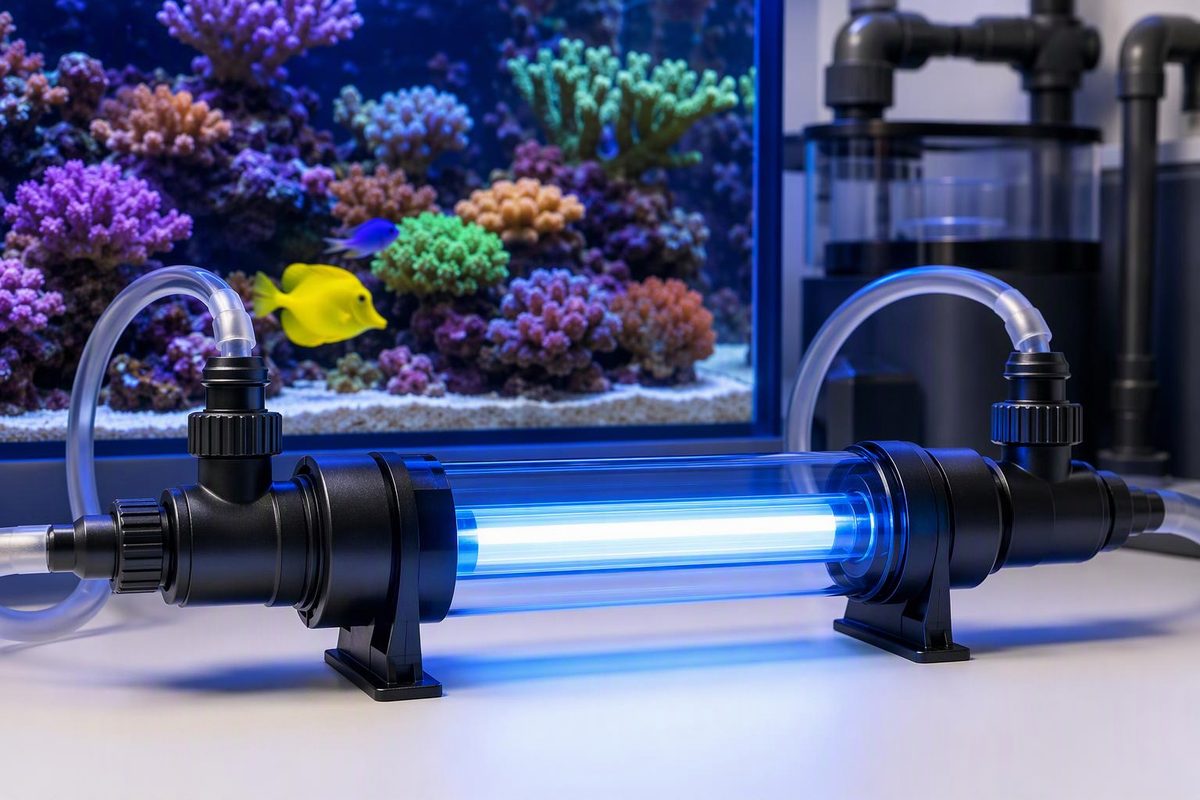
Decide whether your reef needs UV, match flow to the treatment goal, and plan safe installation and maintenance without expecting an ich cure.
A saltwater aquarium UV sterilizer is an optional tool for treating organisms suspended in water, not a requirement for a successful reef. It can help with green water and reduce some waterborne microorganisms when the exposure is appropriate. It does not sterilize the entire aquarium or replace quarantine, biological filtration and stable water chemistry.
Before buying one, name the job: clearing suspended algae, managing a confirmed water-column nuisance, or adding a layer of pathogen reduction. Those goals may require different flow rates through the same unit.
What UV can—and cannot—do
Water passes through an enclosed chamber around a UV-C lamp, usually protected by a quartz sleeve. UV damages microorganisms’ genetic material. Effectiveness depends on the organism, light intensity, exposure time and water clarity—not simply whether the bulb is on. UF/IFAS explains these dose requirements.
| Your problem | Where UV fits |
|---|---|
| Green water from suspended algae | A reasonable application, provided the unit and flow are matched to it. |
| Suspected bacterial cloudiness | Potentially useful if suspended bacteria are the cause; particles or chemical precipitation are a different problem. |
| Hair algae or mats attached to rock and sand | UV does not directly expose attached growth. Address the organism and tank conditions instead. |
| Dinoflagellates | Consider UV only if the identified organism enters the water column and can reach the chamber. Do not assume every brown film will respond. |
| Marine ich | An adjunct at most—not an eradication method or a substitute for treatment. |
The key limitation is physical: an organism must pass through the chamber to receive UV exposure. That is why treating water is different from treating surfaces or fish. See the dinoflagellate troubleshooting guide before buying equipment for an unidentified brown coating.
UV also exposes desirable suspended microorganisms that enter the unit; it cannot distinguish “good” from “bad.” Bacteria established in biological-filter media are not directly irradiated by an enclosed inline unit. Keep the biofilter and cycling process separate from the UV decision.
Do not wait for UV to treat sick fish
Marine ich has stages embedded in fish tissue and encysted on aquarium surfaces. Those stages are outside the UV chamber. UF/IFAS specifically notes that unexposed free-swimming stages and encysted stages remain unaffected, and that proposed UV doses for Cryptocaryon irritans are anecdotal or extrapolated. A generic “parasite” flow setting is not proof of eradication. Read the marine-ich guidance.
If fish are breathing rapidly, scratching or developing spots, check water quality promptly and seek diagnosis and a suitable treatment plan rather than waiting for a sterilizer to work.
Size the unit around exposure and actual flow
There is no dependable universal watts-per-gallon rule. Use this sequence:
- Estimate operating water volume. Include water in the display and sump, allowing for rock, sand and the sump’s actual running level.
- Specify the target. Ask for a flow recommendation for that purpose, not just the largest aquarium printed on the box.
- Read the exact model’s flow-versus-dose chart. A maximum hydraulic flow rating is not necessarily the flow that delivers your required exposure.
- Check the chart’s assumptions. Water clarity and lamp age matter. Prefer ratings that account for end-of-useful-life output rather than only a new bulb.
- Match and measure the installed flow. The pump’s advertised maximum is not the flow through the UV after tubing, valves and elevation are added.
For example, Aqua Ultraviolet’s published saltwater chart lists its Classic 25-watt unit at 1,200 gallons per hour in its lowest-exposure column and 400 gallons per hour in its highest-exposure column. That illustrates why “25 watts” alone cannot tell you how to operate it. These are manufacturer ratings—not a reef flow prescription or evidence that either setting cures marine ich. Confirm the current recommendation for your exact model and purpose. Manufacturer sizing chart.
Slower flow increases exposure time, but also processes less water per hour. Do not keep slowing an undersized unit indefinitely: stay within the manufacturer’s operating limits and check that it can provide both the target exposure and the recommended throughput for your system.
A flow meter on the UV branch makes adjustment much easier. Treat calculated turnover as a plumbing estimate, not a guarantee that every organism reaches the lamp.
Install it so maintenance is possible
For a typical sump-equipped reef, a dedicated pump or controlled branch from the return plumbing lets you set UV flow independently. Do not reduce the whole aquarium’s return flow merely to meet a UV setting.
Feed mechanically filtered water to the chamber where practical: suspended solids reduce UV transmission. Leave room to withdraw the lamp and quartz sleeve, and use suitable unions and isolation valves for servicing. Follow the model’s permitted mounting orientation and pressure limits. Pentair’s installation guide covers mechanical prefiltration, bypass plumbing and flow measurement.
Before powering the lamp:
- Complete the manufacturer’s leak test and establish water flow.
- Use a properly grounded, GFCI-protected supply.
- Confirm how the lamp will be switched off if its pump stops.
- Never operate an exposed lamp or look directly at UV-C light.
Pentair warns against no-flow operation and direct exposure to the lamp, which can damage eyes and skin. Follow your own unit’s safety instructions rather than assuming all housings operate alike.
Maintain output—not just a glowing bulb
A dirty sleeve blocks light, and lamp output declines with use. Set reminders for the exact model’s sleeve inspection and lamp replacement intervals. As one model-specific example, Pentair recommends inspecting its SMART UV sleeve every three months, with cleaning frequency adjusted to the water’s solids load. Unplug the sterilizer before servicing, and follow its instructions for stopping flow, isolating and opening the unit. Maintenance and safety instructions.
Add UV checks to your saltwater aquarium maintenance schedule: leaks, measured flow, sleeve condition, lamp age and tank temperature. Follow medication and live-culture product instructions about whether UV must be switched off during use.
If results are poor, check the diagnosis, plumbing flow, sleeve cleanliness and lamp age before changing other tank settings. Clearer water is a useful outcome; it is not proof that fish are disease-free or that the underlying reef problem is resolved.