
Your Tank Is Ready When the Biofilter Passes the Test
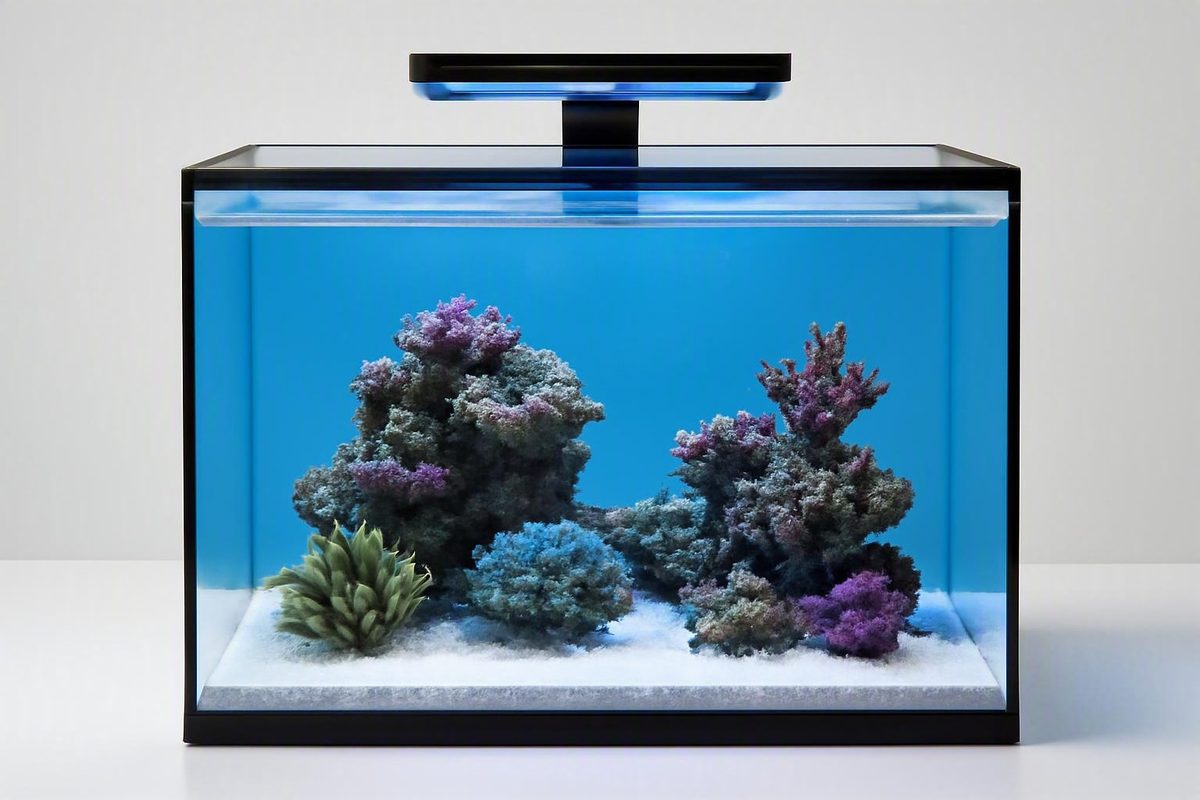
Plan on 4-6 weeks from scratch, with 2-8 weeks or longer possible. Before adding the first fish, tests must show undetectable ammonia and nitrite.
The short answer: plan for weeks, not a fixed date
A new aquarium started from scratch commonly takes about four to six weeks to cycle, based on published saltwater guidance and common hobbyist experience. A broader planning range of approximately two to eight weeks—or longer is realistic; FishLore, for example, describes a possible span from two weeks to two months or beyond in its aquarium nitrogen-cycle guide.
No number of elapsed days proves that a tank is ready. Completion is determined by testing ammonia, nitrite, and nitrate—not by reaching a date on the calendar.
| Starting method | Cautious planning range | How to interpret it |
|---|---|---|
| Unseeded tank started from scratch | Commonly about 4–6 weeks; 2–8 weeks or longer is possible | A planning range, not a stocking date. Test results decide when the cycle has finished. |
| Tank using healthy mature biological media | Potentially much faster than an unseeded cycle | Transferred media may shorten the process substantially, but its capacity remains unknown until tested. |
| Tank using bottled bacteria | Variable; rapid results are possible but not assured | Product timelines and fast-cycle reports are conditional. Treat the product as a possible seed, not proof of completion. |
| New saltwater or reef tank | Published general estimate: 4–6 weeks; Reef Directory recommendation: 6–8 weeks without shortcuts | Live rock, live sand, mature media, or bottled bacteria may shorten the process, but livestock should still wait for passing test results. |
For saltwater systems, a commercial-brand beginner guide gives four to six weeks as a general estimate and requires repeated safe readings before fish are added under its saltwater cycling procedure. Reef Directory takes a more conservative editorial position: allow six to eight weeks without shortcuts for a new reef tank. The site describes three to four weeks with bacterial seeding as a best-case estimate, not an independently proven result or an automatic stocking date on the Reef Directory homepage.
Reports of tanks cycling in a few days or around two weeks are not necessarily impossible. Those conditions make a quick result possible; they do not prove that every similarly treated aquarium will perform the same way.
Typical timeline: 4–6 weeks. Possible range: 2–8 weeks or longer. Actual finish line: water-test results.
The better question is not simply, “How long does it take to cycle a fish tank?” It is, “Can this biofilter process the intended ammonia input without leaving detectable ammonia or nitrite?” The calendar helps you plan. The tests tell you whether the aquarium is ready.
What cycling actually builds inside the aquarium
Cycling establishes the aquarium’s biological filter: a population of microorganisms that processes nitrogen compounds produced by waste and decaying organic material.
At beginner level, the sequence is straightforward:
- An ammonia source enters the system.
- The first stage of the biofilter converts ammonia to nitrite.
- The next stage converts nitrite to nitrate.
- Nitrate is then reviewed and managed according to the aquarium’s needs.
During a typical cycle, ammonia rises and later falls. Nitrite then becomes apparent and eventually falls. Nitrate appears as the process advances. These are trends, not a fixed daily timetable. One tank may show an obvious ammonia peak, while another may process ammonia quickly enough that the peak is easy to miss between tests.
Ammonia and nitrite can harm fish, which is why an empty aquarium should normally be cycled before livestock is introduced. Fish-in cycling exposes animals to these compounds while the biofilter is still developing; fishless cycling supplies ammonia without using livestock as the source. Commercial and hobbyist guides therefore commonly recommend fishless cycling as the safer default when the tank is empty as summarized in this fishless-cycling guide.
The useful organisms are not concentrated primarily in the water column. They colonize wet surfaces with suitable flow, including:
- Biological filter sponges, ceramic media, cartridges, and other filter material
- Substrate
- Rock and reef structures
- Aquarium décor
- Plumbing and other continuously wet surfaces
This is why a piece of established filter media can contribute more than a bucket of old aquarium water. The water may carry some microbial material, but established surfaces hold much more of the functioning biofilter.
An initially cycled aquarium is not an aquarium capable of supporting unlimited livestock. A fishless processing test demonstrates that the current biofilter can handle a particular ammonia input. If the tank then receives its full intended fish population at once, the resulting waste may exceed that tested capacity.
Think of the initial cycle as qualifying the aquarium for a small starting bioload. Biological capacity can respond as livestock is added, but additions must be gradual. “Cycled” also does not mean “mature.” Broader stability develops over time as stocking, feeding, maintenance, and the aquarium’s biological community settle into a repeatable pattern.
Use a fishless cycle when the tank is empty
If no fish are present, use a fishless cycle. This avoids deliberately exposing livestock to ammonia and nitrite while the initial biofilter develops.
A practical fishless workflow has five parts:
- Set up the aquarium and biological filtration. Install the filter media, substrate, rock, or other biological surfaces intended for the system.
- Fill and operate the system appropriately. Follow the requirements for the particular freshwater or marine setup rather than applying reef-specific instructions to freshwater, or vice versa.
- Introduce one ammonia source.
- Test ammonia, nitrite, and nitrate as the system runs.
- Verify ammonia-processing capacity before adding fish.
Possible ammonia sources include:
- Measured additive-free aquarium ammonia or ammonium chloride
- A small amount of fish food allowed to decompose
- Decaying raw shrimp in methods specifically designed around that approach
No one source is universally best. Measured aquarium ammonia or ammonium chloride is generally easier to track because the input is controlled directly. Food and shrimp must decompose before releasing ammonia, so their contribution is slower and less precise. They can work, but it is harder to know how much ammonia the biofilter is being asked to process.
Choose one coherent method rather than combining measured ammonia, repeated ghost feeding, and raw shrimp. In a community discussion of cycle completion, hobbyists specifically caution that excessive ghost feeding can create a very high spike; that advice is practical forum experience rather than controlled research in the Reef2Reef discussion.
Fishless protocols do not agree on one ammonia target. One published marine hobbyist method uses a 1 ppm final challenge, while other hobbyist protocols use approximately 2–3 ppm. These are method-specific procedures, not one scientifically universal dose. Follow the dosing and completion criteria of a single method, and do not raise the concentration merely because another guide uses a larger number.
Keep a simple log:
| Date | Ammonia | Nitrite | Nitrate | Action or observation |
|---|---|---|---|---|
| Day started | Ammonia source added | |||
| Test 2 | ||||
| Test 3 | ||||
| Test 4 |
The log matters because cycling is a trend. Recorded readings show whether ammonia is declining, nitrite is appearing or clearing, and nitrate is accumulating or being removed.
Testing every two to three days is a practical fishless routine used in some detailed hobby protocols. Daily testing provides a clearer record and is the more cautious choice when readings are changing quickly or during a final capacity check as described in this betta-care cycling protocol. Consistency is more useful than trying to make the aquarium match somebody else’s day-by-day chart.
If fish are already present, this is no longer an ordinary fishless cycle. Ammonia and nitrite require daily attention because waiting for the usual fishless timeline is not a safety plan. This article does not provide a complete emergency fish-in procedure; an occupied aquarium with detectable ammonia or nitrite needs prompt, setup-specific water-quality management rather than the addition of more livestock.
How to prove the cycle is complete
The basic completion criteria are:
- No detectable ammonia
- No detectable nitrite
- Nitrate present or otherwise explained by the way the system has been managed
- Results confirmed through testing rather than inferred from tank age
“Nitrate present” needs context. A nitrate reading shows that some nitrogen conversion has occurred, but it does not prove that the process is complete. If ammonia or nitrite remains measurable, the aquarium has not passed the finish line.
Conversely, absent or low nitrate does not automatically prove failure. A recent water change or biological uptake may reduce nitrate. In that situation, the decisive evidence must come from undetectable ammonia and nitrite plus a demonstrated ability to process a known ammonia input. An unexplained zero-nitrate result, by itself, is not proof that the tank has cycled.
A single zero reading can also be ambiguous. The ammonia source may have been too small, never added, or not yet decomposed. A water change or biological uptake may have changed the readings. Repeated results or a controlled processing check provide stronger evidence than one isolated test.
A common fishless capacity check works like this:
- Add the measured ammonia dose specified by the protocol you have followed.
- Record the ammonia concentration and time.
- Test again about 24 hours later.
- Confirm that ammonia and nitrite are again undetectable.
Published hobbyist methods differ. One marine method defines its initial stage as processing a 1 ppm ammonia challenge within 24 hours, with ammonia and nitrite returning to zero. Other fishless protocols use approximately 2–3 ppm. Neither dose is a universal scientific standard; each belongs to a particular hobbyist procedure as illustrated by this marine cycling method.
If you do not perform a controlled challenge, confirm safe readings over several days. Do not declare completion merely because nitrate appeared or ammonia reached zero once. The tank should show a consistent ability to avoid leaving detectable ammonia or nitrite.
Published nitrate criteria vary substantially. Depending on the commercial or hobbyist guide, completion may be described as nitrate being detectable, between 5 and 20 ppm, below 20 ppm, or no higher than 25 ppm. That disagreement is a reason not to turn any one nitrate concentration into a universal finish line. Use nitrate as a value to review and manage while keeping ammonia and nitrite central to the readiness decision.
If nitrate accumulated during the cycle, an appropriate partial water change can be performed after completion is confirmed and before livestock is introduced. The amount should depend on the measured result and the needs of the intended aquarium, not on one universal percentage.
Final readiness checklist
Before adding the first fish, confirm all of the following:
- [ ] Ammonia is undetectable.
- [ ] Nitrite is undetectable.
- [ ] Nitrate has been reviewed and managed as appropriate for the system.
- [ ] Results were confirmed through repeated testing or a defined ammonia-processing check.
- [ ] Readiness was not inferred from tank age, water clarity, or a product label.
- [ ] The first livestock addition will create only a small bioload.
Cloudy water or a visible bacterial bloom is not a substitute for chemical testing. Appearance cannot show whether the biofilter can process the next ammonia input.
What can shorten the cycle—and what cannot prove it
Based on the supplied aquarium guidance—not on controlled comparative trials—a cautious practical order is:
- Healthy mature biological media
- Established live rock or live sand in suitable marine systems
- Bottled bacteria
- Old aquarium water
It does not establish a guaranteed speed for any method.
Mature biological media
An established filter sponge, cartridge, ceramic medium, or comparable biological material can transfer a functioning microbial population directly into the new system. It is generally more useful than moving old water because much of the biofilter population lives on wet surfaces.
Seeded media can shorten the process substantially, sometimes producing rapid ammonia processing. But “seeded” and “cycled” are not interchangeable. The transferred colony may have supported only a lightly stocked donor aquarium, or the aquarist may have moved only a fraction of that aquarium’s filtration. It may not have enough capacity for the receiving tank’s intended livestock.
After adding mature media, provide the ammonia source required by the selected fishless method and perform the same verification used for an unseeded tank. If ammonia or nitrite remains detectable after the method’s processing period, the new system has not demonstrated adequate capacity.
The donor aquarium matters. Use material only from a system known to be healthy and suitable for the receiving aquarium. A specifically documented concern is copper medication residue, which can be transferred with established material and may be unsafe for invertebrates according to FishLore’s seeded-cycling caution. That concern is especially relevant when the receiving tank will house shrimp, snails, corals, or other invertebrates.
There is no universal screening procedure supported here. The practical conclusion is narrower: unknown or unhealthy donor systems are poor sources of biological media, regardless of how quickly the material might accelerate cycling.
Live rock and live sand
In marine aquariums, established live rock and live sand may provide colonized surfaces and shorten startup. Their effect depends on their condition, existing biological capacity, handling, and what happens during transfer.
A favorable live-rock setup may process ammonia rapidly, and some hobbyist methods report completion within days. That is a possible best case, not an expected result for every marine aquarium. Rock that experiences die-off can add organic material and follow a longer path. Test the receiving tank rather than assuming the word “live” guarantees immediate readiness.
Bottled bacteria
Bottled bacteria may help establish a biofilter, but outcomes vary. Some commercial protocols claim completion in roughly one or two weeks under favorable conditions, while hobbyists report mixed results.
Treat bottled bacteria as a possible seed, not a certificate. Continue testing after the date printed in the instructions. If ammonia or nitrite remains measurable, the aquarium is not ready regardless of the advertised timeline.
Old aquarium water
Old water is not equivalent to mature filter media, rock, substrate, or décor. It may transfer dissolved material and some suspended organisms, but it does not carry the same concentration of surface-attached biofilter organisms as established media.
Moving old water may serve other setup purposes in particular circumstances, but it should not be presented as a substitute for colonized biological surfaces. If the choice is between donor water and suitable healthy filter media, the media is the more meaningful biological seed.
The rule is the same for every acceleration method: any speed claim must be confirmed with ammonia and nitrite tests.
Freshwater and saltwater follow the same cycle, but not the same setup
Freshwater and marine aquariums share the same basic nitrogen-processing sequence:
Ammonia → nitrite → nitrate
The universal instructions are therefore limited but important:
- Provide an ammonia source.
- Establish microorganisms on biological surfaces.
- Test ammonia, nitrite, and nitrate.
- Do not begin routine stocking while ammonia or nitrite remains detectable.
- Verify processing capacity before adding the first bioload.
- Add livestock gradually.
The surrounding setup differs. Marine aquariums may use live rock, live sand, dry rock, sumps, and other reef-specific equipment. Freshwater tanks may rely more heavily on filter sponges, ceramic media, gravel, planted substrates, or other freshwater arrangements. Marine salinity instructions do not apply to freshwater tanks, and freshwater practices should not be copied uncritically into reef systems.
A new saltwater aquarium is commonly described as taking four to six weeks to cycle. Reef Directory’s more conservative editorial recommendation is six to eight weeks for a new reef tank without shortcuts. In a favorable seeded reef setup, the site describes three to four weeks as a best case rather than an expected result.
Live rock or mature marine media can sometimes create a much shorter cycle because a biological community is already present. Even then, the aquarium must demonstrate that it can process ammonia without leaving detectable ammonia or nitrite. A few days of operation does not prove that the rock or media can support the intended livestock load.
Published cycling methods conflict over the use of lights, protein skimmers, UV sterilizers, water changes, and particular filtration equipment. There is not one defensible rule here that every such device must always be on or always be off for every freshwater and marine cycle. Follow one coherent method appropriate to the installed system while preserving the universal essentials: biological surfaces, an ammonia source, circulation through the intended biofilter, and chemical testing.
This parameters-first approach is especially useful in reef keeping, where a clean aquascape can look finished long before its biological filtration has been demonstrated. It also reflects Reef Directory’s stated editorial emphasis on biology, water parameters, and husbandry decisions rather than product-led recommendations described on its About page.
When the cycle takes longer than expected
Passing four or six weeks without reaching undetectable ammonia and nitrite does not prove that the cycle has failed. Some aquariums take two months or longer. The readings—not disappointment with the calendar—should determine the next step.
| What the test shows | What it means |
|---|---|
| Ammonia is still present | Ammonia processing is not yet complete at the current input. |
| Ammonia is falling, but nitrite remains | The first conversion stage is active, but the next stage has not yet cleared the available nitrite. |
| Nitrate is present with ammonia or nitrite | Part of the cycle is operating, but the tank has not passed the completion criteria. |
| Ammonia, nitrite, and nitrate never change | Verify that an ammonia source was actually introduced, then repeat the tests carefully. |
| Nitrate is low or absent while ammonia and nitrite are zero | Nitrate alone cannot settle the question; review water changes or biological uptake and confirm ammonia-processing capacity. |
| Ghost feeding produced a very high ammonia reading | Excess decomposing food may have created a larger input than intended. Stop combining sources and continue with one coherent method. |
If readings never change, begin with the supported basics. Verify that an ammonia source actually entered the aquarium and repeat the tests carefully according to their instructions. Fish food or shrimp may take time to decompose, whereas a measured source should create a more immediate, trackable input.
Do not assume that the aquarium “cycled invisibly” merely because several weeks passed. Equally, do not reset the entire process solely because the tank missed an expected date. Continue interpreting the readings you have.
Low nitrate does not automatically mean failure because water changes or biological uptake can affect it. Conversely, high nitrate does not prove success if ammonia or nitrite remains measurable. Nitrate is contextual; persistent ammonia or nitrite is a clear reason not to begin routine stocking.
Avoid three common reactions to a slow cycle:
- Do not add fish as a test.
- Do not buy another bacterial product solely because an expected week arrived.
- Do not declare completion from nitrate alone.
Conditions such as pH, chlorine exposure, oxygen, temperature, salinity, and the ammonia input can matter in particular systems, but this article does not provide enough evidence to diagnose one of them as the cause of a slow cycle. Setup-specific troubleshooting requires reliable measurements and knowledge of the aquarium.
The firm decision rule remains simple: persistent measurable ammonia or nitrite means the tank is not ready for routine stocking, regardless of its age or a bacterial product’s instructions.
What to do after the tank passes
Completing the initial cycle establishes starting biological capacity. It does not make the aquarium ready for its entire planned livestock population.
If nitrate accumulated during fishless cycling, perform an appropriate partial water change before stocking. The amount depends on the measured nitrate concentration, source water, and needs of the intended freshwater or marine aquarium; no single percentage applies to every system.
Then add only a small initial bioload. Some saltwater guidance uses one or two appropriately selected fish as an example and recommends waiting at least two weeks before the next addition to allow the aquarium to respond. These figures are not universal stocking rules. Fish size, species needs, social requirements, feeding, aquarium volume, and the capacity demonstrated during cycling matter more than fish count alone.
Continue testing after livestock arrives. Daily ammonia and nitrite checks for at least the first week are a cautious approach used by some detailed hobby protocols in post-stocking monitoring guidance. Feeding and animal waste may reveal that the real bioload exceeds what the fishless test represented.
If ammonia or nitrite becomes detectable:
- Pause further stocking.
- Continue close testing.
- Address the occupied aquarium’s immediate water-quality needs.
- Do not rely on the tank’s earlier passing result as proof that it can handle the current load.
Wait before the next addition. Approximately two weeks is a common example for early saltwater additions, but readings and species requirements override the calendar. If ammonia or nitrite has appeared—or the aquarium has not stabilized after the last addition—wait longer.
“Cycled” means the aquarium demonstrated initial nitrogen-processing capacity. “Mature” implies broader biological and operational stability that develops over time. Passing the cycle does not guarantee that heavy feeding, rapid stocking, poor maintenance, or later equipment changes cannot overwhelm the system.
Post-cycle checklist
- [ ] Manage accumulated nitrate if needed.
- [ ] Add only a small first bioload.
- [ ] Test ammonia and nitrite after stocking.
- [ ] Pause further additions if either becomes detectable.
- [ ] Allow the aquarium to stabilize between additions.
- [ ] Increase livestock gradually.
For help planning the broader order of equipment, cycling, and livestock introduction, browse the Reef Directory article index.
Frequently asked questions
Can a fish tank cycle in one or two weeks?
Yes, it is possible under favorable conditions, particularly when an aquarium receives healthy mature biological media, established live rock, or a viable bacterial seed. Commercial and hobbyist protocols report results in that range, but the reports are conditional rather than guarantees.
It is not the normal promise for an unseeded tank, and the date proves nothing by itself. A rapidly cycled tank must meet the same test criteria as one that takes much longer: no detectable ammonia, no detectable nitrite, and nitrate reviewed in context. A measured ammonia-processing check provides stronger evidence than the calendar.
Is my tank cycled if nitrate is present?
Not necessarily. Nitrate indicates that some nitrogen conversion has occurred, but ammonia or nitrite may still remain. If either is detectable, the aquarium has not met the basic completion criteria.
Use all three tests together. If nitrate is unexpectedly absent, confirm readiness through repeated safe readings or a controlled ammonia-processing check rather than treating nitrate alone as decisive.
Does established filter media instantly cycle a new tank?
It can shorten cycling substantially, but it does not automatically provide enough capacity for the intended fish population. The transferred biological population reflects conditions in the donor aquarium, not the future stocking plan of the receiving tank.
Supply the ammonia source required by the chosen method and verify that the seeded aquarium can process it without leaving detectable ammonia or nitrite. Use media only from a known, suitable donor system, particularly when medication residue could endanger invertebrates.
How often should I test the water while cycling?
For a fishless cycle, every two to three days is a practical routine used in some hobbyist protocols. Daily testing gives a clearer trend and is particularly useful when readings are changing quickly or during a final processing check.
If fish are already present, ammonia and nitrite require daily attention. After the first livestock is added to a successfully cycled aquarium, daily checks for at least the first week are a cautious monitoring approach rather than a universal requirement.
How soon can I add more fish after the first fish?
Wait long enough to confirm that the biofilter has responded to the first addition. Some saltwater guidance uses about two weeks as an early stocking interval, but stable ammonia and nitrite results, species requirements, fish size, feeding, and aquarium capacity take priority.
If ammonia or nitrite becomes detectable, pause stocking until the immediate problem has been addressed and the system again shows stable readings. Add livestock in small steps rather than treating one completed cycle as permission for immediate full stocking.
Replace the calendar question with a capacity question. Plan on roughly four to six weeks from scratch, allow two to eight weeks or longer, and never add fish merely because the expected date has arrived. The tank is ready for a small first bioload only when testing shows that its biofilter can process ammonia without leaving detectable ammonia or nitrite. Manage accumulated nitrate if needed, stock gradually, and keep testing as every new animal increases the load.