
When Bristle Worms Can Explain a Missing Euphyllia Polyp
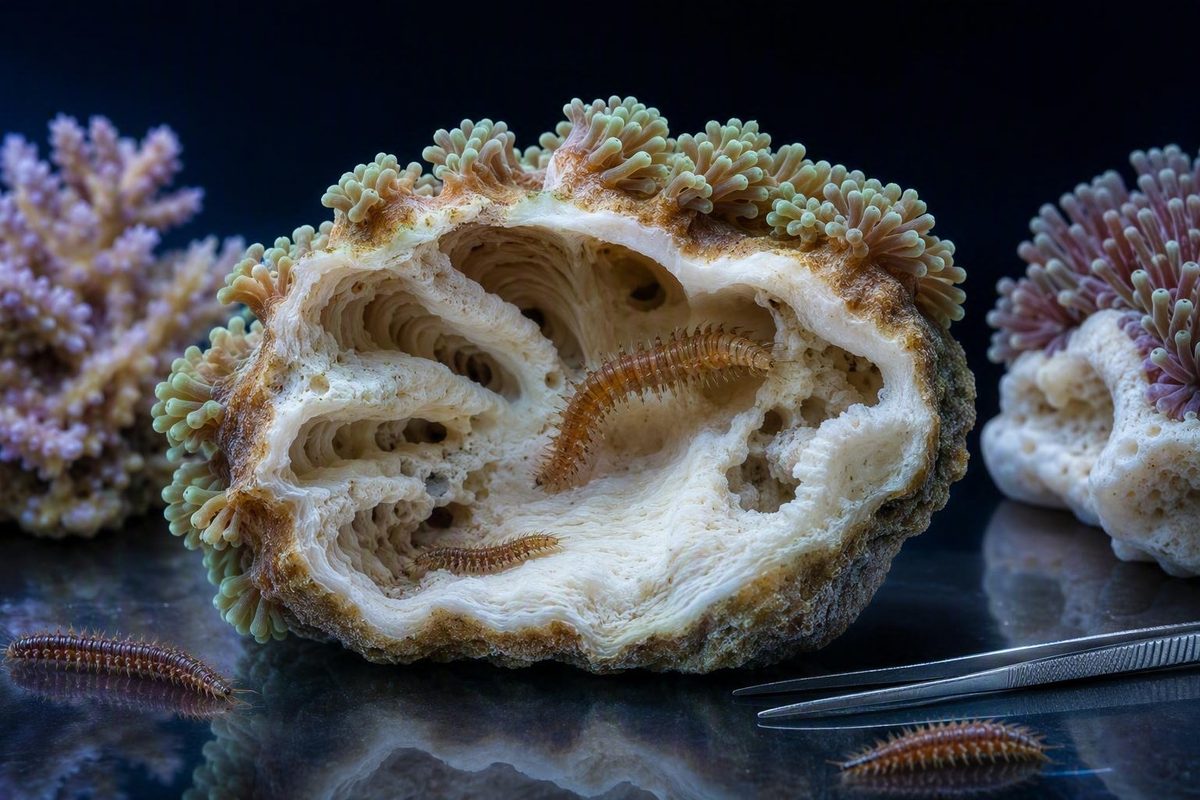
See when worms inside Euphyllia skeletons suggest predation, when alkalinity or infection fits better, and what evidence should guide removal.
Ordinary aquarium bristle worms are not established as a routine cause of polyp bailout. A worm repeatedly emerging from inside an affected Euphyllia or Fimbriaphyllia branch can be a credible suspect, especially when heads vanish one at a time without brown jelly, but proximity alone proves little. Documented alkalinity or salinity instability, rapid gelatinous tissue loss, and direct feeding each support different explanations.
Select what happened before the polyp disappeared; the tool identifies the best-supported cause and next check.
Polyp Loss Cause Checker
Choose the observations that occurred before or during the loss. The result ranks patterns; it does not identify a worm species or diagnose infection.
Most likely pattern: unresolved localized bailout
Confidence: lowA coherent detached polyp fits bailout, but no initiating cause is documented.
Next check: Review the alkalinity, salinity and temperature log, then inspect the branch after lights out.
How Each Evidence Pattern Changes the Verdict
| Evidence Pattern | Best-Supported Interpretation | Next Check | What It Does Not Prove |
|---|---|---|---|
| Brown gelatinous front advancing across attached tissue | Brown-jelly-like tissue loss or another rapid deterioration process | Document spread, protect unaffected tissue and seek coral-health guidance; consider a species-appropriate dip only with informed guidance | Color alone does not identify one pathogen |
| Several heads react after a documented alkalinity or salinity swing | Environmental stress is more likely than one local predator | Verify the measurement and stabilize conditions without abrupt overcorrection | One abnormal reading does not establish the sole cause |
| Intact polyp detaches without visible consumption | Presentation fits true bailout | Review the parameter and equipment timeline | Bailout appearance does not reveal its trigger |
| Worm appears only after recession or death | Post-damage scavenging is more likely | Review earlier photographs and identify what began the recession | The worm's presence does not prove an attack |
| Worm repeatedly emerges from an affected hollow branch | Internal-worm involvement is plausible | Record nighttime video and inspect the exposed cavity without damaging viable tissue | Residence inside the branch does not prove feeding on healthy tissue |
| Video shows repeated feeding on intact tissue before decline | Localized predation has the strongest support | Identify and selectively remove or trap the animal; keep other conditions stable | Predation does not necessarily prove physiological bailout |
| Torn or consumed tissue with no witnessed attacker | Predation or post-detachment scavenging remains possible | Use after-dark video to establish chronology | The final appearance cannot identify which animal acted first |
| Heads disappear sequentially from occupied cavities with stable records | A local skeletal inhabitant becomes more suspicious | Compare affected and healthy cavities and document repeated emergence | The pattern does not identify the worm species |
Sources: Julian Sprung’s Euphyllia/Fimbriaphyllia aquarium observation; Reef Builders’ qualified discussion; peer-reviewed bailout review and controlled hyperosmotic-stress research cited in the article. No prevalence figure for worm-caused bailout is available.
Internal Worms Are Plausible Culprits, Not a General Verdict
The strongest evidence for worm involvement comes from an aquarium observation reported by Julian Sprung on April 8, 2026. Unidentified bristle worms occupied affected hollow coral skeletons, and a worm was observed moving upward through the center of a skeletal branch. Sprung inferred that the worms approached or consumed polyps from below. Read Sprung’s original report.
That location makes the case more concerning than a worm crossing nearby rock after tissue has died. It does not establish that the worms attacked healthy tissue first, identify them to species, or show a complete feeding sequence from intact polyp to empty branch.
Reef Builders amplified the observation on July 23, 2026, but its account is not independent confirmation. It relies on Sprung’s report, uses qualified language, and stresses that animals grouped under “bristle worm” have different diets and behaviors. Its discussion presents internal-worm damage as a possibility rather than a universal rule.
The evidence supports four different levels of confidence:
- Controlled evidence for environmental triggers: Researchers have induced polyp bailout through acute environmental stress.
- Established predation by a specific worm: The bearded fireworm, Hermodice carunculata, is a recognized coral-feeding polychaete.
- Case-specific suspicion: Unidentified worms repeatedly occupying an affected hollow Euphyllia or Fimbriaphyllia skeleton may be involved.
- Weak circumstantial evidence: A worm appearing after tissue recession or death may only be scavenging.
“All bristle worms cause bailout” is unsupported. So is the claim that no bristle worm could damage a coral. The defensible verdict is that some worms can consume coral tissue, while ordinary aquarium bristle worms have not been demonstrated to cause bailout routinely.
True Bailout Leaves a Detached Polyp, Not Just an Empty Branch
Polyp bailout is an acute stress response in which connective tissue breaks down and one or more polyps detach from the calcareous skeleton. Reported signs include tentacle retraction, degradation of connecting tissue and release of an intact or largely intact polyp. A peer-reviewed review distinguishes this short-term response from bleaching, which is generally associated with more chronic stress. The review summarizes bailout physiology and reported triggers.
An empty branch alone does not diagnose bailout. Tissue may instead have receded, decomposed or been consumed.
| Process | Visible Pattern | Most Useful Chronology | Common Diagnostic Error |
|---|---|---|---|
| True polyp bailout | Connecting tissue degrades and a coherent polyp detaches | Retraction and separation follow an acute stress event without visible consumption | Calling every empty skeleton bailout |
| Brown-jelly-like loss | Brown gelatinous material or a rapidly advancing front | Gelatinous deterioration appears before or during rapid loss | Excluding infection because the material is faint or absent |
| Active predation | Bites, tears or missing pieces at an animal’s contact point | The animal contacts intact tissue before damage and repeats the behavior | Blaming an animal first seen after the loss |
| Post-damage scavenging | Animals gather around dead, loose or receding tissue | Coral decline clearly begins before their arrival | Mistaking cleanup for the initial attack |
| Environmental injury or recession | Tissue withdraws along the skeleton rather than detaching coherently | Decline follows instability, handling, altered light, flow or sediment exposure | Selecting one imperfect measurement as the sole cause |
Bailout describes the coral’s response, not its cause. A polyp can begin detaching after chemical stress and then be torn apart or scavenged. That combined sequence may no longer resemble a clean bailout when discovered.
A localized loss is not proof of a pest either. One head can fail because of injury, sediment, uneven flow, a condition inside its cavity or differences in its prior health. Conversely, a tank-wide or colony-wide reaction soon after a parameter change makes a purely local predator less convincing.
The Skeleton Observation Raises Suspicion but Leaves Key Gaps
Sprung’s report described multiple unidentified worms inside an affected hollow skeleton after it was opened. A worm also moved upward through the center of a branch. The proposed route—through the skeleton toward the polyp above—is plausible and directly relevant when a reef keeper sees sequential losses from occupied branches.
The distinction between observation and inference remains essential:
- Worms were observed inside an affected hollow skeleton.
- A worm was observed moving upward through a skeletal branch.
- The author inferred that worms reached or consumed polyps from below.
- No identified worm was documented beginning an attack on intact, healthy tissue.
- The observation did not demonstrate that a worm activated the coral’s physiological bailout response.
- No prevalence or replication data were reported.
The reported case lacked the conspicuous gelatinous front associated there with brown-jelly-like loss. That makes the visible pattern less typical of brown jelly, but absence of a brown mass cannot exclude infection, decomposition or another tissue-loss process.
A comparable home-aquarium case becomes more persuasive when nighttime video shows the same worm repeatedly emerging from the affected cavity and contacting intact tissue before recession. Confidence rises further if damage stops after selective removal while water conditions and other husbandry remain stable.
Even that would support localized predation more directly than biological bailout. A worm can tear or consume a polyp without triggering the organized detachment process that defines bailout.
“Bristle Worm” Does Not Identify a Feeding Behavior
“Bristle worm” is a broad hobby label for polychaetes, encompassing thousands of species with different diets and ecological roles. Bristles do not reveal whether an animal is a detritivore, carrion feeder, opportunistic omnivore or active predator.
Common aquarium forms are generally described as scavengers or detritivores. They consume carrion, trapped organic matter and uneaten food in crevices. That creates a chronology problem: a worm arriving after coral decline fits scavenging, while repeated attacks on intact tissue before decline support predation.
The major reef-keeping exception is the bearded fireworm, Hermodice carunculata, a recognized coral predator. Its behavior should not be assigned to every segmented worm with visible bristles.
Record the suspected worm’s body and bristle coloration, apparent length, head shape, retreat location and behavior. Note whether it emerges from rock, sediment or the coral’s skeleton and whether it contacts healthy tissue or only damaged material. One photograph may help identification, but repeated behavior is usually more informative than a single image.
Do not handle an unidentified worm with bare hands. Bristles can cause localized pain, itching or swelling, and some fireworms have more hazardous bristles. Use gloves and a suitable tool when moving occupied rock or attempting removal. Protective handling guidance is summarized by Reef Builders.
Alkalinity, Salinity and Other Stressors Have Stronger Experimental Support
Environmental stress has stronger experimental support as a bailout trigger than ordinary bristle-worm predation. Researchers induced bailout in Pocillopora acuta using hyperosmotic salinity treatment. Scientific literature also reports induction associated with thermal exposure, acidification and insecticides. The controlled study describes the salinity treatment and recovery observations.
That experiment did not involve Euphyllia, Fimbriaphyllia or worms, so it cannot explain every aquarium event. It does establish that acute environmental disruption can initiate bailout without predation.
Review records for temperature, salinity, alkalinity, pH, nutrients, dosing, water changes, equipment failures, handling, lighting and flow. The useful question is not whether one reading differs from an ideal target. It is whether a measured change occurred before the coral reacted. See the broader relationships among temperature, salinity and chemistry.
A documented swing followed by simultaneous retraction or detachment across several heads points toward environmental stress. Heads disappearing sequentially from separate worm-occupied cavities, while the rest of the colony and parameter log remain stable, raises the relative likelihood of a local animal.
Brown Jelly, Predation and Scavenging Need Different Responses
Brown gelatinous material or a rapidly advancing tissue-loss front deserves coral-health attention even if a worm is also present. Sprung associated brown-jelly-like loss with abundant ciliates and potentially bacteria, but appearance alone is not a universal diagnostic test.
Track the direction and speed of tissue loss. Material advancing across attached tissue differs from a coherent polyp separating at its base. Torn tissue at a repeated contact point differs from a worm eating material that was already loose.
Other pests also belong in the inspection. Some flatworms can seriously damage hammer, torch and frogspawn corals, while others may be less consequential. Their presence does not prove bailout, but concealed animals, egg masses, poor extension and localized feeding marks should not be ignored while attention is fixed on a bristle worm.
These causes can overlap. Instability may weaken a head, tissue may begin receding, and scavengers may then consume it. The correct diagnosis may be that sequence rather than one exclusive culprit.
Reconstruct the Sequence Before Treating the Tank
Write down what appeared first: a parameter change, prolonged retraction, brown material, recession, coherent detachment, a worm entering the branch or visible feeding. Photograph the coral from the same angle and record after-lights-out video before moving it.
Inspect exposed skeletal cavities without tearing viable tissue. Do not destructively dissect a healthy colony solely to search for worms. The destructive examination in one reported case is not a routine diagnostic method.
Compare affected and unaffected heads. Note whether the suspected worm visits healthy polyps, remains inside one damaged branch or emerges before each new loss. Check whether the problem is spreading across attached tissue or remaining confined to occupied cavities.
Use a conservative confidence scale:
- Low confidence in predation: the worm first appears after recession, detachment or tissue death.
- Moderate confidence: the same worm repeatedly occupies or emerges from an affected cavity before loss, but feeding is not documented.
- Higher confidence: repeated video shows feeding on intact tissue before decline, and damage stops after selective removal without simultaneous major husbandry changes.
The highest home-aquarium confidence level supports predation or injury. It still does not prove that the worm directly activated the coral’s bailout mechanism.
Match the Intervention to the Evidence
Do not attempt tank-wide bristle-worm eradication because one polyp detached. When evidence is weak, stabilize conditions, preserve the parameter log and continue nighttime observation.
If a worm repeatedly contacts intact tissue but remains unidentified, protect or isolate the coral when that can be done without further injury. Collect clear video and photographs. If repeated evidence supports predation, use a trap or tool-assisted selective removal aimed at that animal.
Rapidly advancing gelatinous tissue loss requires species-appropriate coral-health guidance rather than an assumption that worm removal will solve it. Avoid stacking multiple dips, parameter corrections and pest treatments at once; doing so adds stress and makes the coral’s response impossible to interpret.
Adding a fish is not a guaranteed shortcut. Individual prey choices vary, and a fish that sometimes eats worms may ignore the suspected animal or consume desirable invertebrates. Do not buy a pink-streaked wrasse, yellow wrasse or another fish expecting selective bristle-worm control.
A detached polyp can survive, but outcomes depend on species, cause, condition and recovery environment. Retailer guidance for hammer, torch and frogspawn corals describes aquarium survival as low and suggests low-flow placement plus a potassium-based or iodine dip. Those are husbandry suggestions, not a validated universal rescue protocol.
Controlled results are more hopeful but narrowly applicable. More than 80% of hyperosmosis-induced Pocillopora acuta polyps survived under favorable isosmotic recovery conditions, and about half of the survivors regained normal morphology within five days. Those results cannot be transferred directly to detached Euphyllia or Fimbriaphyllia polyps in a mixed reef because the coral, trigger and recovery environment differ.
The Evidence Does Not Support Routine Eradication
No controlled study supplied here exposed healthy corals to identified bristle-worm species to test whether they induce bailout. The central aquarium observation had no species-level identification, healthy controls, prevalence data, independent replication or complete pre-damage feeding sequence.
A worm can relate to polyp loss in three materially different ways:
- Contact or injury triggers a bailout response.
- The worm directly tears or consumes tissue, creating loss that resembles bailout.
- Another stressor initiates decline and the worm scavenges compromised tissue.
An empty branch cannot distinguish those pathways. Treat a worm inside an affected cavity as a reason to investigate, not automatic proof. Stable parameters, a clear chronology and repeated observation of behavior provide a stronger basis for action than the worm’s presence alone.