
How to Identify White Flakes in Tap Water—and Choose the Right Next Step
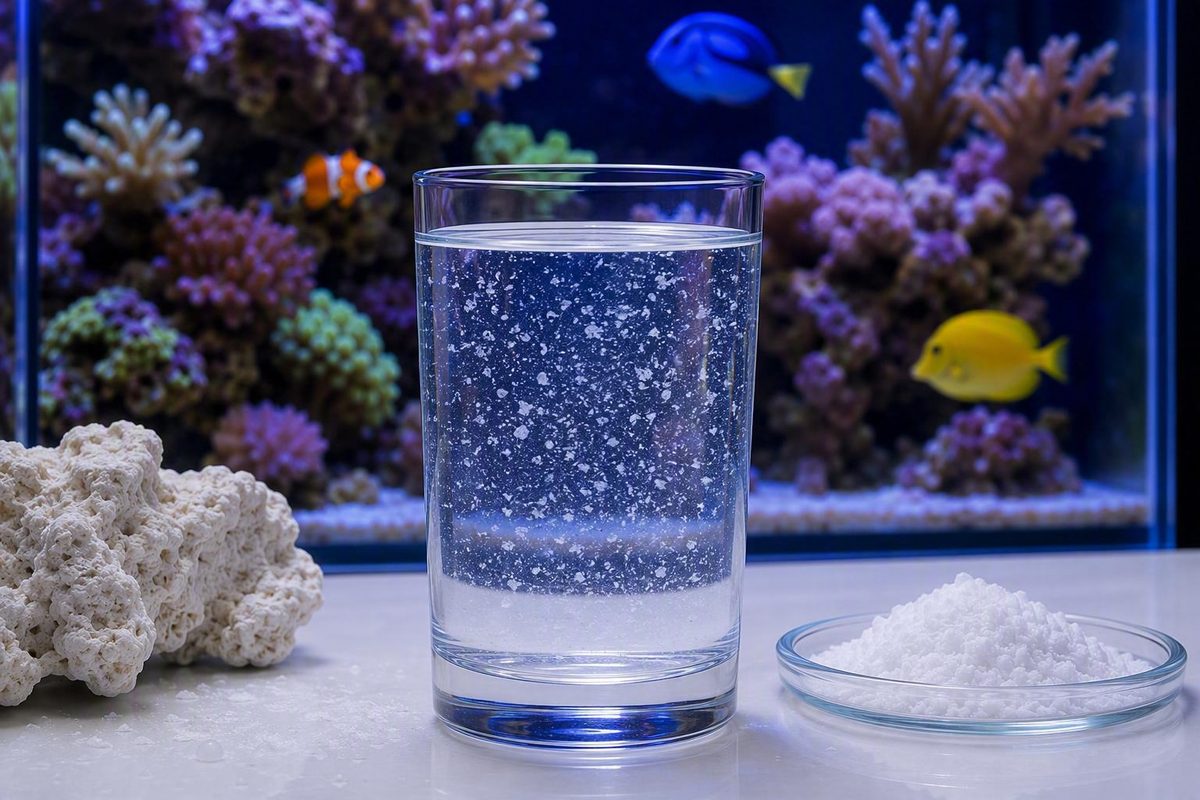
Start by comparing hot and cold samples at several taps. Hot-only particles point toward the heater. White appearance alone cannot establish safety.
White particles in water commonly come from hard-water scale, but their color does not establish what they are or whether they are harmless. This guide is a source-triage tool: it can help you determine whether to investigate a fixture, water heater, household plumbing, municipal supply, or private well. It cannot provide a laboratory identification or an individualized drinking-water safety determination.
Quick answer: What are the white particles in water?
White or tan particles are commonly calcium carbonate or magnesium carbonate deposits associated with hard water. These minerals can accumulate as scale inside pipes, fixtures, and water-heating equipment, then break loose as flakes or grains. Other possibilities include water-heater sediment and fragments from a deteriorating plastic dip tube, according to Mammoth Community Water District’s white-particle guidance.
Other possible sources include:
- Loose scale from household pipes
- Deposits disturbed within the municipal distribution system
- Silt or mineral sediment from a private well
- Degraded washers, linings, hoses, or other plumbing materials
- Debris from a water heater or water-treatment device
- Material whose source has not yet been identified
Do not treat every white-water symptom as interchangeable:
- Suspended flakes move through the water or float.
- Settled grains collect on the bottom of the glass.
- Cloudiness without distinct particles is a different observation and is not diagnosed by this guide.
- Dried white residue on a faucet, showerhead, kettle, or glass often supports a mineral-deposit explanation, but it does not prove that particles in fresh water have the same composition.
Color and appearance are clues, not identifications. Mineral scale, plastic fragments, and other pale materials can look similar under household lighting. Texture, buoyancy, location, and timing may narrow the source, but they cannot establish composition or safety.
The fastest initial split is based on where the particles appear:
- Hot water only: Investigate the water heater.
- Hot and cold water: Consider shared plumbing, the incoming supply, a private well, or treatment equipment.
- One fixture only: Inspect that fixture and its aerator before assuming the entire property is affected.
- Several fixtures: Consider a system-wide source, then use the hot-versus-cold result to narrow it further.
Start here: Compare hot and cold water at several taps
Before buying a filter or arranging invasive maintenance, perform a simple comparison. The goal is to identify a pattern—not to make a final chemical determination.
- Choose a faucet with separate or clearly controllable hot and cold flow.
- Fill one clean, clear glass from the cold side.
- Fill a second glass from the hot side.
- Set both glasses against a plain, well-lit background.
- Repeat the comparison at another fixture, preferably on a different branch or floor.
- If practical, include an outlet that does not pass through a refrigerator filter or specialty dispenser.
Let the samples stand for several minutes. Record whether the particles:
- Float on the surface
- Remain suspended
- Sink quickly or settle gradually
- Look chalky, gritty, flaky, or sand-like
- Resemble brittle, irregular shards
- Crush, smear, or remain rigid
- Accumulate in a faucet aerator
- Appear only after the water becomes hot
Hot-water-only material directs attention toward the water heater. Mineral sediment may settle like sand or small granules, while deteriorated plastic may appear as irregular, brittle pieces. These distinctions are useful but not conclusive.
If cold samples contain the same debris, the heater is unlikely to explain the entire problem. Broaden the investigation to shared plumbing, the municipal supply, a private well, treatment equipment, or another unidentified source.
If only one faucet is affected, remove and inspect its aerator if that can be done safely without damaging the fixture. Look for material matching the particles in the glass. Debris isolated to one aerator may come from the fixture, the local branch line, or material trapped after an earlier disturbance. It does not prove that the faucet itself is deteriorating.
Also record what happened before the particles appeared:
- A water outage or restoration of service
- A main break, hydrant flushing, or utility construction
- Plumbing repairs or fixture replacement
- A sudden pressure change
- Water-softener installation or regeneration
- Water-heater service
- Freezing, thawing, or an abrupt temperature change
- A change in well conditions
- Work elsewhere in a multi-unit building
Service restoration, pressure changes, and plumbing work can disturb deposits that had remained attached inside pipes. A newly installed softener can also loosen old mineral scale. Treat timing as evidence for where to look, not proof of what the material contains.
Photograph the particles against a plain background and note which taps are affected. A record of hot versus cold, fixture locations, timing, odor, color, pressure, and particle behavior will be more useful to a utility or technician than a general statement that the water looks unusual.
Common cause: Hard-water minerals and loose pipe scale
Hard water contains relatively high amounts of dissolved calcium and magnesium. These minerals are not normally visible while dissolved, but under suitable conditions their carbonate compounds can deposit inside pipes, fixtures, heaters, and other equipment.
Over time, deposited material may harden into scale and break loose. The resulting particles can appear:
- White, cream, gray, or tan
- Chalky or powdery
- Gritty or sand-like
- Thin and flaky
- Irregular, like pieces of brittle crust
These traits support a mineral-scale explanation but do not confirm it. Pale plastics and degraded plumbing materials can also be rigid and irregular.
Heating is one reason dissolved hardness becomes visible. As water is heated, calcium and magnesium carbonates can precipitate and collect as scale or sediment. Evaporation creates a related surface effect, which is why white deposits often appear around faucet outlets, on showerheads, inside kettles, and on glassware.
Old scale may be released suddenly instead of gradually. Possible triggers include restored service, pressure changes, turbulence, plumbing repairs, or a change in water conditions. Galvanized iron pipes can also corrode internally and contribute to recurring scale flaking.
A water softener can produce a counterintuitive short-term effect. Although it treats dissolved hardness entering the plumbing, softened water may begin loosening deposits formed before installation. Visible flakes can therefore continue or become temporarily more noticeable. That does not prove the softener is working correctly, but post-installation flakes do not automatically mean it has failed.
Dried limescale is corroborating evidence. Persistent white crust on showerheads, faucet outlets, kettles, and glassware makes mineral scale more plausible. It still does not establish that every suspended particle in the water is carbonate.
Scale can also obstruct small openings. Repeated accumulation may reduce flow through faucet aerators, showerheads, washing-machine screens, spray nozzles, and appliance inlets. Cleaning those components removes trapped material; it does not correct the conditions producing new scale.
When the particles appear only in hot water
Particles limited to hot water commonly point toward the water heater because incoming cold water passes through the heater before reaching hot taps. The two leading possibilities are mineral sediment and a deteriorating plastic dip tube.
Mineral sediment in the heater
Heating hard water can cause calcium and magnesium carbonates to precipitate. The particles may collect in a storage tank and then travel to fixtures during hot-water use.
Heater sediment may resemble:
- White or tan sand
- Chalky granules
- Small pebble-like pieces
- Crushed-eggshell-like fragments
- Fine grit that settles in a glass
Associated clues can include rumbling or popping, reduced hot-water capacity, slower reheating, fluctuating temperatures, or debris concentrated at hot taps. No single symptom is conclusive. Heater noises and performance problems can have other mechanical causes.
Tankless heaters can also develop mineral scale, but their design and servicing requirements differ from those of storage tanks. Instructions for draining a storage tank should not be applied to equipment that does not have one.
Deteriorating dip-tube fragments
A storage water heater may contain a plastic dip tube that carries incoming cold water toward the bottom of the tank. If that component deteriorates, it can release brittle white pieces into the hot-water system. The fragments may float, clog aerators, or range from small irregular pieces to longer shards.
The City of Columbus describes particles that bubble in white vinegar as most likely calcium carbonate and non-bubbling particles that clog aerators as most likely dip-tube material. It advises having a failed dip tube replaced by the manufacturer or a qualified technician (City of Columbus guidance on hot-water particles).
A softener or filter does not repair a failed dip tube. Filtration might capture some fragments downstream, but the deteriorating component would remain in place. Contact the heater manufacturer, a plumber, or a qualified water-heater technician.
Do not assume one flushing schedule fits every heater
Maintenance requirements depend on water hardness, sediment load, heater design, age, condition, and manufacturer instructions. A temperature or flushing interval suggested for one local water system should not be generalized to every home.
Water-heater safety: Draining or flushing can involve scalding water, electricity or gas, clogged or damaged valves, flooding, and property damage. Follow the manual for the specific model. Use qualified service if you cannot safely isolate the energy and water supplies, or if the heater leaks, has damaged valves, makes severe noises, or shows other deterioration. A commercial service overview likewise advises consulting the appliance manual because procedures vary by model (water-heater sediment and service overview).
When particles appear in cold water or throughout the home
If the same particles appear in cold water, the water heater cannot fully explain the problem. Possible sources include loose pipe scale, disturbed municipal deposits, private-well sediment, degraded plumbing materials, treatment equipment, or another unidentified source.
Municipal water
A sudden onset after a main break, outage, hydrant flushing, construction, or pressure change is consistent with disturbed deposits. That timing does not prove the utility caused the debris; pressure changes can also dislodge scale inside household plumbing.
Check the water provider’s website, outage page, alerts, or other official notices. If cold water at several fixtures remains affected, ask the utility:
- Whether nearby main work or hydrant flushing occurred
- Whether other customers have reported sediment
- Whether an advisory is in effect
- What response the utility recommends
- Whether it wants photographs, a sample, or the service address
- How any requested sample should be collected
Renters and residents of multi-unit buildings should notify the landlord, property manager, or building maintenance contact. Reports from nearby units can help distinguish a building-wide issue from debris limited to one apartment or branch line.
Private wells
Persistent sediment in well water warrants source-specific assessment by a well or water-quality professional. Possible sources described in the supplied well-water guidance include fine silt, minerals, changes in the water table, and deteriorating well components. A generic countertop filter cannot determine which explanation applies.
Record whether the problem coincided with a change in well operation, pressure, pumping, water level, or recent well work. If treatment equipment is installed, compare observations at appropriate points before and after that equipment when this can be done safely.
Ask the laboratory or relevant authority for collection instructions before taking a sample.
Household pipes and components
Galvanized iron pipes can corrode internally and contribute to recurring scale flaking. Severe or persistent pipe debris may require plumbing inspection rather than repeated aerator cleaning. A softener can alter dissolved hardness, and a filter can capture certain particles, but neither restores damaged pipe walls.
Other colors are escalation clues rather than laboratory identifications:
- Orange or brown may be consistent with rust or iron-bearing debris.
- Black or dark gray may be associated with degraded washers, gaskets, hoses, linings, or filter material.
- Green or blue may be associated with copper-containing material.
Mixed coloration or any other unusual appearance should widen the investigation rather than produce a confident identification based on color alone.
Bottled spring water is a limited separate scenario. Absopure, a bottled-water manufacturer, says freezing, thawing, or rapid temperature changes can make naturally occurring calcium in some of its spring water precipitate as visible flakes (the manufacturer’s explanation). That product-specific explanation should not be used to diagnose unexplained particles throughout a household tap-water system.
What home checks can—and cannot—tell you
Household checks can strengthen or weaken a hypothesis. They do not replace source investigation, equipment inspection, utility guidance, or suitable laboratory evaluation.
Optional vinegar screening check
If you can collect a few particles without exposure to hot water or damage to plumbing, place them in a small amount of plain white vinegar. Carbonate scale may:
- Release small bubbles
- Soften
- Break apart
- Partly or fully dissolve
Plastic fragments may remain intact. This can be useful because vinegar reacts with carbonate material differently from common dip-tube plastic.
The result is only suggestive. Bubbling or dissolving does not prove that the particles are pure calcium carbonate, and a lack of reaction does not prove that they are plastic. The check cannot determine the overall safety of the water or exclude the presence of other material.
Soap and hardness checks
A soap-bubble comparison or consumer hardness strip may suggest whether the household has hard water. Utility hardness information can also provide context. These observations can support a mineral-scale hypothesis when they align with chalky residue and gritty particles.
They cannot identify the particles themselves. Hard water can exist alongside plumbing debris, and visible particles can have causes unrelated to hardness.
Fixture residue
White crust on faucets, showerheads, kettles, and glassware is commonly associated with limescale. Cleaning removable residue with a method compatible with the fixture can restore flow or appearance.
Dried residue nevertheless shows what accumulated on that surface. It does not conclusively identify every flake in a fresh glass.
Total dissolved solids readings
It does not identify visible flakes.
Better documentation
Save observations instead of relying on one home test:
- Photographs of particles and affected aerators
- Hot- and cold-water comparisons
- A list of affected fixtures
- Whether particles float or settle
- Dates and recent plumbing or utility events
- Changes in color, odor, taste, pressure, or particle volume
- Heater make, model, and known service history
- Well or treatment-equipment details, where applicable
Share that information with the appropriate utility, plumber, heater technician, well professional, health authority, or laboratory. Ask the receiving organization how it wants any sample collected and what evaluation is appropriate.
Are white particles in water safe?
Identified calcium and magnesium carbonate scale is described by public-water guidance as naturally occurring mineral material that does not present a health hazard. That same guidance distinguishes the health question from scale’s ability to clog fixtures and plumbing (Mammoth Community Water District).
That reassurance has a strict boundary: it applies to identified carbonate scale, not every white particle. Color, texture, buoyancy, absence of odor, or a vinegar reaction cannot by itself establish composition or safety.
Seek prompt utility or professional guidance when debris:
- Persists or increases substantially
- Appears in cold water across the property
- Develops an unusual or mixed color
- Accompanies a metallic or chemical odor
- Coincides with a major taste change
- Appears with leaks, corrosion, or visibly damaged plumbing
- Follows a significant change in a well or supply system
- Coincides with illness
Commercial filtration guidance also recommends professional input when particles change color, develop metallic or chemical odors, increase greatly, or coincide with health problems (PureAqua’s overview). These signs still do not identify the material; they indicate that visual reassurance is inappropriate.
Use the source pattern to choose the first contact:
- Municipal cold-water or neighborhood-wide issue: Contact the water utility.
- Hot-water-only issue: Contact the heater manufacturer, a plumber, or a qualified heater technician.
- Private-well issue: Contact a well contractor or water-quality professional.
- One-fixture issue: Start with the fixture, aerator, and local supply line.
- Uncertain composition or safety: Ask the utility, local health authority, or an appropriately accredited water laboratory what evaluation is suitable.
This guide cannot provide a universal consume-or-do-not-consume rule for unidentified particles. Interim advice depends on the source, local conditions, current advisories, the people using the water, and what the relevant authority determines. If safety remains uncertain, obtain situation-specific instructions rather than extending reassurance about mineral scale to unknown debris.
Choose a fix that matches the confirmed source
The appropriate remedy depends on whether the problem is dried residue, dissolved hardness, suspended sediment, deteriorating equipment, damaged plumbing, or disturbed supply material.
| Likely or confirmed source | Supporting pattern | Appropriate next step | What not to assume |
|---|---|---|---|
| Mineral residue on fixtures | Chalky dried crust and local hardness evidence | Clean the fixture or aerator with a material-compatible method; assess hardness if buildup recurs | Surface cleaning does not change dissolved hardness |
| Loose pipe scale | Flakes at several taps, a scale history, or onset after pressure or plumbing changes | Clean clogged screens and arrange plumbing assessment if severe or recurring | Treatment equipment does not repair corroded pipe |
| Water-heater mineral sediment | Hot-water-only particles, settled grit, or possible heater performance symptoms | Consult the model manual and arrange appropriate maintenance or professional service | One flushing procedure or schedule does not fit every heater |
| Deteriorating dip tube | Hot-water-only brittle fragments, often collecting in aerators | Contact the manufacturer, plumber, or qualified heater technician | Softening and routine filtration do not repair the component |
| Disturbed municipal sediment | Cold and hot fixtures affected after utility work, an outage, or a pressure change | Check official notices and contact the provider if the issue persists or an advisory may apply | Timing alone does not prove that the utility is the source |
| Private-well sediment | Persistent grit in cold water or a change associated with well conditions | Obtain professional well and water-quality assessment | A generic filter does not identify or correct every well problem |
| Unidentified debris | Inconsistent appearance, unusual color or odor, rapid increase, or unclear source | Seek utility, plumbing, well, health-authority, or accredited-laboratory guidance | White appearance does not establish harmlessness |
For removable scale, separate cleaning the symptom from controlling the cause. Cleaning an aerator restores flow by removing material already trapped there. If dissolved hardness is producing repeated buildup, the longer-term question is whether hardness treatment is suitable for the home’s water conditions and maintenance goals.
A sediment filter captures physical particles within its rated range. It may be useful when suspended sediment is confirmed and filter placement, capacity, flow, and maintenance have been considered. It does not remove dissolved calcium and magnesium that could later precipitate. A commercial treatment overview similarly distinguishes capture of physical particles from treatment of dissolved hardness (sediment sources and treatment limits).
A water softener treats dissolved hardness minerals, commonly through ion exchange. It may reduce future hardness scale when properly selected and maintained. It does not necessarily remove old debris immediately, and installation may temporarily loosen preexisting scale. It cannot repair a dip tube, corroded pipe, damaged well component, or deteriorating heater.
A carbon filter is primarily chosen for other treatment objectives, such as certain taste and odor concerns. Carbon filtration should not be presented as a universal limescale solution, and carbon alone does not soften water.
For water-heater sediment, defer maintenance frequency and procedure to the appliance manufacturer and local conditions. Professional service is the safer option when you are unsure how to isolate the unit or when the heater leaks, has damaged valves, makes severe noises, heats inconsistently, or shows deterioration.
For a failed dip tube, arrange component or heater evaluation. Capturing fragments downstream leaves the source in place.
For severe recurring pipe scale or corroded galvanized plumbing, a plumber may need to determine whether localized repair or broader replacement is appropriate.
The diagnosis-first principle is simple: do not buy a softener, sediment filter, carbon filter, or reverse-osmosis system until the source and treatment objective are reasonably clear. Removing existing particles, reducing dissolved hardness, repairing equipment, replacing damaged plumbing, addressing a well problem, and involving the utility are different jobs.
Frequently asked questions
Why are white particles coming from only my hot-water tap?
Hot-water-only particles commonly direct attention toward the water heater. Heating can precipitate calcium and magnesium carbonates into sediment, while a deteriorating plastic dip tube can release brittle pieces that travel to hot taps and collect in aerators.
Compare hot and cold samples at a second fixture. If cold samples remain clear, consult the heater manual and ask the manufacturer, plumber, or qualified technician to evaluate sediment and component deterioration.
Do white particles that dissolve or bubble in vinegar prove they are calcium carbonate?
No. Bubbling, softening, or dissolving supports a carbonate-scale hypothesis. Unchanged brittle pieces may support a plastic explanation.
The check cannot establish purity, identify every accompanying material, or determine overall water safety. Use it only alongside the hot-versus-cold pattern, particle location, hardness history, and professional guidance.
Are calcium and magnesium particles safe to drink?
The City of Columbus states that the calcium carbonate and dip-tube situations described in its hot-water guidance do not present a health risk (municipal white-particle guidance). Other public-water guidance similarly describes identified calcium and magnesium carbonate scale as a maintenance issue rather than a health hazard.
Do not extend that reassurance to unidentified flakes merely because they are white. If the source remains uncertain—particularly when debris is widespread, increasing, unusually colored, odorous, or associated with illness or damaged plumbing—request situation-specific guidance.
Will a water softener or sediment filter remove white particles?
They perform different jobs. A sediment filter captures physical particles within its design range but does not remove dissolved hardness. A softener treats dissolved calcium and magnesium and may reduce future scale, but it may not immediately remove preexisting loose debris.
Neither device repairs a deteriorating dip tube, corroded pipe, damaged well component, or failing water heater.
Why did white flakes appear after a water outage, plumbing work, or softener installation?
Service restoration and plumbing work can create pressure changes or turbulence that dislodge old scale. A newly installed softener may also loosen deposits that accumulated before the water was softened. A sudden release can therefore come from scale formed over a much longer period.
Treat the timing as a clue, not proof. Hot-only debris suggests a heater source; cold-water debris broadens the investigation to plumbing, the utility supply, a private well, or treatment equipment.
Decision path
Compare clear hot- and cold-water samples at more than one fixture. Treat hot-only debris as a likely water-heater issue. If cold water is affected, check utility activity and investigate broader plumbing, treatment, or well sources. Use appearance and vinegar only as preliminary clues, then match the remedy to an identified cause.
Confirmed carbonate scale is generally a maintenance concern. Unidentified, persistent, widespread, unusually colored, odorous, or rapidly increasing debris deserves utility or professional investigation.