
Rock Flower Anemone Care Guide for Reef Tanks
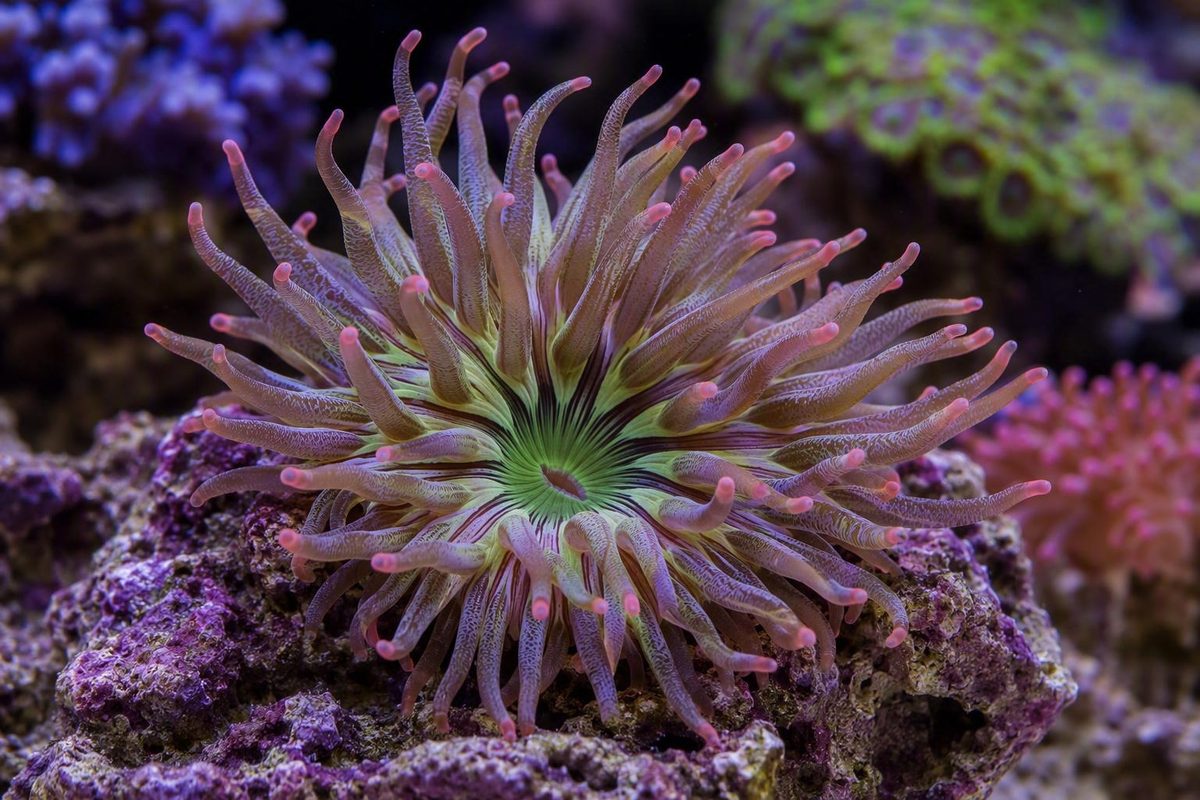
Place it low near the sand bed or lower rockwork, in moderate light and flow, then leave it alone to choose its exact spot.
Rock Flower Anemone Care Guide for Reef Tanks
Overview
A rock flower anemone is a compact, brightly colored sea anemone that reef-keeping guides widely describe as low maintenance and suitable for beginners, provided the tank is stable and the anemone is placed thoughtfully. Success mostly depends on moderate light and flow, safe placement away from pumps, and careful acclimation during the first week.
That short answer comes with a caveat that runs through this whole guide: the strongest public sources on this animal are hobbyist care guides and retail pages, not scientific literature. Worldwide Corals opens its care article by calling rock flower anemones low maintenance and easy to care for, and Reef Chasers frames its care overview around moderate lighting and moderate flow. Those recurring basics are worth trusting; anything more specific — exact lifespans, guaranteed breeding methods, current prices — deserves skepticism until you verify it.
If you are deciding whether to buy one, start with the fit-decision section below. If you already have one on the way, jump to the placement and first-week checklist so the animal’s most vulnerable days go smoothly.
What a rock flower anemone is
A rock flower anemone is a small, disc-shaped anemone kept in reef aquariums primarily for its color and pattern variety. Retail descriptions lean on the flower comparison for a reason: My Saltwater Fish Store describes rock flower anemones as “like the ocean’s flowers,” adding movement and color to a saltwater aquarium, and notes they are also referred to simply as sea anemones. The visual appeal is the main draw — individual specimens vary widely in oral disc color, tentacle pattern, and contrast, which is why photos of two rock flower anemones can look like entirely different animals.
Unlike many showpiece anemones that dominate a tank’s midwater rockwork, rock flower anemones are generally discussed in care guides as animals that settle low in the aquascape, near the sand bed or lower rockwork, and stay relatively compact. The Worldwide Corals care article covers identification, size, colors, and placement as core topics, which reflects how hobbyists actually encounter this animal: as a manageable, ground-level splash of color rather than a centerpiece that reshapes the whole tank plan.
On origin, competitor care content places rock flower anemones in a Caribbean context, with Florida Keys sourcing sometimes mentioned in hobbyist discussion. Treat that as general background rather than a verified supply-chain claim for any specific specimen you buy — collection and sourcing details vary by seller, and the pages reviewed for this guide do not document them specimen by specimen. If provenance matters to you, ask the seller directly rather than assuming.
Naming and taxonomy caveats
The scientific naming you will see attached to rock flower anemones is inconsistent, and that inconsistency is normal for this animal in the hobby. Some sources label them Phymanthus crucifer, others use the broader Phymanthus sp., and family-level references appear with variant spellings of Phymanthidae across care pages and retail listings. None of the sources reviewed for this guide resolves the taxonomy authoritatively, and this article will not pretend to either.
The practical takeaway is simple: do not overinterpret the Latin name on a retail listing. A seller writing “Phymanthus sp.” is not necessarily selling a different animal than one writing “Phymanthus crucifer” — both labels are commonly applied to the same trade animal, sometimes interchangeably. You may also see the trade names flower anemone or beaded anemone used for the same or similar animals. When comparing listings, rely on photographs of the actual specimen and the seller’s care notes rather than the scientific name, because the name alone will not tell you what you are getting.
Is a rock flower anemone right for your tank?
For most reef keepers with an established, stable tank, the answer leans yes — this is one of the anemones that hobbyist guides consistently frame as approachable. Worldwide Corals states directly that rock flower anemones are great for beginners, low maintenance, and easy to care for, and adds that they are not overly particular about conditions. Reef Chasers similarly presents its care overview with a difficulty rating alongside light, food, and flow, treating this as an animal an attentive newer hobbyist can succeed with.
“Beginner-friendly” does not mean “no prerequisites,” though. Before buying, be honest about a few things:
- Tank stability. An anemone joins a system, not a starter kit. If your parameters still swing week to week, stabilize first.
- Equipment safety. Care guides specifically warn about wavemakers and pumps, because a moving anemone can be injured or killed by unguarded intakes. If you cannot cover or protect powerheads, that risk sits on you from day one.
- Placement real estate. You need low, stable territory — sand bed or lower rockwork — where the anemone can settle without pressing into corals.
- Feeding willingness. These animals benefit from meaty foods offered deliberately, not just whatever drifts by. If target feeding sounds like a chore, reconsider.
- Acceptance of movement. Anemones can relocate themselves. If a fixed, glue-it-and-forget-it aquascape is non-negotiable for you, an anemone of any kind is a poor match — Reef Chasers explicitly advises against gluing rock flower anemones down.
If you can check those boxes, a rock flower anemone is a reasonable, forgiving choice compared with more demanding anemones. If two or more give you pause, spend a few more months maturing the tank before adding one.
Care profile: light, flow, food, and water parameters
The recurring husbandry picture across care guides is moderate everything: moderate light, moderate flow, regular meaty feeding, and standard stable reef water chemistry. The most concrete published figure comes from the Reef Chasers care guide, which recommends moderate lighting between 150–250 PAR and notes that rock flower anemones prefer moderate water flow.
The table below separates what the reviewed sources actually support from where you should stay flexible. Where guides differ or omit numbers, the honest move is a range-free note rather than an invented target.
| Care factor | Supported guidance | Evidence notes and limits |
|---|---|---|
| Lighting | Moderate lighting; Reef Chasers recommends 150–250 PAR | A single care guide’s recommendation, not a universal standard; other guides say “moderate” without numbers |
| Water flow | Moderate flow | Reef Chasers notes flow assists the anemone’s feeding; avoid direct blasting from pumps |
| Feeding | Meaty foods, offered by target feeding or broadcast feeding | Care guides cover feeding as a core topic; exact frequency is not standardized across sources |
| Nutrition source | Photosynthetic (hosts zooxanthellae) plus supplemental feeding | Light and food work together; neither fully replaces the other in hobbyist guidance |
| Water chemistry | Stable reef-standard parameters; Reef Chasers lists temperature, pH, nitrate, phosphate, alkalinity, and calcium as tracked factors | The reviewed summaries confirm these categories are listed but do not supply verified numeric targets to republish |
| Placement | Low in the tank, near sand bed or lower rockwork | Covered further in the placement section; do not glue the anemone down |
| Difficulty | Beginner-appropriate | Worldwide Corals calls them low maintenance and easy; Reef Chasers rates difficulty in its care overview |
Two points in that table deserve expansion. First, on nutrition: rock flower anemones are photosynthetic, meaning their symbiotic zooxanthellae convert light into energy, which is why the lighting recommendation matters beyond aesthetics. But hobbyist guides treat supplemental feeding of meaty foods as part of normal care, not an optional extra. A specimen under adequate light that also receives regular food is in a much stronger position than one relying on light alone. Target feeding — placing food directly onto the tentacles — gives you certainty the anemone actually ate, while broadcast feeding lets it capture food from the water column with the help of that moderate flow.
Second, on water chemistry: the Reef Chasers care overview lists temperature, pH, nitrate, phosphate, alkalinity, and calcium among its care requirements, which tells you which levers matter, even though this article deliberately avoids republishing specific numbers that could not be verified from the available source summaries. In practice, the guidance converges on a simple standard: if your tank already holds stable, conventional reef parameters that keep corals happy, you have the chemistry side covered. Instability, not any single exotic parameter, is the realistic chemistry risk for this animal.
The takeaway: aim for the middle of the road on light and flow, feed deliberately, and keep the water boring and consistent. Rock flower anemone care rewards stability over precision-chasing.
Placement and first-week acclimation
Place a rock flower anemone low in the tank — on or near the sand bed, or in lower rockwork — in moderate flow and moderate light, and then leave it alone to choose its exact spot. This mirrors how care guides treat placement, and it respects a fact about all anemones that new owners underestimate: the animal has a vote. It attaches by its foot and can move if it dislikes the location. Reef Chasers specifically warns against gluing a rock flower anemone down; forcing attachment risks damaging the foot, which is the structure the animal depends on to anchor itself.
The single biggest equipment hazard is unguarded water movement hardware. Care guides warn about wavemakers and pumps because a wandering anemone that drifts into an intake or impeller can be shredded — an outcome that is fatal for the anemone and can foul the tank. Cover or guard powerheads before the anemone arrives, not after you notice it moving.
Here is a practical first-week checklist built from the supported care topics — acclimation, inspection, placement, flow, light, pump risk, and feeding:
- Prepare before arrival. Confirm parameters are stable and fit pump/wavemaker guards, so nothing needs adjusting while the anemone is settling.
- Inspect on receipt. Look the specimen over: an intact foot, no obvious tears, and reasonable color. Note anything concerning while any seller guarantee window is open.
- Acclimate slowly and gently. Match the anemone gradually to your tank’s water rather than dropping it straight in; care guides treat acclimation as a distinct step, not a formality. Handle by supporting the base — the foot is the part to protect.
- Place it low. Set it on the sand bed or in a low, stable pocket of rockwork with moderate flow, out of the direct blast of any pump. Do not glue it.
- Ease into lighting. If your lights run at the upper end of the moderate range, let the anemone adjust rather than parking a shipped specimen under full intensity immediately.
- Delay feeding until it settles. Once the anemone is attached and opening normally, offer a small meaty target feeding rather than pushing food at a stressed, closed animal.
- Observe, don’t relocate. Some repositioning and periodic closing is normal adjustment behavior. Resist moving it repeatedly; every relocation restarts the settling process.
Through the first week, your job is mostly restraint. The anemone reads conditions and responds; your role is to make the low-tank environment safe — guarded pumps, moderate flow, no coral crowding — and let it commit to a spot. An anemone that attaches, opens, and accepts food within its first days has cleared the riskiest phase of ownership.
One bounded note on inspection and handling: anemones carry stinging cells (nematocysts), so it is sensible to avoid prolonged bare-skin contact and to keep handling brief and supportive of the base. The sources reviewed here do not provide a detailed quarantine protocol for rock flower anemones, so treat inspection at receipt as your minimum screening step and follow your normal invertebrate quarantine practice if you run one.
Compatibility with corals, shrimp, crabs, clownfish, and other livestock
Rock flower anemones are generally treated in hobbyist care content as reef-compatible additions that coexist with typical reef livestock, which is part of why they appear so often in beginner-oriented guides. Worldwide Corals covers compatibility as a standard section of its care article, and the animal’s habit of settling low and staying relatively put makes it easier to plan around than a large, roaming anemone.
That said, it is still an anemone, and anemones sting. The practical rule is spacing: give it clear distance from corals, especially on the sand-bed margins and lower rockwork where it will settle. The reviewed sources do not publish a specific safe-distance figure, so the honest guidance is directional — do not let tentacles reach a neighbor, and remember that the anemone may shift position, so the buffer you plan on day one should account for some movement. If it relocates next to a coral, be prepared to gently adjust the aquascape around it rather than repeatedly prying the anemone loose.
On invertebrate partners, shrimp and porcelain crabs come up repeatedly in compatibility discussion around rock flower anemones. Certain shrimp and porcelain crabs are known in the hobby to associate with anemones, and rock flowers are among the anemones hobbyists pair them with. Treat any specific pairing as an experiment to observe, not a guarantee: whether a particular shrimp or crab takes up residence with a particular anemone varies by individual animals.
Clownfish deserve a realistic expectation-set. Rock flower anemones are not the classic host anemones clownfish bond with in the wild, and the sources reviewed here do not support a claim that clownfish will reliably host in one. Some hobbyists report clownfish taking an interest; many report indifference. If a hosting relationship is your main reason for buying an anemone, a rock flower anemone is the wrong tool for that job, and you should research host-anemone options separately.
For fish and cleanup-crew planning more broadly, the main risks run in both directions: the anemone can catch small, slow, or careless tankmates, and some predatory or nippy livestock can harass an anemone. Standard reef stocking judgment applies. The takeaway: rock flower anemones fit most mixed reef communities well, provided you respect spacing from corals and skip the assumption that they will host clownfish.
Buying choices: common, ultra, and WYSIWYG rock flower anemones
The labels you will meet while shopping — common, ultra, and WYSIWYG — describe grading and listing style, not different species. Retail anemone collections segment inventory this way: My Saltwater Fish Store’s anemone collection, for example, is a product grid of 35 items with prices, sold-out labels, filters, and sort options, organized around WYSIWYG, Ultra, and Common rock flower anemone naming.
Here is what each label practically means. “Common” typically denotes standard coloration at the lower end of a seller’s price range. “Ultra” signals higher-grade color and pattern — more contrast, rarer color combinations, more striking oral discs — priced accordingly. “WYSIWYG” (what you see is what you get) means the photo shows the exact specimen you will receive, rather than a representative example of the grade. Because rock flower anemones vary so much individually, WYSIWYG listings remove the biggest uncertainty in buying one: whether your animal will look like the picture.
This guide deliberately makes no claims about current prices or availability. Listings change, specimens sell out — sold-out labels are a visible feature of retail anemone collections — and any dollar figure printed here would be stale on arrival. What you can rely on is the price logic: color grade drives cost, and WYSIWYG certainty usually carries a premium over grade-representative listings. Decide which trade-off you want before browsing, or the ultras will decide for you.
Before committing to a specific specimen, run through a short set of checks:
- Photo honesty. Prefer WYSIWYG listings, or confirm whether a photo is the actual animal or a grade example.
- Visible condition. Look for a fully open oral disc, intact tentacles, and no torn or gaping appearance in the listing photos.
- Listing clarity. A seller that states size, grade, and care notes plainly is easier to hold to expectations than one trading on a single glamour shot.
- Guarantee terms. Know the arrival-guarantee window and inspection requirements before you pay, since your receipt-day inspection depends on them.
Worldwide Corals frames its article partly as what to know before buying a rock flower anemone, and that framing is the right one: the buying decision is where most avoidable disappointment happens. A moderately colored, healthy common specimen from a clear listing will outperform a stunning ultra that arrives damaged. Buy condition first, color second.
Troubleshooting movement, poor attachment, and decline signals
If your rock flower anemone is moving, shrinking, or refusing to attach, the first suspects are environmental: placement, flow, light, and food. Care guides establish that these animals respond to their conditions by relocating, and movement is the anemone’s main way of telling you something about its current spot doesn’t suit it. Before assuming disease or decline, audit the basics.
Work through these checks in order:
- Flow at the anemone’s location. Is it sitting in the direct output of a pump, or in a dead spot? The supported guidance is moderate flow; both extremes commonly prompt movement.
- Light at its depth. Reef Chasers’ moderate-light recommendation (150–250 PAR) is a useful reference point. A spot far outside the moderate range in either direction gives the anemone a reason to relocate.
- Substrate and footing. An anemone on loose rubble or an awkward surface may fail to attach. Offer a low, stable spot near the sand bed and — critically — do not respond to poor attachment by gluing it down, which care guidance specifically warns against.
- Feeding history. A shrinking anemone that has not been fed is telling you something straightforward. Offer a small meaty target feeding and see whether it responds and holds food.
- Pump proximity. If the anemone is wandering, treat every unguarded powerhead as an emergency. The documented pump/wavemaker risk becomes acute exactly when the animal is on the move.
- Neighbor conflict. Check whether it has drifted into stinging range of a coral or is being pestered by tankmates; either can drive relocation or closure.
Interpret behavior with patience. Periodic closing, temporary shrinking, and some early wandering fall within normal adjustment, especially in the first weeks after introduction. Persistent decline — an animal that stays shriveled for extended periods, refuses all food, or shows a chronically gaping mouth — is a stronger warning sign, but the sources reviewed for this guide do not support confident diagnosis or treatment claims for specific disease-like symptoms. In that situation, verify water parameters against your normal reef standards, correct any environmental issue you find, and seek current guidance from experienced reef-keeping communities or the seller rather than applying an unverified remedy.
The core troubleshooting mindset: the anemone’s behavior is feedback, not malfunction. Fix the environment it is reacting to, protect it from equipment while it moves, and give changes days rather than hours to show results.
Growth, movement, and reproduction expectations
Expect a rock flower anemone to be a long-term, mostly stationary resident that reserves the right to move — and expect published specifics on lifespan and growth rate to be thin. The reviewed care content covers size and identification in general terms, but none of the sources provides verified figures for how large a given specimen will grow, how fast, or how long it will live in captivity. Rather than inventing numbers, plan around what is supported: the animal stays compact relative to large host anemones, settles low in the tank, and can persist for years under stable care. If precise lifespan matters to your decision, treat it as an open question to research further, not a settled fact.
Movement behavior over the long term follows the same logic as the troubleshooting section: a settled anemone that likes its spot tends to stay, while changes in flow, light, or neighbors can prompt relocation at any point in its life. This is why the pump-guard habit should be permanent, not a first-week-only precaution.
On keeping multiples, rock flower anemones are commonly kept in groups by hobbyists, and their low, compact habit makes gardens of them visually popular. The reviewed sources do not establish a supported stocking density or spacing rule, so add specimens gradually and watch how they space themselves rather than following a fixed formula.
Reproduction gets light treatment in the available evidence: Worldwide Corals includes reproduction among its care topics, and hobbyists do sometimes find baby rock flower anemones appearing in established tanks. In broad hobby understanding, these anemones have separate sexes and reproduce sexually, which is one reason offspring tend to show their own color variations rather than copying a parent. Beyond that, deliberate, repeatable captive breeding is not something the reviewed sources document in enough detail to instruct on. If babies appear, treat them as a bonus: give them the same protection from pumps and the same stable conditions, and enjoy one of this animal’s better surprises.