
Live Rock Is Optional—Source It Carefully and Cure It Before Use
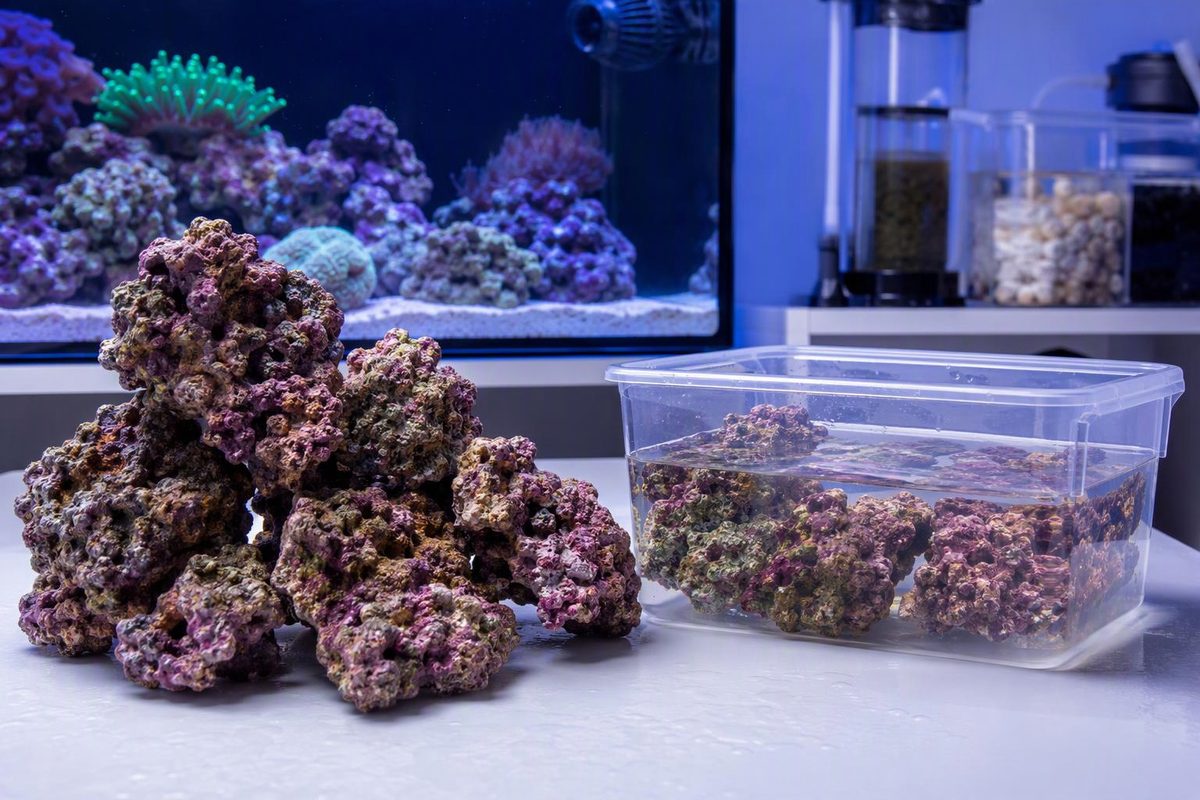
Choose legal, porous live rock, cure transported pieces outside a stocked reef, and verify the cycle before adding livestock.
Live rock can give a new reef tank an established biological community and natural-looking structure, but it is not mandatory. Dry reef rock can serve the same basic aquascaping and biofiltration roles after it is cycled and colonized.
The practical choices are:
- Mostly live rock: faster biological seeding and greater initial diversity, with the greatest hitchhiker and transport-die-off risk.
- Live-rock seed plus dry rock: introduces some biological diversity while reducing cost and the amount of material that needs inspection.
- All dry rock: provides more control over the aquascape and introduced organisms, but it must be cycled and takes time to develop mature biofilms.
What “live rock” means
Live rock is porous calcareous rock colonized by marine organisms. It may carry bacteria, coralline algae, worms, small crustaceans, sponges and other growth in its pores and on its surface. Florida’s agriculture department uses a similar definition and explains that ocean-aquacultured rock begins as quarried rock placed in seawater for natural colonization (FDACS).
The rock itself is not alive. Its value comes from its surface area, attached organisms and the habitat it creates. Ammonia-oxidizing microorganisms are part of marine aquarium biofilters: one study detected genes associated with both archaeal and bacterial ammonia oxidation in all eight saltwater biofilters it sampled (PLOS One). Live rock can carry part of that biofilm, but it does not remove the need to verify the complete aquarium’s ability to process waste.
Three labels are often confused:
- Live means organisms are present.
- Cured means transport-related decay has largely finished and dead material has been removed.
- Cycled means the aquarium’s biofilter can process a defined ammonia input without leaving detectable ammonia or nitrite.
Rock can be live but uncured. It can also be cured without proving that a newly assembled tank is ready for livestock. “Cured” does not mean free of unwanted hitchhikers.
Choose the source before the shape
Ask the seller exactly what “live” means. Ocean-aquacultured rock, rock held in a mature aquarium system and dry rock dosed with bottled bacteria are not equivalent products.
Look for:
- A documented legal source, especially for ocean-grown rock
- Lightweight, irregular pieces with ledges, caves and open pores
- A marine smell rather than a strong rotten odor
- Little blackened or visibly decaying tissue
- An opportunity to inspect the seller’s holding system for nuisance anemones and algae
- A clear answer about time out of water and whether the rock has been cured since transport
Do not collect rock from a beach or reef simply because it is accessible. Rules vary by jurisdiction. Florida prohibits the harvest or use of wild live rock while permitting approved aquaculture on submerged leases or in land-based systems (FDACS). In the federal Gulf of Mexico, harvest or possession of wild live rock is prohibited, and aquacultured live rock requires a permit (Gulf of Mexico Fishery Management Council). Check the rules that apply where collection would occur.
How much live rock do you need?
Do not treat an old pounds-per-gallon rule as a target. Dense and highly porous rocks can weigh the same while providing very different structure and surface area. Excess rock can also restrict flow, collect debris and reduce swimming space.
Build enough structure to provide:
- Stable coral-mounting surfaces
- Caves and visual barriers appropriate for the intended fish
- Open channels around and through the rockwork
- Access for cleaning the glass and siphoning debris
- A secure base that will not shift if a burrowing animal digs nearby
Buy by shape and aquascape volume first. Biological capacity comes from the whole system—including rock, sand and other filter media—and still needs to be confirmed by testing. Plan livestock around the finished habitat rather than adding rock until an arbitrary weight is reached.
Cure transported live rock before adding it to a stocked reef
Transport kills some attached organisms even when rock was previously sold as cured. Their decay can release ammonia that harms fish, corals and invertebrates. LiveAquaria’s curing guidance similarly warns against putting transported rock directly into an occupied aquarium and uses stable water conditions with zero ammonia and nitrite as its endpoint (LiveAquaria).
For an established reef, cure new rock in a separate aquarium-safe container:
- Prepare heated, circulating saltwater. Match the display’s temperature and salinity. Keep the container dim to limit nuisance-algae growth.
- Inspect and rinse each piece in discarded saltwater. Brush away loose decaying material and siphon settled debris. Do not rinse biologically active rock in untreated tap water.
- Provide vigorous water movement. Avoid tightly stacking pieces where decomposing material can remain trapped.
- Test ammonia regularly. Make water changes as it accumulates, remove newly exposed dead tissue and keep the rock submerged.
- Wait for a stable endpoint. Visible decay and foul odor should be gone, while ammonia and nitrite remain undetectable on repeated tests rather than only immediately after a water change.
Curing can take days or weeks depending on shipping conditions and the amount of die-off. Reef Builders gives a wider range of about one week to several months and likewise uses zero ammonia and nitrite as part of the endpoint rather than relying on a fixed date (Reef Builders).
In a completely empty new aquarium, curing can occur in the display. Keep livestock out, remove debris and continue testing. Once curing ends, verify the aquarium against a defined cycling protocol instead of treating one zero-ammonia result as proof of readiness; see the reef tank setup sequence.
Inspect hitchhikers without sterilizing everything
The biodiversity that makes live rock appealing also creates uncertainty. Inspect it during curing, including after dark with a flashlight. Watch for nuisance anemones, predatory crabs, mantis shrimp, invasive algae and dying animals hidden in holes.
Do not assume every worm, snail or small crustacean is harmful. Identify it before removal when possible. Conversely, do not transfer a questionable organism into the display merely to preserve every trace of life.
Wear gloves and use tools rather than placing fingers into unseen crevices. Bleaching or completely drying the rock may remove unwanted organisms, but it also removes the main reason to buy biologically active rock. Treat sterilized material as dry rock and cycle it again before adding livestock.
For many new tanks, a small amount of carefully sourced, separately observed live rock combined with dry rock is a manageable compromise. The priority is not maximizing biodiversity on day one; it is introducing rock whose provenance, decay and effect on the tank’s cycle you have had time to assess.