
Choosing an Angelfish Without Gambling Blindly on Your Corals
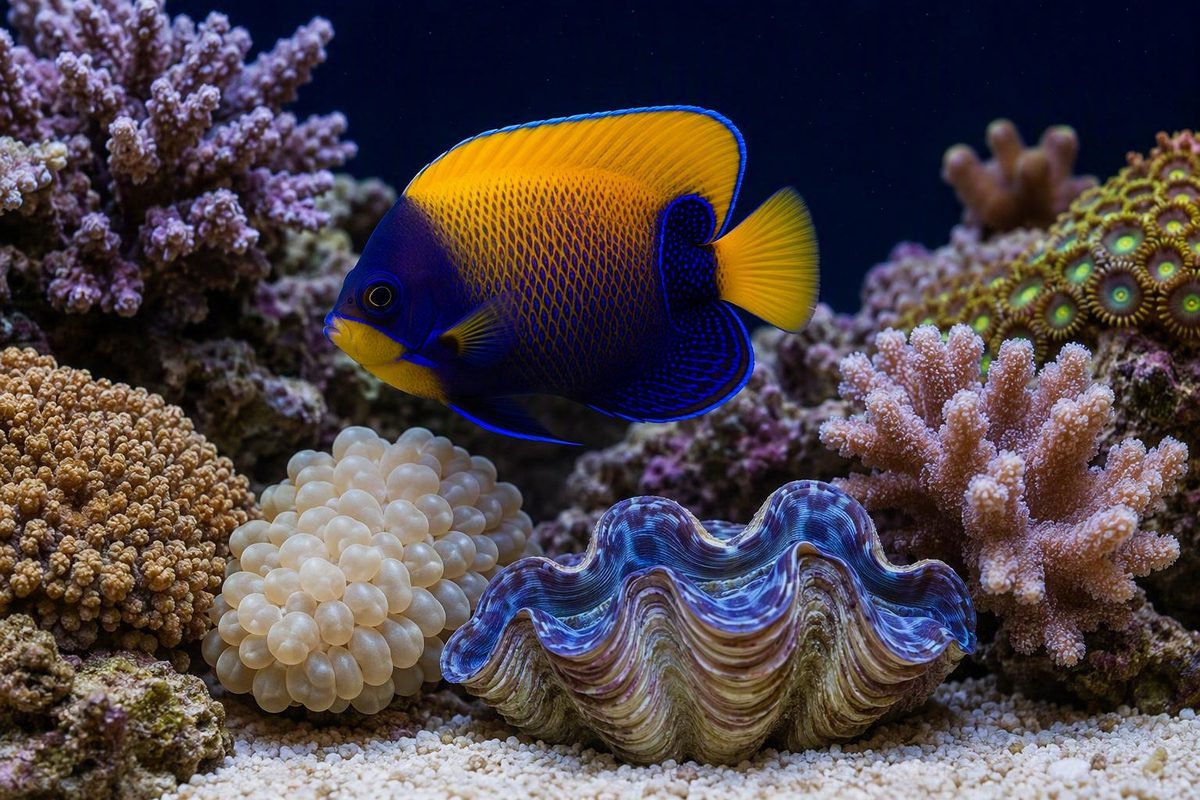
Genicanthus are the lower-risk starting point but commonly reach 7-9 inches; smaller dwarf angels bring less predictable coral compatibility.
The short answer: no angelfish is guaranteed reef safe
No marine angelfish can be guaranteed to leave every coral and clam alone permanently. Some species are more plausible candidates than others, but “lower risk” is not the same as harmless. A conservative specialist-magazine overview recommends no angelfish for a reef because members of the group may eat coral polyps or pick at fleshy clam mantles (Tropical Fish Hobbyist’s marine-angelfish overview).
That is what reef safe with caution means here: compatibility may be possible, but the risk of coral picking, clam-mantle damage, aggression, or another livestock conflict remains unresolved. It is not a softer promise of reef safety.
Species reputation can help compare broad patterns. It cannot predict the permanent behavior of the individual fish in front of you. Two members of the same species may behave differently, and an apparently compatible fish may change as it matures or aquarium conditions change.
It is also important to distinguish between these observations:
- “I have not seen this fish damage coral.”
- “This fish never samples coral tissue.”
Ordinary aquarium observation can establish only the first. Conversely, a fish pecking near a coral is not necessarily consuming living tissue. The meaningful warning is repeated targeting accompanied by persistent closure, tissue loss, exposed skeleton, or another sustained negative response.
The evidence behind reef-safe angelfish rankings is weak. Most available comparisons come from aquarium retailers, hobby publications, individual specialist authors, and self-reported forum experiences. They are not controlled trials in which species are observed with the same corals, diets, aquarium dimensions, tankmates, and time periods.
Accordingly, this guide uses those sources only to identify recurring husbandry judgments and reported outcomes. It does not calculate success rates or treat repeated publication of the same advice as independent scientific confirmation. Retail guidance is also identified as commercial guidance because the publishers may sell the livestock being discussed.
The resulting decision rule is simple:
If any angelfish-related coral or clam loss would be unacceptable, do not add an angelfish.
If some risk is acceptable, begin with the fish’s feeding ecology and adult space requirements—not with the smallest fish carrying a “reef safe with caution” label.
Why Genicanthus angelfish are the lowest-risk starting point
In the available aquarium guidance, the genus Genicanthus is the group most consistently presented as the closest practical match to a reef-compatible angelfish. Commonly discussed examples include swallowtail, Lamarck’s, Watanabei, and Bellus angelfish. This is a synthesis of husbandry opinion, not a demonstrated comparative ranking.
The proposed rationale is feeding behavior. Genicanthus angelfish are described as plankton feeders adapted to taking suspended food from the water column. That differs from the surface-oriented grazing attributed to many dwarf angelfish, which investigate algae, sponges, rockwork, and other benthic material. An experienced Reef Builders author therefore treats Genicanthus as the practical exception to the otherwise unreliable idea of a reef-safe angelfish, while grounding that conclusion in personal experience rather than controlled research (Reef Builders’ discussion of feeding and coral risk).
That feeding pattern provides a reasonable basis for evaluating the genus first. It does not show that every individual will ignore corals or clams throughout its life.
The major trade-off is space. These are not dwarf angelfish that happen to be safer. Commercial guidance commonly describes Genicanthus species as reaching roughly 7–9 inches and needing substantial open swimming room. Broad recommendations begin around 75–100 gallons or more, while another hobby guide lists approximately 125 gallons for Lamarck’s and swallowtail angelfish. These figures are variable husbandry recommendations, not universal biological thresholds (commercial size and aquarium guidance).
Do not infer that every Genicanthus belongs in a 75-gallon aquarium. Before purchase, verify:
- The exact scientific species, not only the trade name
- Expected adult size
- Body shape and normal movement
- Aquarium dimensions and usable open-water area
- Existing fish biomass and territorial pressure
- How much rockwork reduces swimming space
- Whether the system can support the necessary diet without persistent water-quality problems
Nominal volume is only one part of the assessment. Compare the adult fish with the aquarium’s actual swimming space, rock layout, tankmates, and filtration capacity rather than comparing a juvenile at the store with a gallon figure on a sales label.
Genus-level reputation also cannot erase conflicting individual reports. In one hobbyist discussion, a keeper reported Bellus angelfish that ignored polyps, while another reported that two Bellus individuals ate corals before a third behaved acceptably. Those anecdotes do not establish a Bellus failure rate; they show why a favorable reputation cannot become a guarantee (reported Bellus experiences).
The practical conclusion is therefore narrow: If the aquarium can support the exact species as an adult, an appropriately selected Genicanthus is the first angelfish group worth evaluating. If it cannot, substituting a dwarf angel solves the size problem only by accepting greater uncertainty about coral compatibility.
Dwarf angelfish: smaller tanks, greater uncertainty
Dwarf angelfish are tempting because they offer the shape, color, and active grazing behavior associated with angels without the adult size of most Genicanthus. Their smaller bodies make them physically easier to accommodate, but they do not make coral compatibility predictable.
Both have favorable reports, but neither has a dependable claim to being safe.
Coral Beauty reports include multi-year coexistence without observed damage as well as individuals that later developed destructive polyp-picking habits. Flame angelfish receive similarly inconsistent treatment: some commercial guidance places them in a moderate-risk category, while a specialist-magazine author warns that they are particularly likely to pick at corals and clam mantles.
Cherub and Fisher’s angelfish are harder to place. Some guides include them among moderate or unpredictable choices; others express greater concern about coral or clam picking. Territorial tendencies are also reported for Cherubs. Potter’s angelfish appears as a comparatively favorable candidate in one author’s judgment, but that individual assessment does not establish a general ranking.
The table below summarizes the supplied husbandry guidance. “Evidence confidence” reflects the amount and consistency of the available material: very low means a narrow author opinion or sparse anecdotes; low means several reports or guides that remain conflicting; and low to moderate means warnings recur across multiple underlying publications but still lack controlled comparative data. These labels describe confidence in the reported pattern—not the probability that a fish will behave in a particular way.
| Species | Reported adult size | Recurring risk assessment | Reported or suspected targets | Territorial concerns | Evidence confidence |
|---|---|---|---|---|---|
| Coral Beauty | About 4 inches | Plausible but unpredictable dwarf candidate | Zoanthids, fleshy LPS, polyps, clam mantles | May defend rockwork and grazing territory | Low; repeated but conflicting guidance |
| Flame | About 4 inches in several guides | Moderate in some guidance; stronger concern elsewhere | Fleshy LPS, zoanthids, coral polyps, clam mantles | Possible conflict with similar fish or new additions | Low; assessments conflict sharply |
| Cherub | About 3 inches | Moderate in some guides, higher risk in others | SPS, acans, zoanthids, clam mantles | Territorial tendencies repeatedly noted | Low; mainly author judgment and anecdotes |
| Fisher’s | About 4 inches | Disputed; moderate to higher concern | Zoanthids, coral tissue, clam mantles | Possible conflict with other dwarf angels | Very low to low; reports are sparse |
| Potter’s | Not consistently established in the supplied material | Comparatively favorable in one author’s judgment | Fleshy corals and clams remain possible targets | Overall husbandry suitability must be assessed separately | Very low for comparative ranking |
| Lemonpeel | About 5.5 inches in one hobby guide | Commonly treated as a poor coral-reef bet | Fleshy LPS, polyps, clam mantles | Territorial behavior may add another conflict | Low to moderate; warnings recur |
| Bicolor | Size guidance varies | Commonly treated as a poor coral-reef bet | Corals and other benthic livestock | Territorial behavior may compound compatibility problems | Low to moderate; no controlled rate |
The size figures and most broad risk categories come from commercial or hobby guidance rather than scientific species comparisons. Top Shelf Aquatics reports Coral Beauty, Flame, and Fisher’s angelfish at about 4 inches and Cherubs at about 3 inches; its recommendations should be read with the knowledge that the publisher is an aquarium retailer (commercial dwarf-angelfish comparison).
A small mouth does not make a dwarf angelfish safe.
Individual accounts illustrate the uncertainty. One dwarf-angelfish guide describes a Coral Beauty living with zoanthids and LPS for years, while the same author reports a Cherub attacking an acan colony within a week. These observations are useful warnings, but they do not predict how a newly purchased fish will behave (Manta Systems’ dwarf-angelfish guide).
Make the decision from the aquarium backward:
- Inventory the corals and clams already present.
- Identify which animals are difficult, expensive, or impossible to replace.
- Decide what degree of closure or tissue damage would trigger removal.
- Confirm that capture and rehoming are realistically possible.
- Only then compare dwarf-angelfish candidates.
Do not begin with “Which dwarf angel is safest?” Begin with “What am I willing to risk, and can I catch the fish if the combination fails?”
Angelfish that are poor bets for a coral-focused reef
When coral protection is the priority, Lemonpeel and Bicolor angelfish belong in the higher-risk discussion. Commercial and hobby guidance repeatedly warns about coral picking by these species, although one broader list still labels them “reef safe with caution.” That disagreement demonstrates why a category label should never override the species description, reported feeding behavior, adult requirements, and livestock already in the aquarium.
Large Pomacanthus and Holacanthus angelfish are also generally discouraged for coral-focused systems in the reviewed guidance. Coral risk is only part of the suitability test. Adult size, aggression, territorial behavior, diet, and swimming-space requirements may make a fish inappropriate even before its interest in coral is considered. This is a risk-based husbandry recommendation, not proof that every large angel will damage every reef (higher-risk angelfish guidance).
Exceptional individuals and carefully chosen coral combinations do exist. But an exception is not a sound purchase plan when protecting a coral collection is the primary objective.
Disputed case: Regal angelfish
One experienced Reef Builders author recommends Regal—and even Majestic—angelfish as possible starting choices in appropriately sized systems. Commercial guidance reviewed for this article instead places large angels, including Regals, outside its reef recommendations. The disagreement is too substantial to support presenting either species as a beginner reef choice. A Regal must also be evaluated for feeding, acclimation, adult space, and overall husbandry difficulty, not only coral interest.
The same rule applies whenever a striking fish receives a favorable anecdote: success in one aquarium shows that coexistence is possible, not that the species is predictably suitable.
Which corals and invertebrates face the most risk?
Angelfish do not present equal apparent risk to every reef animal. Across the reviewed husbandry sources, three targets recur most often:
- Fleshy LPS corals
- Zoanthids
- The exposed mantles of Tridacna clams
Open brains, acans, and other fleshy colonies are frequently mentioned in damage reports. Zoanthids offer accessible individual polyps, while an expanded clam mantle creates a separate potential target even if a fish has shown little interest in coral.
The following matrix is a synthesis of retailer guidance, hobby articles, and personal reports—not a measured hierarchy of attack rates. “Lower apparent vulnerability” means only that these corals are described as receiving less feeding interest in some accounts. No category is protected.
| Livestock category | Apparent vulnerability | Practical interpretation |
|---|---|---|
| Fleshy LPS | High | Repeatedly identified as targets; exposed tissue may show obvious damage from persistent picking |
| Zoanthids | High | Commonly flagged, although some individual fish reportedly ignore them |
| Tridacna clam mantles | High | Must be assessed separately from coral compatibility |
| SPS | Lower apparent vulnerability | Often described as attracting less interest than fleshy LPS, but repeated picking can still damage tissue |
| Soft corals | Variable | Some specimens are reportedly ignored; others may have polyps sampled or consumed |
| Gorgonians | Variable | Reports differ among fish, colonies, and aquariums |
| Euphyllia | Variable to high | Its fleshy structure creates concern, but experienced reports conflict |
| Other ornamental invertebrates | Species dependent | Apparent coral compatibility does not establish safety for shrimp, worms, clams, or cleanup-crew animals |
This qualified pattern is reflected in hobby guidance that identifies fleshy LPS, zoanthids, and clam mantles as especially vulnerable while describing SPS and leather corals as less appealing but not immune (qualified coral-vulnerability guidance).
A hobbyist discussion includes a report of a Flame angelfish eating acans and another angel targeting chalice and fleshy brain corals. Such reports illustrate possible damage; they do not establish how often it occurs across either species (individual coral-damage reports).
SPS corals should be treated as comparatively lower risk, not safe. Persistent picking may coincide with reduced extension or visible tissue damage. An SPS-dominant reef may change the apparent risk profile, but it does not eliminate the need for scheduled observation and a capture plan.
Some experienced keepers report particular leather corals, gorgonians, and other soft corals being ignored. Other accounts describe soft-coral polyps or zoanthids being consumed. “Soft coral” is therefore too broad to function as a safe list.
Euphyllia deserves explicit caution because the guidance conflicts. Broad angelfish guides include fleshy Euphyllia among vulnerable LPS, while one experienced author reports several Euphyllia species remaining relatively unaffected in that author’s aquarium. The defensible conclusion is not that Euphyllia is safe or doomed, but that fish, coral specimens, and aquarium conditions produce inconsistent outcomes.
Clam compatibility must always be considered separately. A fish may appear compatible with the coral collection yet repeatedly approach a fleshy clam mantle. Repeated closure or failure to resume normal expansion is a warning that the combination may be failing.
Rather than publishing rigid lists of corals an angelfish “will” or “will not” eat, rank the stakes:
- High stakes: fleshy LPS, zoanthid collections, prized open brains, acans, and Tridacna clams
- Variable stakes: Euphyllia, soft corals, gorgonians, and mixed reefs containing many tissue types
- Lower apparent but continuing risk: SPS-dominant systems without clams
That matrix supports planning, but no row is an exemption from monitoring.
A pre-purchase decision framework for your reef
The best time to decide how an angelfish will be removed is before buying it. Use the following sequence rather than allowing appearance, availability, or a sales label to drive the decision.
1. Does the aquarium fit the adult fish?
Begin with tank dimensions and usable swimming space. Identify the exact species, then compare its reported adult size, movement, hiding needs, and territorial behavior with the aquarium.
If an appropriate Genicanthus fits, it is the lower-risk starting route in the available hobby guidance. If it does not fit, move to the next decision rather than treating a dwarf angel as an automatically safe replacement.
2. What livestock is already present?
Create an inventory that is more specific than “mixed reef.” Include:
- Fleshy LPS colonies
- Acans and brain-type corals
- Zoanthid collections
- Euphyllia
- SPS colonies
- Soft corals and gorgonians
- Tridacna clams
- Ornamental shrimp and other invertebrates
An LPS-heavy aquarium or any reef containing a valued clam is a higher-stakes setting according to the recurring vulnerability reports. Replacement cost matters, but so do age, growth history, rarity, sentimental value, and the difficulty of finding a comparable healthy specimen.
3. Is the aquarium established enough to offer varied habitat?
Established live rock, crevices, algae, and naturally occurring food offer more behavioral and dietary options than barren rockwork. Hobby authors recommend such conditions as part of risk management, but no supplied evidence shows that aquarium maturity prevents coral picking.
The system must also have enough biological and mechanical capacity for the intended feeding routine.
4. Can you provide a species-appropriate varied diet?
Determine whether your schedule and filtration can support suitably varied feeding without degrading water quality. The aim is to meet the fish’s nutritional needs and avoid preventable hunger, not to assume that feeding will suppress all natural investigation.
Suggested diets vary by species and may include marine algae, suitable prepared foods, and foods containing sponge or other appropriate ingredients. Research the exact species rather than applying one generic angelfish menu.
5. Can the angelfish be introduced after delicate residents are established?
Late introduction is commonly recommended so that delicate or peaceful residents settle before the angelfish can claim territory. It also gives the keeper a baseline for normal coral appearance and expansion.
This is a management tactic, not proof against aggression or picking. An angelfish introduced last may still claim rockwork, challenge similar fish, or investigate coral.
6. Can you remove the fish without dismantling the reef?
A realistic plan may include:
- A fish trap already tested in the aquarium
- A feeding location where the fish can be conditioned to enter the trap
- Rockwork that remains accessible
- A suitable backup aquarium
- A written retailer return agreement
- A confirmed store or local keeper willing to accept the fish
“Someone online will probably take it” is not a removal plan. Neither is owning a net when the fish can retreat into interconnected rockwork.
7. Which outcome fits your priorities?
- Proceed with an appropriately sized Genicanthus. Appropriate when the exact species fits the adult space available and residual livestock risk is acceptable.
- Accept the greater uncertainty of a dwarf angel. Reasonable only when the coral inventory, monitoring commitment, and removal plan support that risk.
- Redesign the livestock plan. Keep the angelfish in a fish-focused system or build the reef around lower-apparent-vulnerability livestock without assuming immunity.
- Skip angelfish. The appropriate outcome when prized corals or clams take priority, the aquarium is too small, feeding capacity is inadequate, or capture would be unrealistic.
This is not merely a species-selection decision. It is a comparison among adult fish suitability, coral value, possible damage severity, personal risk tolerance, and reversibility.
Introduction, feeding, monitoring, and removal protocol
Established rockwork, suitable hiding places, adequate swimming space, varied feeding, late introduction, and close observation recur throughout angelfish husbandry guidance. Treat them as practical risk-management measures, not proven prevention methods.
Before release
Confirm that the fish is feeding and that aquarium conditions are stable.
One commercial guide recommends observing a new dwarf angelfish in an acclimation box for at least five to seven days. That period cannot predict long-term coral compatibility because the fish does not have unrestricted access to the reef and may behave differently after release (acclimation and intervention guidance).
During the first weeks
Observe at consistent times rather than relying on occasional glances. Useful periods include:
- Before feeding
- Shortly after feeding
- When coral polyps are extended
- Early and late in the light cycle
- When the keeper is not standing directly in front of the aquarium
Record which colonies are investigated. A basic log is more useful than memory:
| Date and time | Fish behavior | Target | Coral or clam response | Visible damage | Action |
|---|---|---|---|---|---|
| Day 2, evening | One brief peck | Zoanthid edge | Brief retraction | None | Continue scheduled observation |
| Day 5, morning | Repeated pecking | Same acan head | Persistent closure | Small area of tissue loss | Prepare trap and increase checks |
| Day 6, afternoon | Repeated targeting | Same acan | Remains closed | Damage continuing | Remove fish |
The difference between exploratory picking and destructive targeting is the pattern and outcome. One peck with no continuing response may be investigation. Repeated returns to the same colony accompanied by declining condition are a stronger warning.
Warning signs include:
- Repeated pecking at one coral or clam
- Missing or torn tissue
- Newly exposed skeleton
- Persistent polyp closure
- Declining inflation or extension
- A colony deteriorating while general conditions appear stable
- Repeated clam closure when the fish approaches
- Continued stress after the fish leaves the immediate area
A fish may begin destructive behavior after months or years of apparently acceptable coexistence. Reports involving captive-bred Coral Beauties include individuals beginning to nip or consume polyps as they matured, although those reports do not show that captive-bred fish are safer or riskier than wild-caught fish (Humble.Fish discussion of captive-bred Coral Beauty behavior).
Monitoring should therefore continue throughout the fish’s life, with additional attention when:
- The fish matures
- The feeding schedule changes
- A new coral or clam is introduced
- Rockwork is rearranged
- A competing fish is added or removed
- Territorial behavior increases
- A previously dominant fish disappears
If targeted picking begins
First verify that the diet is appropriate and that the aquarium has not developed a broader husbandry problem. Correct any clear feeding or environmental deficiency, but do not assume that extra food or a minor aquascape change will stop established targeting.
Prepare for removal as soon as repeated picking and declining coral condition occur together. Remove the fish when continued targeting is producing ongoing tissue damage rather than waiting indefinitely for the coral to recover while the source of injury remains present.
Place food in or near the trap before an emergency so the fish becomes familiar with it. Suitable backup housing and a confirmed rehoming arrangement reduce the pressure to leave a destructive fish in place. None of these measures guarantees easy capture in a mature reef.
When skipping the angelfish is the better choice
Avoiding angelfish is the only choice consistent with requiring zero angelfish-related coral or clam damage. That does not mean a reef must lack color, movement, or a visually prominent fish.
If the aquarium cannot support an adult Genicanthus, evaluate suitable non-angelfish instead of forcing a dwarf angel into a role it cannot predictably fill. Fairy and flasher wrasses are often suggested by hobbyists as colorful alternatives, but those broad groups still require species-specific research. Tank size, feeding, aggression, jumping behavior, and compatibility vary.
For a smaller peaceful community, the pink-streaked wrasse is commonly kept as reef-compatible. It needs an established, covered aquarium, complex rockwork, suitably small foods, and calm tankmates; its compact size does not make it suitable for an unstable or aggressive system (pink-streaked wrasse care guide).
The fish commonly sold as a yellow coris wrasse is another colorful option generally described as coral-compatible. It is not safe for every ornamental invertebrate because it may consume small shrimp, worms, or crustaceans. Appropriate housing also includes an established aquarium, secure cover, open swimming space, rockwork, and fine sand for burial.
These alternatives show why “reef safe” should never mean only “does not eat coral.” Compatibility has several separate dimensions:
- Coral tissue
- Clam mantles
- Ornamental shrimp
- Worms and small crustaceans
- Snails and cleanup-crew animals
- Other fish
- Adult space requirements
- Feeding and habitat needs
The choice hierarchy is straightforward:
- Protect irreplaceable corals and clams first.
- Match the fish to adult space and husbandry requirements second.
- Treat appearance, novelty, and impulse availability as secondary.
The real question is not which angelfish is perfectly reef safe. The available evidence supports no such promise. The decision is whether a lower-risk Genicanthus fits the aquarium or whether the greater uncertainty of a dwarf angel is acceptable for the exact livestock already present.
If you proceed, provide appropriate habitat and feeding, observe on a regular schedule, and prepare a removal plan. None eliminates risk. If dependable coral protection matters more than owning an angelfish, choose a more predictably compatible non-angelfish.
Are any saltwater angelfish completely reef safe?
No marine angelfish can be guaranteed to ignore every coral and clam permanently. Genicanthus species have the strongest lower-risk reputation in the reviewed aquarium guidance because they are described as feeding from the water column, but that remains a husbandry judgment rather than proof of permanent compatibility (Reef Builders’ angelfish assessment).
If zero angelfish-related damage is required, skip angelfish.
Is a Coral Beauty safer for corals than a Flame angelfish?
There is not enough comparative evidence to make that a dependable rule. Coral Beauties have both favorable long-term reports and reports of destructive polyp picking. Flame angelfish receive similarly conflicting assessments, including strong warnings about coral and clam-mantle picking.
Choose between them only after considering the individual fish, adult husbandry requirements, coral inventory, territorial fit, and removal plan.
Are captive-bred Coral Beauty angelfish less likely to eat coral?
That has not been established. The available discussion contains anecdotal reports and a very small self-selected poll, but no reliable comparison showing that captive-bred Coral Beauties damage coral less often than wild-caught fish. One reported captive-bred individual began eating polyps as it matured (captive-bred Coral Beauty discussion).
Treat a captive-bred Coral Beauty as an unpredictable dwarf angel and prepare for removal if sustained picking develops.
Will frequent feeding stop an angelfish from nipping corals?
Not reliably. Appropriate varied feeding is part of responsible husbandry and may address avoidable hunger, but the supplied guidance does not show that feeding prevents opportunistic grazing or coral picking. Hobbyist reports continue to describe variable outcomes among well-kept individuals (reported variation in reef-angelfish behavior).
Extra food can also burden water-quality control. Feed according to the species’ needs rather than using overfeeding as a substitute for removing a fish that continues to cause damage.
Can an angelfish start eating coral after behaving for months or years?
Yes. Aquarium reports describe individuals beginning to pick after a long period without observed damage, including as fish matured. Those anecdotes do not establish how often this happens, but they show that early success cannot guarantee permanent compatibility (mixed long-term angelfish experiences).
Continue scheduled observation throughout the fish’s life, especially after changes to feeding, territory, tankmates, rockwork, or coral selection.