
First Identify Your Kit, Then Test Alkalinity the Right Way
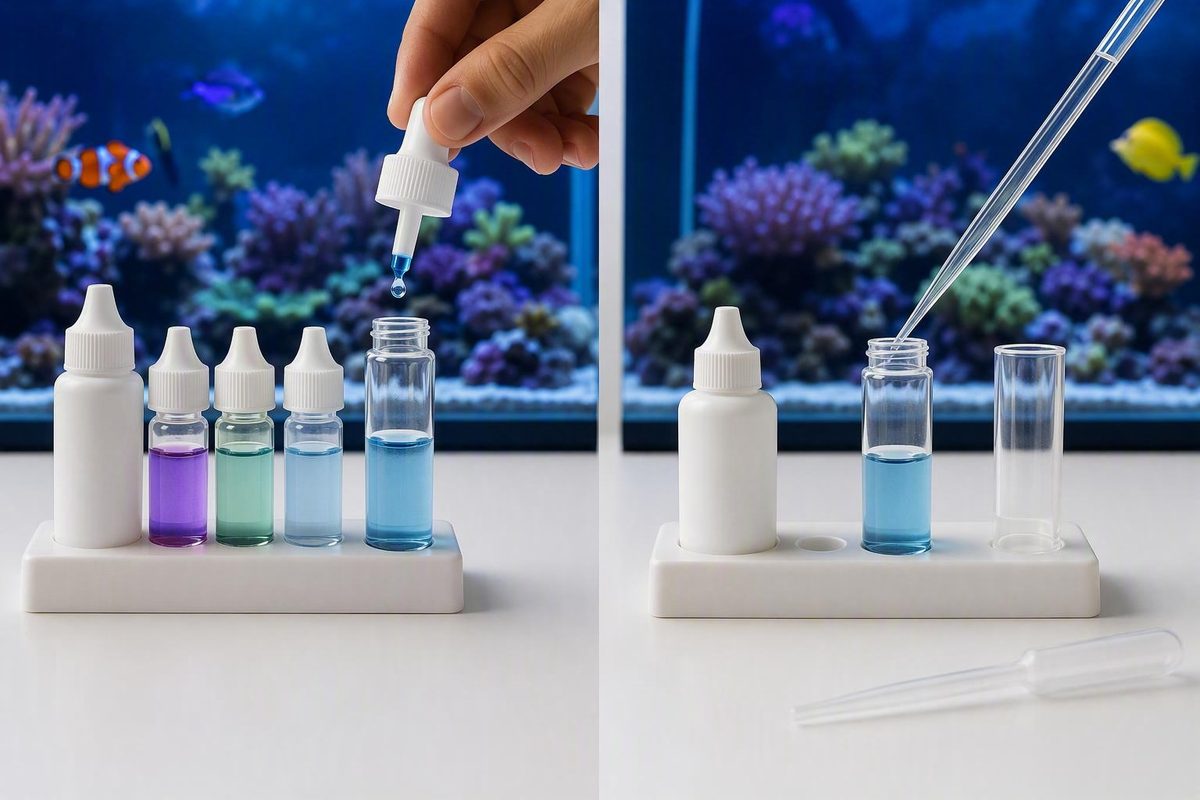
Using one sample volume with the other conversion makes the result wrong by a factor of two. Marine Care counts drops; Pro uses syringe volume and its kit chart.
Red Sea KH test instructions are not interchangeable. The Marine Care KH test calculates alkalinity by counting indicator drops, while the KH/Alkalinity Pro test calculates it from the volume of titrant dispensed from a syringe.
Before testing, identify the exact product name and keep the instruction card packaged with that kit beside you. That card—not a generic color description from a video, retailer, or forum—controls the endpoint and conversion method.
Before You Begin: Determine Which Red Sea KH Test You Have
Do not combine Red Sea KH procedures. Marine Care users count indicator drops and multiply. Pro users measure titrant dispensed from a syringe and consult the chart supplied with that exact kit. Do not apply Marine Care multipliers or overdose corrections to a Pro syringe reading.
Identify the test by the way it produces a result:
- Marine Care KH: Add indicator one drop at a time, count every drop required to reach the endpoint, and multiply the count by the factor for the selected sample volume.
- KH/Alkalinity Pro: Dispense titrant from a graduated syringe, calculate how much was used, and convert that volume with the chart supplied with the kit.
The documented Marine Care procedure is a drop-count method. Red Sea’s KH/Alkalinity Pro how-to page instead identifies the Pro product as an advanced titration test and links to a demonstration, but the page does not publish a complete written procedure.
| Identification point | Marine Care KH | KH/Alkalinity Pro |
|---|---|---|
| Workflow | Add indicator one drop at a time | Dispense titrant from a graduated syringe |
| Sample handling | Choose one of the two documented sample-volume methods | Use the sample volume stated on the current Pro card |
| Result method | Count drops and multiply | Calculate syringe volume used and consult the current chart |
| Controlling reference | Marine Care instruction card and manual | Card, endpoint reference, and chart supplied with the exact Pro kit |
Do not rely on package color, bottle shape, model-number assumptions, or accessory arrangement to identify the procedure. Read the exact product name and confirm whether the result comes from counted drops or syringe volume.
Endpoint colors also should not be generalized across every Red Sea alkalinity test. Online sources mention card-defined endpoint and overdose colors, pale green or yellow, and a blue-to-red transition. These descriptions may concern different products, generations, or reagent formulations; they are not one universal color sequence.
If the product name or instruction card is missing, pause rather than improvising. Obtain the correct instructions before adding reagent.
Prepare the Sample and Test Equipment for a Repeatable Result
Good technique begins before the titration. Keep the equipment and preparation steps for the two workflows separate.
Marine Care preparation
- Rinse the glass vial with water from the aquarium being tested.
- Rinse the large measuring syringe with the same aquarium water.
- Select the documented sample-volume method you intend to use.
- Measure that volume exactly.
- Keep the Marine Care color card within reach.
- Hold the indicator bottle vertically when dispensing drops.
The sample volume determines the value represented by each drop. A roughly filled vial is not sufficient. Measuring one sample volume and calculating as though you used the other will produce a result that is wrong by a factor of two.
A vertical bottle position helps produce consistent drops. Avoid tilting the bottle sideways, touching its tip to the vial, or squeezing it aggressively.
Pro-style syringe preparation
The historical Pro demonstration uses a different setup:
- Measure the sample volume specified for that version.
- Attach the syringe tip firmly.
- Draw titrant into the syringe.
- Align the designated plunger stopper with the specified starting graduation.
- Read the plunger position rather than the visible liquid level.
An air gap may remain in the syringe even when the plunger is aligned correctly. In the demonstrated setup, reagent held inside the attached tip compensates for that gap. Do not draw extra reagent merely to force the visible liquid to the starting line.
Because kit versions can differ, verify the sample volume, syringe-filling method, endpoint, and conversion chart against the card packaged with your current Pro kit.
For either workflow, use consistent lighting and keep the supplied color reference nearby. White material behind the vial may make a subtle transition easier to see, but it is only a visibility aid. It does not define the endpoint or replace the kit card.
Marine Care KH Test: Verified Step-by-Step Instructions
This procedure is specifically for the Red Sea Marine Care KH drop-count test. The official manual specifies the exact sample volumes, resolution, drop sequence, mixing time, and endpoint process described below. It is not the procedure for a KH/Alkalinity Pro syringe kit. (Marine Care Program user manual)
-
Measure the aquarium-water sample. Use the supplied syringe to place exactly 10 mL of aquarium water into the vial for 0.5 dKH resolution, or exactly 5 mL for 1 dKH resolution.
-
Draw KH indicator into the dropper. Prepare enough indicator to complete the test without changing methods midway through the titration.
-
Add the first drop. Hold the reagent bottle vertically, add one drop, and shake the vial for 10 seconds. The sample should reach the start color shown on the instruction card.
-
Continue one drop at a time. Add one indicator drop and shake for 10 seconds. Repeat this add-and-mix sequence after every drop rather than adding several drops before mixing.
-
Stop at the card-defined endpoint. Continue until the sample matches the endpoint printed on the Marine Care instruction card.
-
Count every drop. Include the first drop in the total. The complete drop count is used in the calculation.
-
Return unused indicator and close the bottle. Return unused indicator to its bottle as directed and close the reagent tightly.
Endpoint warning: Match both the endpoint and overdose colors against your physical Marine Care card. Screens, photographs, and verbal color descriptions may not reproduce those colors accurately.
Do not substitute:
- A Pro syringe-volume conversion chart
- A forum instruction such as “stop at pale green”
- A generic blue-to-red endpoint
- The Pro syringe air-gap procedure
- A calculation based on the indicator remaining in the Marine Care dropper
Mixing is part of the test. If you judge the color immediately after adding a drop without completing the required shaking, the vial may not show a fully mixed endpoint. Shake for the full time after every drop, including the final drop being evaluated.
Calculate the Marine Care Result in dKH or meq/L
For Marine Care, the calculation depends entirely on whether you used the 10 mL or 5 mL sample method. The per-drop factors and overdose adjustments below are documented for this drop-count procedure. (Marine Care test instructions)
| Marine Care sample | Resolution | dKH calculation | meq/L calculation | Overdose correction |
|---|---|---|---|---|
| 10 mL | 0.5 dKH per drop | Drops × 0.5 dKH | Drops × 0.18 meq/L | Subtract 0.25 dKH or 0.09 meq/L |
| 5 mL | 1 dKH per drop | Drops × 1 dKH | Drops × 0.36 meq/L | Subtract 0.5 dKH or 0.18 meq/L |
These factors must not be applied to a Pro syringe test.
10 mL worked example
If a 10 mL sample reaches the endpoint after 16 drops:
16 drops × 0.5 dKH = 8.0 dKH
In meq/L:
16 drops × 0.18 meq/L = 2.88 meq/L
5 mL worked example
If a 5 mL sample reaches the endpoint after 8 drops:
8 drops × 1 dKH = 8 dKH
In meq/L:
8 drops × 0.36 meq/L = 2.88 meq/L
The 10 mL option provides finer resolution because each drop changes the result by 0.5 dKH. The 5 mL option uses less sample water but reports in coarser 1 dKH increments. Both use the same fundamental drop-count workflow.
Marine Care overdose correction
Apply the correction only if the final drop produces the overdose color shown on the Marine Care card, rather than the endpoint color:
- For a 10 mL sample, subtract 0.25 dKH or 0.09 meq/L.
- For a 5 mL sample, subtract 0.5 dKH or 0.18 meq/L.
For example, if 16 drops in a 10 mL sample produce the overdose color:
16 × 0.5 dKH = 8.0 dKH
Then apply the correction:
8.0 − 0.25 = 7.75 dKH
If 8 drops in a 5 mL sample produce the overdose color:
8 × 1 dKH = 8 dKH
Then:
8 − 0.5 = 7.5 dKH
Do not invent an intermediate correction for a color that is difficult to classify. If you cannot determine whether the vial matches the endpoint or overdose reference, repeat the test under better viewing conditions.
Keep these concepts separate:
- Resolution: The smallest reporting step built into the method—0.5 or 1 dKH for the two Marine Care options.
- Claimed accuracy: A manufacturer’s statement about how closely a method measures the true value.
- Measured result: The number produced by this particular test.
- Chosen aquarium target: The alkalinity level the aquarist intends to maintain.
A measured value does not, by itself, establish the correct target or determine how much supplement to add.
KH/Alkalinity Pro Test: What the Available Demonstration Supports
Important limitation: A complete current manufacturer-written Pro procedure and conversion chart are not reproduced here. The workflow below comes from a 2015 Vivid Aquariums demonstration. Use it to understand the syringe method—not as a replacement for the current card, endpoint reference, and chart packaged with your exact kit.
The historical demonstration shows this workflow:
-
Measure 10 mL of aquarium water. This was the sample volume used in the demonstrated version. Confirm the volume against your current card.
-
Attach the syringe tip firmly. The presenter states that the tip must be seated firmly for an accurate reading.
-
Fill and align the syringe. Position the designated plunger stopper at the 1.00 mL mark. Do not use the visible liquid surface as the filling reference.
-
Accept the expected air gap. Reagent held in the attached tip compensates for the visible gap in the syringe barrel. Do not overfill the syringe in an attempt to remove it.
-
Add titrant while swirling. When learning the procedure or testing an unfamiliar sample, add titrant drop by drop. Once the expected range is familiar, it may be added more quickly at first, but delivery should slow near the endpoint.
-
Stop at the endpoint defined by the current kit. The historical demonstration describes a blue-to-red transition. Do not assume that this endpoint applies to every Pro generation or reagent formulation.
-
Read the designated plunger stopper. Use the graduated syringe scale to determine how much titrant remains.
-
Calculate the total reagent used. Subtract the final syringe reading from the 1.00 mL starting position.
-
Consult the chart supplied with the exact kit. Convert the volume used into alkalinity with the chart packaged with the current reagents.
In the demonstration, the syringe started at 1.00 mL and ended at 0.47 mL:
1.00 mL − 0.47 mL = 0.53 mL used
The demonstrated chart interpreted 0.53 mL used as approximately 7.3 dKH. That conversion belongs only to the historical kit and chart shown in the video; it is not a universal formula or a substitute for a current conversion chart. (Historical Pro example)
Do not count Pro drops and multiply them by 0.5 or 1 dKH. Do not apply the Marine Care overdose correction after passing a Pro endpoint. If a Pro titration is overshot, follow the current kit instructions or repeat the test rather than applying an unsupported subtraction.
Endpoint and Consistency Troubleshooting
If repeated results disagree, check likely sources of error in a fixed order. Do not average readings that were produced with different sample volumes, endpoints, or visibly different technique.
1. Wrong procedure for the kit
Confirm how the result is supposed to be obtained:
- Marine Care: count drops and multiply.
- Pro: calculate syringe volume used and consult the current chart.
A test can look technically neat while still using the wrong calculation.
2. Inaccurate sample volume
Measure the sample with the supplied equipment rather than judging it by eye. Marine Care’s two sample volumes have different per-drop conversions. For Pro, use the volume stated on the current card rather than assuming that a historical demonstration applies.
3. Residue in the vial
Start with a properly cleaned vial and complete the kit-specific rinsing procedure before measuring the sample.
4. Angled Marine Care bottle
Hold the reagent bottle vertically. Changing the angle or squeezing force can make drop delivery less consistent.
5. Insufficient mixing
For Marine Care, shake for the specified time after every indicator drop. For Pro, swirl as directed while delivering titrant. Do not judge the endpoint before the sample is fully mixed.
6. Loose Pro syringe tip
Seat the tip firmly before aligning the plunger. A loose or incompletely attached tip undermines the demonstrated measurement setup.
7. Incorrect plunger reading
In the demonstrated Pro workflow, read the designated stopper on the plunger—not the visible liquid level. The air gap does not automatically indicate missing reagent.
8. Endpoint overshoot
Slow to individual drops as the expected transition approaches. Mix after each addition and compare the vial with the supplied endpoint reference before adding more titrant.
A 2018 Reef2Reef discussion suggests holding the vial against the target card with white material behind it. This may improve visibility, but the thread mixes advice for different kits and includes conflicting endpoint descriptions. Treat the white background as a viewing aid, not official endpoint guidance.
Do not combine descriptions such as pale green, yellow or overdose, and blue-to-red into one progression:
- For Marine Care, use the endpoint and overdose references on the Marine Care card.
- For Pro, use the endpoint reference packaged with the exact reagents and conversion chart.
- Do not let an older video or forum comment override the instructions for your current kit.
If Marine Care reaches the card-defined overdose color, apply only the documented correction for the selected sample volume. No universal Pro overshoot correction is established here; repeat the test or follow the current Pro instructions.
A simple log can help trace discrepancies. Record:
- Exact kit name or version
- Sample volume
- Drop count, or starting and final syringe readings
- Endpoint judgment
- Whether the Marine Care overdose color was reached
- Result after any documented correction
- Duplicate result
- Setup problems such as residue or a loose syringe tip
If duplicate results disagree, repeat the setup checks and perform another careful test. Do not create an unsupported tolerance or average results that ended at visibly different colors.
Clean, Store, and Use the Result Without Overcorrecting the Tank
For Marine Care equipment, rinse the syringes and vials with RO or distilled water after testing and before storage. Residue in an unwashed vial can affect later results; the manual recommends a mildly acidic solution such as vinegar for removing deposits.
Close the reagents tightly immediately after use. Store them closed at 15–25°C, and protect both the reagents and color card from prolonged light exposure. These are Marine Care instructions and should not be assumed to apply identically to every Pro generation. (Marine Care cleaning and storage guidance)
Once you have a result, separate measurement from tank correction. A valid KH reading does not by itself determine:
- The appropriate target for your aquarium
- Whether one unexpected result represents a real change
- How quickly alkalinity changed
- Which supplement to use
- How much supplement to add
Red Sea states that the Pro test can support Reef Foundation B dosing, but its how-to page does not provide a dosing calculation or complete supplement safety protocol. Confirm an unexpected measurement and consult the current Reef Foundation B instructions before dosing. Do not calculate a dose from the historical 0.53 mL test example or from the Marine Care per-drop multipliers. (Red Sea Pro overview)
For general parameter context beyond test mechanics, you can browse Reef Directory’s water-chemistry and aquarium articles. Keep the question of what target to maintain separate from whether the KH measurement was performed correctly.
The practical recap has two paths:
- Marine Care: Measure the correct sample volume, dispense vertical drops, shake for 10 seconds after every drop, count all drops, and apply the documented multiplier. Use the overdose correction only when the vial matches the card’s overdose color.
- Pro: Prepare and read the syringe according to the current kit, calculate the titrant volume dispensed, and use the endpoint and conversion chart supplied with that exact kit.
Correct kit identification matters more than a generic online color description. Obtain and confirm a valid measurement before deciding whether the aquarium needs buffer.
Should I count drops or read the Red Sea KH syringe?
Count drops only with the Marine Care KH procedure. Multiply the total drop count by the factor for the sample volume used.
For a KH/Alkalinity Pro test, calculate the volume dispensed from the syringe and convert it with the chart supplied with the exact kit. Do not count Pro drops or apply Marine Care multipliers.
Why is there an air gap in the Pro test syringe?
In the demonstrated Pro setup, the attached tip contains titrant that compensates for the visible air gap in the syringe barrel. The designated plunger stopper—not the liquid surface—is aligned with the required starting graduation.
Attach the tip firmly and do not overfill the syringe merely to remove the gap. Confirm the setup against the instructions for your current Pro version.
What color is the endpoint for a Red Sea alkalinity test?
There is no reliably established universal endpoint color for every Red Sea alkalinity kit. Marine Care uses endpoint and overdose colors printed on its supplied card, while the older Pro demonstration describes a blue-to-red transition. Online discussions introduce other descriptions, sometimes inconsistently.
Use the endpoint reference packaged with your exact kit and reagent formulation. A verbal color description or white background may help you view the vial, but neither replaces the card.
What should I do if the Marine Care test reaches the overdose color?
Use the documented correction for the sample volume:
- For a 10 mL sample, subtract 0.25 dKH or 0.09 meq/L.
- For a 5 mL sample, subtract 0.5 dKH or 0.18 meq/L.
Apply the correction only when the final color matches the Marine Care card’s overdose reference. Do not apply it to a Pro syringe test. (Documented Marine Care correction)
Can I use my KH result to calculate a Reef Foundation B dose?
A confirmed KH result may inform a dosing decision, and Red Sea describes the Pro kit as supporting Reef Foundation B dosing. The test result alone, however, does not establish the required supplement quantity or a safe dosing schedule.
Confirm the measurement and follow the current Reef Foundation B instructions for your product and aquarium. Do not derive a dose from a Marine Care drop count, an older Pro conversion example, or a generic alkalinity target alone.