
Unlocking Orange Fish Eggs: From Crunchy Tobiko on Sushi to Natural Aquarium Feeds
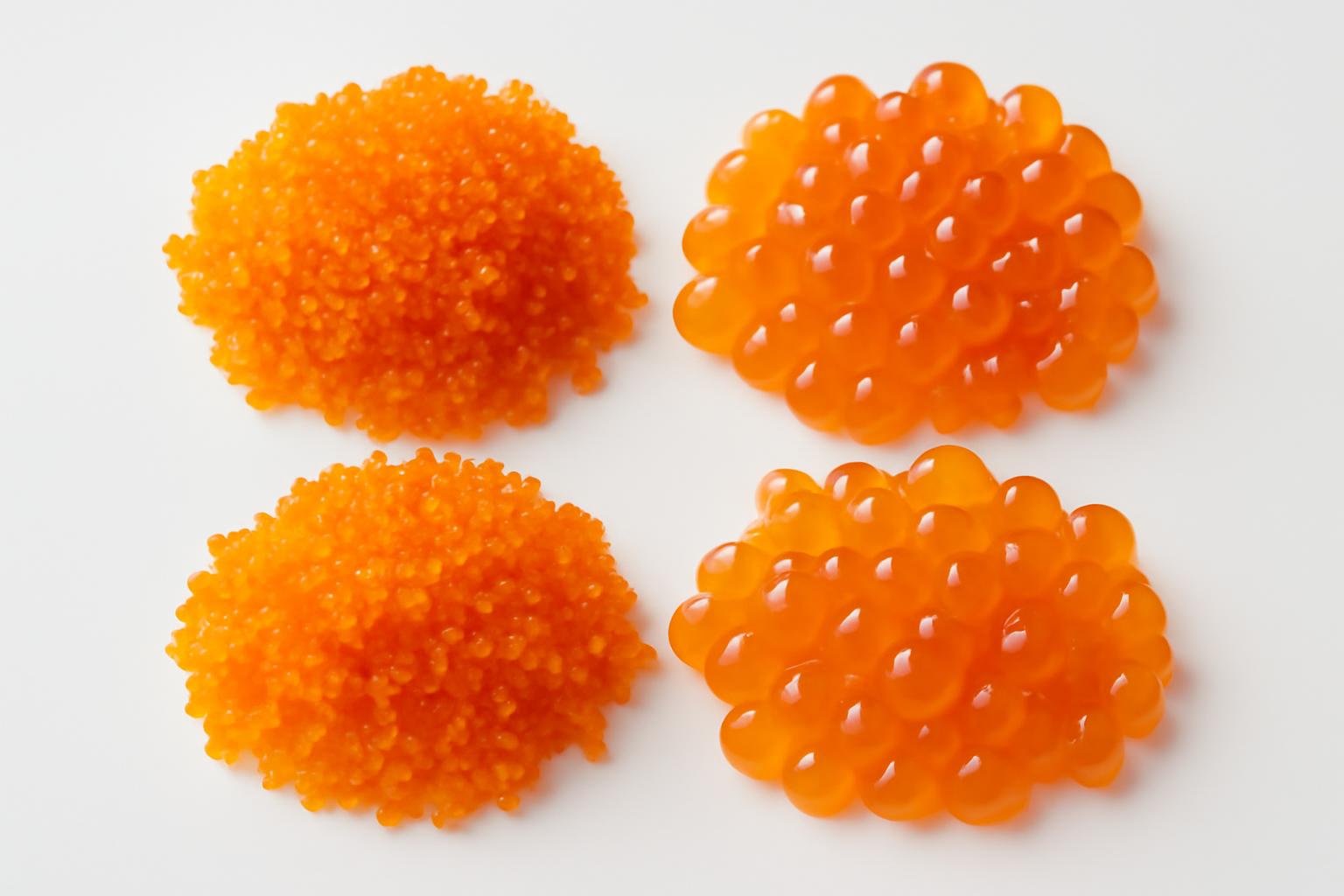
Very small eggs scattered over a sushi roll point first to tobiko. Distinguish ikura, masago and trout roe by size, texture, species and the label.
Orange fish eggs are not one single ingredient. In everyday food use, the phrase usually refers to orange or orange-tinted fish roe from species such as flying fish, salmon, trout, capelin, and carp. On sushi, the two forms most people notice first are the tiny crunchy eggs called tobiko and the much larger orange salmon roe called ikura.
That broad use is also why the category causes confusion. A bright orange garnish on a sushi roll might be flying fish roe, but a bright orange mound on top of rice is more likely salmon roe. A product sold as “orange caviar” may not be caviar in the strict sense at all. And in stores, similar-looking orange roe products can differ quite a bit in size, texture, additives, and species.
The easiest way to make sense of orange fish eggs is to sort them by four practical clues:
- Species
- Size
- Texture
- Labeling
Color helps, but it is not the best first test because some roe is naturally orange while some is dyed or otherwise color-adjusted for presentation.
This guide focuses first on the main culinary question—what orange fish eggs usually are, how tobiko differs from ikura and masago, and how to buy and handle them—then closes with a clearly secondary niche topic: their occasional use in reef aquariums.
What Are Orange Fish Eggs?
In common usage, orange fish eggs usually means non-sturgeon roe. The orange roe category commonly includes products from flying fish, salmon, trout, capelin, and carp. These eggs vary widely in size, texture, and flavor, so two orange roes can look similar at a glance but behave very differently on the plate.
The first distinction to keep clear is this:
- Roe is the general culinary term for fish eggs.
- True caviar is, in the strict sense, salt-cured sturgeon roe.
So tobiko, ikura, masago, and trout roe are all types of fish roe, but they are not true caviar unless they come from sturgeon. Retailers do sometimes use phrases like “orange caviar” for non-sturgeon products, but that is broader market language, not the strict definition.
That distinction matters because it explains why orange roe is often positioned as a more accessible alternative to sturgeon caviar. It can still be a premium ingredient, but it belongs to a different category.
For most readers, orange fish eggs show up in two very recognizable forms:
- Tiny orange eggs with a crisp pop, usually tobiko on sushi rolls
- Large orange salmon eggs, usually ikura, served more prominently
Those two examples explain a lot of menu confusion. If the eggs are extremely small and scattered as a garnish or roll coating, tobiko is the likely first guess. If the eggs are large enough to stand out individually on top of rice or in a small spooned serving, salmon roe is much more likely.
Orange roe also appears outside sushi. Specialty food sellers group salmon, trout, flying fish, and carp-based products together because they share a similar orange or reddish-orange appearance and are used in garnishes, appetizers, and spreads. But color by itself does not identify the species. The same bright orange look can cover very different products.
In short, “orange fish eggs” is best understood as a visual and culinary category, not a single species.
Tobiko: The Crunchy Flying Fish Roe
Tobiko is the Japanese culinary term most commonly used for flying fish roe. It is one of the best-known orange roes because it is so closely associated with sushi presentation.
Several references describe tobiko eggs as very small, around 0.5 to 0.8 mm. That makes them larger than masago but still small enough to coat sushi rolls, top gunkan, or be scattered as a finishing garnish. The defining trait, though, is not size alone. Tobiko is widely described as having a firm, crunchy pop.
That texture is what makes tobiko useful in sushi. It contributes more than color. On a roll with soft rice, avocado, or seafood salad, tobiko adds a crisp surface texture that stands out immediately.
Why tobiko is orange
Tobiko is commonly described as having a natural red-orange or reddish-orange color. So orange tobiko does not need artificial coloring to exist. But not every orange tobiko product on the market relies only on natural pigment.
Some commercial orange tobiko products include added colorants. One product label lists:
- FD&C Yellow #6
- FD&C Red #40
That does not mean all tobiko is dyed. It means shoppers should not assume that every vivid orange tobiko product gets its color solely from the roe itself. If color additives matter to you, the ingredient panel matters more than the front label.
How tobiko is sold and presented
Commercial tobiko is often more than plain roe. Product labels can include ingredients such as:
- Salt
- Sugar
- D-sorbitol
- Color additives
Because of that, two tubs labeled “tobiko” may taste and handle differently even when both come from flying fish.
Tobiko is also not always orange. Sushi references commonly mention colored versions such as:
- Black tobiko, often linked with squid ink
- Green tobiko, often associated with wasabi-style seasoning
- Pale orange or yellowish tobiko, sometimes associated with yuzu
- Red variants
These are still tobiko; the color change mainly affects presentation and, in some cases, flavoring.
Species and sourcing: what can and cannot be said broadly
One commercial orange tobiko listing identifies the roe as coming from Cypselurus heterurus and describes it as wild-caught from tropical or subtropical waters. That is useful as an example of how one product is labeled. It should not be treated as a universal species claim for all tobiko sold in all markets.
In practice, the safest reader-facing rule is simple: if you care about exact species, origin, or additives, rely on the specific product label, not the generic word tobiko.
Common culinary uses for tobiko
Tobiko is usually used as a finishing ingredient rather than a bulk ingredient. Common uses include:
- Maki rolls
- California rolls
- Gunkan sushi
- Sashimi presentations
- Avocado-based presentations
- Poke bowls
- Salads
- Canapés and hors d’oeuvres
- Some sauces or finishing garnishes
Because the eggs are so small and firm, tobiko is especially effective where the goal is surface texture and visual contrast.
Common source of confusion
Tobiko is often confused with masago, and some sellers or restaurants may use masago as a cheaper substitute. Other references note that tobiko may sometimes be mixed with or replaced by dyed herring eggs. That is why species labeling matters. If authenticity is important, do not identify tobiko by color alone.
Ikura and Salmon Roe: Large Orange Pearls
Ikura is the Japanese term commonly used for salmon roe, especially when it is cured or prepared for serving. In sushi settings, it is the classic example of the large orange eggs many diners think of first.
The visual difference from tobiko is immediate. Ikura appears as large orange spheres, while tobiko appears as much smaller eggs. If the roe is large enough to notice individual beads clearly from across the plate, salmon roe is the more likely answer.
Texture is the next major distinction. Ikura is commonly described as:
- Soft
- Juicy or gooey inside
- Less crunchy than tobiko
- More prominent as an individual bite
That texture changes how it is used. Tobiko is often a coating or accent. Ikura is usually served where the roe itself is meant to be the main feature.
Flavor and preparation
Flavor descriptions for roe are inherently subjective, so they are best treated as common impressions rather than fixed facts. Ikura is often described as briny, salty, and slightly sweet. Some sushi references describe cured ikura in the context of a Japanese seasoning method involving soy sauce, dashi, and sake.
The main practical point is that ikura delivers a larger, softer bite than tobiko.
Where ikura is used
Ikura commonly appears:
- On gunkan sushi
- Spooned over sushi rice
- In small appetizer portions
- On plated bites where the roe is meant to be noticed immediately
Because the eggs are large and soft, ikura is not usually used the same way as tobiko on the exterior of rolls.
Market labeling and origin notes
Retail listings in the orange-roe category commonly include salmon roe products from places such as the United States, Alaska, and Canada. Those examples are useful for shoppers because they show how salmon roe is often marketed in North American specialty food contexts. They should still be read as product examples, not as a rule for every salmon roe product.
Ikura is not true caviar
Ikura is sometimes casually called caviar because it looks luxurious and is served as glossy cured roe. But in strict terminology, it is still salmon roe, not sturgeon caviar.
For menu reading and shopping, that means a specific request matters. If you want the large orange salmon eggs used in Japanese cuisine, ask for ikura or salmon roe, not just “caviar.”
The short practical contrast with tobiko
The quickest comparison is:
- Species: ikura is salmon roe; tobiko is flying fish roe
- Size: ikura is much larger
- Texture: ikura is soft and bursting; tobiko is firmer and crunchier
Those three points identify most restaurant presentations correctly.
Masago, Trout Roe, and Other Orange Varieties
Tobiko and ikura are the best-known orange roes in sushi discussions, but they are not the only orange fish eggs people encounter.
Masago
Masago is capelin roe. It is the roe most often confused with tobiko because both are small, both are used in sushi, and both may appear orange in finished dishes.
Compared with tobiko, masago is commonly described as:
- Smaller
- Softer
- Paler
- More yellow than orange in its natural appearance
That last point matters. Some references include masago under the orange-roe umbrella, while others stress that it is naturally pale yellow and often dyed brighter for sale. Those ideas are not contradictory. A natural masago product may look yellowish, while a prepared sushi garnish may be much more orange because of coloring or seasoning.
Masago is also frequently used as a substitute for tobiko because it is generally cheaper and visually similar enough for many casual diners. But the texture is different. Tobiko is usually the firmer, crunchier option. Masago is typically finer and softer.
Retail naming can make this more confusing. Some sellers use mixed labels that combine terms like tobico and capelin in the same product name. If the roe comes from capelin, it is best understood as masago regardless of branding shortcuts.
Trout roe
Trout roe is another important orange roe in specialty food markets. Retail and culinary references describe it as bright orange. In size and appearance, trout roe often sits between tobiko and some salmon roe products, though exact size depends on the trout species and the preparation.
Common flavor descriptions include savory and sometimes smoky notes, but those should be read as typical descriptions rather than exact rules.
For identification, the useful point is this: trout roe usually looks like a more substantial bead than tobiko, while still not always matching the larger scale associated with ikura.
Carp and tarama-type products
Some orange-roe retail categories also include carp-based products, including tarama. These are less central to standard sushi identification, but they show how broad the orange-roe category can be. Not every orange roe product is intended for sushi. Some belong more naturally to spreads, dips, or appetizer traditions outside Japanese cuisine.
Substitutions and look-alikes
Orange roe can be misidentified or loosely labeled in several ways. Depending on the seller or restaurant, a product may be:
- Genuine flying fish roe
- Capelin roe used in place of tobiko
- Dyed masago
- Dyed herring eggs sold for a similar look
- A roe product marketed with loose “caviar” language
That does not mean every product is deceptive. It means the buyer should not rely on color alone.
The most useful checks are:
- Species name
- Ingredient list
- Egg size
- Whether colorants are listed
If the eggs are very fine and naturally pale unless colored, masago is a strong possibility. If they are tiny but firmer and clearly sold as flying fish roe, tobiko is more likely. If they are distinctly larger and bright orange, trout roe or salmon roe becomes more plausible.
Key Differences: Size, Texture, Color, and Taste
If you want the fastest way to tell orange fish eggs apart, use this order:
- Size
- Texture
- Color
- Taste
Color is helpful, but it is also the easiest feature for processors to change.
Here is a practical comparison of the main types most readers encounter.
| Roe type | Fish source | Relative size | Texture | Typical color | Common flavor descriptions |
|---|---|---|---|---|---|
| Ikura | Salmon | Largest | Soft, bursting, juicy | Orange to reddish-orange | Briny, salty, slightly sweet |
| Tobiko | Flying fish | Smaller than ikura, larger than masago; often described around 0.5-0.8 mm | Firm, crunchy, popping | Natural red-orange; may also be color-adjusted or sold in other shades | Salty, mildly smoky |
| Masago | Capelin | Smallest of the three | Softer, finer, less crisp | Pale yellow to yellow-orange; often dyed brighter | Mild, sometimes slightly bitter |
| Trout roe | Trout | Often larger than tobiko; can approach salmon-roe scale depending on product | Tender, popping | Bright orange | Savory, sometimes smoky |
Size
Size is the clearest visual clue.
- Ikura is the largest
- Tobiko is smaller
- Masago is the smallest
If the roe looks like a coating of very fine eggs on a roll, you are probably looking at tobiko or masago. If the roe appears as clearly distinct large beads served in a mound or topping, it is much more likely to be ikura.
Texture
Texture usually confirms what size suggests.
- Tobiko has the most obvious crunchy pop
- Ikura is soft and juicy
- Masago is generally softer and finer than tobiko
This is why tobiko and masago are often confused visually but not texturally.
Color
Color helps, but it needs context.
- Tobiko is naturally red-orange or reddish-orange, though some products are color-enhanced
- Ikura is commonly orange to reddish-orange
- Masago is often paler and more yellow, but it is frequently dyed brighter for presentation
- Trout roe is often described as bright orange
A dyed masago product can look more vivid than a natural tobiko product, so color alone can mislead.
Taste
Taste is the least precise clue because descriptions vary by cure, seasoning, and brand. Still, a few broad patterns show up consistently in culinary references:
- Tobiko is often described as salty and mildly smoky
- Ikura is often described as briny and slightly sweet
- Masago is usually described as milder, sometimes with a faint bitter edge
- Trout roe is often described as savory and sometimes smoky
It is best to treat these as common descriptions, not hard rules.
A quick identification rule
For real-world menu reading, this shorthand works well:
- Tiny crunchy orange eggs on a roll: probably tobiko
- Very small, softer, pale-to-orange eggs often used as a cheaper substitute: probably masago
- Large soft orange salmon eggs served prominently: probably ikura
Culinary Uses for Orange Fish Roe
Orange fish roe is used most visibly in sushi, but it is not limited to sushi.
In sushi
This is the setting most readers know best.
- Tobiko is commonly used on the outside of maki rolls for color and crunch
- It also appears on California rolls, gunkan, and some sashimi presentations
- Ikura is commonly served on gunkan sushi or spooned over rice
- Masago appears in many of the same roles as tobiko, especially when a softer, lower-cost alternative is acceptable
In sushi, orange roe usually contributes two things at once:
- A visual highlight
- A texture contrast
That is especially true with tobiko, which changes the feel of a roll as much as its appearance.
Beyond sushi
Orange fish eggs also appear in other dishes and finishing applications, including:
- Poke bowls
- Salads
- Canapés
- Appetizers
- Seafood plates
- Avocado-based bites
- Some sauces or plated garnishes
Tobiko is especially useful where a cook wants a light scattering of crisp eggs across the surface of a dish. Ikura works better where the roe should read as an intentional topping rather than a fine garnish. Trout roe can occupy a middle position between those two styles.
How home cooks can use roe well
For most home uses, roe works best as a finishing ingredient. Heat can work against the qualities people usually buy it for: clear bead structure, bright appearance, and distinct texture.
A relatively small amount can be enough to:
- Add a salty accent
- Introduce texture contrast
- Improve plating visually
- Turn a simple bite into something more composed
Because of that, orange roe is often more effective when used sparingly than when mixed heavily into a dish.
Where shoppers typically find it
Depending on the market, orange roe may be sold:
- In the seafood department
- In refrigerated specialty cases
- In jars or tubs
- In some stores, as canned roe near the seafood section
- Online, often in frozen or chilled form
One grocery reference specifically places canned flying fish eggs near the seafood department. That is useful because shoppers often look in the wrong part of the store first.
Buying, Storage, and Handling Orange Roe
Buying orange roe is not just about choosing between tobiko, ikura, masago, or trout roe. It is also about reading the label carefully and understanding how the product is packaged.
Orange roe is commonly sold in forms such as:
- Frozen tubs
- Plastic containers
- Jars
- Refrigerated specialty items
- Some canned products
What to check before buying
Before comparing brands on price or appearance, check these basics:
-
Species Is it flying fish, salmon, capelin, trout, carp, or something else?
-
Ingredient list Is it mostly roe and salt, or does it also include sweeteners, humectants, or color additives?
-
Packaging form Frozen, refrigerated, jarred, or canned?
-
Intended use Roll coating, topping, appetizer service, or general garnish?
These checks matter because a vividly orange product sold as “tobiko” may contain added colors, and a cheaper substitute may in fact be masago.
Why the ingredient list matters
Commercial tobiko labels can include more than roe and salt. One orange tobiko product lists:
- Flying fish roe
- Sugar
- D-sorbitol
- Salt
- FD&C Yellow #6
- FD&C Red #40
That does not automatically make the product undesirable. It simply means that “orange fish eggs” covers a wide range—from relatively straightforward roe to more heavily processed garnish products.
Thawing and cold storage
Where roe is sold frozen, the clearest handling instruction in the evidence is to thaw it under refrigeration rather than at room temperature.
One commercial orange tobiko listing also warns that repeated freeze-thaw cycles reduce texture and flavor. Even without extending that into a universal rule for all roe products, it is a useful quality guideline for delicate cured eggs.
Shelf-life guidance: use the product label first
One detailed tobiko product listing gives these storage timelines:
- Up to 12 months frozen, unopened
- About 1 week thawed and unopened under refrigeration
- About 2 to 3 days after opening
Those numbers are best treated as product-specific label guidance, not as a universal shelf-life rule for all roe. Salt level, packaging, and processing vary. For that reason, the safest practice is to follow the instructions attached to the exact product you buy.
Allergen and raw-seafood cautions
Product labeling also matters for safety. One commercial orange tobiko listing states:
- Contains fish
- There is a risk of foodborne illness from raw seafood
Those are not reasons to avoid roe automatically, but they are reminders that roe should be handled as a perishable seafood product and that fish allergies remain relevant even when the food is served in small amounts.
A practical shopping summary
When in doubt, prioritize:
- Clear species labeling
- Short, understandable ingredient lists
- Cold-chain integrity
- The seller’s storage instructions for that exact product
For orange roe, the label often tells you more than the front-of-package name.
Orange Roe as Aquarium Fish Food
For most readers, this is a secondary topic rather than the main reason to look up orange fish eggs. But it does come up in reef keeping.
In aquarium discussions, fish roe is sometimes used as a natural supplemental feed for marine fish and other tank inhabitants. Forum discussions and commercial aquarium-food references mention roe such as:
- Capelin roe (masago)
- Atlantic cod eggs
- Saithe or pollock eggs
- Other fish eggs used in prepared aquarium foods
Some hobbyists and product discussions describe roe as a rich natural food containing protein, fat, carbohydrates, vitamins, minerals, and trace elements. That framing comes from hobbyist discussion and aquarium-product context, not from controlled feeding evidence in the material here, so it should be read cautiously.
What the evidence supports—and what it does not
What can be said with reasonable confidence from the available material is narrow:
- Roe is used by some hobbyists as a supplemental aquarium food
- Commercial aquarium foods may use cod and saithe/pollock eggs
- Some hobbyists also use market roe such as masago
- Reports of success are largely anecdotal
What the evidence does not support is a strong claim that roe is a proven complete or superior diet for marine aquariums.
Hobbyist preparation methods
Forum discussions mention a few practical methods:
- Chop egg sacs with a knife or scissors
- Avoid heavy blending
- Freeze in small portions
- Use flat sheets or cube-style servings for convenience
If hobbyists use market masago or other human-food roe, some recommend caution because such products may be dyed or seasoned. One forum discussion specifically mentions rinsing market masago for that reason.
Freshwater roe for saltwater fish: a debated point
Another hobbyist question is whether freshwater roe can be fed to saltwater fish. Forum discussion suggests no settled agreement.
The available material shows three things:
- Some hobbyists report freezing and feeding wild freshwater bass eggs
- Some recommend saltwater-sourced fish eggs instead
- Others raise concerns about nutritional differences, including fat profile, if freshwater eggs are used too heavily
That means the cautious takeaway is limited: freshwater roe is used by some hobbyists, but the evidence here does not justify calling it a proven best practice for marine tanks.
Bottom line for aquarium readers
If orange roe is used in a reef setting, the most defensible description is this: it is a niche, hobbyist-reported supplemental feed, not a firmly established nutritional standard.
FAQ
Is tobiko naturally orange or dyed?
Both are possible.
Tobiko is commonly described as having a natural red-orange to reddish-orange color, so orange tobiko does not have to be dyed. At the same time, some commercial orange tobiko products list added colorants such as FD&C Yellow #6 and FD&C Red #40. Colored tobiko variations such as black, green, and pale orange are also common.
So the practical answer is: tobiko can be naturally orange, but some products are color-enhanced.
Tobiko vs masago: which is crunchier?
Tobiko is usually the crunchier option.
Across sushi references, tobiko is described as having a firmer, crunchier pop, while masago is usually described as smaller, softer, and finer. If texture is the priority, tobiko is generally the more distinct choice.
What fish makes ikura orange roe?
Salmon.
Ikura is the Japanese term commonly used for salmon roe, especially when cured for serving. It is the large orange roe often seen on gunkan sushi or served over rice.
Safe to feed freshwater roe to saltwater fish?
It is debated, not settled.
Forum discussions show that some hobbyists freeze and feed freshwater roe, such as bass eggs, to marine fish. Other hobbyists question whether freshwater roe is as suitable as saltwater roe for regular marine feeding because of nutritional differences. Based on the material here, the careful answer is that it is a reported hobbyist practice, not a proven standard.
Where to find canned orange fish eggs?
Start near the seafood department of an Asian grocery or specialty food store.
Flying fish eggs and other orange roe may be sold in canned, jarred, tubbed, refrigerated, or frozen form depending on the store. In person, useful places to check include:
- Seafood counters
- Refrigerated specialty cases
- Asian grocery seafood sections
- Gourmet food shops
If you want a specific product, searching by species name—tobiko, ikura, masago, or trout roe—is usually more effective than searching only for “orange fish eggs.”
Orange fish eggs become much easier to identify once you stop treating them as one ingredient. Tobiko is the small, crunchy flying fish roe commonly used on sushi rolls. Ikura is the much larger, softer salmon roe. Masago is the smaller, softer capelin roe often used as a substitute. Trout roe and carp-based products round out the wider orange-roe category in specialty markets. For shoppers and diners alike, the most reliable clues are still the simplest ones: species, size, texture, and label wording.