
Choosing a Kalk Reactor Without Trusting the Tank-Size Label
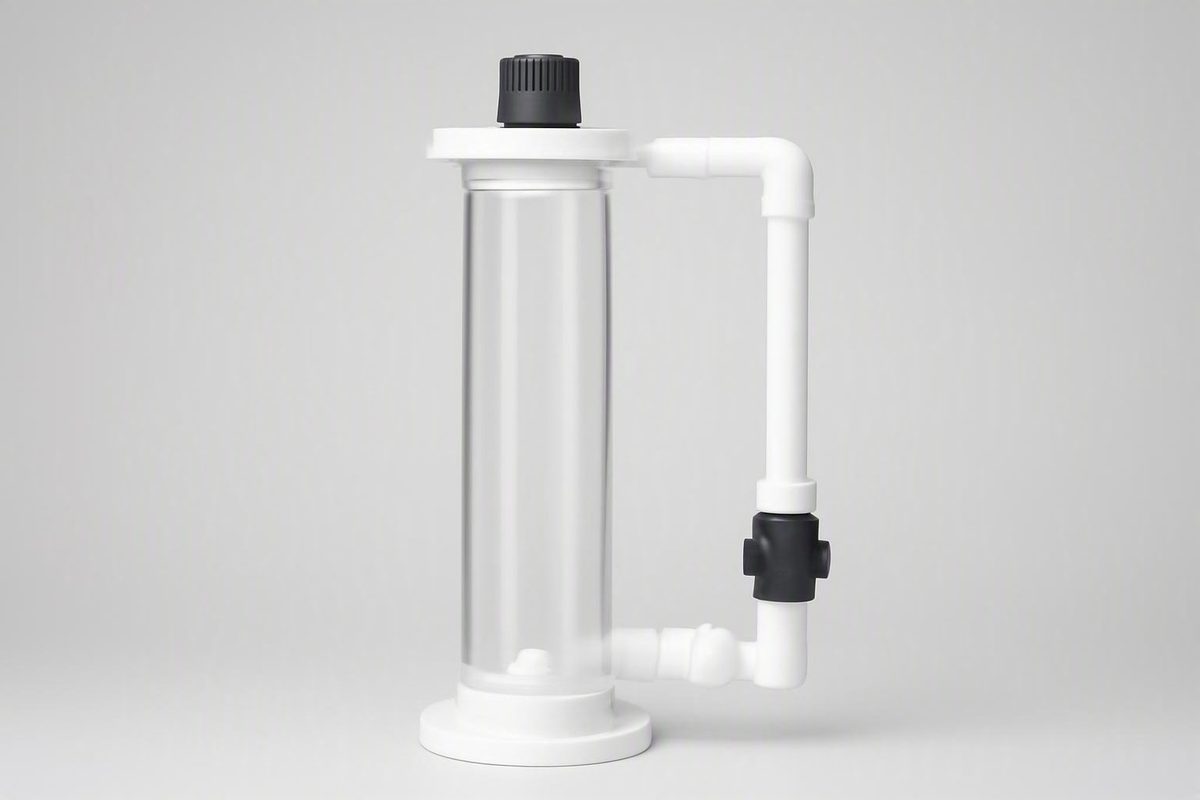
Delivery must stay below minimum daily evaporation, not average loss. Reactor design and model instructions govern setup, safeguards and upkeep.
A kalkwasser reactor can reduce the routine work of preparing limewater, but it is not required to dose kalkwasser. It does not create different chemistry from kalkwasser prepared in a reservoir. Its purpose is automation: storing calcium hydroxide, mixing it with incoming RO/DI water, and delivering the resulting solution through a controlled plumbing system.
That convenience introduces another chamber, additional plumbing, operating rules, cleaning requirements, and failure points. The right reactor is therefore not necessarily the one with the largest advertised aquarium rating. It is the one that can support the aquarium’s measured calcium and alkalinity demand within its freshwater limit, fit the installation and service space, follow its model-specific mixing schedule, and operate with practical safeguards.
What a kalkwasser reactor does—and what it does not do
Kalkwasser, or limewater, is made by mixing calcium hydroxide with fresh RO/DI water. When dosed into a reef aquarium, the solution supplies calcium and alkalinity together. Because limewater is strongly alkaline, it may also support a higher aquarium pH, but the response depends on the delivered dose, the aquarium’s carbon-dioxide environment, gas exchange, biological activity, and supplementation demand. Kalkwasser does not independently maintain magnesium or every trace element, so those parameters require separate testing and replacement where needed (Bulk Reef Supply’s kalkwasser setup guide).
A typical reactor follows a displacement process:
- Fresh RO/DI water enters the reactor.
- The water contacts calcium hydroxide held in the chamber.
- A stirrer, recirculation pump, or incoming-water flow mixes the contents.
- The entering water displaces approximately the same volume of kalkwasser through the outlet.
- The effluent enters the aquarium, usually through the sump.
Many designs intentionally retain excess undissolved powder near the bottom while drawing effluent from higher in the chamber. This arrangement is meant to limit the amount of undissolved material carried into the aquarium. The intended output is clearer, settled solution—not concentrated slurry.
The terms kalkwasser reactor, kalk reactor, kalk stirrer, and Nilsen reactor are often used for related equipment, but they do not guarantee interchangeable construction. One model may use a slow mechanical paddle, another a recirculation pump, and another the force of incoming water. Pressure limits, outlet arrangements, mixing schedules, fittings, and required controls can differ substantially.
A reactor automates preparation and delivery; it does not change the underlying calcium-hydroxide chemistry. It also should not be assumed to produce fully saturated kalkwasser continuously. Concentration can vary with powder availability and condition, feed rate, mixing, settling time, chamber geometry, and maintenance. The supplied product pages do not provide independent performance testing that would justify treating maximum or constant saturation as guaranteed.
Do you actually need a reactor?
No. Fully prepared kalkwasser can be stored in a suitable reservoir and delivered slowly with a dosing pump.
A reactor packages powder storage and mixing into a dedicated chamber, potentially reducing how often a complete batch of solution must be prepared. That is an operational benefit, not proof that a reactor produces better chemistry, better livestock outcomes, or inherently safer dosing.
The main workflows are:
| Workflow | How it works | Main advantage | Main limitation |
|---|---|---|---|
| Manual preparation and addition | Prepare a batch, allow it to settle, and add controlled portions manually | Minimal equipment | Repetitive work and dependence on operator consistency |
| Prepared-solution reservoir plus dosing pump | Store settled kalkwasser and pump a programmed volume into the aquarium | Simple fixed-volume dosing with few components | The reservoir must be prepared and refilled periodically |
| Kalkwasser in an ATO reservoir | The automatic top-off system delivers kalkwasser when the water level falls | Few additional components | Dose volume and timing follow evaporation and sensor events |
| Dedicated reactor | A pump feeds freshwater through a chamber holding calcium hydroxide | Greater onboard powder capacity and less frequent full-batch preparation | More equipment, plumbing, cleaning, and failure modes |
A prepared-solution reservoir is often the logical starting point when low cost, visibility, and straightforward troubleshooting matter most. The operator can inspect the solution, measure how much leaves the container, and avoid adding a reactor motor, lid, seals, and extra fittings.
A reactor becomes more attractive after an ongoing kalkwasser requirement has been established and repeated batch preparation has become burdensome. It may also suit an installation that has room for a tall chamber but not a large reservoir of prepared solution. The reactor will normally still require an RO/DI reservoir because it mixes incoming freshwater rather than producing water.
Account for the complete installation rather than the reactor body alone. Possible components include:
- Freshwater reservoir
- Feed or dosing pump
- Timer, controller, or controllable outlet
- Tubing, valves, adapters, and fittings
- Leak detection or pH monitoring
- Calcium-hydroxide powder
- Cleaning tools and replacement parts
- Separate ATO equipment for the balance of evaporation
The supplied evidence does not establish that reactors are categorically safer, more efficient, or more effective than prepared-solution reservoirs. Community accounts describe successful use of both methods, but those reports are tank-specific anecdotes rather than controlled comparisons.
A practical decision tree is:
- Choose a prepared reservoir and dosing pump when simplicity, cost, visibility, and easy troubleshooting dominate.
- Consider a reactor when measured kalkwasser demand is ongoing and reduced solution preparation or additional powder capacity justifies another chamber and its controls.
- Use kalkwasser in an ATO reservoir cautiously when you accept that supplementation will follow evaporation and water-level events rather than a fixed schedule.
- Choose neither when measured demand, available freshwater, cabinet space, or the preferred control method is better served by two-part dosing, a calcium reactor, or another supplementation system.
Stirrer, recirculation, and upflow designs compared
“Kalk reactor” describes a category, not a single interchangeable mechanism. The documented approaches include mechanical stirring, pump recirculation, and feed-driven upflow.
Low-speed mechanical stirrers
A mechanical stirrer uses a motor and shaft or paddle to move calcium hydroxide near the bottom of the chamber. How long that motor should operate is model-specific.
The Avast K1 and K2 are non-pressurized, gravity-drain stirrers. Their manufacturer specifies continuous motor operation, 24 hours per day. Water enters through the lid and drains from a side outlet, while the removable lid means the vessel is not intended to function as a sealed, pressurized inline chamber (Avast K1 and K2 specifications).
Reef Octopus KS reactors also use low-RPM motors, but their published instructions differ materially. The manufacturer page warns against continuous operation and specifies five minutes of mixing every two hours (Reef Octopus KS specifications). A distributor guide instead states 15 minutes every two hours (CoralVue’s Reef Octopus setup guide).
Those two schedules should not be averaged or resolved editorially. Because the supplied evidence does not include a dated current manual that settles the conflict, this part of the KS comparison remains incomplete. Obtain the current manual for the exact model and revision before programming the timer.
Recirculation-pump reactors
A recirculation reactor uses a pump to move liquid within the chamber. Pump placement, flow, and operating intervals are part of the individual design and should not be inferred from instructions written for a paddle stirrer.
The GEO KR818 uses an adjustable 24 V DC recirculation pump mounted in an inverted orientation. GEO says the position helps protect the impeller from kalkwasser slurry, but that is a manufacturer-provided design claim rather than an independently tested durability result (GEO KR818 product information).
The presence of stronger internal circulation does not by itself establish more consistent concentration or greater slurry carryover. Those outcomes would also depend on chamber geometry, pump operation, powder condition, feed rate, settling, and outlet placement. The supplied evidence does not provide comparative testing among these designs.
Feed-driven or upflow reactors
An upflow reactor uses incoming top-off water to move upward through or past calcium hydroxide. Depending on the model, this can reduce or eliminate reliance on a continuously powered internal stirrer.
A retailer describes the Two Little Fishies KW Reactor 300 as using the upflow principle, illustrating that feed-driven mixing is a marketed alternative to paddles and recirculation pumps (retailer listing for the upflow design). That description does not establish that upflow is more efficient, consistent, or reliable than another method.
Design comparison
| Mixing method | Motor schedule | Pressure or drainage constraint | Outlet arrangement | Required external controls | Evidence limitations |
|---|---|---|---|---|---|
| Avast K1/K2 low-speed stirrer | Manufacturer specifies continuous operation | Non-pressurized and gravity-drained | Side outlet above the powder zone | Controlled feed source; other safeguards depend on installation | Output and capacity are manufacturer specifications |
| Reef Octopus KS low-RPM stirrer | Intermittent; published sources conflict on duration | Current model manual must control | Clearer liquid is taken from the upper chamber | Feed pump plus timer or controllable outlet | Conflicting schedules remain unresolved without the current manual |
| GEO KR818 recirculation pump | Follow current model instructions | Confirm from the current manual | Model-specific push-connect plumbing | Feed or top-off system and selected safeguards | No supported aquarium-volume or daily-output figure is published on the cited page |
| Feed-driven upflow | Determined by feed events and model design | Model-specific | Upper discharge following upward water movement | Controlled feed source | Retail descriptions do not establish comparative performance |
Motor schedules cannot be generalized across brands. Reef Octopus warns that continuous operation may damage its equipment or reduce motor life, while Avast explicitly specifies continuous operation for its documented stirrers.
The model manual—not the generic product category—must control operation.
How to size and compare a kalkwasser reactor
Begin with two measured constraints:
- How much calcium and alkalinity the aquarium consumes
- The aquarium’s minimum daily evaporation
Display volume alone answers neither question.
Every unit of kalkwasser delivered through the reactor also adds freshwater. A large chamber with ample powder cannot overcome low evaporation if the aquarium cannot accept the required water volume. A larger reactor may extend the interval between powder additions without increasing the amount that can safely be delivered each day.
Manufacturer tank ratings should therefore be treated as screening figures, not standardized performance measurements. The supplied evidence does not show that manufacturers use the same livestock load, consumption rate, evaporation, concentration, or safety margin when assigning those ratings.
A practical demand-versus-evaporation worksheet
The evidence pack does not contain an authoritative concentration-to-demand conversion that would support calculating an exact limewater volume from a measured dKH decline. Do not invent that conversion or assume every reactor produces the same concentration. Instead, establish the required working volume by controlled commissioning:
| Input | How to establish it |
|---|---|
| Baseline consumption trend | Measure alkalinity at the same time on consecutive days while other supplementation remains consistent |
| Current supplementation | Record the amount and timing so a change is not mistakenly attributed to the reactor |
| Minimum daily evaporation | Measure water loss during the lowest-evaporation conditions relevant to the system |
| Trial kalkwasser volume | Start below minimum evaporation and divide it into small additions |
| Working daily volume | Adjust gradually until the measured trend is acceptable |
| Freshwater headroom | Minimum daily evaporation minus the established reactor dose |
| Reactor output requirement | The selected reactor and feed system must accommodate the established daily volume without exceeding published limits |
This is slower than calculating from an assumed saturation value, but it avoids treating unverified concentration as constant. If the working daily volume approaches minimum evaporation while alkalinity still declines, the aquarium has reached the practical freshwater constraint for that dosing arrangement. A larger powder chamber does not remove it.
Published model specifications
Avast rates the K1 for aquariums up to 200 gallons, with output up to 2.5 gallons per day, a two-cup powder capacity, dimensions of 5.5 × 5.5 × 21 inches, and electrical specifications of 120 V AC and 3 W. The K2 is rated up to 400 gallons, with output up to five gallons per day, a four-cup capacity, dimensions of 7 × 7 × 21 inches, and the same listed voltage and power. These are manufacturer figures, not independently verified dosing capacities (Avast specifications).
Reef Octopus publishes the following model figures:
| Model | Powder capacity | Manufacturer aquarium rating | Footprint | Height | Suggested feed-pump flow |
|---|---|---|---|---|---|
| KS-100 | 90–120 g | 80–132 US gal | 140 × 140 mm | 700 mm | 100–200 L/h |
| KS-150 | 120–150 g | 132–211 US gal | 195 × 195 mm | 660 mm | 100–200 L/h |
| KS-250 | 150–180 g | 211–317 US gal | 320 × 320 mm | 660 mm | 200–300 L/h |
These powder capacities, dimensions, ratings, and suggested feed ranges are manufacturer specifications. The fittings table on the same page is ambiguous, so connector sizes should be checked against the current model manual rather than inferred from the table (Reef Octopus model data).
The GEO KR818 is specified with an 8-inch-diameter chamber, an 11 × 13-inch footprint, a height of 21 inches, 1/4-inch OD push-to-connect fittings, and an adjustable 24 V DC recirculation pump. Its product page does not publish a supported aquarium volume or daily kalkwasser-output capacity, so neither should be inferred from chamber diameter or pump rating (GEO KR818 specifications).
Published height is not total installation height. Leave enough vertical clearance to remove the lid, withdraw any internal parts that require servicing, add powder without spilling, and clean the chamber. Allow additional room for tubing bends, valves, unions, and hands.
Pre-purchase checklist
Before ordering, verify:
- Established daily delivery: Can the reactor and feed system accommodate the intended controlled volume?
- Published output limit: Is the intended daily volume within any manufacturer-stated limit?
- Powder capacity: Will the chamber provide a practical inspection and refill interval?
- Footprint: Include external pumps, valves, unions, and tubing.
- Published height: Confirm the body fits upright.
- Service clearance: Make sure the lid and internal components can be removed.
- Fitting sizes: Verify inlet and outlet dimensions in the current manual.
- Outlet elevation: Confirm that gravity drainage can remain unobstructed where required.
- Pressure compatibility: Determine whether the vessel is explicitly pressure-rated or non-pressurized.
- Feed-pump needs: Check whether a pump is included, recommended, or sold separately.
- Flow requirements: Confirm that the selected pump can operate within the specified range.
- Motor controls: Determine whether operation is continuous or timer-controlled.
- Included parts: Check tubing, valves, adapters, seals, and power supplies.
- Warranty: Confirm current terms and exclusions at purchase.
- Replacement parts: Look for motors, shafts, impellers, fittings, seals, and lids.
- Maintenance access: Plan how the reactor will be isolated, drained, removed, and cleaned.
- Safeguards: Budget for rate limits, alarms, shutoffs, and leak detection.
Costing the complete installation
The supplied listings show reactor-body prices from $124.59 for one upflow model to $785.39 for a listed Reef Octopus model, but those are changeable retailer figures rather than a current market benchmark (retailer price listings).
A separate retailer page lists reactor bodies as high as $1,050. These prices have no supplied verification date and may not reflect current stock, shipping, warranty terms, or included accessories (additional reactor listings).
Because the evidence does not provide current accessory prices, a defensible installed-cost estimate must be built from live quotes rather than fabricated totals:
| Cost category | Reservoir dosing | Basic reactor installation | More controlled reactor installation |
|---|---|---|---|
| Prepared-solution reservoir | Required | Freshwater reservoir required | Freshwater reservoir required |
| Reactor body | Not required | Required | Required |
| Feed or dosing pump | Required | Required unless included | Programmable, rate-limited pump |
| Timer or controller | Pump-dependent | Required for intermittent models | Controller or independent timer limits |
| Tubing and fittings | Basic | Model-specific | Model-specific plus isolation or service fittings |
| Monitoring | Existing aquarium testing | Existing testing; optional alarms | pH alarm, runtime alarm, or leak detection as selected |
| Separate ATO | Optional by workflow | Needed for remaining evaporation in the reference layout | Needed for remaining evaporation |
| Consumables and service parts | Kalkwasser and tubing | Kalkwasser, tubing, seals, cleaning supplies | Same, plus selected replacement parts |
Use the table as a quotation worksheet. Record the date, seller, included accessories, shipping, warranty, and replacement-part availability. A low reactor-body price does not necessarily mean a low installed price.
A controlled plumbing layout: dosing pump, reactor, sump, and separate ATO
A conservative reference layout is:
RO/DI reservoir → rate-limited dosing pump → reactor inlet → reactor outlet → appropriate high-flow sump area
Use a separate plain-RO/DI ATO to replace evaporation not covered by the programmed kalkwasser dose.
The dosing pump moves a programmed volume of freshwater into the reactor. That incoming water displaces approximately the corresponding volume of kalkwasser through the outlet, provided the plumbing remains open and leak-free. The programmed feed therefore creates a daily target that can be measured and audited.
Fixed-volume feeding separates supplementation from short-term evaporation. The reactor can deliver a planned daily amount in multiple small additions while the independent ATO handles changes in water loss. Reef2Reef participants describe using this arrangement to keep reactor delivery below evaporation while plain RO/DI maintains sump level, but those reports are anecdotal examples rather than controlled safety evidence (fixed-volume setup discussion).
Program the kalkwasser volume below the aquarium’s minimum daily evaporation, not its average or highest observed evaporation. This leaves room for the plain-water ATO to operate and reduces the chance that a lower-evaporation day results in more freshwater delivery than the aquarium can accommodate.
Direct ATO control may use fewer controls because a water-level sensor commands the feed pump. This does not make every ATO-fed reactor inherently safe or unsafe, but it makes supplementation dependent on water-level behavior.
Gravity drainage and outlet placement
A non-pressurized reactor must not be treated as a sealed pressure vessel. In the documented Avast design, the outlet must remain positioned so effluent can gravity-drain freely to the sump. Restrictions or backpressure are incompatible with that published arrangement.
Route the outlet according to the current model instructions.
Before commissioning, trace every possible water path:
- Could the reservoir siphon through the pump while it is off?
- Could sump water move backward toward the reactor?
- What happens if the feed pump remains on?
- Where will water go if the outlet becomes restricted?
- Could a loose tube empty the reservoir into the cabinet?
- Would a leak reach power strips or controllers?
- Could a gravity-drain reactor overflow if its outlet were blocked?
- Does the pump’s maximum possible delivery exceed the intended daily limit?
Fully seat compatible tubing and inspect every connection under operating conditions. After moving or servicing the reactor, verify the fittings again and observe the system for leaks.
Tubing sizes, pump-flow limits, outlet restrictions, pressure constraints, and permitted valve arrangements must follow the current manual for the selected model. The reference layout is a control concept, not permission to override model-specific instructions.
Commissioning the reactor without guessing at a universal dose
Commissioning should begin with aquarium measurements rather than an advertised tank rating or copied drip rate.
Record:
- Baseline alkalinity
- Baseline calcium
- Daily minimum and maximum pH
- Minimum daily evaporation
- Existing supplementation volume and timing
- Recent parameter trends rather than one test result
If calcium or alkalinity begins materially below the aquarium’s chosen operating range, correct the starting deficit separately and deliberately. The supplied distributor guidance treats kalkwasser as a method for replacing ongoing demand rather than rapidly repairing a large initial imbalance.
Next, follow the selected manufacturer’s instructions for filling, powder quantity, initial mixing, settling, and motor operation. Do not transfer one brand’s powder load or mixing schedule to another chamber.
As a model-specific example, Reef Octopus guidance lists powder quantities of 90–120 g for the KS-100, 120–150 g for the KS-150, and 150–180 g for the KS-250. The distributor procedure describes partially filling the chamber with RO/DI water, adding the model-specific powder quantity, mixing, topping up, and allowing solids to settle before dosing. These figures and steps apply to the named KS models; they are not a universal formula for kalk reactors.
Do not start aquarium delivery while the upper chamber remains visibly milky. Wait for solids to settle and confirm that the outlet is drawing clearer solution. If mixing clouds the outlet area, coordinate feed timing and settling according to the current model instructions.
Establishing the initial dose
Use this sequence:
- Confirm the baseline trend. Test alkalinity at the same time on consecutive days while the existing routine remains consistent.
- Choose a conservative fixed volume. Keep it below minimum daily evaporation.
- Divide the volume into small additions. Avoid delivering the entire daily amount at once.
- Keep the separate ATO active with plain RO/DI. It should replace the remaining water loss.
- Test alkalinity consistently. Similar testing times make trends easier to compare.
- Monitor calcium and pH. Kalkwasser dosing affects all three considerations.
- Measure actual pump output. Do not assume the programmed volume equals delivered volume.
- Adjust gradually. Use the measured trend rather than a single result.
- Recheck freshwater headroom. Every increase must remain within minimum evaporation.
- Stop and inspect unexpected behavior. A sudden rise may indicate a delivery fault rather than a small tuning error.
If alkalinity continues to decline and unused freshwater capacity remains, increase delivery cautiously. If alkalinity or pH rises undesirably, reduce or suspend delivery and verify the equipment before resuming.
Some aquarists distribute kalkwasser evenly through the day. Others emphasize nighttime delivery because aquarium pH may vary over a daily cycle. The evidence supplied here does not establish one universal schedule or guarantee a particular pH response. Choose a schedule that keeps individual additions small and controllable, then evaluate it from the aquarium’s measured trends.
A retailer guide gives approximately one drop every five to ten seconds as an example, but that is not a transferable recommendation. Drop size, tubing, head pressure, concentration, evaporation, and aquarium demand differ. A calibrated daily volume is more useful than an unmeasured visual drip rate.
Commissioning log template
| Date | Daily reactor dose | Alkalinity | Calcium | Minimum pH | Maximum pH | Daily evaporation | Mixing events | Effluent clarity and observations |
|---|---|---|---|---|---|---|---|---|
Also record unusual events such as water changes, test-kit changes, major livestock additions, pump maintenance, manual supplementation, or unusual evaporation. Otherwise, those events may make an unrelated dosing adjustment appear responsible for a trend.
Overdose prevention and failure modes
The central risk is excessive or rapid kalkwasser delivery. Distributor guidance warns that overdosing or dosing too quickly can sharply increase aquarium pH and harm or kill livestock. The same guidance warns against delivering milky solution because it may contain undissolved calcium hydroxide rather than settled limewater. It also describes calcium hydroxide as highly caustic (CoralVue’s handling and overdose warnings).
Handle calcium hydroxide according to the current product label and safety documentation supplied for the material. Avoid improvising chemical-handling practices from forum posts. Keep the product secured from children and pets, and do not intentionally deliver cloudy reactor contents to the aquarium.
Failure-mode matrix
| Failure mode | Possible consequence | Prevention or detection |
|---|---|---|
| Feed pump stuck on or output left on | Excessive water and kalkwasser delivery | Use a rate-limited pump, cap programmed daily volume, add runtime limits where supported, and alarm on abnormal operation or pH |
| Failed ATO sensor | Prolonged delivery when the reactor is ATO-controlled | Use supported level protections, limit pump rate and exposed reservoir volume, or separate fixed kalkwasser dosing from plain-water top-off |
| Timer or controller error | Excess mixing, missed mixing, or prolonged feeding | Verify programming after changes and outages; use independent maximum-runtime limits where practical |
| Unintended siphon | Flow continues after the pump stops | Arrange line elevations appropriately and test the complete system with power off and reservoirs full |
| Clogged or restricted outlet | Interrupted delivery, leakage, overflow, or pressure in a non-pressurized chamber | Follow model flow limits, inspect tubing, avoid unsupported outlet restrictions, and never pressurize a non-pressurized vessel |
| Disconnected tube | Water or kalkwasser enters the cabinet | Fully seat compatible fittings, secure tubing where appropriate, inspect after service, and use leak detection |
| Chamber or fitting leak | Cabinet flooding, equipment damage, or inconsistent dosing | Inspect seals and fittings, keep electrical connections away from likely leak paths, and observe the system after every service |
| Powder caking | Altered mixing or motor strain | Follow model powder limits, inspect the chamber, and clean rather than forcing a stalled mechanism |
| Exhausted powder | Falling calcium and alkalinity despite normal water delivery | Track refill history, inspect the chamber, and confirm the trend with testing |
| Slurry carryover | Delivery of undissolved calcium hydroxide | Allow settling, coordinate feeding with model instructions, and stop delivery when effluent is milky |
Safeguards should be layered. A pH alarm does not stop a disconnected tube from emptying into a cabinet. A slow pump does not prevent a long-duration programming error. A controller cannot keep a clogged gravity outlet open. Rate limitation, maximum daily volume, appropriate plumbing, secure tubing, alarms, leak inspection, and a separate plain-water ATO address different failure paths.
They reduce risk; they do not make the system failure-proof.
Forum accounts of overdoses, clogged lines, leaks, and cabinet flooding can identify plausible failure modes, but they do not establish failure frequency or prove that a particular brand is reliable or unreliable.
If an overdose or slurry-delivery event occurs, stop the kalkwasser feed and identify the failed delivery path. This guide does not provide an improvised chemical-correction protocol.
Maintenance, troubleshooting, and knowing when kalkwasser is no longer enough
Retailer guidance describes cleaning and refilling about every one to two months, but that is a broad planning interval rather than a fixed schedule.
Inspect more frequently during commissioning. Look for:
- Outlet restriction
- Sediment or crust near fittings
- Powder caking
- Changes in effluent clarity
- Chamber or fitting leaks
- Abnormal motor or pump noise
- A stalled shaft or impeller
- Reduced delivered volume
- Unexpected powder depletion
- Tubing movement or discoloration
When alkalinity continues to fall
Use a mechanical-to-chemical troubleshooting sequence:
- Measure actual pump delivery. Do not rely solely on the programmed number.
- Inspect inlet and outlet tubing. Look for clogs, pinches, or restrictions.
- Check for leaks. Water leaving the reservoir may not be reaching the aquarium.
- Verify that powder remains available. An operating motor does not prove useful material remains.
- Confirm the mixing schedule. Check the timer, controller history, and current manual.
- Inspect for caking. Visible white material may not be mixing as intended.
- Review effluent clarity and reactor behavior. A change may indicate a service problem.
- Reassess aquarium demand. Livestock growth or additions may have increased consumption.
- Compare the required dose with minimum evaporation. The reactor may be operating correctly while kalkwasser has reached the freshwater limit.
Depleted or caked powder may change reactor behavior, but the supplied evidence does not quantify concentration over a refill cycle. Do not infer solution strength solely from the amount of white material visible at the bottom.
When pH or alkalinity rises
Use this sequence:
- Suspend or reduce reactor delivery.
- Verify the actual delivered volume.
- Check whether the feed pump ran longer than programmed.
- Test for an unintended siphon.
- Confirm that the ATO did not deliver an abnormal amount of water.
- Inspect the outlet for milky effluent or slurry.
- Review recent mixing events and controller logs.
- Resume only after the delivery path is understood and aquarium measurements support doing so.
Do not adjust kalkwasser solely to reach a desired pH. Every increase also adds calcium and alkalinity, so pH cannot be pursued independently of those additions.
When kalkwasser reaches its limit
A high-demand reef or a low-evaporation system may consume more calcium and alkalinity than kalkwasser can replace within its freshwater allowance. A larger reactor cannot remove that constraint.
Options include:
- Retaining a limited kalkwasser dose and adding two-part supplementation
- Retaining kalkwasser while a calcium reactor covers additional demand
- Transitioning fully to another supplementation method
- Reducing kalkwasser if the combined system becomes difficult to control
Hybrid systems are not inherently a failure of kalkwasser. They can use an evaporation-limited kalkwasser baseline while another independently controlled method covers the remaining measured demand. Community reports describe combining kalkwasser with two-part dosing or calcium reactors, but they do not establish one universally superior combination (discussion of hybrid supplementation).
Recurring review checklist
At regular intervals:
- Review alkalinity, calcium, and pH trends.
- Measure the volume actually delivered.
- Inspect tubing, fittings, and possible siphon paths.
- Confirm the mixing schedule against the current manual.
- Check for caking, exhausted powder, residue, and cloudy effluent.
- Clean and refill according to observed condition and model instructions.
- Test alarms, timers, and maximum-delivery limits.
- Recalculate demand after significant livestock growth or changes.
- Confirm that minimum evaporation remains greater than the programmed dose.
- Reassess whether kalkwasser remains the right primary or supplemental method.
Frequently asked questions
Will a kalkwasser reactor raise and stabilize my reef tank’s pH?
It may support a higher pH, but it cannot guarantee a particular value or eliminate daily variation. The response depends on the dose, aquarium carbon-dioxide conditions, gas exchange, biological activity, alkalinity demand, and dosing schedule.
The reactor itself is not uniquely responsible for the effect; prepared kalkwasser from a reservoir uses the same chemistry. Because every dose also supplies calcium and alkalinity, do not adjust the reactor solely to chase pH. Monitor all three parameters and treat reported outcomes from individual aquariums as anecdotes rather than predictions.
Should a kalkwasser reactor run from a dosing pump or an automatic top-off system?
A programmable, rate-limited dosing pump provides the more predictable reference layout because it can deliver a fixed daily amount independently of short-term evaporation. A separate plain-RO/DI ATO can then replace the remaining water loss.
An ATO-fed reactor may use fewer controls, but its dose follows evaporation and water-level events. If that approach is used, evaluate pump rate, sensor behavior, reservoir exposure, siphon paths, outlet restrictions, and maximum possible delivery. Neither configuration is failure-proof.
Should the reactor stir continuously or only on a timer?
Follow the current manual for the exact model. Avast specifies continuous operation for its documented K1 and K2 stirrers, while Reef Octopus warns against continuous operation for its KS models.
The published Reef Octopus sources conflict on whether the mixer should run for five or 15 minutes every two hours. Do not choose between those schedules by assumption. Obtain the current official manual for the exact model and revision before programming the timer.
Can kalkwasser replace two-part dosing completely?
Sometimes. It may replace two-part calcium and alkalinity dosing when the aquarium’s measured demand can be met within the volume of kalkwasser the system can accept.
It may be insufficient for a high-demand reef or a system with low evaporation. If alkalinity continues to fall after the practical freshwater limit is reached, two-part dosing or a calcium reactor can cover the remaining demand. Kalkwasser also does not independently maintain magnesium or every trace element.
How often should a kalkwasser reactor be cleaned and refilled?
Retailer guidance suggests about every one to two months, but no interval applies universally. Throughput, powder capacity, caking, residue, motor or pump behavior, and effluent clarity all affect service needs.
Inspect frequently during initial operation. Clean or service the reactor when buildup, restricted flow, leakage, abnormal noise, caking, reduced delivery, or cloudy effluent indicates a problem. Refill according to observed powder condition and aquarium trends rather than waiting for alkalinity to fall.
Final decision framework
First determine whether kalkwasser matches the aquarium’s measured calcium and alkalinity demand. Then compare the established daily limewater requirement with minimum evaporation and the amount the feed system can deliver predictably.
If a reactor is justified, compare:
- Mixing method
- Current model-specific operating instructions
- Published output limits
- Powder capacity
- Pressure and drainage constraints
- Fittings and pump requirements
- Footprint and vertical service clearance
- Included accessories and replacement parts
- Total installed cost
- Safeguards against siphons, clogs, leaks, and unintended delivery
Do not choose the winner from a tank-size label. Conservative commissioning, repeated testing, verified delivery volume, clear effluent, and correct model-specific operation matter more than an advertised gallon rating.