
Hybrid Bluegill for Ponds: Traits, Stocking Strategies, and Realistic Management Expectations
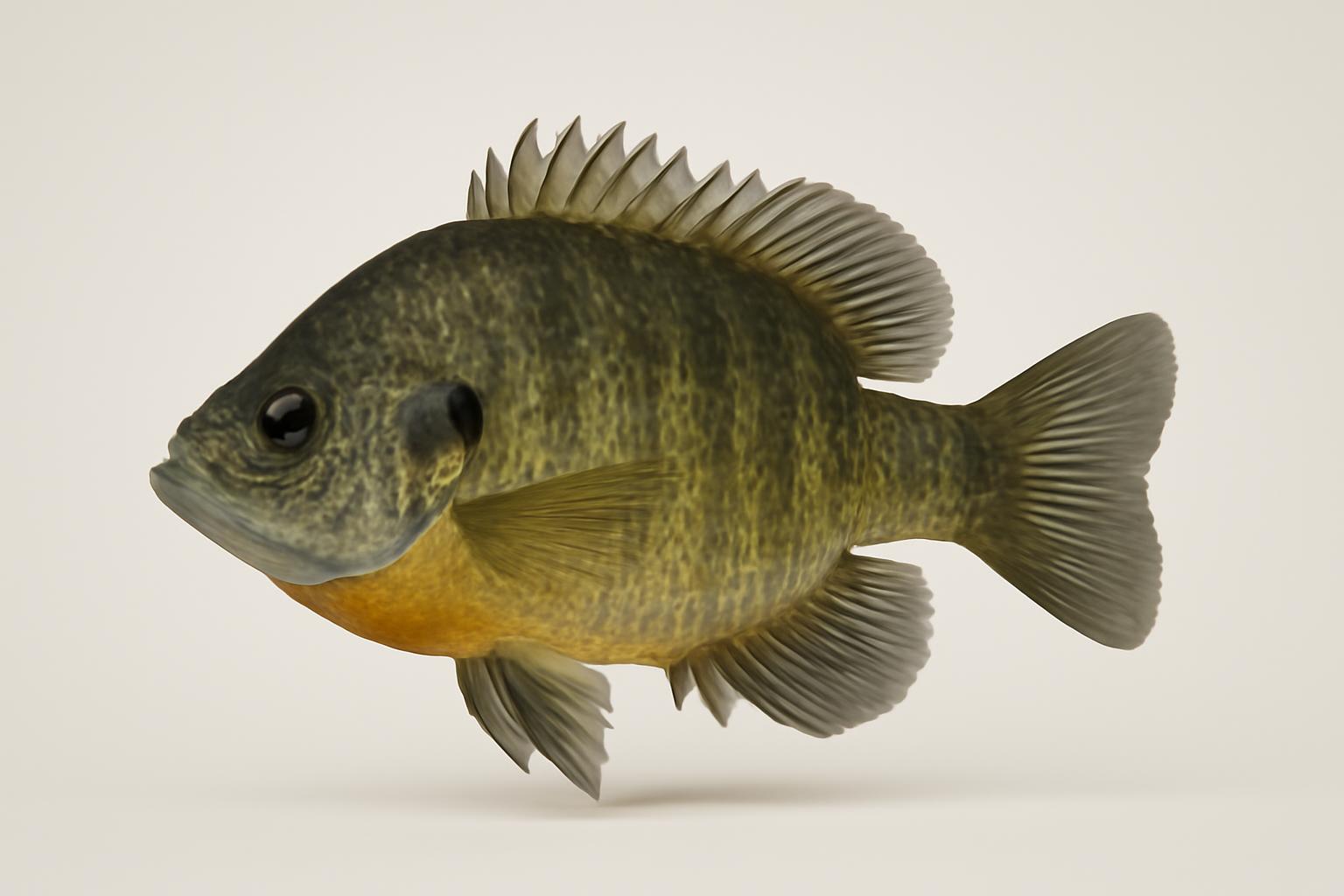
First-generation stocks are commonly 80% to 95% male, lowering spawning success without eliminating it, so sterility is the wrong planning assumption.
Hybrid bluegill are popular with private pond owners for a reason: in the right setting, they can grow quickly, hit pellets hard, and provide a lot of catchable panfish in a small pond. They are especially attractive to owners who want a feed-based, harvest-oriented fishery rather than a self-sustaining predator-prey system.
They are not, however, a universal pond fix. If your real goal is a long-lived largemouth bass–bluegill balance that largely maintains itself through reproduction, pure bluegill usually fit that job better. Hybrid bluegill are better understood as a managed fish than a “stock them once and forget them” fish.
A quick evidence note matters here. Most published guidance on hybrid bluegill comes from Missouri Extension, hatcheries, pond service companies, and experienced pond advisers. That means the practical lessons are useful, but the more precise claims—stocking rates, growth timelines, and restocking schedules—should be read as management-dependent examples, not guarantees for every pond.
If your objective is quick-growing panfish for family fishing in a small pond, hybrid bluegill may be an excellent fit. If your objective is dependable forage for largemouth bass, they usually are not.
What Is a Hybrid Bluegill?
In pond stocking, hybrid bluegill usually means an F1 cross between a male bluegill (Lepomis macrochirus) and a female green sunfish (Lepomis cyanellus). That is the version most consistently described by Missouri Extension, hatcheries, and pond-management sources in the evidence base.
Several practical details matter right away.
First, the parent sexes matter. One hatchery biology explainer quoting work attributed to Dr. Joe Morris notes that the common green sunfish female × bluegill male cross produces the strongly male-skewed first generation that pond owners usually want, while the reverse cross does not produce the same result. In other words, “hybrid bluegill” is not just any bluegill-sunfish mix.
Second, the label is not always used precisely. Missouri Extension discusses hybrid sunfish more broadly, including crosses involving redear sunfish as well as green sunfish. Those fish may be useful, but they are not automatically the same as the bluegill–green sunfish cross most pond owners mean when they say “hybrid bluegill.”
Third, seller naming can be messy. You may see:
- the parent species listed in either order
- a generic label such as “hybrid sunfish”
- or even a conflicting scientific name on a seller page
Because of that, the safest buying rule is simple:
Verify the actual parent species and whether the fish are true first-generation hybrids, rather than relying on the product name alone.
Hybrid bluegill are best thought of as a hatchery-produced stocking fish, not a stable wild type that reproduces true generation after generation. That distinction is important. Many pond owners assume the fish they buy will reproduce into more fish with the same desirable traits. With hybrid bluegill, that is usually not how pond management plays out.
The “F1” label matters for the same reason. When pond managers praise hybrid bluegill, they are usually praising the first-generation cross from carefully selected parents. Once those fish reproduce, the next generation becomes less predictable in both appearance and performance.
A practical working definition is this:
A hybrid bluegill is typically a hatchery-produced first-generation cross of male bluegill and female green sunfish, stocked to create fast-growing, catchable panfish with reduced—but not eliminated—reproduction.
Key Traits vs. Regular Bluegill
Hybrid bluegill are sold on differences in mouth size, feeding behavior, early growth, and reproduction. Those differences are real enough to matter, but they matter most in certain kinds of ponds.
Appearance and identification
Compared with a regular bluegill, hybrid bluegill are commonly described as having:
- a larger mouth
- a thicker, deeper body
- brighter or more contrasting coloration in some fish
- yellow to orange margins on the pelvic and anal fins, often used as a field clue
Regular bluegill, by contrast, are commonly described in pond guides as:
- olive green
- with an orange underbelly
- and more uniform blue-black markings on the gill area and fins
No single field mark is perfect, especially in stressed, spawning, or mixed populations. In practice, though, the larger mouth is one of the most useful clues. Many hybrid bluegill look like a fish with bluegill body depth and more green-sunfish-like mouth size.
Feeding behavior
That larger mouth is not just cosmetic. Multiple hatchery and advisory sources tie it to more aggressive feeding.
Hybrid bluegill are commonly described as:
- quick to take floating pellets
- willing to eat insects, larvae, and other invertebrates
- able to take larger prey items than regular bluegill
- aggressive around feeders and baits
Regular bluegill also eat a broad range of natural foods and can be pellet trained, but their smaller mouth limits the size of prey they can exploit. In a pellet-fed pond, hybrid bluegill often show up fast and compete hard.
For a recreational pond owner, that is one of the clearest advantages: fish that feed aggressively are generally easier to grow and easier to catch.
Growth
The strongest case for hybrid bluegill is usually faster early growth, not some guarantee of giant size forever.
Missouri Extension describes hybrid sunfish as fast growing and gives a useful planning benchmark for small recreational ponds:
- roughly 0.25 pound in two years without feed
- roughly 0.5 pound in two years with feed
That is one of the more credible numbers in the evidence because it comes from extension guidance rather than a sales page. Even so, it is still a planning benchmark, not a promise. Growth will depend on:
- stocking density
- water quality
- oxygen
- season length
- feeding rate
- forage availability
- harvest
- predator pressure
Some hatchery and pond-management sources also stress that hybrid bluegill grow fastest in the first few years, especially in new or lightly crowded ponds.
Regular bluegill are often described in general pond advice as a 6- to 10-inch fish, although well-managed pure bluegill can certainly exceed that.
Competition with regular bluegill
A useful nuance is that hybrid bluegill can outcompete regular bluegill early, especially in new ponds. Their larger mouth, aggressive feeding, and pellet response can give them an edge for the first several years.
But that advantage is not always permanent. Pond advisers note that if pure bluegill are mixed in and reproduce successfully, the pure bluegill can eventually dominate numerically because they simply replace themselves more effectively.
So the hybrid’s edge is usually best understood as front-loaded performance, not long-term control of a mixed sunfish community.
The bottom-line difference
If you want a fish that:
- grows quickly early
- responds well to feed
- bites aggressively
- and makes a small pond feel full of catchable panfish
hybrid bluegill have a real appeal.
If you want a fish that reproduces heavily enough to support a durable bass-forage cycle, pure bluegill still have the stronger case.
Growth, Diet, and Size Records
The easiest way to think about hybrid bluegill growth is to separate three questions:
- What do they eat?
- How fast do they grow under realistic pond management?
- How big should you actually plan for?
Diet
Across seller, hatchery, and advisory descriptions, hybrid bluegill are opportunistic feeders. Commonly listed foods include:
- insects
- insect larvae
- small aquatic invertebrates
- very small fish
- fathead minnows
- other small forage fish
- commercial floating pellets
A major practical advantage is that they generally accept commercial feed readily. Several sources describe them as shifting well between pellets and natural foods. In pond terms, that makes them easier to grow in small systems where the owner is actively feeding.
That flexibility is one reason they are so often recommended for intensively managed recreational ponds. A fish that will use both natural pond productivity and a feeder program is easier to push toward catchable size than a fish relying only on naturally available food.
Growth rate
The most defensible growth claim is not that hybrid bluegill always become huge. It is that they often show faster early growth than pure bluegill, especially in fed ponds.
Missouri Extension’s planning benchmark—about a quarter pound in two years unfed and about a half pound in two years fed—is a good reality check. It suggests what good management can do without implying that every fish becomes a pound-class panfish.
Small-pond advisers also emphasize that hybrid bluegill are often strongest from the first year through the first few years, especially where the pond is:
- new or recently renovated
- lightly crowded at startup
- pellet fed
- well oxygenated
Results usually fall short when owners try to combine high density, limited feeding, and weak aeration.
Size potential
Marketing around hybrid bluegill often focuses on “big bluegill,” and that message is not entirely wrong. Some small-pond advisers recommend them specifically for owners trying to grow unusually large sunfish quickly in ponds under an acre.
But there is a difference between high-end potential and routine planning.
A realistic interpretation of the evidence is:
- hybrid bluegill can produce larger catchable panfish sooner
- half-pound-class fish are a reasonable managed target in some fed ponds
- a true one-pound hybrid bluegill is a high-end outcome, not something to assume
Some commercial sources also advertise exceptional record fish, but those reports are best treated as promotional extremes rather than a management benchmark.
What sizes are sold?
Commercial listings commonly sell hybrid bluegill in broad size groups such as:
- fingerlings
- juveniles
- larger stocker or adult fish
The practical lesson is not the exact posted price on any one seller page. It is that:
- larger fish cost much more per fish than fingerlings
- size labels vary by seller
- permit fees or state paperwork may add cost
- the buyer should confirm what size range will actually be delivered
If you are buying, ask for the actual delivered length range, not just a category label.
For long-term budgeting, the fish themselves are often only part of the expense. Feed, aeration, predator additions, forage stockings, and future restocking usually matter more than the first invoice.
Reproduction Limitations and Offspring Risks
This is the part of hybrid bluegill management that causes the most confusion.
Hybrid bluegill are not sterile. Their reproduction is reduced, not absent.
Why reproduction is lower
The standard bluegill–green sunfish cross is widely described as producing a heavily male-skewed brood, usually around 80% to 95% male depending on the source. Missouri Extension gives a range of 85% to 95% male; other pond sources commonly cite 80% to 90% or “more than 90%.”
That male bias is the main reason reproduction is reduced.
Commercial descriptions still report spawning behavior in late spring to early summer, with nest building in shallow water. So the question is not whether they can spawn. They can. The question is whether they reproduce efficiently enough to maintain a stable, desirable fishery. Usually, they do not.
Why reduced reproduction is not the same as “problem solved”
At first glance, reduced reproduction sounds ideal because pure bluegill can overpopulate if predators are inadequate. But low reproduction creates its own management problems:
- too little recruitment means your catchable population fades
- some second-generation fish may be poor quality
- later generations may be more reproductively active than the original F1 fish
That is why hybrid bluegill are so often managed as a put-and-take or stock-grow-harvest-restock fish.
What the offspring may become
This is where the sources differ in detail, but the warning is consistent.
Hybrid bluegill offspring do not reliably produce more uniform, desirable F1 hybrid bluegill. Depending on the source, second-generation fish may:
- resemble green sunfish
- resemble bluegill
- show a mixed blend of sunfish traits
- become more reproductively active than the original stocked fish
Several pond-management sources warn specifically about offspring drifting toward green sunfish-like traits, which is why this issue gets so much attention.
That matters because green sunfish are widely regarded as troublesome in many recreational ponds. The concerns commonly cited are:
- relatively large mouth for body size
- aggressive behavior
- less value as a long-term forage base
- nuisance populations if conditions allow
Not every owner who stocks hybrid bluegill ends up with a pond overrun by green sunfish-like fish. But the risk is well established enough in the evidence base that it should be part of the original stocking decision, not an afterthought.
F1 versus later generations
When hybrid bluegill are praised, the praise almost always refers to the first-generation hatchery cross.
Once those fish reproduce, you are no longer managing a uniform F1 population. You are managing a mix of:
- second-generation offspring with less predictable traits
- possible backcrossing with other sunfish
- any contamination introduced with the original shipment
That last point is important. One hatchery biology explainer argues that producers who do not carefully separate and sex broodfish may inadvertently sell mixed sunfish rather than a uniform F1 hybrid. Whether or not every producer has that problem, the broader lesson is sound: broodstock control matters.
Managing the reproduction risk
The recurring management solutions are straightforward:
- use predators, usually largemouth bass, to suppress offspring
- use active harvest and periodic restocking
- in heavily controlled ponds, restart or renovate if later-generation fish become a nuisance
Hybrid bluegill stocked alone are often expected to need restocking every few years. Several sources use a 3- to 5-year window as a common management expectation, although the exact schedule depends on harvest, predation, and pond productivity.
Ideal Pond Stocking Rates and Strategies
There is no single correct hybrid bluegill stocking rate. The published recommendations vary widely because the fish are being used for very different pond goals.
Across seller pages, pond advisers, and Missouri Extension guidance, a broad range of about 200 to 1,500 hybrid bluegill per acre appears in circulation. That spread sounds messy, but it makes more sense when you sort rates by pond objective and management intensity.
A practical way to interpret the range
Treat the published numbers as strategy examples, not universal formulas.
Lower-density or mixed management: roughly 200 to 500 per acre
This lower range appears in seller recommendations and regional pond advice where hybrid bluegill are part of a more moderate fish community or are stocked with predators.
This kind of rate may fit an owner who:
- wants catchable panfish, but not maximum biomass
- is adding bass for control
- is not trying to push production hard with feed and aeration
Moderate fed ponds: roughly 400 to 1,000 per acre
This is a common middle band in small-pond advice, especially for ponds where the owner intends to feed pellets and monitor the fish closely.
This may fit a pond owner who:
- uses floating feed
- wants frequent action
- may aerate
- accepts restocking as part of the program
Intensive put-and-take ponds: roughly 300 to 1,500 per acre
The high end comes from heavily managed put-and-take recommendations, especially for ponds without predators at startup.
That approach only makes sense when the owner is committed to:
- strong water quality
- dependable oxygen
- regular feeding
- active harvest
- realistic restocking
At high density, management quality matters more than the species choice. Overstocked, underfed, low-oxygen ponds disappoint quickly.
Small pond guidance
Hybrid bluegill are most often recommended for small ponds.
In the evidence base, that usually means:
- under 1 acre in some small-pond advisory material
- up to about 3 acres in Missouri Extension guidance
The reason is not that the fish biologically require tiny ponds. It is that their management style fits small private ponds well:
- feeding is easier
- fish condition is easier to observe
- harvest is easier to control
- restarting the fishery is easier if needed
Stocking with predators
If you want predators in the pond, a commonly cited example from pond-supply guidance is a 3:1 prey-to-predator ratio, such as 150 hybrid bluegill to 50 bass of similar size.
Missouri Extension also recommends stocking largemouth bass as control fish in hybrid sunfish ponds and gives example rates of roughly 25 to 50 bass per acre. The key point is not the exact number. It is the role those bass are playing.
In a hybrid bluegill pond, bass are often stocked mainly to:
- suppress unwanted offspring
- reduce nuisance recruitment
- help maintain fish quality
That is a different purpose from a classic bass-bluegill pond, where bluegill are expected to drive bass growth through strong reproduction.
Add forage species
Several pond sources recommend adding forage fish such as:
- fathead minnows
- shiners
This is especially useful at startup, before the pond’s natural food base is fully established. Forage fish can support both hybrid bluegill and predator fish during the early phase of pond development.
Best stocked in new or renovated ponds
This is one of the clearer cross-source points of agreement: hybrid bluegill usually make the most sense in:
- new ponds
- recently renovated ponds
- ponds where existing undesirable fish have been removed
Missouri Extension is particularly clear that stocking hybrid sunfish into an already established fish community is often wasteful because the new fish may be outcompeted, cross with other sunfish, or fail to produce the intended result.
Feeding and aeration
Most higher-output management plans assume supplemental feeding.
Missouri Extension recommends a floating pellet of at least about 28% protein, fed when water temperatures are roughly 60°F to 65°F or warmer. Feeding generally does three things:
- improves growth
- increases carrying capacity
- makes fish easier to monitor
Aeration also matters. Small-pond advisers note that aerated ponds can support somewhat higher stocking densities than unaerated ponds, all else equal. That is not a license to overstock; it is just a reminder that oxygen is often one of the first limits in an intensive hybrid bluegill program.
Some guidance also discusses fertilized ponds, but fertilization is regional and management-sensitive. It is not something to add casually without local guidance.
Restocking strategy
Restocking advice varies by source, but the common theme is the same: plan to restock.
Examples in the evidence include:
- restocking 30% to 50% every 3 years
- restocking fingerlings after about 4 to 5 years in put-and-take systems
- restocking sooner after heavy harvest
A sensible synthesis is that hybrid bluegill usually need partial or full restocking every few years, with the exact schedule determined by:
- harvest pressure
- predator density
- recruitment
- feeding intensity
- whether nuisance offspring are appearing
Permits and shipping rules
Do not assume a hatchery can legally ship hybrid bluegill to you just because it lists them online.
The evidence includes seller examples showing that:
- some companies are licensed only in certain states
- additional import permits or processing fees may apply
- legal availability is vendor-specific and state-specific
So the practical rule is simple: ask the hatchery what states it is licensed to ship to, then confirm your own state’s import rules before ordering.
Pros, Cons, and Pond Management Realities
Hybrid bluegill are neither miracle fish nor worthless fish. They are a specialized tool that works well when the pond goal matches the fish.
Where they shine
Hybrid bluegill are a strong option when your main goal is:
- fast panfish growth
- aggressive feeding on pellets
- a small recreational pond
- a fishery centered on harvest and restocking
- easy-to-catch fish for regular angling
Their most consistent practical strengths are:
- strong early growth under good management
- good acceptance of floating feed
- aggressive bite response
- less immediate overpopulation risk than pure bluegill
- good fit for small, intensively managed ponds
The real drawbacks
The drawbacks are just as important.
1. They are a weak substitute for pure bluegill in bass-forage systems
This is one of the clearest conclusions in the evidence. Missouri Extension explicitly says hybrid sunfish cannot replace bluegill as forage in a bass-bluegill pond because they do not produce enough offspring.
That means a pond built around bass growth can drift toward:
- poor sunfish recruitment
- underfed bass
- thin bass
- more human intervention and restocking
2. Restocking is usually part of the deal
If you want a pond that largely carries itself once established, hybrid bluegill are usually not the best fit. Their limited reproduction is useful only if you accept the other side of the equation: numbers decline over time.
3. Offspring quality may deteriorate
Whether the source describes it as reversion, breakdown, or later-generation unpredictability, the management point is the same: once hybrid bluegill reproduce, the resulting fish may be less desirable than the original stock.
4. They can become more expensive than they first appear
The long-term cost of a hybrid bluegill program may include:
- feed
- feeder equipment
- aeration
- bass for control
- forage fish
- replacement stockings
- in some cases, renovation if the fish community deteriorates
Best as a put-and-take fishery
The most realistic way to frame hybrid bluegill is as a put-and-take fishery:
- stock fish
- feed and grow them
- fish and harvest them
- restock when numbers or quality fall
That is not a flaw. It is simply a different pond model from a self-renewing bass-bluegill system.
Small ponds are where they make the most sense
This is why hybrid bluegill are so often recommended for small ponds. In a quarter-acre to one-acre pond, a feed-based, closely watched, harvest-oriented fishery can work very well. The owner can watch feeding behavior, adjust harvest, spot recruitment problems early, and restock when needed.
Mixing with pure bluegill
Some managers do mix hybrid bluegill with pure bluegill. Missouri Extension even mentions a compromise approach using hybrids and bluegill together with largemouth bass.
That can work, but it changes the goal. A mixed pond may offer:
- faster early angling from hybrids
- better long-term forage contribution from pure bluegill
It also creates more complexity:
- pure bluegill may eventually dominate reproduction
- hybrids may outcompete them early
- fish become harder to identify
- management goals become less clean
Ecosystem concerns
A few pond advisers argue that hybrid bluegill can compete hard with other fish and may affect broader pond food-web dynamics. Those concerns may be plausible in dense, heavily managed ponds, but the evidence supplied here is much stronger on growth, feeding, and reproduction than on broader ecosystem effects.
So the safest conclusion is this: hybrid bluegill can be excellent in a tightly managed recreational pond, but they should be treated as a management choice, not a shortcut to ecological balance.
Common Myths and Sourcing Caveats
Hybrid bluegill attract more myth than many pond fish. Some of that comes from marketing. Some comes from pond owners seeing one good result and assuming it applies everywhere.
Myth: hybrid bluegill are sterile
False.
The best-supported description is that they have reduced reproduction because first-generation stocks are heavily male skewed. Some reproduction still occurs.
Myth: once stocked, they maintain themselves
Usually false.
Published guidance repeatedly warns that hybrid bluegill numbers may dwindle and that restocking every few years is often part of normal management.
Myth: every fish sold as “hybrid bluegill” is a true F1 cross
Not necessarily.
Because parent species and sex selection matter, poor broodstock control can change what the buyer actually receives. This is why asking direct sourcing questions matters.
Myth: growth claims are automatic
Also false.
Fast growth generally assumes some mix of:
- good water quality
- manageable density
- regular feeding
- adequate oxygen
- enough food in the pond
- a pond design that matches the fish
How to verify stock quality
Before buying, ask the seller:
- What exact cross are you selling?
- Are these true F1 fish?
- Were broodfish sexed and separated?
- What male percentage do you expect from this cross?
- Are these fish raised in a controlled breeding program?
- What size range will I actually receive?
- What is your mortality policy?
- What permits or import paperwork are required?
If a seller cannot answer basic broodstock questions, caution is reasonable.
Shipping and regulation caveats
Shipping rules are not national in any simple sense. Seller listings in the evidence show restricted licensed-state lists and additional permit fees. The takeaway is not “these are the approved states.” The takeaway is that legality varies by hatchery and destination state.
Verify with both:
- the hatchery
- your state fish and wildlife or agriculture authority
Alternatives: Pure Bluegill, Hybrid Catfish, or Mixed Strategies
The right fish depends on the real pond goal. “Best” changes quickly depending on whether you want forage, fast panfish, or a feed-based harvest pond.
Pure bluegill
Choose pure bluegill when your main goal is a more traditional, self-renewing pond system, especially with largemouth bass.
Pure bluegill are usually better when you want:
- a dependable forage base for bass
- heavy natural reproduction
- a more stable predator-prey cycle
- less reliance on repeated restocking
The tradeoff is obvious: pure bluegill can overpopulate and stunt if predators are inadequate. But that same reproductive power is why they support bass better.
Hybrid catfish
Hybrid catfish appear in the evidence only as a secondary comparison from a pond-management source, so they should be treated carefully rather than as a default recommendation.
The useful takeaway is narrower: if your true goal is not “sunfish management” at all, but rather:
- fast growth on feed
- heavy harvest
- routine restocking
- a put-and-take fishery
then a catfish-based plan may deserve separate research. That does not make hybrid catfish universally better than hybrid bluegill. It simply means some pond owners are really looking for a feed-driven harvest fishery and may be forcing hybrid bluegill into that role because the name sounds familiar.
Mixed strategies
A mixed pond can work if the owner is honest about the tradeoffs.
Option 1: pure bluegill + largemouth bass
Best for a more classic pond balance and dependable bass forage.
Option 2: hybrid bluegill + limited bass + feed
Best for a small recreational pond focused on catchable panfish and offspring control.
Option 3: hybrids + pure bluegill + largemouth bass
Missouri Extension presents a version of this as a compromise strategy. It may provide:
- quicker early angling from hybrids
- better long-term forage contribution from pure bluegill
It also produces a more complex pond to interpret and manage.
Option 4: hybrid bluegill + forage minnows
Useful in startup phases, especially in small ponds where early growth is the priority.
Match the fish to the objective
| Pond goal | Best fit | Main tradeoff |
|---|---|---|
| Quick-catching, pellet-fed panfish in a small pond | Hybrid bluegill | Requires restocking; not self-sustaining |
| Long-term forage for largemouth bass | Pure bluegill | Can overpopulate without predator control |
| Feed-based harvest fishery where panfish biology is not the main goal | A catfish-based plan may be worth separate research | Different fishery experience |
| Compromise pond with both action and forage | Mixed strategy | More complex management |
Final takeaway
Hybrid bluegill can be a very good pond fish when used for what they actually are: a managed recreational fish for small ponds, not a self-sustaining replacement for pure bluegill.
They reward active management—feeding, oxygen management, harvest planning, predator control where appropriate, and restocking. They disappoint when sold as a permanent shortcut.
If you stock them, verify the cross, verify the hatchery’s breeding controls, verify the legal paperwork, and design the pond around your real goal. That is how you get the upside of hybrid bluegill without inheriting the worst surprises.
FAQ
Are hybrid bluegill sterile?
No. Hybrid bluegill are not sterile.
The better description is reduced reproduction. First-generation stocks are usually heavily male skewed—commonly around 80% to 95% male depending on the source—which lowers spawning success but does not eliminate it.
That is why hybrid bluegill ponds still need management. Some reproduction happens, and later-generation fish may be less desirable than the original stocked fish.
What is the best stocking rate for hybrid bluegill per acre?
There is no single best rate for every pond.
Published guidance in the evidence ranges from about 200 to 1,500 fish per acre, depending on whether the pond is lightly managed, pellet fed, intensively stocked, or run as a put-and-take fishery.
A practical way to think about it is:
- lower rates for moderate or mixed management
- middle-range rates for fed small ponds
- higher rates only for intensive management with strong feeding and oxygen support
The right number depends on pond size, feeding, water quality, oxygen, harvest goals, and whether bass will be used mainly as control fish.
How often do hybrid bluegill ponds need restocking?
Often every few years.
The evidence includes example programs such as:
- partial restocking every 3 years
- fingerling restocking after about 4 to 5 years
- sooner restocking after heavy harvest
The shared point across those programs is simple: hybrid bluegill usually do not maintain strong long-term numbers by reproduction alone.
Can hybrid bluegill be used as forage for bass?
They can be eaten by bass, but they are generally not recommended as the main forage base in a bass-bluegill pond.
Missouri Extension is explicit that hybrid sunfish cannot replace bluegill in a bass pond because they do not produce enough offspring. Over time, that can leave bass short on food unless the owner intervenes with other forage or restocking.
If your main goal is largemouth bass performance, pure bluegill are usually the better foundation fish.
What states allow hybrid bluegill shipping?
There is no single national approved-state list that answers this for every buyer.
The evidence shows that shipping depends on:
- the hatchery’s own licenses
- your state’s fish import rules
- any permit or paperwork requirements
Some sellers publish a limited list of states they can serve; others note that extra permit fees or state approvals may apply. So the useful answer is not a universal map. It is a process:
- ask the hatchery what states it is licensed to ship to
- confirm your state’s import rules before ordering
- verify any permit, inspection, or processing fees in advance