
Steelhead Fishing Lures: How to Choose the Right Lure for the Water
Plugs are not boat-only: from the bank, cast quartering downstream, sweep across the current, pause, then retrieve upstream.
Steelhead Fishing Lures: How to Choose the Right Lure for the Water
Overview
The main steelhead fishing lure families are spoons, spinners, plugs and stick baits, jigs, soft beads, plastic worms, and drift bobbers such as the Spin-N-Glo, Corky, and Okie Drifter. There is no single best lure: the right pick depends on water clarity, current speed, depth, how you plan to present it, and what your local regulations allow.
That answer matches how experienced steelhead writers actually talk about lures. Riptidefish’s winter steelhead roundup covers fifteen lures spanning spoons, spinners, plugs, jigs, beads, worms, and drift bobbers rather than crowning one winner. Even Bill Herzog’s Salmon & Steelhead Journal piece arguing that the #3 “nail polish” sunrise translucent Okie Drifter may be the greatest steelhead lure of all time frames the question through criteria and a top-ten list of artificial lures, not a guarantee.
This guide compares the recurring lure families, matches them to water conditions and fishing methods, covers rigging and troubleshooting basics, and finishes with a compact starter selection — all framed as common, source-backed choices rather than promises.
The main steelhead lure families and when they fit
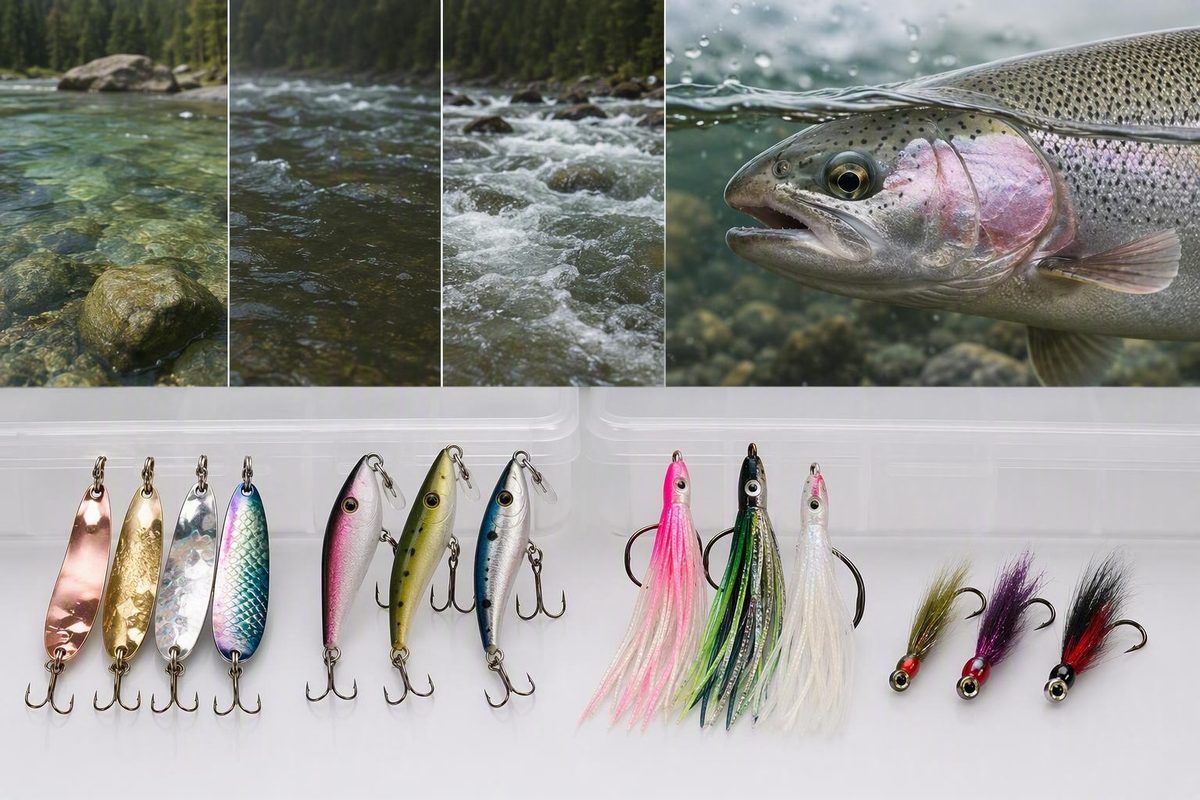
Start by picking a lure family that matches how you will fish, then pick individual lures inside it. Most steelhead lures fall into three broad groups: metal lures you cast and swing (spoons and spinners), diving plugs and stick baits you work against or across current, and drift-oriented presentations (jigs, beads, worms, and drift bobbers) that ride near the bottom or under a float.
The matrix below summarizes the roles these families commonly play, using examples named in the supplied sources. Treat it as a starting point for comparison, not a performance ranking.
| Lure family | Typical presentation | Common fit | Source-backed examples |
|---|---|---|---|
| Spoons | Casting and swinging across current | Covering water in medium to heavy flows | P-Line Pro Steel, Little Cleo (Riptidefish) |
| Spinners | Casting and retrieving through likely holding water | Active searching with flash and vibration | Vibrax-style spinners (Riptidefish) |
| Plugs and stick baits | Held or worked against current, backed downriver, or cast and swept | Precise depth control in defined slots and runs | Hotshot, Flatfish, Kwikfish, Brad’s Wiggler (GLAngler) |
| Jigs | Suspended under a float | Slow, controlled presentations at a set depth | Marabou-style steelhead jigs (Riptidefish) |
| Soft beads and worms | Drift or float fishing near bottom | Natural, current-carried presentations | Soft beads and plastic worms (Riptidefish) |
| Drift bobbers | Drift fishing along the bottom | Buoyant attractors on a drift rig | Spin-N-Glo, Corky and yarn (Riptidefish); Okie Drifter (Salmon & Steelhead Journal) |
If you can only learn one family well before your trip, choose the one that matches your access and method — the sections below explain each in turn.
Spoons and spinners
Spoons and spinners are the classic cast-and-retrieve metal lures for steelhead, and they are a common first choice when you want to cover water actively from a fixed position. Their appeal is simple: flash and vibration that steelhead can detect even when they are not feeding aggressively.
Spoons shine when swung across current. Riptidefish notes that swinging spoons in the medium to heavy flows of winter rivers is a productive approach, naming P-Line Pro Steel Spoons and Little Cleo Spoons as favorites. The wobble of a swinging spoon slows and throbs as it crosses the current seam, which lets you present it broadside to holding fish without constant retrieving.
Spinners work on a similar cast-and-swing or cast-and-retrieve logic, but the rotating blade produces steadier vibration at slower speeds. Vibrax-style spinners recur in Riptidefish’s winter lineup as a standard hardware category. They are a useful option when you want to probe pockets and seams methodically with a controlled retrieve rather than a long swing.
As a practical rule, reach for heavier spoons when you need to get down in pushier water, and consider spinners when you want vibration at slower retrieve speeds or in smaller pockets. Avoid treating either as a magic answer — both depend on getting the lure into the strike zone at a speed the fish will tolerate, which the conditions section below addresses.
Plugs and stick baits
Plugs and stick baits are the right family to consider when you need precise depth control and want the current to do much of the work. A diving plug’s lip drives it down and gives it a wide, aggressive wobble that can provoke territorial strikes from steelhead holding in defined slots.
The GLAngler article by Jim Bedford names the Hotshot, Wigglewort, Tadpolly, Hot-n-Tot, Flatfish, Steeliewort, Kwikfish, and Brad’s Wiggler as good examples of steelhead plugs. Riptidefish likewise includes Brad’s Wigglers in its winter steelhead selection, which makes plugs one of the most consistently recommended categories across the supplied sources.
What sets plugs apart is how they are fished. Bedford describes holding crankbaits and diving plugs against the current and backing them downriver, so the lure works in place while it slips slowly downstream toward holding fish. He also gives a casting version for anglers without a boat: cast quartering downstream, sweep the lure across the river, pause, and retrieve upstream. The current keeps the plug digging and wobbling through the entire presentation.
That current-driven action is also the family’s main constraint: a plug only fishes well when its action is true and its depth matches the water. Bedford’s advice emphasizes controlling depth, choosing appropriate rigging hardware, and staying stealthy. If you fish defined runs where you can control the lure’s position — from a boat or by wading into casting position — plugs are a strong candidate. If you mostly fish snaggy pocket water on foot, another family may serve you better.
Jigs, soft beads, worms, Spin-N-Glo, Corky, and drift bobbers
Choose this group when you want a slow, natural presentation carried by the current rather than an actively worked lure. These are drift- and float-oriented presentations, and they appear repeatedly in Riptidefish’s winter steelhead lure roundup alongside the hardware categories.
Jigs — commonly marabou-style for steelhead — are usually suspended under a float so they hang at a set depth and pulse in the current. That makes them useful when fish are holding in a specific lane and you want to keep a lure in front of them for the full length of a drift without dragging bottom.
Soft beads and plastic worms take the natural-drift idea further. Fished on a drift rig or under a float, they imitate eggs and worms tumbling along the bottom, and Riptidefish includes both in its winter selection. They are a common choice when fish see a lot of pressure and a subtler offering earns more takes than flash and vibration.
Drift bobbers — the Spin-N-Glo, the Corky (often paired with yarn), and the classic Okie Drifter — are buoyant attractors fished on drift rigs. Riptidefish covers Spin-N-Glo and Corky-and-yarn setups, while Herzog’s Salmon & Steelhead Journal piece makes the historical case that the #3 sunrise translucent Okie Drifter may be the greatest steelhead lure ever, judged against his criteria for an all-time artificial. The takeaway is not that one bobber wins, but that this family has produced steelhead for generations and belongs in the comparison.
Choose by water clarity, flow, depth, and visibility
The most useful selection rule is to match your lure’s visibility and depth to what the river gives you that day. Conditions change constantly on steelhead rivers — especially in winter, when rain and snowmelt swing clarity and flow — so the same run can call for different lures on different days.
The supplied sources support this at a qualitative level. Riptidefish frames its whole winter roundup around lures suited to medium to heavy winter flows, and Bedford’s plug article stresses controlling depth and staying stealthy as core presentation variables. The table below translates those factors into starting-point logic. It is deliberately qualitative: exact sizes, colors, and weights vary by river, and the evidence here does not support universal prescriptions.
| Condition | Practical challenge | Reasonable starting adjustment |
|---|---|---|
| Clear, low water | Fish see everything and spook easily | Smaller, subtler lures; stealthy approach; longer casts or drifts |
| Stained or rising water | Reduced visibility | Lures with more flash, vibration, or bulk so fish can find them |
| Medium to heavy flow | Getting down and staying down | Heavier spoons swung across current, or diving plugs that hold depth (Riptidefish; GLAngler) |
| Deep slots and runs | Reaching the strike zone near bottom | Diving plugs with depth control, or weighted drift/float rigs |
| Shallow pockets and tailouts | Avoiding snags and spooked fish | Lighter hardware, jigs under a float, or unweighted-feeling drift presentations |
| Low light or heavy cover | Fish may hold in more exposed lies | Cover water efficiently with swung spoons or spinners |
Season matters mainly through these same variables. The strongest supplied source is winter-focused, and winter typically means higher, colder, often less clear water — which is exactly why its list leans on lures that fish deep and slow. In warmer, lower conditions, the same logic pushes you toward subtler, smaller presentations, but treat that as reasoning to test, not a verified seasonal rule.
Whatever the calendar says, read the water in front of you first. If you can see bottom in four feet of current, think stealth and subtlety. If the river is pushing hard and green, think depth, visibility, and lures that keep working at slow speeds.
Match the lure to how you will fish it
Your presentation method narrows the lure decision faster than any color chart. A lure that excels under a float can be nearly useless on a drift rig, and a plug that fishes beautifully backed down a run from a boat is a liability cast blindly into boulder water.
The methods that recur across the supplied sources map cleanly onto the lure families:
- Casting and swinging suits spoons and spinners, worked across current from bank or boat (Riptidefish).
- Drift fishing suits drift bobbers such as the Spin-N-Glo, Corky and yarn, and Okie Drifter, plus soft beads and worms bounced along the bottom (Riptidefish; Salmon & Steelhead Journal).
- Float fishing suits jigs, beads, and worms suspended at a controlled depth (Riptidefish).
- Plug fishing suits diving plugs and stick baits held against current, backed downriver, or cast and swept (GLAngler).
Decide on the method first — based on your access, your gear, and the water type — and the lure family usually follows. An angler committed to float fishing does not need a plug wallet on day one; an angler running a drift boat down plug water does not need a float rod rigged.
The next two subsections separate the decision by access style, because bank and boat anglers face different constraints even when they fish the same run.
Bank fishing choices
From the bank, favor lure families you can cast, swing, or drift without needing to hold position over the fish. Spoons and spinners are natural bank choices because a single casting rod lets you cover a run methodically — cast, swing, step down, repeat — and Riptidefish’s spoon guidance about swinging through medium to heavy flows applies directly to wading anglers.
Drift and float presentations are equally bank-friendly. A drift rig with a Corky and yarn or a Spin-N-Glo, or a jig or bead under a float, lets you work a seam repeatedly from a fixed position, which suits the pools and slots most bank access points offer.
Plugs are not boat-only. Bedford’s casting method for stick baits — cast quartering downstream, sweep across the current, pause, retrieve upstream — was written precisely so anglers on foot can fish diving plugs effectively. If your bank water includes defined runs with steady current, that technique adds a fourth option to your rotation. The practical takeaway: pick two methods that fit your usual access, and carry lures for both.
Boat and controlled-drift choices
From a boat, the standout advantage is controlled presentation — you can hold a lure in the strike zone far longer than any cast allows, and that is where plugs earn their reputation. Bedford describes the core approach: hold crankbaits and diving plugs against the current and back them slowly downriver, so the plug wobbles in place while it inches downstream toward holding fish. This is the logic behind backtrolling and hot-shotting, and it explains why plugs such as the Hotshot, Flatfish, and Kwikfish are so closely associated with boat fishing.
Depth control is the discipline that makes it work. A plug that runs too shallow passes over fish; one that digs too deep snags and fouls. Bedford’s emphasis on choosing lure styles and depths to match the water applies doubly from a boat, where you may be running several rods at once.
Boats do not lock you into plugs, though. A boat also improves access for swinging spoons through otherwise unreachable runs or float-fishing jigs down long seams. Treat the boat as a positioning tool: it makes controlled-depth presentations practical, but the conditions logic above still decides which lure goes in the water.
Rigging and running steelhead lures
Rigging determines whether a lure fishes the way it was designed to, so treat it as part of lure selection rather than an afterthought. A perfectly chosen plug with a pinched-down knot or the wrong attachment hardware can run crooked all day, and you will blame the lure instead of the connection.
The supplied sources support rigging guidance at the level of principles and selected examples rather than universal recipes. Bedford’s plug article covers rigging hardware, depth, and stealth for stick baits; Riptidefish’s lure entries assume standard drift and float rigs for bobbers, beads, worms, and jigs. Exact leader lengths, weights, and hook sizes vary by river and by rule, so this section stays with the principles that transfer:
- Attach plugs with hardware that preserves their action rather than deadening it.
- Check knots and connections regularly, especially after snags or fish.
- Match weight to the water so the lure reaches — and stays in — the strike zone.
- Keep terminal gear as unobtrusive as conditions and rules allow.
Two subsections follow: the rigging details that most affect lure action, and a troubleshooting checklist for when a lure is not producing. Together they cover most of what goes wrong between a good lure choice and a fish in the net.
Rigging basics that affect lure action
The connection between line and lure matters most for action-dependent lures like plugs. Bedford recommends using snaps to attach stick baits, because a snap gives the plug freedom to wobble and makes lure changes fast — and he pairs that with the habit of checking knots so a worked-over connection does not fail on a fish. If your plug tracks off to one side, the attachment point and knot are the first things to inspect.
Weight placement drives drift presentations. Drift bobbers such as the Spin-N-Glo, Corky, and Okie Drifter are buoyant by design, so the standard arrangement puts weight on the mainline side and lets the bobber ride up off the bottom on a leader — the buoyancy is the point, and rigging that pins it to the rocks defeats it. Riptidefish’s coverage of Corky-and-yarn and Spin-N-Glo setups sits within this drift-rig context.
Hooks and leaders finish the system. Sharp hooks matter for steelhead’s hard mouths, and leader choice affects both stealth and how naturally a bead, worm, or bobber drifts. Because hook style, barb rules, and gear restrictions can be regulated locally, confirm the legal requirements for your water before finalizing any rig — the closing section covers what to check.
Troubleshooting common lure problems
When a lure is not producing, change one variable at a time instead of abandoning the family. Bedford’s stick-bait article supports a practical checklist for plug anglers that generalizes well:
- Snagging bottom constantly: you are running too deep for the water. Switch to a shallower-diving plug, reduce weight, or shorten the amount of line out.
- Running too shallow: the lure never reaches holding fish. Move to a deeper-diving model or adjust your angle so the current drives the lure down.
- Poor or crooked action: check the attachment first. Confirm the snap is seated correctly, retie any suspect knot, and watch the lure swim beside you before casting again.
- Spooking fish: Bedford emphasizes stealth. Lengthen casts, lower your profile, quiet your approach, and consider a subtler lure in clear water.
- No takers after a thorough pass: switch lures based on conditions rather than repeating the same presentation. Bedford treats changing lure style and depth as a normal part of working a run, not an admission of failure.
The same logic applies to drift and float presentations: if a bead or jig fishes a seam repeatedly without a take, adjust depth first, then size or color, then move water. Give each change a fair number of presentations before the next one — otherwise you learn nothing from the experiment.
A compact beginner steelhead lure box
A beginner does not need fifteen lures; you need one or two representatives of each family so you can respond to conditions without overbuying. Build by category first and add depth to the categories that match your rivers later.
A compact, source-backed starter selection looks like this:
- Two spoons in different weights for different flows — Riptidefish names Little Cleo and P-Line Pro Steel spoons as examples of the type.
- One or two spinners, such as the Vibrax-style hardware Riptidefish includes, for cast-and-retrieve searching.
- One or two diving plugs — the Hotshot, Kwikfish, or Brad’s Wiggler styles named by GLAngler and Riptidefish — if your water and method suit plug fishing.
- A few marabou-style jigs for float fishing at controlled depths.
- A small assortment of soft beads and plastic worms for pressured or clear water.
- A handful of drift bobbers — Corkies with yarn and a Spin-N-Glo or two — covering the classic drift-rig role the Okie Drifter made famous.
Resist the urge to buy every color. Within each category, a couple of contrasting options — one subtle, one visible — cover far more situations than a dozen variations of the same lure. The supplied sources do not support budget tiers or current pricing, so shop by category and let local shop advice fill in river-specific sizes and colors.
Pack the box around your planned method: a float-fishing trip needs the jigs, beads, and worms up front, while a plug-water trip needs the divers rigged and checked. The box exists to answer conditions, not to be emptied in one day.
Check rules and local context before choosing lures
Before any lure in this guide touches the water, confirm it is legal on your river that day. Steelhead fisheries are frequently managed with gear rules that can affect lure choice directly — waters may restrict hook numbers or barbs, prohibit bait, designate artificial-only or fly-only sections, or close seasonally. None of the sources supplied for this guide document specific regulations, so no jurisdiction-specific rules are stated here: check the current regulations published by the fisheries agency that manages your water, and read the river-specific notes, not just the general rules.
Local context matters beyond legality. Steelhead are fished across very different regions — Pacific Northwest coastal rivers, Great Lakes tributaries, and elsewhere — and lure norms, common sizes, and effective presentations can differ between fisheries. The sources behind this guide lean toward winter river fishing and do not support detailed regional comparisons, so treat local tackle shops, guides, and regional forums as the authority on what your specific river rewards.
Finally, remember that many steelhead rivers hold wild fish alongside hatchery fish, often with different retention rules and handling expectations. Know how to identify what you are required to release before you hook it, and rig accordingly. The best lure choice is one that fits the water, the rules, and the fishery you are standing in — in that order.