
How Much Space Does a 40-Gallon Breeder Aquarium Really Need?
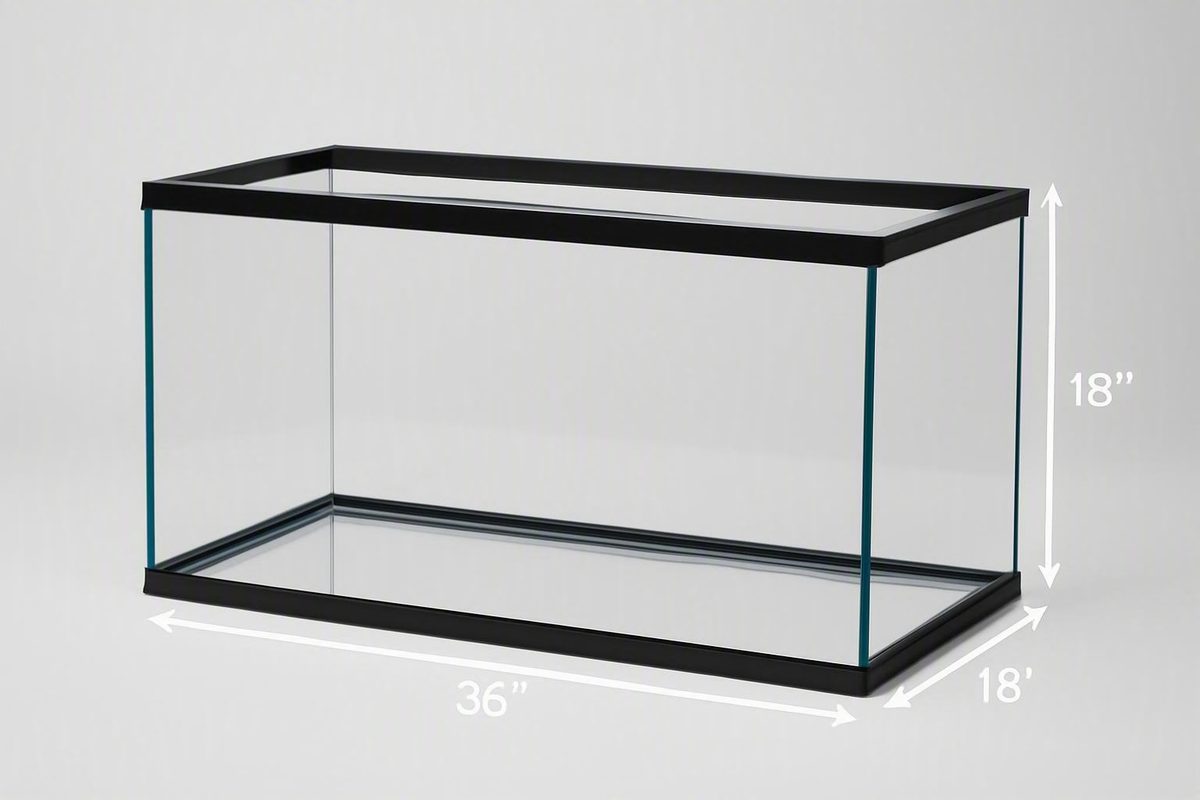
Use 36 × 18 × 16-17 inches for early planning, but verify the chosen model's measurements and support requirements before buying or building.
A dimensional planning guide from the Reef Directory editorial team. Retailer listings were checked for publication on August 4, 2026. Model-specific figures below are attributed to the pages that published them; they are not presented as manufacturer-confirmed specifications. This independent, non-sales approach reflects Reef Directory’s editorial policy.
The short answer: typical 40-gallon breeder dimensions
A typical 40-gallon breeder aquarium is approximately 36 × 18 × 16–17 inches, stated in length × width × height order. The familiar 36 × 18 × 16-inch figure is a rounded category reference, not a precision specification that applies to every brand or model. See the approximate breeder dimensions from Fish Tanks Direct.
For initial planning, allow for:
- Length: about 36 inches
- Front-to-back width: about 18 inches
- Height: about 16 to 17 inches
- Nominal base footprint: 36 × 18 inches
In metric units, that planning range is approximately 91.4 × 45.7 × 40.6–43.2 centimeters. These are conversions of rounded nominal measurements, so the decimal values should not be mistaken for exact product specifications.
40-gallon breeder dimensions at a glance
Planning detail Approximate measurement Common nominal dimensions 36 × 18 × 16 inches Practical planning range 36 × 18 × 16–17 inches Retailer-listed examples About 36.19–36.25 × 18.25–18.3 × 16.94–17 inches; compare the Petco listing and Aquatica listing Nominal footprint 36 × 18 inches Nominal base area 648 square inches, or 4.5 square feet Approximate metric range 91.4 × 45.7 × 40.6–43.2 centimeters Final-fit rule Verify the exact brand, model, SKU, support instructions, and physical measurements before buying or building anything fitted to the tank
The footprint and height describe different space requirements. The nominal supporting base is 36 inches long by 18 inches front to back. The 16-to-17-inch measurement is the tank’s height; it does not add to the floor or stand footprint.
The nominal measurements are suitable for sketching a room layout or comparing aquarium formats. They are not sufficient for ordering a close-fitting stand, lid, canopy, cabinet, or mounting system. Those decisions require the chosen tank’s actual dimensions and support instructions.
Nominal dimensions versus model-specific measurements
Product listings may appear to contradict the standard 36 × 18 × 16-inch description because the standard number is rounded. It identifies a general aquarium format rather than a universal manufacturing specification.
Named products can differ by fractions of an inch. That may be inconsequential in an open room, but it can determine whether a framed aquarium fits inside a raised stand lip, under a close canopy, or within built-in cabinetry.
The retailer pages checked for this article illustrate the distinction:
| Reference or product | Published dimensions | How to interpret the figure |
|---|---|---|
| Generic 40-gallon breeder size | 36 × 18 × 16 inches, L × W × H | Rounded planning reference rather than a specification for every tank |
| Petco Aqueon 40-gallon open-glass aquarium | 36.19 × 18.25 × 16.94 inches, L × W × H | Product-specific retailer figure; Petco says third-party product information is not independently verified |
| Aquatica Aqueon 40 Gallon Breeder | 36.25 × 18.25 × 17 inches | Retailer-listed dimensions; the page does not expressly label the order |
| Pet Supplies Plus Aqueon 40 Gallons Breeder | 36.2 × 18.3 × 17 inches | Retailer-listed dimensions; the page does not label the order and says third-party product information is not independently verified |
Petco identifies its example as an Aqueon Standard Open-Glass Aquarium Tank and lists it at 36.19 inches long, 18.25 inches wide, and 16.94 inches high. Because Petco states that product information supplied by manufacturers, suppliers, and other third parties is not independently verified, these numbers should be treated as Petco’s listing for that product—not as confirmed specifications for every Aqueon aquarium.
Aquatica lists an Aqueon 40 Gallon Breeder at 36.25 × 18.25 × 17 inches. The page does not expressly state that the sequence is length, width, and height, although the values appear in the conventional aquarium order.
Pet Supplies Plus lists another Aqueon breeder at 36.2 × 18.3 × 17 inches and identifies its materials as glass, a plastic frame, and silicone. Its page also leaves the dimension order unlabeled and says that third-party product information is not independently verified. Review the Pet Supplies Plus product listing and disclaimer.
These measurements should not be averaged into a supposedly exact universal size. An average would not reveal whether a particular tank frame fits a particular stand opening, lid, or canopy. Each set of numbers belongs to a specific retailer listing, while the nominal figure describes the broader size category.
Also confirm that apparently similar listings refer to the same configuration. Record the full product name and SKU rather than relying only on “40-gallon breeder.”
Why some tanks are listed as 16 inches tall and others as 17
A 40-gallon breeder may be described as either 16 inches or approximately 17 inches tall. Both figures appear in the available references, and neither should be treated as universally correct.
Generic size references commonly use a nominal height of 16 inches. Retailer-listed Aqueon examples approach 17 inches, and a published profile of one hobbyist’s glass breeder reports a 36 × 18 × 17-inch display. See the documented 17-inch example in the Nano-Reef aquarium profile.
Possible explanations include:
- Rounding to a standard aquarium-size category
- Differences among models or production versions
- Frames, rims, or trim affecting the measurement
- Different measurement points or conventions
- Retailers reproducing supplier-provided information
The evidence does not establish one explanation for every discrepancy. In particular, the cited retailer pages do not consistently state whether height includes upper and lower trim or whether another measurement point was used.
A difference of roughly an inch may not affect open placement, but it can matter in a height-restricted installation. It may alter:
- Canopy or shelf clearance
- Space for a lid to open
- Lighting adjustment range
- Cabinet-door movement
- Access for feeding and maintenance
- Room to remove equipment above the tank
Do not try to settle the discrepancy from the gallon label alone. Instead:
- Identify the exact product and SKU.
- Check the dimensions published for that product.
- Ask whether the measurement includes the frame or trim.
- Measure the physical aquarium when possible.
- Use the verified measurement for close-tolerance work.
For early planning, 16–17 inches high is a reasonable range. For final construction or purchasing, the chosen aquarium’s measured height is what matters.
The 36-by-18-inch footprint and room-space calculation
The nominal base of a 40-gallon breeder is 36 × 18 inches. That footprint is also reported in aquarium community references, although such references are not substitutes for model-specific specifications. See the reported 36-by-18-inch footprint discussion.
The base-area calculation is:
- 36 × 18 = 648 square inches
- 648 ÷ 144 = 4.5 square feet
That 4.5-square-foot result describes only the nominal area directly beneath the tank. It does not represent the complete working area needed for an installed aquarium.
The retailer-listed examples extend slightly beyond the rounded footprint, reaching about 36.25 inches long and 18.3 inches wide. A stand opening or cabinet designed around an exact 36-by-18-inch rectangle could therefore be too small even though the aquarium carries the familiar breeder label.
The full installation may also need space for:
- Plumbing and hose bends
- Power cords and drip loops
- Hang-on filters or other rear-mounted equipment
- Intakes, returns, or overflow components
- Light mounts and adjustment hardware
- A hinged, sliding, or removable lid
- Cabinet doors and removable panels
- Hands and tools used during maintenance
- A sump, reservoir, controller, or power equipment
There is no evidence-based universal clearance that applies to every installation. A tank with rear-mounted equipment requires a different envelope from one with an overflow and under-cabinet plumbing. A hinged canopy needs different overhead space from a removable mesh top.
Measure four separate areas before committing to a location:
- The final tank position. Check the available width, front-to-back projection, overhead restrictions, nearby doors, and anything that must remain accessible.
- The stand’s supporting surface. Compare the tank’s complete exterior footprint with the stand manufacturer’s compatibility and support instructions.
- The equipment envelope. Account for every component that projects behind, above, below, or beside the tank.
- The transport route. Measure doorways, halls, elevators, stairs, landings, railings, corners, and the approach to the stand.
A destination can be large enough while the delivery route is not. Consider whether the aquarium can be rotated through corners, lifted over railings, and carried with enough hand clearance. Packaging may also be larger than the bare tank.
For a quick visualization, tape a 36-by-18-inch rectangle onto the floor or stand. Then mark separate equipment and access zones. Treat the outline as a preliminary layout tool—not as proof that the exact tank and complete installation will fit.
How to check a stand, lid, canopy, and lighting fit
Stand fit
Match the stand to the exact tank model’s full exterior footprint and support instructions. Do not assume that every top described as 36 × 18 inches will fit or safely support every breeder.
Check:
- The stand manufacturer’s approved tank models or dimensional range
- The usable supporting surface, not just the cabinet’s outside dimensions
- Whether the top has a raised lip or recessed opening
- Which parts of the aquarium must be supported
- Whether the stand is designed for framed, rimless, or another construction type
- The installation instructions supplied with both products
Aquatica advises placing its listed aquarium on a stand capable of safely bearing the filled aquarium’s weight. That is general placement guidance, not approval of a particular commercial stand, homemade design, or piece of furniture.
If a stand is marketed only by gallon capacity, look for a compatibility chart or written confirmation covering the actual tank. Capacity alone does not establish length, front-to-back width, frame configuration, or support pattern.
Lid and canopy fit
Verify:
- Clear opening dimensions
- Rim and frame thickness
- Center braces, if present
- Corners, notches, and feeding openings
- Filter, overflow, plumbing, and cord cutouts
- The accessory manufacturer’s compatible models
- Room for hinges or sliding panels to operate
The cited retailer pages do not consistently establish whether their listed tank measurements include trim. They also do not provide enough opening detail to determine lid fit from outside dimensions alone.
Lighting fit
Tank length and light-fixture compatibility are different measurements.
Compare:
- Fixture body length
- Minimum and maximum mounting span
- Clamp or bracket requirements
- Rim compatibility
- Intended mounting height
- Lid or canopy operating space
- Cleaning and adjustment access
Do not select a light only because its name includes “36 inch” or “40 breeder.” Confirm the mounting system against the actual aquarium and surrounding equipment.
Cabinetry and under-tank equipment
Exterior cabinet size is only the starting point. Measure the usable interior around:
- Doors and hinges
- Center supports
- Shelves
- Ventilation openings
- Plumbing paths
- Controllers and power equipment
If the setup includes a sump or reservoir, confirm that it can pass through the cabinet opening. An item can fit within the total interior volume yet still be impossible to install or remove through the doors.
Leave practical access for pumps, filter components, collection cups, plumbing unions, reservoirs, and other serviceable parts.
Petco presents its example as a bare aquarium and identifies the lid, lighting, filter, heater, substrate, décor, and other items separately. That distinction illustrates why bare-tank dimensions answer only one part of the installation question. Review the items Petco lists separately from the aquarium.
Pre-purchase compatibility checklist
Before ordering the aquarium or fitted equipment, verify:
- [ ] Exact aquarium brand
- [ ] Complete product name, model, and SKU
- [ ] Published exterior dimensions
- [ ] Physical measurements, if the tank is locally available
- [ ] Whether the measurements include frames or trim
- [ ] Tank manufacturer’s support requirements
- [ ] Stand approval or model compatibility
- [ ] Lid or canopy opening and rim compatibility
- [ ] Lighting mount span and bracket requirements
- [ ] Rear, side, and overhead equipment space
- [ ] Cabinet interior and door-opening dimensions
- [ ] Route through doors, corridors, stairs, and corners
- [ ] Maintenance access after installation
How the breeder shape compares with other aquarium formats
Aquarium capacity does not determine shape. Tanks with the same or greater gallon rating can have substantially different lengths, widths, heights, and base areas.
The following are generic or source-reported comparison figures, not guaranteed specifications for every product sold under these format names:
| Aquarium format | Generic or reported dimensions | Nominal base area | Dimensional character |
|---|---|---|---|
| 40-gallon breeder | 36 × 18 × 16 inches | 648 square inches | Shorter length with a wider front-to-back base |
| 40-gallon long | 48 × 12 × 16 inches | 576 square inches | Longer and narrower |
| 55-gallon | 48 × 13 × 21 inches | 624 square inches | Longer and taller, but narrower front to back |
| “Regular” 40-gallon example | About 36 × 13 × 20 inches | 468 square inches | Similar reported length, narrower and taller |
A general aquarium-size chart lists the 40-gallon long at 48 × 12 × 16 inches and the 55-gallon at 48 × 13 × 21 inches. Based on those figures, the nominal breeder base covers 648 square inches, while the listed 55-gallon base covers 624 square inches. Compare the generic aquarium dimensions in the size chart.
That does not make one format universally better. It demonstrates that base area and total nominal capacity are different measurements. In this comparison, the 55-gallon tank is longer and taller, while the breeder is wider from front to back and has a slightly larger nominal base area.
The label “regular 40-gallon” is particularly imprecise. One retailer blog describes a typical regular 40-gallon as approximately 36 × 13 × 20 inches, compared with about 36 × 18 × 16 inches for a breeder. Those are source-reported examples rather than universal definitions.
The dimensional comparison supports several practical conclusions:
- A larger gallon rating does not guarantee a larger base area.
- Tanks with similar capacity may require stands of different lengths and depths.
- A lid cannot be selected from gallon capacity alone.
- Height-restricted cabinetry must account for the specific format.
- Front-to-back room projection may differ even when nominal capacities are similar.
Shape can affect how equipment and interior features are arranged, but dimensions alone do not establish suitability for a particular fish, coral, stocking plan, or reef configuration. Livestock decisions require separate evaluation of adult needs, behavior, habitat, water quality, and overall system design.
Weight planning: useful estimates without false precision
A general aquarium-size chart estimates a 40-gallon breeder at 58 pounds empty and 458 pounds filled. The same chart explicitly presents its figures as rough guidelines and says weight can vary with glass thickness, rock quantity, and water type. See the chart’s weight estimates and qualifications.
Those numbers help communicate the setup’s general scale. They are not exact weights for a named tank model, and 458 pounds is not a guaranteed installed weight or structural design load.
A completed setup may include:
- The glass aquarium and frame
- Water
- Rock
- Sand or other substrate
- Pumps, heaters, and filtration equipment
- Plumbing and water inside the plumbing
- A sump or reservoir
- Lighting and mounting hardware
- A lid or canopy
- Controllers and electrical equipment
- The cabinet or stand
- Supplies stored in the cabinet
Conversely, the display may not contain its full nominal capacity as usable water after allowing for air space, glass thickness, internal geometry, rock, substrate, and equipment displacement. Exterior dimensions alone cannot establish exact usable water volume.
For a reef installation, prepare an itemized load estimate rather than multiplying the gallon label by one water-weight figure. Use the actual tank weight when available, estimate the water held in both display and sump, and include rock, substrate, equipment, plumbing, and cabinetry.
For support decisions, follow the aquarium and stand manufacturers’ requirements. A general weight chart cannot prove that a floor location, shelf, furniture item, homemade stand, or commercial stand is suitable.
A final measurement checklist before buying or installing
The most reliable planning sequence begins with the exact aquarium rather than its category name.
1. Identify the tank. Record the brand, complete product name, model, SKU, trim style, and package type. A bare tank and a kit with a similar name may present different installation requirements.
2. Verify its dimensions. Distinguish nominal category measurements from product-specific figures. Confirm the order of the dimensions and ask what physical points were measured.
3. Clarify rim and frame measurements. Determine whether the stated dimensions include upper trim, lower trim, braces, or other projections. Measure the actual product before commissioning close-tolerance cabinetry.
4. Confirm support requirements. Use the tank manufacturer’s instructions to determine how the aquarium must be supported. Select a stand suited to both those requirements and the complete exterior footprint.
5. Check fitted accessories. Match lids, canopies, brackets, and rigid accessories by physical measurement and model compatibility—not only by gallon label.
6. Measure the installation envelope. Check the stand top, wall space, front-to-back room projection, overhead clearance, equipment area, cabinet interior, and door openings.
7. Plan the transport route. Measure every doorway, corridor, stair turn, landing, railing, and corner between delivery and the final location. Allow room for people to grip and rotate the aquarium.
8. Test maintenance access. Make sure lids can open, equipment can be removed, cabinet doors can swing, and plumbing and cords remain reachable after installation.
9. Retain the product information. Save the specification page, model number, receipt, manual, and your own measurements. If you later need a replacement lid or fitted part, “40-gallon breeder” may not identify the correct item.
The practical rule is straightforward: use 36 × 18 × 16–17 inches for early planning, but use the chosen model’s verified measurements and support requirements for final purchasing, construction, and installation.
Frequently asked questions
What are the standard dimensions of a 40-gallon breeder tank?
The commonly cited nominal dimensions are 36 inches long, 18 inches wide, and 16 inches high. A practical preliminary range is approximately 36 × 18 × 16–17 inches because documented products and aquarium profiles sometimes approach 17 inches high.
These are category-level planning figures. Confirm the exact tank before selecting a stand, lid, canopy, or cabinet.
Is a 40-gallon breeder 16 or 17 inches tall?
Both measurements appear in the available references. Generic charts commonly use 16 inches, while retailer listings and at least one documented aquarium profile report approximately 17 inches. The profile identifies its display as 36 × 18 × 17 inches. See the reported tank specifications.
Rounding, model variation, trim, frames, or measurement conventions could explain the difference, but the evidence does not establish one universal cause. Use the range for preliminary planning and measure the specific tank for final fit.
Are the published measurements interior or exterior dimensions?
The cited retailer pages do not consistently state whether all measurements are interior, exterior, or inclusive of the frame and trim. They should not be treated as proof of internal glass dimensions or exact usable water volume.
For a fitted installation, ask the seller or manufacturer to identify the measurement points. When possible, measure the complete exterior, rim opening, braces, and projecting trim yourself.
What size stand fits a 40-gallon breeder aquarium?
Use a stand intended for the exact tank model, full exterior footprint, construction type, and required support pattern. The nominal 36 × 18-inch footprint is useful for searching and preliminary planning, but some retailer-listed tanks are slightly longer and wider.
Confirm the stand’s usable top dimensions and stated compatibility. A nominally similar furniture top is not automatically an aquarium stand and is not guaranteed to fit or safely support the tank.
How much does a 40-gallon breeder weigh when filled?
A general aquarium chart gives rough estimates of 58 pounds empty and 458 pounds filled. Those are broad guidelines, not exact model specifications or guaranteed installed weights.
Actual load depends on the tank, water volume and type, glass thickness, rock, substrate, equipment, plumbing, sump, stand, and other materials. Inventory the full installation and follow the aquarium and stand manufacturers’ support requirements.